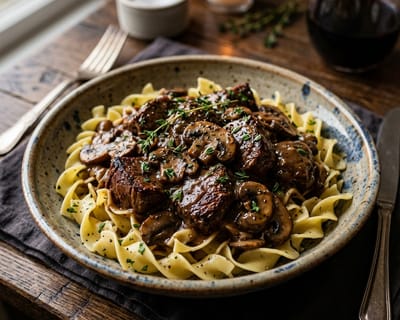
Beef Tips with Mushroom Gravy

Tender seared beef sirloin tips smothered in a rich, velvety brown mushroom gravy with caramelized cremini mushrooms, sweet shallots, fresh thyme, and red wine over buttered egg noodles.
Key Takeaways
- ✓Ready in just 25 mins using straightforward, kitchen-tested technique.
- ✓Delivers 46g of muscle-fueling protein per serving for lasting satiety.
- ✓Portion-balanced at 580 calories per serving with wholesome, unrefined ingredients.
- ✓Masterclass temperature checkpoints ensure maximum tenderness and flavor development.
The Story
Beef Tips with Mushroom Gravy stands as one of the most enduring, comforting centerpieces of traditional American regional dining. Featuring succulent cubes of beef top sirloin seared over high heat to develop a caramelized outer crust, simmered in a velvety pan gravy enriched with sautéed cremini mushrooms, caramelized shallots, red wine, and fresh thyme, and ladled over buttered egg noodles, it delivers an exceptional synthesis of rich umami, earthy fungi, and savory beefiness.
Despite its straightforward skillet execution, home versions often suffer from common culinary mistakes: tough, chewy cubes of boiled beef caused by overcrowding the skillet; pale, watery gravies lacking savory depth; rubbery, slimy mushrooms; or chalky sauces thickened with raw flour pastes.
Mastering restaurant-quality beef tips requires understanding the Maillard reaction in red meat cookery, the moisture dynamics of fungi, the nucleotide synergy between beef and mushrooms, and the physics of flour-butter roux emulsions.
The Culinary Heritage: From French Sauté to Midwestern Supper Clubs
Beef tips with gravy evolved as an accessible domestic interpretation of classical French sauté and ragoût cookery. In traditional French cuisine, dishes such as bœuf sauté aux champignons paired tender steak cutlets with pan reductions of wine, stock, and cultivated mushrooms.
As European culinary techniques blended into mid-twentieth-century American domestic cooking, particularly throughout the Midwest and South, "beef tips" became a beloved fixture of family dinners, diner menus, and supper clubs. Home cooks appreciated that sirloin steak trimmings could be converted into a luxurious, gravy-smothered dinner within thirty minutes. Served over wide egg noodles or a mountain of buttered mashed potatoes, beef tips remain the gold standard of comforting, satisfying meat-and-gravy cooking.
Meat Science: Selecting the Cut and Fiber Orientation
The texture of beef tips is dictated by muscle anatomy and cooking technique:
1. The Supermarket "Stew Meat" Pitfall
Supermarkets frequently package meat trimmings under the label "beef stew meat."- These packages are almost invariably made of tough chuck, round, or shank cuts filled with dense collagen and elastin connective tissue.
- These cuts require two to three hours of low-and-slow braising at 190°F to break down collagen into gelatin.
- If cooked in a quick 20-minute skillet recipe, stew meat remains tough, rubbery, and impossible to chew.
2. The Gold Standard: Beef Top Sirloin
For quick-cooking skillet beef tips, beef top sirloin steak (or sirloin tip roast) is the ideal cut:- Top sirloin is cut from the primal loin. It is lean, highly flavorful, and naturally tender with minimal gristle.
- Because it contains little tough connective tissue, sirloin only needs a rapid high-heat sear followed by a brief 8-minute simmer in gravy to achieve fork-tender succulence.
- While tenderloin (filet mignon) is also tender, it lacks the deep, mineral beefiness of sirloin and costs more than twice as much.
3. Slicing Mechanics: Cutting Across the Grain
Trim any tough exterior silverskin or hard fat caps from the sirloin steak. Slice the beef into uniform 1 1/2-inch cubes:- Always slice perpendicular to the muscle fibers (against the grain).
- Severing the longitudinal muscle strands into short segments ensures the cooked meat breaks apart effortlessly under tooth pressure.
The Maillard Reaction: Searing Thermodynamics
The rich flavor of beef tips comes from the Maillard reaction—a chemical reaction between amino acids and reducing sugars that occurs at temperatures between 300°F and 375°F (150°C to 190°C):
1. Surface Moisture Elimination
Raw beef consists of roughly 75% water. If beef cubes enter a hot skillet with damp surfaces, the water must boil away before the surface temperature can rise above 212°F (100°C).- The beef effectively steams in its own liquid, turning an unappetizing gray color without developing crust.
- The Solution: Pat the beef cubes thoroughly dry with paper towels before seasoning. Dry meat sears on contact.
2. High Thermal Mass and Batch Cooking
When two pounds of cold beef are dumped into a pan simultaneously, the thermal mass of the meat drops the pan temperature drastically. Trapped water pools across the pan floor, aborting the sear.- The Two-Batch Rule: Heat a heavy 12-inch cast-iron skillet until shimmering hot.
- Add the beef in two separate batches, ensuring at least 1/2 inch of clear space surrounds each cube.
- Sear undisturbed for 90 seconds per side, achieving a deep mahogany crust, then remove the beef while the interior is still rare to medium-rare.
Mushroom Science: Umami Synergy and Moisture Control
Cremini mushrooms (the immature form of Portobello mushrooms, Agaricus bisporus) provide an earthy, savory backbone to the gravy:
1. Nucleotide and Glutamate Synergy
The pairing of mushrooms and beef is one of nature's most potent chemical flavor harmonies:- Beef contains high levels of inosine monophosphate (IMP).
- Mushrooms are naturally rich in guanosine monophosphate (GMP) and free glutamic acid.
- When these nucleotide flavor molecules combine on the human palate, they bind to umami taste receptors simultaneously, multiplying the perception of savory richness up to eight times.
2. The Two-Stage Mushroom Sauté
Mushrooms are 92% water contained within rigid chitin cell walls:- Sauté the sliced cremini mushrooms over medium-high heat. Initially, they will release their cellular water into the skillet.
- Continue cooking until this water completely evaporates and the pan begins to sizzle.
- Only then add 1 tablespoon of butter. The dehydrated mushroom flesh will rapidly absorb the hot fat and undergo deep Maillard browning, concentrating its earthy flavors.
Deglazing and Gravy Emulsion Mechanics
A great pan gravy is built upon the caramelized sediment (fond) left on the skillet floor:
1. Alcohol Extraction via Red Wine
Deglazing with dry red wine serves a chemical purpose:- Ethanol dissolves fat-soluble aromatic flavor compounds from the browned beef fond that water or broth cannot dissolve.
- Boiling the wine down by half evaporates the harsh alcohol, leaving concentrated malic, tartaric, and fruit acids that balance the rich beef fat.
2. The Starch Gelatinization of Flour
Sprinkling unbleached all-purpose flour over the sautéed mushrooms and shallots coats the vegetables in fat, creating an integrated roux:- Cooking the flour for 90 seconds breaks down raw wheat starches and develops a light nutty aroma.
- Slowly whisking in rich beef bone broth allows the starch granules (amylose and amylopectin) to hydrate evenly.
Step-by-Step Instructions
Follow these culinary steps for perfect Beef Tips with Mushroom Gravy:
Step 1: Prep and Season the Sirloin
Trim 2 1/2 pounds of beef top sirloin steak of any tough connective tissue or excess fat. Cut into uniform 1 1/2-inch cubes.Pat the beef cubes thoroughly dry on all sides using paper towels.
In a small bowl, combine 1 teaspoon of kosher salt, 1 teaspoon of freshly cracked black pepper, and 1 teaspoon of garlic powder.
Sprinkle the seasoning evenly over the beef cubes, tossing by hand to ensure every facet is coated.
Step 2: High-Heat Batch Searing
Place a heavy 12-inch cast-iron skillet or Dutch oven over high heat. Add 1 tablespoon of olive oil and heat until shimmering and faintly smoking (around 400°F / 204°C).Add half of the seasoned beef cubes in a single layer, ensuring they do not touch.
Sear undisturbed for 90 seconds until a deep mahogany-brown crust forms on the bottom. Flip with tongs and sear the second side for another 60 to 90 seconds.
Transfer the seared beef to a warm plate (the centers will still be rare; they will finish gently later).
Add the remaining 1 tablespoon of olive oil to the skillet and repeat with the second batch of beef. Transfer to the plate.
Step 3: Sauté and Caramelize the Mushrooms
Reduce the skillet heat to medium-high.Add 1 pound of sliced cremini mushrooms to the dry pan drippings. Cook for 4 to 5 minutes, stirring occasionally, as the mushrooms release their moisture and the liquid boils away.
Once the pan is dry and begins to sizzle, add 1 tablespoon of unsalted butter. Sauté for another 3 to 4 minutes until the mushrooms are deeply browned, tender, and caramelized.
Step 4: Add Aromatics and Fresh Thyme
Reduce heat to medium. Add the remaining 2 tablespoons of unsalted butter to the skillet with the mushrooms.Add 2 finely diced shallots (or 1 small diced yellow onion) and 1/2 teaspoon of kosher salt. Sauté for 3 minutes, stirring frequently, until the shallots are soft, translucent, and fragrant.
Add 4 finely minced garlic cloves and 1 tablespoon of fresh thyme leaves. Cook for 60 seconds, stirring constantly, until aromatic.
Step 5: Deglaze with Red Wine
Pour 1/2 cup of dry red wine (Cabernet Sauvignon or Pinot Noir) into the hot skillet.Using a flat wooden spoon, scrape vigorously across the bottom of the pan to dissolve all caramelized brown beef fond.
Allow the wine to boil steadily for 2 to 3 minutes until reduced by half and the pungent alcohol aroma has vanished.
Step 6: Form the Roux and Whisk in Broth
Sprinkle 3 tablespoons of all-purpose flour evenly over the sautéed mushrooms and shallots.Stir continuously with the wooden spoon for 90 seconds to cook out the raw flour taste and coat all the vegetables.
Slowly pour in 3 cups of rich low-sodium beef bone broth in a steady stream, whisking constantly with a wire whisk to dissolve the flour without forming lumps.
Whisk in 1 tablespoon of Worcestershire sauce, 1 tablespoon of soy sauce (for nucleotide umami), and 1 teaspoon of Dijon mustard.
Step 7: Simmer the Gravy to Velvet Texture
Bring the sauce to a gentle boil over medium heat, stirring frequently.Reduce the heat to medium-low and simmer gently for 5 to 6 minutes until the gravy thickens into a glossy, velvety sauce that smoothly coats the back of a spoon. Taste and adjust seasoning with extra salt or black pepper if desired.
Step 8: Simmer the Beef Tips and Serve
Pour the seared beef tips along with all accumulated savory resting juices from the plate back into the bubbling mushroom gravy.Stir gently to coat every cube of beef in the rich sauce.
Simmer over low heat for strictly 6 to 8 minutes—only long enough to heat the beef through to a tender medium doneness (145°F / 63°C) without boiling the meat.
Remove the skillet from the heat.
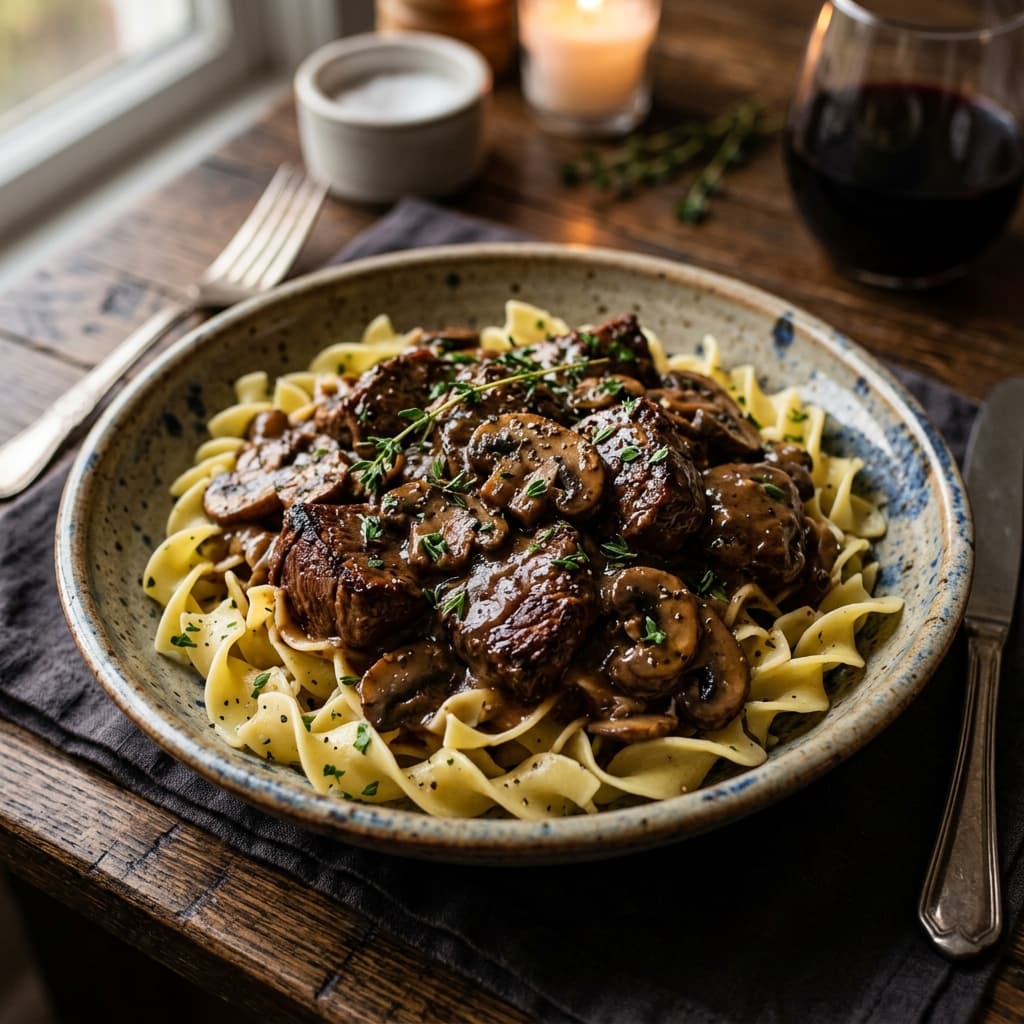
To serve, ladle generous portions of buttered, cooked wide egg noodles into shallow bowls. Spoon the tender beef tips and rich mushroom gravy generously over the noodles. Garnish with chopped fresh flat-leaf parsley and serve piping hot.
Pro-Tips for Masterful Skillet Beef Tips
- Dry the Beef Thoroughly: Wet meat cannot sear; it boils in its own juice. Paper towels are your most important tool for achieving a deep, caramelized crust.
- Sear in Batches: Crowding 2 1/2 pounds of cold beef into one skillet lowers pan temperature below the searing point. Two uncrowded batches produce twice the fond and twice the flavor.
- Simmer Gently at the End: Top sirloin is steak, not stew meat. Boiling it for 30 minutes will make it tough and stringy. Simmer for strictly 6 to 8 minutes so it stays juicy and pink-centered.
- Soy Sauce as an Umami Booster: Adding 1 tablespoon of soy sauce does not make the dish taste Asian; it provides concentrated glutamate nucleotides that deepen the beef flavor and darken the color of the gravy.
Flavor Variations and Additions
Storage, Reheating, and Make-Ahead Instructions
This skillet dinner is exceptional for meal-prep and dinner party prep:
Make-Ahead Strategy
Prepare the beef tips and mushroom gravy completely up to 2 days in advance. Cool completely and store in an airtight glass container in the refrigerator. The flavors of red wine, mushrooms, and beef will deepen overnight. Cook fresh egg noodles right before serving.Reheating Leftovers
- Stovetop (Best): Transfer cold beef tips and gravy into a saucepan over medium-low heat. Add 1/4 cup of beef broth or water to loosen the thickened starches. Cover and heat gently for 6 to 8 minutes, stirring occasionally, until hot and simmering.
- Avoid High-Heat Microwaving: Microwaving at full power overcooks the tender sirloin cubes into rubber. If microwaving, heat at 50% power in 60-second intervals.
Freezing Instructions
Freeze cooked beef tips and gravy (without noodles) in an airtight freezer container for up to 3 months. Thaw overnight in the refrigerator before reheating gently on the stovetop.Sommelier Wine Pairings
The rich, savory beef, caramelized mushrooms, and red wine pan gravy demand medium-to-full-bodied red wines with good structure and earthy undertones:
- Cabernet Sauvignon (Napa Valley or Sonoma): Ripe blackcurrant fruit, firm tannins, and subtle oak cedar notes match the seared beef crust while slicing cleanly through the rich, buttery gravy.
- Syrah / Shiraz (Northern Rhône or Barossa Valley): Offers dark plum fruit, cracked black pepper, and smoked meat aromas that echo the seared sirloin and fresh thyme.
- Bordeaux Blend (Merlot/Cabernet): Earthy graphite, dried herbs, and plush plum flavors harmonize seamlessly with the forest notes of sautéed cremini mushrooms.
- Non-Alcoholic Refreshers: Chilled sparkling blackberry-thyme water, unsweetened iced black tea with lemon, or a rich non-alcoholic stout.
Troubleshooting Common Beef Tips Problems
1. The Beef Tips Are Tough and Chewy
- The Cause: Packaged "stew meat" (chuck or round) was used instead of sirloin, or the beef was boiled too long in the gravy.
- The Solution: Use beef top sirloin steak cut into cubes. Sear quickly over high heat, and simmer in the gravy for strictly 6 to 8 minutes.
2. The Gravy is Pale, Thin, and Lacks Flavor
- The Cause: The beef was not seared deeply, the mushrooms were not caramelized, or too much water was used.
- The Solution: Develop a dark mahogany fond during searing. Cook mushrooms until completely browned. Use rich beef bone broth and reduce wine by half.
3. The Gravy Turned Lumpy
- The Cause: Cold broth was dumped in all at once onto dry flour without whisking.
- The Solution: Stir flour into the sautéed butter and mushrooms for 90 seconds. Whisk in broth slowly in a steady stream, allowing starches to hydrate smoothly.
Nutritional Breakdown and Macro Profile
Per serving (serving size: generous portion of beef tips with gravy over egg noodles, recipe makes 6 servings):
| Nutrient | Amount per Serving | % Daily Value |
|---|---|---|
| Calories | 580 kcal | — |
| Total Fat | 24 g | 31% |
| Saturated Fat | 10 g | 50% |
| Cholesterol | 145 mg | 48% |
| Sodium | 860 mg | 37% |
| Total Carbohydrates | 42 g | 15% |
| Dietary Fiber | 3 g | 11% |
| Total Sugars | 4 g | — |
| Protein | 46 g | 92% |
| Potassium | 760 mg | 16% |
| Calcium | 65 mg | 5% |
| Iron | 4.8 mg | 27% |
Beef Tips with Mushroom Gravy
Tender seared beef sirloin tips smothered in a rich, velvety brown mushroom gravy with caramelized cremini mushrooms, sweet shallots, fresh thyme, and red wine over buttered egg noodles.
Macro Nutrition Profile (Per Serving)
Ingredients
Tender Seared Beef Sirloin Tips
Caramelized Cremini Mushrooms & Aromatics
Rich Brown Pan Gravy
Serving & Garnishes
Ingredient Substitutions
| Original Ingredient | Healthy Alternative |
|---|---|
| Animal protein | Firm tofu, tempeh, or organic chickpeas |
| Cooking fat | Extra virgin olive oil or grass-fed butter |
Instructions
Prep and Season the Sirloin: Trim 2 1/2 pounds of beef top sirloin steak of any tough connective tissue or excess fat. Cut into uniform 1 1/2-inch cubes. Pat the beef cubes thoroughly dry on all sides using paper towels. In a small bowl, combine 1 teaspoon of kosher salt, 1 teaspoon of freshly cracked black pepper, and 1 teaspoon of garlic powder. Sprinkle the seasoning evenly over the beef cubes, tossing by hand to ensure every facet is coated.
High-Heat Batch Searing: Place a heavy 12-inch cast-iron skillet or Dutch oven over high heat. Add 1 tablespoon of olive oil and heat until shimmering and faintly smoking (around 400°F / 204°C). Add half of the seasoned beef cubes in a single layer, ensuring they do not touch. Sear undisturbed for 90 seconds until a deep mahogany-brown crust forms on the bottom. Flip with tongs and sear the second side for another 60 to 90 seconds. Transfer the seared beef to a warm plate (the centers will still be rare; they will finish gently later). Add the remaining 1 tablespoon of olive oil to the skillet and repeat with the second batch of beef. Transfer to the plate.
Sauté and Caramelize the Mushrooms: Reduce the skillet heat to medium-high. Add 1 pound of sliced cremini mushrooms to the dry pan drippings. Cook for 4 to 5 minutes, stirring occasionally, as the mushrooms release their moisture and the liquid boils away. Once the pan is dry and begins to sizzle, add 1 tablespoon of unsalted butter. Sauté for another 3 to 4 minutes until the mushrooms are deeply browned, tender, and caramelized.
Add Aromatics and Fresh Thyme: Reduce heat to medium. Add the remaining 2 tablespoons of unsalted butter to the skillet with the mushrooms. Add 2 finely diced shallots (or 1 small diced yellow onion) and 1/2 teaspoon of kosher salt. Sauté for 3 minutes, stirring frequently, until the shallots are soft, translucent, and fragrant. Add 4 finely minced garlic cloves and 1 tablespoon of fresh thyme leaves. Cook for 60 seconds, stirring constantly, until aromatic.
Deglaze with Red Wine: Pour 1/2 cup of dry red wine (Cabernet Sauvignon or Pinot Noir) into the hot skillet. Using a flat wooden spoon, scrape vigorously across the bottom of the pan to dissolve all caramelized brown beef fond. Allow the wine to boil steadily for 2 to 3 minutes until reduced by half and the pungent alcohol aroma has vanished.
Form the Roux and Whisk in Broth: Sprinkle 3 tablespoons of all-purpose flour evenly over the sautéed mushrooms and shallots. Stir continuously with the wooden spoon for 90 seconds to cook out the raw flour taste and coat all the vegetables. Slowly pour in 3 cups of rich low-sodium beef bone broth in a steady stream, whisking constantly with a wire whisk to dissolve the flour without forming lumps. Whisk in 1 tablespoon of Worcestershire sauce, 1 tablespoon of soy sauce (for nucleotide umami), and 1 teaspoon of Dijon mustard.
Simmer the Gravy to Velvet Texture: Bring the sauce to a gentle boil over medium heat, stirring frequently. Reduce the heat to medium-low and simmer gently for 5 to 6 minutes until the gravy thickens into a glossy, velvety sauce that smoothly coats the back of a spoon. Taste and adjust seasoning with extra salt or black pepper if desired.
Simmer the Beef Tips and Serve: Pour the seared beef tips along with all accumulated savory resting juices from the plate back into the bubbling mushroom gravy. Stir gently to coat every cube of beef in the rich sauce. Simmer over low heat for strictly 6 to 8 minutes—only long enough to heat the beef through to a tender medium doneness (145°F / 63°C) without boiling the meat. Remove the skillet from the heat. To serve, ladle generous portions of buttered, cooked wide egg noodles into shallow bowls. Spoon the tender beef tips and rich mushroom gravy generously over the noodles. Garnish with chopped fresh flat-leaf parsley and serve piping hot.
The Creamy Stroganoff Finish: Stir 1/3 cup of thick cultured sour cream or crème fraîche into the gravy during the final minute of simmering off the heat. Garnish with fresh dill sprigs for an authentic Russian/Bistro Stroganoff profile.
The Smoky Bacon and Pearl Onion Variation: Render 4 strips of chopped thick-cut bacon in the skillet before searing the beef, and sear the beef in the rendered bacon drippings. Sauté 1 cup of peeled white pearl onions alongside the cremini mushrooms for sweet, tender onion pops.
The Stout Beer and Cheddar Twist: Replace the red wine with 1/2 cup of dry Irish stout (such as Guinness). Serve the beef tips over sharp cheddar cheese grits or colcannon mashed potatoes.
The Beef Tips Are Tough and Chewy: The Cause: Packaged "stew meat" (chuck or round) was used instead of sirloin, or the beef was boiled too long in the gravy. The Solution: Use beef top sirloin steak cut into cubes. Sear quickly over high heat, and simmer in the gravy for strictly 6 to 8 minutes.
The Gravy is Pale, Thin, and Lacks Flavor: The Cause: The beef was not seared deeply, the mushrooms were not caramelized, or too much water was used. The Solution: Develop a dark mahogany fond during searing. Cook mushrooms until completely browned. Use rich beef bone broth and reduce wine by half.
The Gravy Turned Lumpy: The Cause: Cold broth was dumped in all at once onto dry flour without whisking. The Solution: Stir flour into the sautéed butter and mushrooms for 90 seconds. Whisk in broth slowly in a steady stream, allowing starches to hydrate smoothly.
Tried this recipe?
Let us know how it turned out! Click a star below to leave a review and rate the recipe.
Coaching Insights & Tips
- Dry the Beef Thoroughly: Wet meat cannot sear; it boils in its own juice. Paper towels are your most important tool for achieving a deep, caramelized crust.
- Sear in Batches: Crowding 2 1/2 pounds of cold beef into one skillet lowers pan temperature below the searing point. Two uncrowded batches produce twice the fond and twice the flavor.
- Simmer Gently at the End: Top sirloin is steak, not stew meat. Boiling it for 30 minutes will make it tough and stringy. Simmer for strictly 6 to 8 minutes so it stays juicy and pink-centered.
- Soy Sauce as an Umami Booster: Adding 1 tablespoon of soy sauce does not make the dish taste Asian; it provides concentrated glutamate nucleotides that deepen the beef flavor and darken the color of the gravy.
Storage & Freezing Tips
- Refrigerator: Store in an airtight container for up to 2 days. Keep the components separate if possible to preserve texture.
- Reheating: Reheat gently in a skillet on medium-low heat with a splash of olive oil or butter.
- Freezing: Freezing is not recommended for this dish because ingredients like eggs become soggy, rubbery, or mushy when defrosted.
Frequently Asked Questions
Can this recipe be prepared ahead of time?▼
Yes, this meal is excellent for weekly meal prep. Store components separately and assemble before serving.
Is this recipe gluten-free?▼
All ingredients used are naturally gluten-free. If you are highly sensitive, verify that packaged ingredients are certified gluten-free.
Tried this recipe?
Tag @stewartlucas on Instagram and hashtag it #nutriguide!
You Might Also Like
Stewart Lucas
Chief Culinary SpecialistStewart Lucas is the Chief Culinary Specialist and lead recipe developer representing the NutriGuide team. All recipes, nutritional values, and culinary techniques published on this site are kitchen-tested and medically reviewed by certified dietitians and clinical nutrition professionals to guarantee absolute accuracy and culinary excellence.
Community Reviews
Please log in to leave a review.