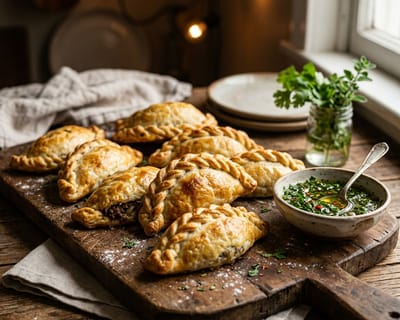
Mini Beef Empanadas

Golden, flaky baked mini empanadas filled with seasoned ground beef picadillo, caramelized yellow onions, briny green olives, hard-boiled eggs, smoked paprika, and ground cumin, served with scratch herb chimichurri.
Key Takeaways
- ✓Ready in just 25 mins using straightforward, kitchen-tested technique.
- ✓Delivers 12g of muscle-fueling protein per serving for lasting satiety.
- ✓Portion-balanced at 340 calories per serving with wholesome, unrefined ingredients.
- ✓Masterclass temperature checkpoints ensure maximum tenderness and flavor development.
The Story
Mini Beef Empanadas stand as one of the most celebrated handheld pastry traditions in Latin American gastronomy. Featuring seasoned, savory ground beef picadillo, sweet caramelized onions, briny green Manzanilla olives, hard-boiled eggs, and warm Andean spices sealed inside a flaky, golden pastry turnover and served alongside a tangy scratch chimichurri sauce, they offer an ideal balance of rich protein, aromatic spices, and crisp, buttery crust.
Whether served as elegant finger food at cocktail gatherings, holiday buffet tables, or casual game-day parties, these bite-sized turnovers frequently suffer from common home-kitchen errors: soggy, grease-soaked bottoms; filling blowouts that leak juices across the baking sheet; tough, rubbery pastry crusts; or dry, bland meat fillings that lack moisture.
Mastering authentic mini beef empanadas requires understanding fat-to-flour ratios in pastry lamination, the gelatinization dynamics of cold picadillo filling, edge-crimping geometry (repulgue), and high-heat oven conduction.
Culinary Lineage: From Medieval Iberia to the Argentine Pampas
The word empanada derives from the Spanish verb empanar, meaning 'to wrap or coat in bread.' The earliest recorded references appear in medieval Iberian culinary manuscripts, notably the Catalan cookbook Llibre de Coch by Robert de Nola in 1520, which documented large baked pastries filled with seafood, game, and poultry. Spanish colonists, conquistadors, and immigrants carried this preservation and transport method across the Atlantic to the Americas during the sixteenth century.
In Argentina, empanadas evolved into a regional art form shaped by local agriculture and cowboy (gaucho) culture on the vast grasslands of the Pampas: The Tucumán Tradition: In the northwestern province of Tucumán, empanadas are traditionally filled with hand-carved beef flank (matambre) parboiled and diced fine, simmered with generous scallions and cumin, and fried in deep beef tallow (grasa vacuna*).
- The Mendoza Tradition: In the wine-producing province of Mendoza, empanadas are predominantly baked in wood-fired clay ovens. Their defining characteristic is an equal volume of sweet onions to beef, along with chopped hard-boiled eggs and green olives, producing a remarkably juicy filling that bursts with sweet-savory balance.
The Food Science of Flaky Empanada Dough
Empanada dough must achieve a delicate mechanical compromise: it must be supple and elastic enough to stretch over filling without tearing, yet short and flaky enough to yield crisp, melt-in-the-mouth layers when baked:
1. Fat Selection: Butter vs. Leaf Lard vs. Shortening
Traditional Beef Tallow or Lard (Grasa Vacuna*): In traditional Argentine kitchens, rendered beef fat or pork leaf lard is the gold standard. Lard has large crystalline fat structures that produce exceptionally flaky, blistered pastry with a savory undertone.- Unsalted European-Style Butter: Butter contains roughly 82% butterfat and 16% to 18% water. When cold butter is cut into flour, the water within the butter evaporates during high-heat baking (400°F / 204°C), flashing into steam. This steam expands the spaces between gluten sheets, creating light, tender, laminated layers with a rich dairy sweetness.
- The Vinegar Addition: Adding 1 tablespoon of distilled white vinegar or apple cider vinegar lowers the pH of the dough. This mild acidity inhibits excessive gluten protein bonding (gliadin and glutenin), preventing the crust from turning tough and rubbery during rolling and crimping.
2. The Rest Period: Gluten Relaxation
After kneading the dough for 2 to 3 minutes into a smooth ball, it must rest wrapped in the refrigerator for at least 60 minutes.- During this rest, the wheat starches fully hydrate from the water and egg yolk.
- The stressed gluten strands relax completely, eliminating elasticity spring-back when the dough is rolled thin with a rolling pin.
The Chemistry of the Picadillo Filling
A dry, crumbly empanada filling ruins the eating experience. The interior must remain moist, savory, and rich with savory juices:
1. The 1:1 Onion-to-Beef Volume Rule
Authentic Argentine picadillo relies on an astonishing volume of yellow onions: roughly equal volume to the meat (about 2 large onions, diced fine, for 1 pound of beef).- Onions are 89% water and naturally high in sugars (fructose and glucose).
- Sautéing the onions slowly over medium heat breaks down their cellular pectins, releasing water that dissolves pan fond while caramelizing their sugars into a rich, sweet base.
- As the empanada bakes, this sweet onion moisture keeps the ground beef juicy and tender inside the sealed pastry pocket.
2. Blooming Spices in Rendered Lipids
Ground cumin, smoked Spanish paprika (pimentón dulce), and dried Mexican oregano contain fat-soluble volatile aroma compounds (such as cuminaldehyde and thymol).- If dumped into a cold liquid broth, these spices clump and taste raw.
- Stirring them directly into the hot rendered beef fat and sautéed onions for 60 seconds toasts the spices and dissolves their essential oils into the lipid phase, distributing warmth and deep color uniformly throughout the filling.
3. The Chilling Mandate: Why Warm Filling Fails
Never assemble empanadas with warm filling:- Warm filling melts the butterfat pockets in the raw dough on contact, turning the pastry greasy and weak.
- The dough tears when folded, and steam from the hot meat causes premature puffing, blowing the crimped seams wide open in the oven.
- The Scientific Solution: Chill the cooked picadillo in the refrigerator for at least 2 hours (or overnight). The rendered beef drippings and natural collagen cool into a firm, gelatinized mixture that can be portioned cleanly with a spoon. When exposed to the 400°F oven, the gelatin melts back into a rich, hot broth inside the sealed pastry.
The Art of the Repulgue (Crimping Mechanics)
The decorative braided seam running along the curved edge of an empanada is called the repulgue. In Argentine tradition, different repulgue patterns historically signaled different fillings (beef, chicken, corn, or cheese) so guests could identify them on a platter:
1. The Traditional Rope Braid
- Lightly moisten the inner edge of the dough circle with a tiny dab of water.
- Fold the circle in half over the filling to create a half-moon shape.
- Press the flat edges firmly together with your fingers to seal and purge any trapped air.
- Starting at one corner, fold a triangular pinch of dough inward toward the center.
- Press down with your thumb, move forward 1/2 inch, and fold the next pinch of dough inward over the first fold.
- Continue this overlapping fold-and-press pattern along the entire curve, tucking the final tail underneath.
2. The Fork Crimp Alternative
For rapid preparation or novice bakers, pressing the flat tines of a table fork firmly across the sealed perimeter creates a secure, attractive striped seal that holds equally well during baking.Step-by-Step Instructions
Follow these culinary steps for perfect Mini Beef Empanadas:
Step 1: Prepare the Flaky Empanada Dough
In the bowl of a food processor or a large mixing bowl, combine 3 cups of unbleached all-purpose flour and 1 teaspoon of kosher salt. Pulse or whisk to combine.Add 8 tablespoons (1 stick) of cold unsalted butter cut into 1/2-inch cubes. Pulse 8 to 10 times (or cut in using a pastry blender) until the mixture resembles coarse meal with pea-sized bits of cold butter remaining.
In a small measuring cup, whisk together 1 large egg yolk, 3/4 cup of ice-cold water, and 1 tablespoon of distilled white vinegar.
Pour the liquid into the flour mixture. Pulse or stir with a fork just until a shaggy dough begins to pull together.
Turn the dough out onto a lightly floured surface. Knead gently for 60 to 90 seconds until a smooth, cohesive dough ball forms. (Do not overwork the dough). Flatten into a 1-inch thick disc, wrap tightly in plastic wrap, and chill in the refrigerator for at least 60 minutes.
Step 2: Sauté the Onions and Garlic
While the dough rests, place a wide 12-inch skillet over medium heat. Add 2 tablespoons of extra virgin olive oil (or rendered beef tallow).Add 2 large finely diced yellow onions and 1/2 teaspoon of kosher salt. Cook for 8 to 10 minutes, stirring frequently, until the onions are completely soft, translucent, and just beginning to turn pale golden around the edges.
Add 3 cloves of finely minced garlic and cook for 60 seconds until fragrant.
Step 3: Brown the Beef and Bloom Spices
Increase the skillet heat to medium-high. Add 1 pound of ground beef chuck to the skillet.Using a wooden spoon, break the beef into fine crumbles as it cooks. Sauté for 5 to 6 minutes until the meat is no longer pink and begins to brown.
Add 1 tablespoon of smoked Spanish paprika, 1 1/2 teaspoons of ground cumin, 1 teaspoon of crushed dried Mexican oregano, 1/2 teaspoon of crushed red pepper flakes, the remaining 1/2 teaspoon of kosher salt, and 1/2 teaspoon of black pepper.
Stir continuously for 60 to 90 seconds to toast the spices in the hot beef fat.
Step 4: Deglaze and Simmer
Pour 1/3 cup of low-sodium beef broth into the skillet.Scrape the bottom of the pan to dislodge any caramelized browned bits.
Simmer over medium heat for 3 to 4 minutes until the liquid reduces into a thick, glossy glaze that coats the meat.
Remove the skillet from the heat.
Step 5: Fold Finishing Fillings and Chill
To the warm beef mixture, fold in 1/2 cup of chopped green Manzanilla olives, 2 finely diced hard-boiled eggs, and sliced green onions. Stir gently to distribute without crushing the tender egg whites.Taste the filling; it should be boldly seasoned, savory, and lightly piquant.
Transfer the filling to a shallow bowl or rimmed sheet pan, spread it into a thin layer, cover with plastic wrap, and refrigerate for at least 2 hours until thoroughly cold and firm.
Step 6: Roll and Cut Dough Circles
Preheat your oven to 400°F (204°C). Line two large rimmed baking sheets with parchment paper.Remove the chilled dough from the refrigerator. Cut the dough disc in half, keeping one half covered in plastic wrap.
On a lightly floured surface, roll the dough with a rolling pin to an even thickness of 1/8 inch (3 mm).
Using a 4-inch round cookie cutter or bowl, cut out circles. Gather dough scraps, press them gently together (do not knead heavily), re-roll, and cut additional circles. Repeat with the second dough half to yield roughly 20 to 24 circles.
Step 7: Fill, Fold, and Crimp (Repulgue)
Place 1 heaping tablespoon of cold beef filling into the center of each dough circle. Do not overfill.Dip your fingertip into cold water and lightly trace halfway around the outer edge of the circle.
Fold the dough in half over the filling to form a half-moon. Press the curved edges firmly together with your fingers to expel any trapped air pockets and create a flat, 1/4-inch sealed border.
Crimp the sealed border by either creating the overlapping rope braid (repulgue) or pressing firmly with the tines of a table fork.
Arrange the crimped turnovers on the prepared baking sheets, spaced 1 1/2 inches apart. Using a toothpick or small paring knife, poke one tiny vent hole in the top of each empanada to allow steam to escape.
Step 8: Egg Wash, Bake, and Serve
In a small bowl, whisk 1 whole egg with 1 tablespoon of whole milk.Lightly brush the top and crimped borders of each empanada with the egg wash. Sprinkle with a tiny pinch of flaky Maldon sea salt.
Bake at 400°F (204°C) for 18 to 22 minutes, rotating the baking sheets halfway through, until the pastry is deep golden-brown, puffed, and crisp.
Remove from the oven and let rest on the baking sheets for 5 to 7 minutes to allow the hot internal juices to settle.
Serve warm accompanied by fresh herb chimichurri sauce.
How to Whisk Fresh Herb Chimichurri Sauce
Authentic Argentine chimichurri is an uncooked, oil-and-vinegar sauce that cuts through the rich beef pastry:
- In a glass jar or small bowl, combine 1 cup of finely minced fresh flat-leaf parsley, 2 tablespoons of minced fresh oregano, and 3 finely grated garlic cloves.
- Add 2 tablespoons of red wine vinegar, 1/2 teaspoon of kosher salt, and 1/4 teaspoon of crushed red pepper flakes. Allow the vinegar to dissolve the salt and bloom the herbs for 5 minutes.
- Whisk in 1/3 cup of extra virgin olive oil until emulsified.
- Let stand at room temperature for 30 minutes before serving.
Pro-Tips for Masterful Empanadas
- Never Use Warm Filling: If your filling is above 45°F, it will soften the dough and cause tears. Always make the filling several hours ahead or the night before.
- Keep Dough Cold: If the dough becomes sticky or difficult to handle while cutting circles, return it to the refrigerator for 10 minutes to firm up the butter.
- Vent the Top: A tiny toothpick hole in the top pastry allows expanding steam to vent harmlessly without forcing the crimped side seams open.
- Bake on Heavy Rimmed Sheets: Use heavy commercial aluminum half-sheet pans. Thin baking sheets scorch the pastry bottoms before the tops turn golden.
Flavor Variations and Additions
Freezing and Make-Ahead Instructions
Empanadas are one of the most freezer-friendly appetizers in world cooking:
Freezing Raw Empanadas (Recommended)
- Assemble and crimp the empanadas completely, but do not brush with egg wash.
- Arrange the raw turnovers in a single layer on a parchment-lined sheet pan without touching.
- Freeze solid for 2 to 3 hours until completely rock-hard.
- Transfer to a heavy-duty freezer zip-top bag, label with the date, and freeze for up to 3 months.
- To Bake from Frozen: Place frozen empanadas directly onto a parchment-lined baking sheet. Brush with egg wash. Bake in a preheated 400°F (204°C) oven for 22 to 26 minutes until golden and bubbling. Do not thaw before baking.
Storing and Reheating Cooked Empanadas
Store cooled baked empanadas in an airtight container in the refrigerator for up to 4 days. Reheat in a 375°F (190°C) oven or toaster oven for 8 to 10 minutes until hot and crisp.Sommelier Beverage Pairings
The rich beef, toasted cumin, and herbal chimichurri pair naturally with bold, fruit-forward wines:
- Argentine Malbec (Mendoza / Uco Valley): The quintessential pairing. A medium-to-full-bodied Malbec with notes of ripe blackberry, plum, and soft tannins echoes the rich beef while matching the warm cumin and smoked paprika.
- Cabernet Franc: Argentina produces outstanding cool-climate Cabernet Franc with herbal, bell-pepper undertones that harmonize with the fresh oregano and parsley chimichurri.
- Torrontés (White Wine Pairing): A crisp, aromatic white wine from Salta with floral aromas of jasmine and crisp peach that contrasts delightfully with savory pastry.
- Craft Beer: A crisp German Dunkel or Mexican Amber Lager provides toasted malt notes that complement the golden baked pastry crust.
Troubleshooting Common Empanada Problems
1. The Empanadas Exploded and Leaked Filling Across the Pan
- The Cause: The pastry was overfilled, no steam vent hole was poked in the top, or the edges were crimped loosely.
- The Solution: Use strictly 1 heaping tablespoon of cold filling for 4-inch circles. Moisten the edge lightly with water, press firmly to seal out air, crimp tightly, and poke a tiny vent hole in the top.
2. The Pastry Dough is Tough, Chewy, and Shrinks When Rolled
- The Cause: The dough was overworked during kneading, or it was not allowed to rest long enough to relax gluten.
- The Solution: Knead the dough just until cohesive (60 to 90 seconds). Wrap tightly and chill for at least 60 minutes. The resting phase allows gluten bonds to relax so the dough rolls effortlessly.
3. The Bottom Crust is Pale, Soft, and Soggy
- The Cause: Filling was warm when assembled, or the oven was not hot enough.
- The Solution: Ensure filling is completely cold before spooning into pastry. Bake on the middle-lower rack in a preheated 400°F (204°C) oven on heavy-gauge aluminum baking sheets.
Nutritional Breakdown and Macro Profile
Per serving (serving size: 2 mini empanadas with 1 tablespoon chimichurri, recipe makes 12 servings of 2 turnovers each):
| Nutrient | Amount per Serving | % Daily Value |
|---|---|---|
| Calories | 340 kcal | — |
| Total Fat | 20 g | 26% |
| Saturated Fat | 8 g | 40% |
| Cholesterol | 65 mg | 22% |
| Sodium | 460 mg | 20% |
| Total Carbohydrates | 27 g | 10% |
| Dietary Fiber | 1.8 g | 6% |
| Total Sugars | 2 g | — |
| Protein | 12 g | 24% |
| Potassium | 280 mg | 6% |
| Calcium | 35 mg | 3% |
| Iron | 2.6 mg | 14% |
Mini Beef Empanadas
Golden, flaky baked mini empanadas filled with seasoned ground beef picadillo, caramelized yellow onions, briny green olives, hard-boiled eggs, smoked paprika, and ground cumin, served with scratch herb chimichurri.
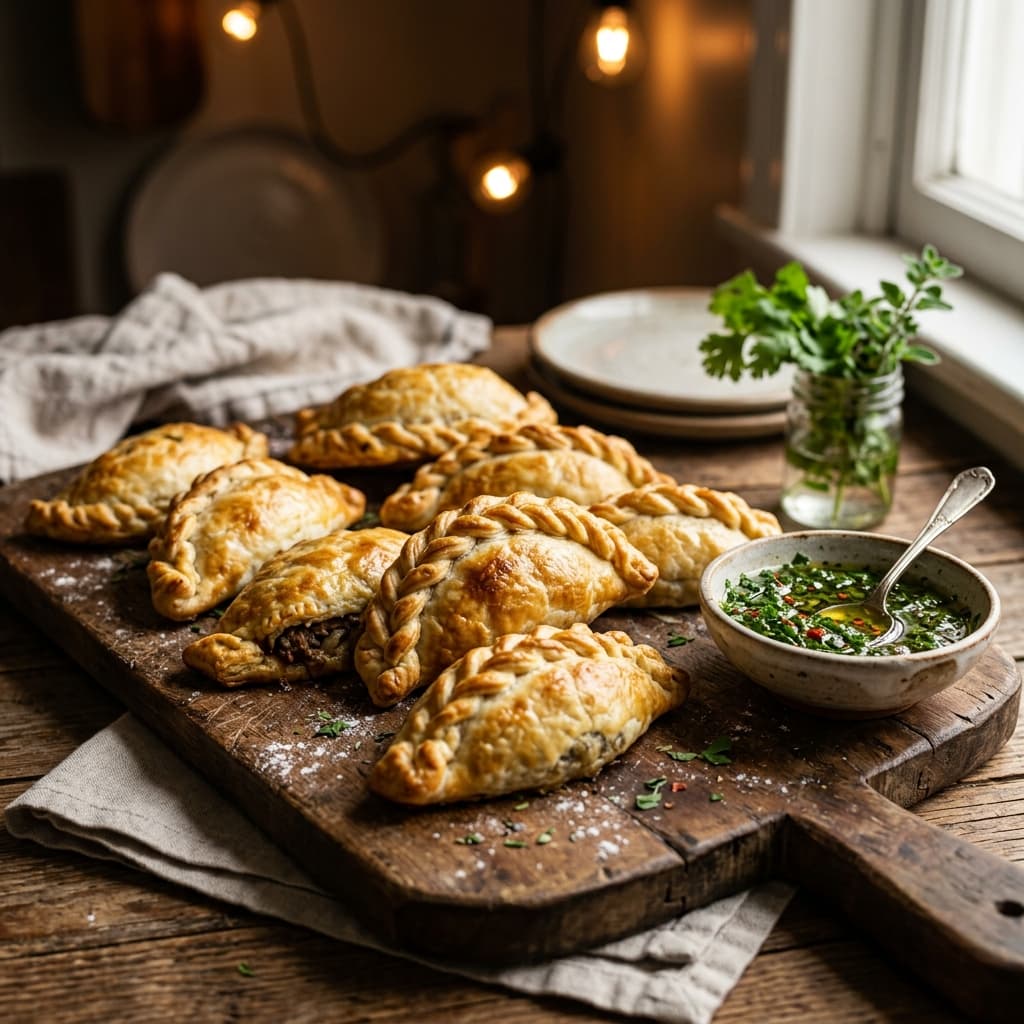
Macro Nutrition Profile (Per Serving)
Ingredients
Flaky Empanada Dough (or 24 store-bought 4-inch empanada tapas)
Savory Beef Picadillo Filling
Assembly & Egg Wash Finish
Fresh Herb Chimichurri Sauce
Ingredient Substitutions
| Original Ingredient | Healthy Alternative |
|---|---|
| Animal protein | Firm tofu, tempeh, or organic chickpeas |
| Cooking fat | Extra virgin olive oil or grass-fed butter |
Instructions
Prepare the Flaky Empanada Dough: In the bowl of a food processor or a large mixing bowl, combine 3 cups of unbleached all-purpose flour and 1 teaspoon of kosher salt. Pulse or whisk to combine. Add 8 tablespoons (1 stick) of cold unsalted butter cut into 1/2-inch cubes. Pulse 8 to 10 times (or cut in using a pastry blender) until the mixture resembles coarse meal with pea-sized bits of cold butter remaining. In a small measuring cup, whisk together 1 large egg yolk, 3/4 cup of ice-cold water, and 1 tablespoon of distilled white vinegar. Pour the liquid into the flour mixture. Pulse or stir with a fork just until a shaggy dough begins to pull together. Turn the dough out onto a lightly floured surface. Knead gently for 60 to 90 seconds until a smooth, cohesive dough ball forms. (Do not overwork the dough). Flatten into a 1-inch thick disc, wrap tightly in plastic wrap, and chill in the refrigerator for at least 60 minutes.
Sauté the Onions and Garlic: While the dough rests, place a wide 12-inch skillet over medium heat. Add 2 tablespoons of extra virgin olive oil (or rendered beef tallow). Add 2 large finely diced yellow onions and 1/2 teaspoon of kosher salt. Cook for 8 to 10 minutes, stirring frequently, until the onions are completely soft, translucent, and just beginning to turn pale golden around the edges. Add 3 cloves of finely minced garlic and cook for 60 seconds until fragrant.
Brown the Beef and Bloom Spices: Increase the skillet heat to medium-high. Add 1 pound of ground beef chuck to the skillet. Using a wooden spoon, break the beef into fine crumbles as it cooks. Sauté for 5 to 6 minutes until the meat is no longer pink and begins to brown. Add 1 tablespoon of smoked Spanish paprika, 1 1/2 teaspoons of ground cumin, 1 teaspoon of crushed dried Mexican oregano, 1/2 teaspoon of crushed red pepper flakes, the remaining 1/2 teaspoon of kosher salt, and 1/2 teaspoon of black pepper. Stir continuously for 60 to 90 seconds to toast the spices in the hot beef fat.
Deglaze and Simmer: Pour 1/3 cup of low-sodium beef broth into the skillet. Scrape the bottom of the pan to dislodge any caramelized browned bits. Simmer over medium heat for 3 to 4 minutes until the liquid reduces into a thick, glossy glaze that coats the meat. Remove the skillet from the heat.
Fold Finishing Fillings and Chill: To the warm beef mixture, fold in 1/2 cup of chopped green Manzanilla olives, 2 finely diced hard-boiled eggs, and sliced green onions. Stir gently to distribute without crushing the tender egg whites. Taste the filling; it should be boldly seasoned, savory, and lightly piquant. Transfer the filling to a shallow bowl or rimmed sheet pan, spread it into a thin layer, cover with plastic wrap, and refrigerate for at least 2 hours until thoroughly cold and firm.
Roll and Cut Dough Circles: Preheat your oven to 400°F (204°C). Line two large rimmed baking sheets with parchment paper. Remove the chilled dough from the refrigerator. Cut the dough disc in half, keeping one half covered in plastic wrap. On a lightly floured surface, roll the dough with a rolling pin to an even thickness of 1/8 inch (3 mm). Using a 4-inch round cookie cutter or bowl, cut out circles. Gather dough scraps, press them gently together (do not knead heavily), re-roll, and cut additional circles. Repeat with the second dough half to yield roughly 20 to 24 circles.
Egg Wash, Bake, and Serve: In a small bowl, whisk 1 whole egg with 1 tablespoon of whole milk. Lightly brush the top and crimped borders of each empanada with the egg wash. Sprinkle with a tiny pinch of flaky Maldon sea salt. Bake at 400°F (204°C) for 18 to 22 minutes, rotating the baking sheets halfway through, until the pastry is deep golden-brown, puffed, and crisp. Remove from the oven and let rest on the baking sheets for 5 to 7 minutes to allow the hot internal juices to settle. Serve warm accompanied by fresh herb chimichurri sauce.
The Sweet Mendoza Raisin Addition: Soak 1/3 cup of dark or golden raisins in hot water or dry sherry for 15 minutes, drain, and fold into the cooked beef filling along with the olives and eggs. The burst of sweet raisin contrasts beautifully with earthy cumin and smoked paprika.
The Spicy Gaucho Empanada: Add 1 finely diced jalapeño or serrano pepper to the sautéing onions and increase the crushed red pepper flakes to 1 full teaspoon.
The Empanadas Exploded and Leaked Filling Across the Pan: The Cause: The pastry was overfilled, no steam vent hole was poked in the top, or the edges were crimped loosely. The Solution: Use strictly 1 heaping tablespoon of cold filling for 4-inch circles. Moisten the edge lightly with water, press firmly to seal out air, crimp tightly, and poke a tiny vent hole in the top.
The Pastry Dough is Tough, Chewy, and Shrinks When Rolled: The Cause: The dough was overworked during kneading, or it was not allowed to rest long enough to relax gluten. The Solution: Knead the dough just until cohesive (60 to 90 seconds). Wrap tightly and chill for at least 60 minutes. The resting phase allows gluten bonds to relax so the dough rolls effortlessly.
The Bottom Crust is Pale, Soft, and Soggy: The Cause: Filling was warm when assembled, or the oven was not hot enough. The Solution: Ensure filling is completely cold before spooning into pastry. Bake on the middle-lower rack in a preheated 400°F (204°C) oven on heavy-gauge aluminum baking sheets.
Tried this recipe?
Let us know how it turned out! Click a star below to leave a review and rate the recipe.
Storage & Freezing Tips
- Refrigerator: Store in an airtight container for up to 2 days. Keep the components separate if possible to preserve texture.
- Reheating: Reheat gently in a skillet on medium-low heat with a splash of olive oil or butter.
- Freezing: Freezing is not recommended for this dish because ingredients like eggs become soggy, rubbery, or mushy when defrosted.
Frequently Asked Questions
Can this recipe be prepared ahead of time?▼
Yes, this meal is excellent for weekly meal prep. Store components separately and assemble before serving.
Is this recipe gluten-free?▼
All ingredients used are naturally gluten-free. If you are highly sensitive, verify that packaged ingredients are certified gluten-free.
Tried this recipe?
Tag @stewartlucas on Instagram and hashtag it #nutriguide!
You Might Also Like
Stewart Lucas
Chief Culinary SpecialistStewart Lucas is the Chief Culinary Specialist and lead recipe developer representing the NutriGuide team. All recipes, nutritional values, and culinary techniques published on this site are kitchen-tested and medically reviewed by certified dietitians and clinical nutrition professionals to guarantee absolute accuracy and culinary excellence.
Community Reviews
Please log in to leave a review.