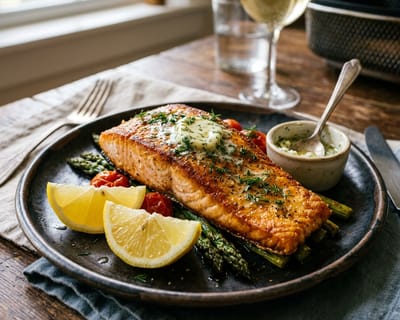
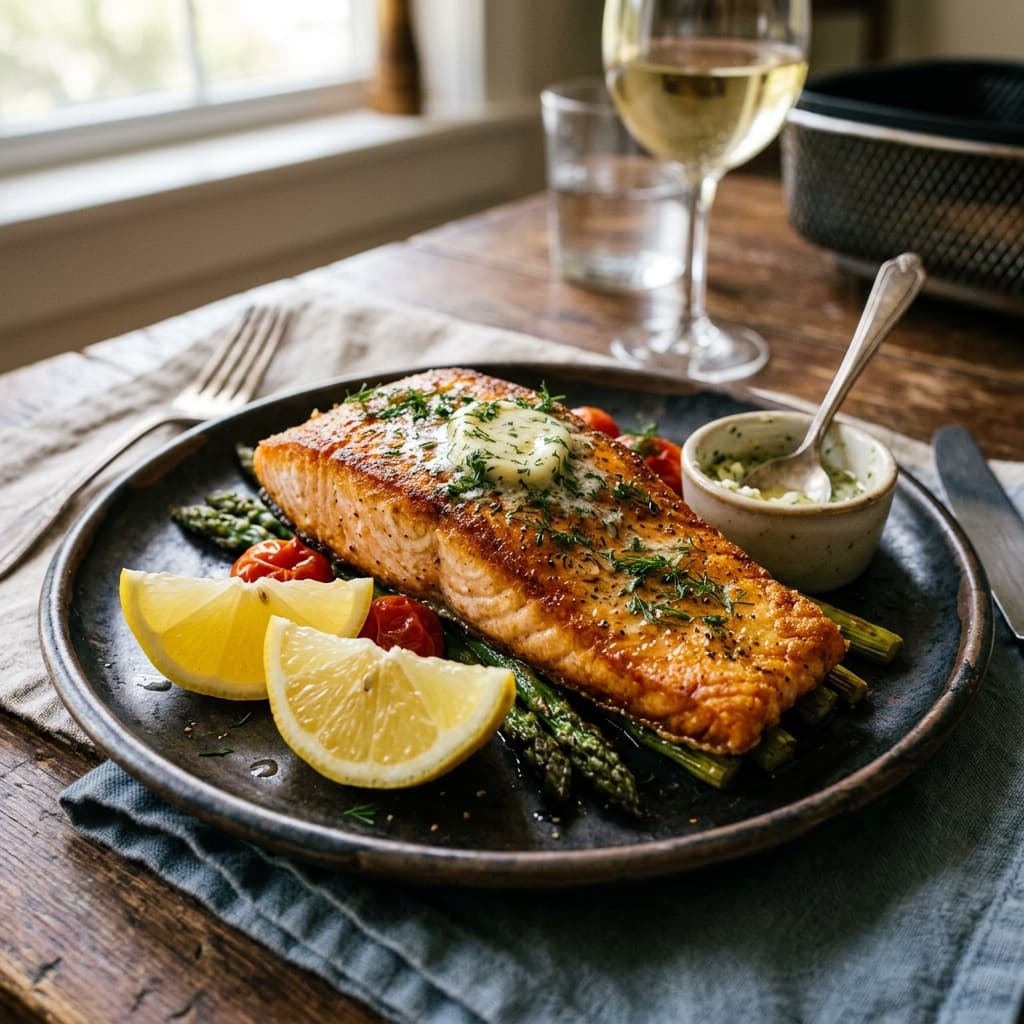
Air Fryer Salmon (Crispy Skin & Juicy Flaky Fillets Masterclass)
The definitive masterclass for restaurant-grade Air Fryer Salmon. Learn the culinary science of skin desiccation, albumin prevention, and 8-minute convection heat for melt-in-your-mouth medium flakiness.
Key Takeaways
- ✓Preheating the air fryer to 390°F (199°C) is non-negotiable to trigger rapid thermal crusting.
- ✓Salting and resting the salmon dry for 10 minutes prevents unsightly white albumin protein leakage.
- ✓Placing the fillets skin-side down utilizes hot basket airflow to crisp the skin into a savory chip.
- ✓Pull the salmon when an instant-read thermometer reads 125°F-130°F for silky, buttery center flakes.
The Story
Salmon has long been celebrated as the crowning jewel of cold-water gastronomy, from the misty fjords of Norway and the rushing estuaries of the Pacific Northwest to the Michelin-starred kitchens of Paris and Tokyo. Historically, cooking salmon to perfection was considered one of the ultimate tests of a saucier’s touch. The challenge lay in salmon's delicate cellular anatomy: unlike terrestrial meats, fish muscle fibers (myotomes) are short and bound by delicate collagen sheets (myocommata) that dissolve at remarkably low temperatures. Cook salmon a mere sixty seconds too long in a traditional oven, and moisture evaporates, turning silky fat into a dry, chalky brick.
For decades, pan-searing in cast iron was the gold standard, yet it required splattering hot oil, careful spatula maneuvering, and constant vigilance to prevent the skin from adhering to the pan. Enter the modern culinary revolution of high-velocity convection: the Air Fryer.
By circulating superheated dry air through an enclosed cyclonic chamber, the air fryer creates an intense microclimate that mimics an industrial salamander broiler combined with a convection hearth. Moisture on the skin vaporizes almost instantaneously, rendering subcutaneous lipids and transforming the salmon skin into an ultra-crispy, potato-chip-like delicacy, while shielding the interior flesh from direct scorched heat.
This masterclass is designed to demystify every variable of the process. Whether you are aiming for a quick weeknight keto dinner or hosting an elegant dinner party, this foolproof blueprint guarantees translucent, buttery flakes, vibrant color, and zero fishy odor.
The Science of Flavor Chemistry & Thermal Dynamics
To master salmon in the air fryer, you must understand the biochemistry of fish muscle and thermal convection.
1. The Albumin Phenomenon & Dry Brine Mitigation
Have you ever noticed unsightly white curd seeping out of cooked salmon? That substance is albumin, a soluble protein suspended inside the muscle fibers. When salmon is subjected to rapid thermal shock or overcooking, the muscle fibers contract aggressively like a squeezed sponge, expelling water and albumin onto the surface where it coagulates into white clumps. To prevent this, our method employs a 10-minute surface dry-brine. Sprinkling coarse Kosher salt onto the flesh before cooking draws out a micro-layer of moisture. The salt dissolves, denatures the immediate surface proteins into a tight, moisture-sealing matrix, and gets reabsorbed. When the salmon hits the air fryer, the surface proteins hold firm, locking internal juices inside and virtually eliminating albumin expulsion.2. Convection Dynamics & Skin Desiccation
Salmon skin is rich in collagen and subcutaneous fat. In a conventional oven with stagnant heat, the moisture trapped beneath the fillet steams the skin, leaving it rubbery and gummy. In an air fryer, 390°F (199°C) air flows around and through the perforated basket grate at high speed. This cyclonic velocity strips water molecules from the exterior skin cells far faster than internal moisture can replace them. The result is rapid cellular desiccation followed by high-heat fat rendering—turning the skin shatteringly crisp while keeping the flesh above perfectly insulated.3. Temperature Science & Carryover Heat
Fish proteins begin coagulating at 110°F (43°C) and reach optimal tenderness at 125°F–130°F (52°C–54°C) for medium-rare to medium doneness. At 140°F and above, muscle fibers contract violently, squeezing out all natural omega-3 oils. Because the air fryer basket holds residual thermal energy, the salmon will experience carryover cooking of 3°F to 5°F once removed. Therefore, pulling your salmon at an internal core temperature of exactly 125°F ensures that after a 3-minute rest, it stabilizes at a perfect, juicy 130°F.Anatomy of the Ingredients & Artisanal Sourcing
A masterclass dish is only as extraordinary as the raw materials selected. Here is how to source and handle every element:
- The Salmon Cut: Always request center-cut fillets of uniform thickness (approximately 1 to 1.25 inches thick). Tail sections taper off into thin flaps that overcook long before the thicker edge is done. If choosing between Wild King (Chinook), Coho, Sockeye, or Farmed Atlantic:
- Skin-On is Mandatory: Even if you choose not to eat the skin, always cook salmon with the skin intact. The skin acts as a thermal heat shield, protecting the delicate flesh against direct heat and preventing moisture loss.
- The Oil Vehicle: Use extra virgin olive oil or avocado oil. Avoid aerosol cooking sprays containing chemical propellants (like lecithin or butane), which can erode the non-stick coating of your air fryer basket over time. Apply oil using a silicone pastry brush.
- The Artisanal Spice Rub: Smoked Spanish paprika provides both sweetness and smoky depth without artificial liquid smoke. Garlic powder and onion powder create an umami-rich crust. Fresh cracked Tellicherry peppercorns provide floral warmth without harsh bitterness.
Step-by-Step Culinary Masterclass
Step 1: Fillet Inspection & Bone Removal
Run your fingertips gently along the length of each salmon fillet against the grain. If you detect any pin bones, use kitchen tweezers or fish pliers to pull them out in the direction they lie. Inspect the skin side to ensure all scales have been cleanly descaled.
- Chef's Technique Tip: Pulling pin bones diagonally in the direction of the grain prevents tearing the delicate raw flesh.
- Sensory Checkpoint: The fillets should feel silky smooth across the surface with zero rigid bone fragments.
Step 2: Surface Desiccation & Patting Dry
Using multi-ply paper towels, press firmly on both the top flesh and the bottom skin of each fillet. Change paper towels and repeat until the paper towel emerges bone dry. Moisture is the mortal enemy of crispiness; any surface water will boil into steam instead of searing.
- Chef's Technique Tip: Never rinse fresh fish under the tap; it spreads bacteria and saturates the protein structure with chlorine water.
- Sensory Checkpoint: The skin should feel tacky and matte, not slick or wet to the touch.
Step 3: The 10-Minute Dry-Brine & Seasoning Bloom
In a small ramekin, mix smoked paprika, garlic powder, onion powder, dried oregano, coarse sea salt, and black pepper. Brush the salmon flesh and skin with olive oil. Generously coat all surfaces with the spice blend, pressing the spices gently into the flesh with your fingers so they adhere.
- Chef's Technique Tip: Let the seasoned fillets sit on the cutting board at room temperature for 10 minutes before cooking. This takes the refrigerator chill off and allows the salt to penetrate the muscle tissue.
- Sensory Checkpoint: The spice rub will darken slightly as it absorbs the micro-layer of oil and salt.
Step 4: Air Fryer Calibration & Thermal Preheating
Set your air fryer to 390°F (199°C) and allow it to run empty for a full 4 to 5 minutes. Preheating guarantees that the moment the cold salmon skin hits the basket grate, heat transfer begins instantly, preventing the skin from sticking.
- Chef's Technique Tip: Lightly brush the hot basket grate with a drop of avocado oil right before loading the fish.
- Sensory Checkpoint: You should feel intense, dry convective heat billowing upward when you slide open the basket.
Step 5: Loading the Chamber with Airflow Spacing
Carefully place the 4 seasoned salmon fillets into the air fryer basket skin-side down. Ensure there is at least 1/2-inch to 1-inch of open space between each fillet. Never overlap or crowd the fillets.
- Chef's Technique Tip: Crowding traps evaporative steam between the fillets, softening the skin and creating uneven cooking zones.
- Sensory Checkpoint: Each fillet sits independently on the grate with clear perimeter airflow channels.
Step 6: The Cyclonic Convection Roast
Close the air fryer basket immediately and cook at 390°F (199°C) undisturbed for 7 to 9 minutes (7 minutes for 1-inch thick fillets, 8 to 9 minutes for thick center-cut pieces over 1.25 inches). Do not open the basket during the first 6 minutes to preserve internal chamber heat.
- Chef's Technique Tip: Flipping is completely unnecessary! The perforated grate allows heat to circulate beneath the skin while the top element browns the spice crust.
- Sensory Checkpoint: At the 7-minute mark, you will hear vigorous sizzling and smell sweet paprika and roasted garlic.
Step 7: Core Temperature Verification
Slide open the air fryer basket. Insert an instant-read digital probe thermometer horizontally into the thickest center core of the largest fillet. Look for a reading between 125°F and 130°F (52°C–54°C) for medium doneness.
- Chef's Technique Tip: If you prefer well-done salmon (145°F), add 2 additional minutes, but be aware that the natural fats will begin to render out.
- Sensory Checkpoint: The flesh will yield gently to light fingertip pressure with slight spring-back, showing defined coral-pink flakes.
Step 8: Resting, Carryover Cooking & Lemon Butter Finishing
Use a wide fish spatula to lift the salmon fillets gently out of the basket onto a warm serving platter. Immediately squeeze fresh organic lemon juice over the hot spice crust and, if desired, brush with melted garlic herb butter. Let the fillets rest for 3 full minutes undisturbed before serving.
- Chef's Technique Tip: Resting allows the constricted muscle fibers to relax, redistributing the liquified omega-3 oils back into the center of the flakes.
- Sensory Checkpoint: A glistening, aromatic sheen covers the fillet, and the skin beneath remains rigid and crisp.
Pro-Chef Troubleshooting & Critical Checkpoints
Problem: White Albumin Curds Formed on Top of Salmon
- The Root Cause: The salmon was cooked at too high a temperature, cooked straight out of a freezing refrigerator, or left in the basket past 135°F.
- The Masterclass Solution: Always dry-brine with salt for 10 minutes at room temperature, and pull the salmon at 125°F-130°F. The residual heat finishes the cook without squeezing out albumin.
Problem: Salmon Skin Stuck to the Air Fryer Basket
- The Root Cause: The air fryer basket was not preheated, the skin was wet when loaded, or oil was omitted from the skin.
- The Masterclass Solution: Thoroughly pat the skin bone-dry, rub skin with oil, and preheat the air fryer to 390°F so the hot metal grate immediately sears the skin on contact.
Problem: Salmon is Burnt on Top but Raw in the Center
- The Root Cause: The fillet was excessively thick (over 1.5 inches) or placed directly under the heating coil in a compact air fryer.
- The Masterclass Solution: Lower the temperature to 370°F (188°C) and extend the cook time to 11-12 minutes to allow gentle heat penetration without scorching the spice rub.
Problem: The Fish Tastes Dry and Stringy
- The Root Cause: Overcooked past 145°F (63°C). Fish loses 80% of its moisture between 135°F and 150°F.
- The Masterclass Solution: Use an instant-read digital probe thermometer. Never guess cooking time by sight alone; pull the fish when the thermometer reaches 125°F.
Macro Analysis & Nutritional Optimization
Salmon is universally recognized by clinical dietitians and cardiologists as one of nature’s most nutrient-dense superfoods.
- High-Bioavailability Marine Protein: A single 6-ounce fillet yields 38 grams of complete protein, supplying all nine essential amino acids required for cellular repair, lean muscle preservation, and satiety signaling.
- Cardioprotective Omega-3 Fatty Acids (EPA & DHA): Unlike plant-derived ALA, wild and high-grade Atlantic salmon provide pre-formed Eicosapentaenoic Acid (EPA) and Docosahexaenoic Acid (DHA). These long-chain fatty acids actively lower arterial inflammation, reduce circulating triglycerides, and enhance cell membrane fluidity.
- Astaxanthin Antioxidant Shield: The vibrant coral-orange hue of salmon stems from astaxanthin, a potent marine carotenoid. Astaxanthin has been shown in clinical trials to neutralize free radicals, support dermal UV protection, and promote endothelial vascular elasticity.
- Micronutrient Powerhouse: Exceptionally rich in Vitamin B12 (supporting neurological function and red blood cell synthesis), Vitamin D3 (essential for bone mineral density and immune homeostasis), Selenium, and Potassium.
- Dietary Adaptations: Naturally 100% Gluten-Free, Zero Refined Sugars, and strict Keto / Low-Carb compliant (<1g net carb).
Artisanal Serving & Pairing Architecture
To transform this Air Fryer Salmon into a fine-dining experience, balance the rich, fatty richness of the fish with bright acidity, crisp garden greens, and artisanal complex starches:
- Vegetable Companions: Air-fried asparagus spears with lemon zest, roasted broccolini with toasted pine nuts, or charred Mediterranean zucchini.
- Artisanal Grains & Starches: Fluffy garlic-herb quinoa, saffron-infused basmati rice, or creamy cauliflower-parmesan mash for a low-carb alternative.
- Fresh Herbaceous Salads: A crisp English cucumber salad with shaved red onions, dill, and white wine vinaigrette cleanly cuts through the rich salmon fats.
- Sommelier Wine Pairing:
Scientific Storage, Meal Prep & Reheating Protocol
Proper post-cooking preservation ensures that your salmon remains succulent rather than rubbery when enjoyed as meal prep:
- Refrigeration: Cool leftover fillets to room temperature within 45 minutes of cooking. Transfer to an airtight glass container lined with a piece of parchment paper. Store in the coldest part of your refrigerator for up to 3 to 4 days.
- Freezer Protocol: Wrap individual cooked fillets tightly in plastic cling film, followed by heavy-duty aluminum foil. Freeze for up to 2 months. Thaw overnight in the refrigerator before reheating.
- The Masterclass Reheating Technique (NEVER Microwave!): Microwaving salmon denatures fats violently, emitting a pungent fishy odor and turning the meat rubbery.
Frequently Asked Questions (Masterclass Edition)
Q: Do I need to flip the salmon in the air fryer?
A: No! Convective air circulates completely underneath the perforated basket grate. Flipping salmon runs the risk of breaking the delicate flakes and ruining the spice crust.Q: Can I use frozen salmon fillets directly in the air fryer?
A: While possible, it is not recommended for masterclass results. Cooking from frozen releases substantial water into the basket, steaming the fish instead of crisping the skin. For best results, thaw frozen fillets overnight in the refrigerator, or thaw in a cold water bath for 20 minutes before patting dry.Q: How do I know the salmon is fully cooked without a thermometer?
A: Gently press down on the center of the fillet with the back of a fork. The salmon should yield and begin to flake cleanly along the white inter-muscular fat lines. If it feels mushy and resists flaking, it needs 1 to 2 more minutes.Q: Why did my air fryer smoke while cooking salmon?
A: Salmon renders natural fish oils into the bottom drip pan. In compact air fryers, hot elements can cause these rendered drippings to smoke. To fix, pour 2 tablespoons of water into the bottom drip pan under the basket to catch fat drippings before they scorch.Q: Can I remove the skin before air frying?
A: You can, but cooking skinless salmon requires dropping the temperature to 375°F and lightly oiling the basket to prevent sticking. We strongly advise cooking with skin-on to protect moisture, even if you peel the skin off before eating.Air Fryer Salmon (Crispy Skin & Juicy Flaky Fillets Masterclass)
The definitive masterclass for restaurant-grade Air Fryer Salmon. Learn the culinary science of skin desiccation, albumin prevention, and 8-minute convection heat for melt-in-your-mouth medium flakiness.
Macro Nutrition Profile (Per Serving)
Ingredients
Ingredient Substitutions
| Original Ingredient | Healthy Alternative |
|---|---|
| Salmon/Cod | Steelhead trout, halibut, or sea bass (baking times may vary) |
| Asparagus/Veg | Zucchini slices, broccoli florets, or green beans (roast at same temperature) |
Instructions
Fillet Inspection & Bone Removal: Run your fingertips gently along the length of each salmon fillet against the grain. If you detect any pin bones, use kitchen tweezers or fish pliers to pull them out in the direction they lie. Inspect the skin side to ensure all scales have been cleanly descaled. Chef's Technique Tip: Pulling pin bones diagonally in the direction of the grain prevents tearing the delicate raw flesh. Sensory Checkpoint: The fillets should feel silky smooth across the surface with zero rigid bone fragments.
Surface Desiccation & Patting Dry: Using multi-ply paper towels, press firmly on both the top flesh and the bottom skin of each fillet. Change paper towels and repeat until the paper towel emerges bone dry. Moisture is the mortal enemy of crispiness; any surface water will boil into steam instead of searing. Chef's Technique Tip: Never rinse fresh fish under the tap; it spreads bacteria and saturates the protein structure with chlorine water. Sensory Checkpoint: The skin should feel tacky and matte, not slick or wet to the touch.
The 10-Minute Dry-Brine & Seasoning Bloom: In a small ramekin, mix smoked paprika, garlic powder, onion powder, dried oregano, coarse sea salt, and black pepper. Brush the salmon flesh and skin with olive oil. Generously coat all surfaces with the spice blend, pressing the spices gently into the flesh with your fingers so they adhere. Chef's Technique Tip: Let the seasoned fillets sit on the cutting board at room temperature for 10 minutes before cooking. This takes the refrigerator chill off and allows the salt to penetrate the muscle tissue. Sensory Checkpoint: The spice rub will darken slightly as it absorbs the micro-layer of oil and salt.
Air Fryer Calibration & Thermal Preheating: Set your air fryer to 390°F (199°C) and allow it to run empty for a full 4 to 5 minutes. Preheating guarantees that the moment the cold salmon skin hits the basket grate, heat transfer begins instantly, preventing the skin from sticking. Chef's Technique Tip: Lightly brush the hot basket grate with a drop of avocado oil right before loading the fish. Sensory Checkpoint: You should feel intense, dry convective heat billowing upward when you slide open the basket.
Loading the Chamber with Airflow Spacing: Carefully place the 4 seasoned salmon fillets into the air fryer basket skin-side down. Ensure there is at least 1/2-inch to 1-inch of open space between each fillet. Never overlap or crowd the fillets. Chef's Technique Tip: Crowding traps evaporative steam between the fillets, softening the skin and creating uneven cooking zones. Sensory Checkpoint: Each fillet sits independently on the grate with clear perimeter airflow channels.
The Cyclonic Convection Roast: Close the air fryer basket immediately and cook at 390°F (199°C) undisturbed for 7 to 9 minutes (7 minutes for 1-inch thick fillets, 8 to 9 minutes for thick center-cut pieces over 1.25 inches). Do not open the basket during the first 6 minutes to preserve internal chamber heat. Chef's Technique Tip: Flipping is completely unnecessary! The perforated grate allows heat to circulate beneath the skin while the top element browns the spice crust. Sensory Checkpoint: At the 7-minute mark, you will hear vigorous sizzling and smell sweet paprika and roasted garlic.
Core Temperature Verification: Slide open the air fryer basket. Insert an instant-read digital probe thermometer horizontally into the thickest center core of the largest fillet. Look for a reading between 125°F and 130°F (52°C–54°C) for medium doneness. Chef's Technique Tip: If you prefer well-done salmon (145°F), add 2 additional minutes, but be aware that the natural fats will begin to render out. Sensory Checkpoint: The flesh will yield gently to light fingertip pressure with slight spring-back, showing defined coral-pink flakes.
Resting, Carryover Cooking & Lemon Butter Finishing: Use a wide fish spatula to lift the salmon fillets gently out of the basket onto a warm serving platter. Immediately squeeze fresh organic lemon juice over the hot spice crust and, if desired, brush with melted garlic herb butter. Let the fillets rest for 3 full minutes undisturbed before serving. Chef's Technique Tip: Resting allows the constricted muscle fibers to relax, redistributing the liquified omega-3 oils back into the center of the flakes. Sensory Checkpoint: A glistening, aromatic sheen covers the fillet, and the skin beneath remains rigid and crisp.
Tried this recipe?
Let us know how it turned out! Click a star below to leave a review and rate the recipe.
Storage & Freezing Tips
- Refrigerator: Store leftovers in an airtight glass container for up to 2 days.
- Reheating: Warm gently in a skillet on medium-low heat with a lid to keep the fish tender. Avoid microwaving to prevent rubbery texture.
- Freezing: We do not recommend freezing cooked fish as it degrades the texture.
Frequently Asked Questions
How do I prevent the fish from sticking to the pan?▼
Ensure your baking dish is lightly oiled or lined with parchment paper, and make sure the oven is fully preheated before cooking.
Can I make this recipe with frozen fish?▼
Yes. Thaw the fish completely in the refrigerator overnight, then pat it dry thoroughly with a paper towel before adding seasonings.
Tried this recipe?
Tag @stewartlucas on Instagram and hashtag it #nutriguide!
You Might Also Like

Stewart Lucas
Nutritionist & Recipe DeveloperStewart Lucas is a nutritionist and recipe developer representing the NutriGuide team. All recipes, nutritional values, and diet protocols published on this site are designed and audited by certified dietitians and clinical nutrition professionals to guarantee absolute accuracy.
Community Reviews
Please log in to leave a review.