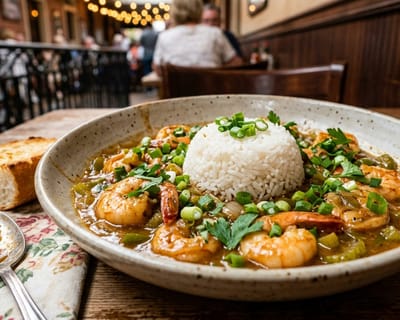
New Orleans Shrimp Étouffée
Succulent wild Gulf shrimp smothered in a rich, velvety blond-to-copper roux loaded with sweet onions, celery, bell peppers, garlic, and homemade shellfish broth, served over steamed white rice.
Key Takeaways
- ✓Ready in just 40 mins using straightforward, kitchen-tested technique.
- ✓Delivers 34g of muscle-fueling protein per serving for lasting satiety.
- ✓Portion-balanced at 480 calories per serving with wholesome, unrefined ingredients.
- ✓Masterclass temperature checkpoints ensure maximum tenderness and flavor development.
The Story
In French Louisiana culinary tradition, étouffée translates literally to "smothered" or "suffocated." It describes a method of cooking where seafood or poultry is gently braised in a covered vessel with aromatic vegetables, rich stock, and a roux-thickened gravy until tender.
While crawfish étouffée remains iconic along the bayous of Cajun country, shrimp étouffée gained equal prominence in New Orleans Creole restaurants and Gulf Coast home kitchens. When executed properly, shrimp étouffée showcases sweet, snappy wild Gulf shrimp suspended in a glossy, copper-hued butter gravy perfumed with celery, green bell pepper, onion, garlic, and cayenne, spooned over a mound of hot Louisiana long-grain white rice.
Despite its straightforward appeal, many home interpretations suffer from thin, watery sauce, floury aftertastes from rushed roux, or rubbery, overcooked shrimp that have boiled too long in the pot. Achieving the depth of flavor found in the French Quarter requires three fundamentals: simmering a fast homemade stock from raw shrimp shells, taking the roux to the correct copper-peanut-butter stage, and timing the shrimp addition to the last five minutes of cooking.
The Food Science of an Authentic Étouffée
Understanding how roux starches, vegetable aromatics, and shellfish proteins interact ensures consistent success:
- Roux Color and Thickening Power: Wheat flour contains starch granules (amylose and amylopectin). When whisked into hot butter, the starch granules gelatinize and disperse. As the roux browns, heat causes pyrolysis and dextrinization—breaking starch molecules into smaller dextrin chains.
- The Chemistry of the Holy Trinity: In Louisiana cooking, the French mirepoix (onion, carrot, celery) was adapted to local crops by replacing carrots with green bell pepper. Yellow onion provides sweetness (fructose and allicin derivatives), celery adds savory phthalides and herbal moisture, and green bell pepper contributes refreshing vegetal bitterness and pyrazines. When sweated in hot roux, these vegetables release water, immediately halting the darkening of the flour while sweating out aromatic sulfur compounds.
- Shell Broth Glutamates: Raw shrimp shells and tails contain chitin, carotenoids (astaxanthin), and abundant free amino acids (particularly glycine, arginine, and glutamic acid). Simmering discarded shells in water extracts these natural flavor enhancers into a golden, fragrant broth far superior to tap water or commercial boxed stock.
Ingredient Selection and Prep
1. The Shrimp: Wild-Caught Gulf Shrimp
- Source: Always choose wild-caught American Gulf brown or white shrimp over imported farm-raised varieties. Wild Gulf shrimp feed on coastal marshes and algae, resulting in a firm, snappy texture and a clean, naturally sweet, briny flavor.
- Size: Medium-to-large shrimp (21/25 or 26/30 count per pound) work best. They provide substantial, succulent bites that do not vanish into the sauce.
- Shell-On Is Essential: Purchase raw shrimp with heads and shells intact whenever possible. The shells provide the building blocks for the broth.
2. The Cooking Fat: Pure Butter vs. Rendered Fat
Traditional Creole étouffée is characterized by its distinct buttery finish. Using unsalted European-style butter (with 82% butterfat) gives the sauce a velvety, rounded mouthfeel. For a deeper, rustic Cajun note, you can substitute 2 tablespoons of the butter with rendered bacon fat or duck fat.3. The Trinity Ratio
Maintain the classic proportion of aromatic vegetables: two parts yellow onion to one part celery and one part green bell pepper (by weight or volume). Dice the vegetables small (roughly 1/4-inch dice) so they soften completely into the gravy without remaining crunchy.4. Seasoning: Creole vs. Cajun Balance
Use a balanced blend of sweet paprika, black pepper, white pepper, dried thyme, and cayenne. If using commercial Creole seasoning blends (such as Tony Chachere's or Slap Ya Mama), check the sodium level: many commercial mixes contain up to 50% salt by weight. Using salt-free Creole seasoning allows you to control the salinity independently of the spice level.Step-by-Step Instructions
Follow these steps for authentic New Orleans shrimp étouffée:
Step 1: Peel Shrimp and Simmer the Shell Stock
Peel and devein 2 pounds of wild Gulf shrimp. Place the raw peeled shrimp in a covered glass bowl in the refrigerator. Transfer all the discarded shrimp shells and tails into a medium saucepan.Add 5 cups of cold water, 1 quartered yellow onion (including clean dry onion skins), trimmings and leaves from your celery stalks, 2 dried bay leaves, 1 teaspoon of whole black peppercorns, and 2 fresh thyme sprigs. Bring to a boil over medium-high heat.
Once boiling, lower the heat to medium-low and simmer gently, uncovered, for 20 to 25 minutes. The water will turn amber-orange and smell sweet and oceanic. Strain the stock through a fine-mesh sieve into a heatproof bowl or large liquid measuring cup; discard solids. You should have roughly 4 to 4 1/2 cups of rich shrimp broth. Keep warm on low heat.
Step 2: Season the Peeled Shrimp
Remove the peeled shrimp from the refrigerator. Pat dry with paper towels. Toss with 1 teaspoon of Creole seasoning, 1/4 teaspoon of fine sea salt, and 1/4 teaspoon of black pepper. Return to the refrigerator to chill while preparing the base.Step 3: Cook the Butter and Flour Roux
Set a large, heavy-bottomed Dutch oven, enameled cast-iron pot, or deep cast-iron skillet over medium-low heat. Add 6 tablespoons of unsalted butter and allow it to melt completely until foaming subsides.Sprinkle in 6 tablespoons of all-purpose flour. Whisk continuously with a flat roux whisk or wooden spoon, working the mixture across the entire bottom and corners of the pan. Cook over medium-low heat, stirring constantly, for 12 to 16 minutes.
Watch the color transition closely:
- 3 to 5 minutes: Pale, foaming blond roux with a raw flour aroma fading into cooked pie crust.
- 8 to 10 minutes: Warm straw color smelling of toasted oats.
- 12 to 16 minutes: Rich copper or light peanut butter color with a toasted nutty fragrance.
Step 4: Add the Holy Trinity and Aromatics
Dump 1 1/2 cups of diced yellow onions, 1 cup of diced celery, and 1 cup of diced green bell peppers all at once into the hot roux.The cold moisture from the vegetables will cause the roux to sizzle and steam vigorously, instantly halting the browning of the flour. Switch from a whisk to a wooden spoon. Cook over medium heat, stirring frequently, for 6 to 8 minutes until the onions become translucent and soft, and the vegetables are coated in the glossy roux.
Stir in 5 cloves of minced garlic and 1 tablespoon of tomato paste (if using). Cook for 1 to 2 minutes until the garlic is fragrant and the tomato paste deepens to a brick-red color.
Step 5: Incorporate the Warm Shrimp Stock
Pour in approximately 1 cup of the warm strained shrimp stock while stirring constantly with your wooden spoon. The starch in the roux will absorb the liquid rapidly, turning into a thick paste.Continue adding the remaining warm stock in 1-cup increments, stirring vigorously after each addition to ensure a silky, lump-free emulsion. Add 1 tablespoon of Worcestershire sauce, 1 teaspoon of dried thyme, 1/2 teaspoon of smoked paprika, 1/4 teaspoon of cayenne pepper, and 1 bay leaf.
Bring the sauce to a gentle boil over medium heat. Reduce heat to low, cover the pot with the lid slightly ajar, and let the gravy simmer gently for 25 to 30 minutes, stirring occasionally. The sauce will thicken into a rich, velvety gravy that coats the back of a spoon.
Step 6: Smother the Shrimp
Remove the bay leaf. Taste the gravy and adjust seasoning with salt, black pepper, or cayenne to your preference.Gently drop the seasoned raw shrimp into the simmering gravy. Stir once to submerge all the shrimp beneath the liquid. Cover the pot with a tight-fitting lid and cook over low heat for 4 to 5 minutes.
Remove the lid: the shrimp should be pink, plump, and curled into loose 'C' shapes (if curled into tight 'O' shapes, they are overcooked). Immediately remove the pot from the burner to halt active cooking. Stir in 1 teaspoon of freshly squeezed lemon juice to brighten the sauce.
Step 7: Garnish and Serve
Fold in half of the sliced green onions and chopped fresh flat-leaf parsley, reserving the rest for garnish.To serve, scoop a generous mound of hot steamed white rice into the center of shallow wide bowls. Ladle the shrimp and velvety copper étouffée gravy over and around the rice. Garnish with remaining green onions and fresh parsley. Serve hot alongside Louisiana hot sauce and warm crusty French bread.
Culinary Rules for Restaurant-Grade Étouffée
- Never Walk Away from the Roux: Cooking roux requires patience and constant motion. Flour particles settle quickly to the bottom; if a dark speck burns, the scorched taste will permeate the entire batch, requiring you to discard it and start fresh.
- Warm Stock Prevents Clumps: Never pour ice-cold liquid into a hot roux. Adding cold stock causes butter fats to seize and flour starches to clump into gelatinous lumps. Keep your shrimp stock steaming warm on an adjacent burner.
- Control Salt Until the Finish: As stock simmers down and concentrates, salinity increases. Season your shrimp lightly and wait until Step 6 to make final salt adjustments to the finished gravy.
Accompaniments and Pairing Suggestions
An authentic Louisiana meal balances the rich butter sauce of étouffée with acidic and crunchy textures:
- Warm French Bread: A fresh loaf of Leidenheimer or crusty French bread with a crisp crust and airy crumb is essential for mopping up every drop of copper gravy.
- Steamed Long-Grain Rice: Louisiana long-grain white rice (such as Jazzmen or standard long-grain) provides separate, fluffy grains that absorb the sauce without turning mushy.
- Crisp Green Salad: A simple salad of mixed greens, shaved radishes, cucumbers, and a sharp lemon-dijon vinaigrette cleanses the palate between rich bites.
- Beverage Pairing: A crisp, high-acidity dry white wine such as Sauvignon Blanc, unoaked Chardonnay, or an off-dry Chenin Blanc cuts through the butterfat. For beer drinkers, an amber lager or crisp Pilsner pairs cleanly with Cajun spices.
Storage and Reheating Guidelines
- Refrigerator Storage: Allow leftovers to cool to room temperature within 1 hour of cooking. Transfer into an airtight glass container and store in the refrigerator for up to 3 days.
- Reheating on the Stovetop: Place the étouffée into a skillet or small pot over low heat. Add 2 to 3 tablespoons of water or broth to loosen the gravy, as the roux starches firm up when chilled. Heat gently just until hot and steaming; avoid boiling, which will toughen the cooked shrimp.
- Microwave Reheating: Reheat at 50% power in 45-second intervals, stirring between bursts, to warm the sauce without rubberizing the shrimp proteins.
Cajun vs. Creole: The Regional Divide in Étouffée
Understanding the historical evolution between country Cajun cooking and metropolitan Creole cooking clarifies how étouffée developed:
1. Prairie Cajun Étouffée (Acadiana)
Originating in towns like Breaux Bridge, Opelousas, and Henderson, country Cajun étouffée is historically associated with freshwater crawfish caught in the Atchafalaya Basin.- The Fat: Traditional Cajun cooks frequently employed rendered pork lard or bacon grease for the roux rather than butter.
- No Tomatoes: Authentic Cajun étouffée strictly forbids tomatoes or tomato paste. The flavor profile is characterized by onions, green bell peppers, black pepper, and animal fat, yielding a brown or blonde sauce.
- Crawfish Fat: In crawfish season, fresh crawfish head fat (the yellow hepatopancreas) is folded directly into the braising gravy, producing an unmistakable richness and natural orange sheen.
2. New Orleans Creole Étouffée
As the dish migrated into historic French Quarter dining rooms (such as Galatoire's, Arnaud's, and Dooky Chase), city chefs adapted the recipe for white tablecloth service:- The Fat: Creole cooking relies heavily on sweet European-style butter and French culinary classical technique.
- Tomato Inclusion: Creole versions often introduce a modest spoonful of tomato paste or peeled chopped tomatoes, creating a warm copper-red hue and subtle fruit acidity.
- Gulf Seafood: Gulf white and brown shrimp replaced crawfish during off-season months, solidifying shrimp étouffée as an urban classic.
Regional Variations and Seafood Swaps
Troubleshooting Common Étouffée Problems
1. The Roux Separated or Broke into Oil and Paste
- The Cause: Heat was too high during roux cooking, or cold liquid was dumped into the hot roux too rapidly.
- The Solution: Keep burner heat on medium-low and whisk continuously. Always heat your shrimp stock in a separate saucepan until steaming hot before incorporating it into the roux in gradual 1-cup splashes.
2. The Gravy Has a Bitter, Scorched Flavor
- The Cause: Black flecks appeared in the roux during the browning stage and were not discarded.
- The Solution: If the flour burns and dark flecks appear on the bottom of the pan, the pan must be washed and the roux restarted. You cannot mask scorched roux flour with broth or seasonings.
3. The Shrimp Are Rubberized and Tough
- The Cause: The shrimp were added too early and boiled vigorously in the gravy for 15 minutes or longer.
- The Solution: Raw shrimp require only 4 to 5 minutes in low, simmering liquid to cook through. The moment they curl into a 'C' shape and turn pink, remove the pot from the stove immediately.
Nutritional Breakdown and Macro Profile
Per serving (serving size: 1 generous bowl with gravy and shrimp over 1 cup steamed white rice, recipe makes 6 hearty servings):
| Nutrient | Amount per Serving | % Daily Value |
|---|---|---|
| Calories | 480 kcal | — |
| Total Fat | 14 g | 18% |
| Saturated Fat | 7.5 g | 38% |
| Cholesterol | 240 mg | 80% |
| Sodium | 820 mg | 36% |
| Total Carbohydrates | 52 g | 19% |
| Dietary Fiber | 3 g | 11% |
| Total Sugars | 3.5 g | — |
| Protein | 34 g | 68% |
| Potassium | 460 mg | 10% |
| Calcium | 110 mg | 8% |
| Iron | 3.8 mg | 21% |
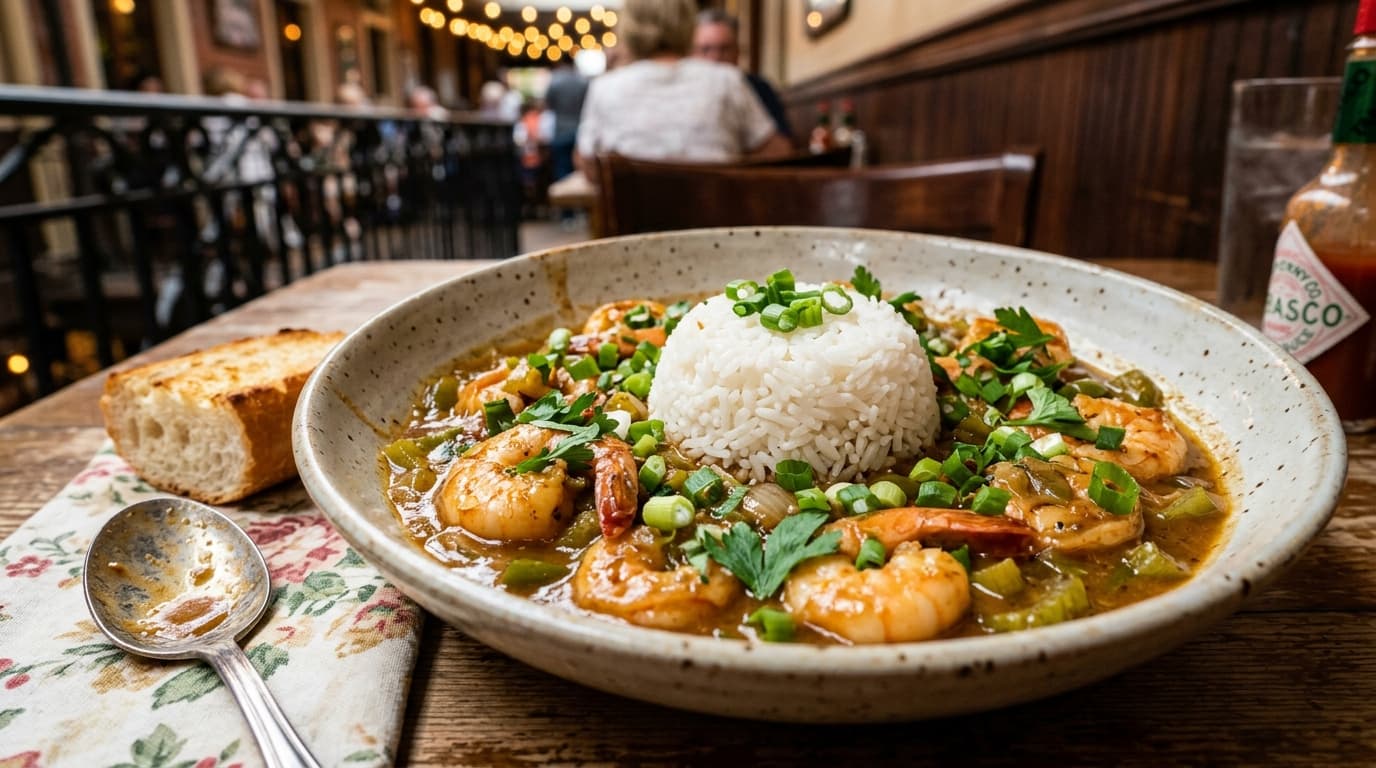
New Orleans Shrimp Étouffée
Succulent wild Gulf shrimp smothered in a rich, velvety blond-to-copper roux loaded with sweet onions, celery, bell peppers, garlic, and homemade shellfish broth, served over steamed white rice.
Macro Nutrition Profile (Per Serving)
Ingredients
Rich Homemade Shrimp Stock
Creole Blond-to-Copper Roux & Holy Trinity
Seasonings & Aromatics
To Serve
Ingredient Substitutions
| Original Ingredient | Healthy Alternative |
|---|---|
| Animal protein | Firm tofu, tempeh, or organic chickpeas |
| Cooking fat | Extra virgin olive oil or grass-fed butter |
Instructions
Peel Shrimp and Simmer the Shell Stock: Peel and devein 2 pounds of wild Gulf shrimp. Place the raw peeled shrimp in a covered glass bowl in the refrigerator. Transfer all the discarded shrimp shells and tails into a medium saucepan. Add 5 cups of cold water, 1 quartered yellow onion (including clean dry onion skins), trimmings and leaves from your celery stalks, 2 dried bay leaves, 1 teaspoon of whole black peppercorns, and 2 fresh thyme sprigs. Bring to a boil over medium-high heat. Once boiling, lower the heat to medium-low and simmer gently, uncovered, for 20 to 25 minutes. The water will turn amber-orange and smell sweet and oceanic. Strain the stock through a fine-mesh sieve into a heatproof bowl or large liquid measuring cup; discard solids. You should have roughly 4 to 4 1/2 cups of rich shrimp broth. Keep warm on low heat.
Season the Peeled Shrimp: Remove the peeled shrimp from the refrigerator. Pat dry with paper towels. Toss with 1 teaspoon of Creole seasoning, 1/4 teaspoon of fine sea salt, and 1/4 teaspoon of black pepper. Return to the refrigerator to chill while preparing the base.
Cook the Butter and Flour Roux: Set a large, heavy-bottomed Dutch oven, enameled cast-iron pot, or deep cast-iron skillet over medium-low heat. Add 6 tablespoons of unsalted butter and allow it to melt completely until foaming subsides. Sprinkle in 6 tablespoons of all-purpose flour. Whisk continuously with a flat roux whisk or wooden spoon, working the mixture across the entire bottom and corners of the pan. Cook over medium-low heat, stirring constantly, for 12 to 16 minutes. Watch the color transition closely: 3 to 5 minutes: Pale, foaming blond roux with a raw flour aroma fading into cooked pie crust. 8 to 10 minutes: Warm straw color smelling of toasted oats. 12 to 16 minutes: Rich copper or light peanut butter color with a toasted nutty fragrance. As soon as the roux reaches this copper-penny hue, proceed immediately to Step 4.
Add the Holy Trinity and Aromatics: Dump 1 1/2 cups of diced yellow onions, 1 cup of diced celery, and 1 cup of diced green bell peppers all at once into the hot roux. The cold moisture from the vegetables will cause the roux to sizzle and steam vigorously, instantly halting the browning of the flour. Switch from a whisk to a wooden spoon. Cook over medium heat, stirring frequently, for 6 to 8 minutes until the onions become translucent and soft, and the vegetables are coated in the glossy roux. Stir in 5 cloves of minced garlic and 1 tablespoon of tomato paste (if using). Cook for 1 to 2 minutes until the garlic is fragrant and the tomato paste deepens to a brick-red color.
Incorporate the Warm Shrimp Stock: Pour in approximately 1 cup of the warm strained shrimp stock while stirring constantly with your wooden spoon. The starch in the roux will absorb the liquid rapidly, turning into a thick paste. Continue adding the remaining warm stock in 1-cup increments, stirring vigorously after each addition to ensure a silky, lump-free emulsion. Add 1 tablespoon of Worcestershire sauce, 1 teaspoon of dried thyme, 1/2 teaspoon of smoked paprika, 1/4 teaspoon of cayenne pepper, and 1 bay leaf. Bring the sauce to a gentle boil over medium heat. Reduce heat to low, cover the pot with the lid slightly ajar, and let the gravy simmer gently for 25 to 30 minutes, stirring occasionally. The sauce will thicken into a rich, velvety gravy that coats the back of a spoon.
Smother the Shrimp: Remove the bay leaf. Taste the gravy and adjust seasoning with salt, black pepper, or cayenne to your preference. Gently drop the seasoned raw shrimp into the simmering gravy. Stir once to submerge all the shrimp beneath the liquid. Cover the pot with a tight-fitting lid and cook over low heat for 4 to 5 minutes. Remove the lid: the shrimp should be pink, plump, and curled into loose 'C' shapes (if curled into tight 'O' shapes, they are overcooked). Immediately remove the pot from the burner to halt active cooking. Stir in 1 teaspoon of freshly squeezed lemon juice to brighten the sauce.
Garnish and Serve: Fold in half of the sliced green onions and chopped fresh flat-leaf parsley, reserving the rest for garnish. To serve, scoop a generous mound of hot steamed white rice into the center of shallow wide bowls. Ladle the shrimp and velvety copper étouffée gravy over and around the rice. Garnish with remaining green onions and fresh parsley. Serve hot alongside Louisiana hot sauce and warm crusty French bread.
Prairie Cajun Étouffée (Acadiana): Originating in towns like Breaux Bridge, Opelousas, and Henderson, country Cajun étouffée is historically associated with freshwater crawfish caught in the Atchafalaya Basin. The Fat: Traditional Cajun cooks frequently employed rendered pork lard or bacon grease for the roux rather than butter. No Tomatoes: Authentic Cajun étouffée strictly forbids tomatoes or tomato paste. The flavor profile is characterized by onions, green bell peppers, black pepper, and animal fat, yielding a brown or blonde sauce. Crawfish Fat: In crawfish season, fresh crawfish head fat (the yellow hepatopancreas) is folded directly into the braising gravy, producing an unmistakable richness and natural orange sheen.
New Orleans Creole Étouffée: As the dish migrated into historic French Quarter dining rooms (such as Galatoire's, Arnaud's, and Dooky Chase), city chefs adapted the recipe for white tablecloth service: The Fat: Creole cooking relies heavily on sweet European-style butter and French culinary classical technique. Tomato Inclusion: Creole versions often introduce a modest spoonful of tomato paste or peeled chopped tomatoes, creating a warm copper-red hue and subtle fruit acidity. Gulf Seafood: Gulf white and brown shrimp replaced crawfish during off-season months, solidifying shrimp étouffée as an urban classic.
Classic Crawfish Étouffée: Substitute 1 1/2 to 2 pounds of peeled Louisiana crawfish tail meat (with fat) for the shrimp. Because commercial peeled crawfish tails are already par-cooked during the peeling process, fold them into the gravy during the final 3 minutes of cooking just to warm them through. Simmering them longer results in a mealy texture.
Crab and Shrimp Combination: Fold in 8 ounces of fresh jumbo lump Gulf blue crab meat along with the shrimp. Add the crab during the last 2 minutes without aggressive stirring so the delicate sweet lumps remain intact.
Redfish or Catfish Smothered Étouffée: Sear firm fillets of wild black drum, redfish, or Mississippi channel catfish in a cast-iron skillet until golden. Pour the finished copper étouffée gravy directly over the seared fish fillets on a platter rather than simmering the fish in the pot, preserving the crisp skin of the fish.
The Roux Separated or Broke into Oil and Paste: The Cause: Heat was too high during roux cooking, or cold liquid was dumped into the hot roux too rapidly. The Solution: Keep burner heat on medium-low and whisk continuously. Always heat your shrimp stock in a separate saucepan until steaming hot before incorporating it into the roux in gradual 1-cup splashes.
The Gravy Has a Bitter, Scorched Flavor: The Cause: Black flecks appeared in the roux during the browning stage and were not discarded. The Solution: If the flour burns and dark flecks appear on the bottom of the pan, the pan must be washed and the roux restarted. You cannot mask scorched roux flour with broth or seasonings.
The Shrimp Are Rubberized and Tough: The Cause: The shrimp were added too early and boiled vigorously in the gravy for 15 minutes or longer. The Solution: Raw shrimp require only 4 to 5 minutes in low, simmering liquid to cook through. The moment they curl into a 'C' shape and turn pink, remove the pot from the stove immediately.
Tried this recipe?
Let us know how it turned out! Click a star below to leave a review and rate the recipe.
Storage & Freezing Tips
- Refrigerator: Store leftovers in an airtight container for up to 3-4 days.
- Reheating: Heat in a saucepan or skillet on medium heat until hot throughout.
- Freezing: Freeze portions in airtight containers for up to 2 months. Reheat directly from frozen or after thawing.
Frequently Asked Questions
Can this recipe be prepared ahead of time?▼
Yes, this meal is excellent for weekly meal prep. Store components separately and assemble before serving.
Is this recipe gluten-free?▼
All ingredients used are naturally gluten-free. If you are highly sensitive, verify that packaged ingredients are certified gluten-free.
Tried this recipe?
Tag @stewartlucas on Instagram and hashtag it #nutriguide!
You Might Also Like

Stewart Lucas
Nutritionist & Recipe DeveloperStewart Lucas is a nutritionist and recipe developer representing the NutriGuide team. All recipes, nutritional values, and diet protocols published on this site are designed and audited by certified dietitians and clinical nutrition professionals to guarantee absolute accuracy.
Community Reviews
Please log in to leave a review.