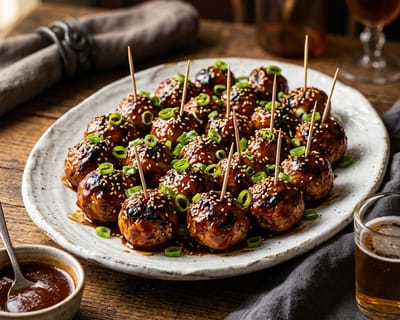
BBQ Chicken Meatballs

Tender, juicy baked ground chicken meatballs seasoned with smoked paprika, garlic, and fresh herbs, glazed in a sticky, sweet-and-tangy scratch barbecue sauce and garnished with scallions and toasted sesame seeds.
Key Takeaways
- ✓Ready in just 20 mins using straightforward, kitchen-tested technique.
- ✓Delivers 25g of muscle-fueling protein per serving for lasting satiety.
- ✓Portion-balanced at 280 calories per serving with wholesome, unrefined ingredients.
- ✓Masterclass temperature checkpoints ensure maximum tenderness and flavor development.
The Story
BBQ Chicken Meatballs represent one of the most versatile, crowd-pleasing culinary offerings in modern casual entertaining and weeknight dining. Featuring tender, seasoned ground chicken spheres lightened by a buttermilk panade, roasted to golden juiciness, and enveloped in a sticky, sweet-and-tangy scratch barbecue glaze, they bridge the gap between cocktail party finger food and satisfying dinner comfort food.
Despite their widespread popularity on game-day buffets and appetizer spreads, chicken meatballs frequently fall victim to common cooking pitfalls: dry, chalky textures caused by over-lean poultry meat; dense, rubbery spheres that resemble bouncy balls from over-mixing; or watery, runny sauces that fail to cling to the meat.
Producing tender, succulent BBQ chicken meatballs requires understanding the protein chemistry of ground poultry, the science of starch-based panades, the emulsification of aromatics, and the high-heat caramelization dynamics of sugar-rich barbecue glazes.
The Food Science of Poultry Meatballs: Fat, Protein, and Tenderness
Ground poultry behaves fundamentally differently from ground beef or pork in meatball cookery:
1. The Muscle Fiber Density Problem
Chicken muscle tissue contains delicate myofibrillar proteins with lower connective collagen than red meats.- When ground chicken is exposed to high thermal heat, the actin and myosin protein coils contract rapidly.
- Because commercial ground poultry is often ground very fine, this protein contraction forms a dense, tight mesh that expels intracellular water.
- If prepared without moisture buffers, chicken meatballs quickly turn rubbery, tough, and dry.
2. Ground Breast vs. Ground Thigh Meat
- Ground Chicken Breast (99% Lean): Extremely lean with virtually zero intramuscular fat. While popular for calorie-restricted diets, it produces meatballs that lack lubricity and tenderness.
- Ground Chicken Thigh or Dark/White Blend (90/10 or 92/8): Contains moderate amounts of natural poultry fat and collagen. As the meatballs bake, the intramuscular fat melts slowly, basting the interior meat fibers and yielding an unctuous, tender mouthfeel. For superior culinary results, always select a dark meat or mixed blend.
The Panade Advantage: Buttermilk and Panko Science
The single most effective culinary tool for ensuring moist poultry meatballs is a starch-liquid panade:
1. How a Panade Protects Moisture
A panade is a mixture of starch (such as breadcrumbs) and liquid (such as milk or buttermilk):- When panko breadcrumbs soak in buttermilk for 5 minutes, the dried wheat starches swell and hydrate, forming a soft, viscoelastic gel.
- When folded gently into the raw ground meat, this starch gel distributes between the ground muscle fibers.
- As the meatballs bake and the meat proteins contract, the gelatinized starches absorb the rendering juices and fats, trapping them inside the meatball rather than letting them leak out onto the baking sheet.
- The Result: The meatballs retain a pillowy, tender crumb that shears effortlessly under a gentle fork bite.
2. The Role of Cultured Buttermilk
Whole buttermilk introduces mild lactic acid (pH 4.4–4.8):- This mild acidity gently denatures the outer protein sheaths of the raw ground chicken, tenderizing the meat before it ever enters the oven.
- Furthermore, the slight tang of buttermilk cuts through the sweetness of the barbecue glaze, creating a balanced flavor profile.
The Mixing Rule: Gentle Incorporation vs. Sausage Emulsion
The mechanical handling of meatball mixture dictates its final density:
1. The Danger of Over-Mixing
When raw ground meat is kneaded vigorously with salt, the mechanical shear breaks down muscle cell membranes, dissolving the protein myosin into a sticky, pasty emulsion.- In sausage making, this myosin extraction is desirable to create a firm, bouncy snap.
- In meatball making, excessive myosin extraction produces heavy, dense cannonballs.
2. The Light Touch Technique
Always mix meatball ingredients with clean, lightly oiled hands or a flexible silicone spatula just until the components are evenly distributed. Stop mixing the second no dry pockets of breadcrumbs or unblended meat remain.The Chemistry of Scratch Sticky BBQ Glaze
Commercial bottled barbecue sauces are often thick with high-fructose corn syrup, artificial smoke flavoring, and sodium benzoate preservatives, leaving a syrupy, artificial aftertaste. A scratch barbecue glaze simmered on the stovetop provides clean, complex balance:
1. The Four Flavor Pillars
- Tomato Base (Umami and Body): Ketchup or tomato purée supplies natural glutamates and lycopene, giving the glaze rich red color and deep savory foundation.
- Apple Cider Vinegar (Acidic Punch): Acetic acid provides sharp brightness that balances sweet sugars and cuts through poultry fat.
- Brown Sugar and Molasses (Caramelization): Sucrose and dark blackstrap molasses supply deep caramel notes, potassium, and mineral undertones. The high sugar content creates the sticky, lacquered sheen that coats the meatballs.
- Alliums, Spices, and Mustard (Aromatic Warmth): Smoked Spanish paprika supplies authentic wood-smoke terpenes, while Dijon mustard introduces sinigrin glucosinolates that sharpen the tongue.
3. Wood Smoke Chemistry: Liquid Smoke vs. Pimentón de la Vera
While commercial barbecue sauces rely heavily on synthetic pyroligneous acid (liquid smoke), scratch barbecue glazes gain deeper, more nuanced complexity from oak-smoked pimentón de la Vera.- Spanish pimentón is slowly dried over burning Holm oak wood logs for two weeks, absorbing guaiacol and syringol smoke phenols directly into the pepper flesh before milling.
- When cooked into an acidic tomato and vinegar glaze, these natural wood phenols impart a gentle, authentic pit-smoke aroma that complements roasted poultry without producing the harsh, chemical bitterness associated with artificial smoke additives.
4. Lacquering Mechanics
Brushing the warm glaze over the meatballs during the final 4 minutes of baking exposes the sugars to dry oven heat. The sugars undergo rapid pyrolysis (caramelization), transforming from a liquid sauce into a sticky, glistening lacquer that clings firmly to the meatball surface without sliding off onto the platter.Step-by-Step Instructions
Follow these culinary steps for perfect BBQ Chicken Meatballs:
Step 1: Hydrate the Buttermilk Panade
In a large mixing bowl, combine 1 cup of panko breadcrumbs and 1/3 cup of whole buttermilk (or whole milk).Stir gently with a fork and let stand undisturbed for 5 minutes until the breadcrumbs absorb the liquid completely, forming a soft, moist starch paste.
Step 2: Add Aromatics and Seasonings
To the bowl with the hydrated panade, add 1 lightly beaten large egg, 1/3 cup of finely grated yellow onion (along with its collected juices), 3 finely grated garlic cloves, 1 tablespoon of Worcestershire sauce, 1 1/2 teaspoons of smoked Spanish paprika, 1 teaspoon of garlic powder, 1 teaspoon of onion powder, 1 teaspoon of kosher salt, 1/2 teaspoon of freshly cracked black pepper, and 2 tablespoons of finely chopped flat-leaf parsley.Whisk these ingredients thoroughly with a fork until they form a smooth, fragrant seasoning paste.
Step 3: Gently Fold in the Ground Chicken
Add 2 pounds of ground chicken (preferably 90/10 dark/white blend) into the seasoning bowl.Using clean hands or a flexible silicone spatula, fold the meat into the seasoning paste gently from the bottom up.
Mix just until the meat and panade are uniformly incorporated. Do not overwork or knead the meat. As soon as the mixture is uniform, stop.
Step 4: Portion and Roll Meatballs
Preheat your oven to 400°F (204°C) with a rack set in the upper-middle position. Line a large rimmed half-sheet baking pan with parchment paper or nonstick aluminum foil.Lightly coat your palms with olive oil or cold water to prevent sticking.
Using a 1 1/2-tablespoon cookie scoop (or measuring spoon), portion the chicken mixture into uniform 1 1/2-inch balls (about 1 ounce each).
Gently roll each portion between your palms into a smooth sphere and place on the prepared baking sheet, spacing them roughly 1 inch apart. The recipe yields approximately 28 to 32 meatballs.
Step 5: Initial High-Heat Roast
Slide the baking sheet into the preheated 400°F (204°C) oven.Bake undisturbed for 14 to 15 minutes until the meatballs are cooked through, firm to the touch, and show pale golden edges (an instant-read thermometer inserted into the center of a meatball should register 160°F / 71°C).
Step 6: Simmer the Scratch BBQ Glaze
While the meatballs bake, prepare the glaze. In a medium saucepan, combine 1 cup of ketchup, 1/3 cup of packed dark brown sugar, 1/4 cup of apple cider vinegar, 2 tablespoons of blackstrap molasses, 1 tablespoon of Worcestershire sauce, 1 tablespoon of Dijon mustard, 1 teaspoon of smoked paprika, 1/2 teaspoon of garlic powder, 1/4 teaspoon of kosher salt, and 1/4 teaspoon of cayenne pepper.Whisk over medium heat until the sugar dissolves and the sauce comes to a gentle simmer.
Cook for 5 to 6 minutes, stirring frequently, until the glaze reduces into a thick, glossy, spoon-coating consistency. Remove from the heat.
Step 7: Glaze and Caramelize
Remove the baking sheet of meatballs from the oven.Using a silicone pastry brush, generously brush every meatball with the warm BBQ glaze, coating the entire surface. (Reserve roughly 1/3 cup of glaze for serving).
Return the baking sheet to the 400°F oven for 3 to 4 minutes (or place under a low broiler for 2 to 3 minutes) until the glaze is bubbling, caramelized, and sticky.
Remove from the oven and let rest on the baking sheet for 5 minutes.
Step 8: Garnish and Serve
Transfer the warm glazed meatballs to a serving platter, shallow stoneware dish, or a warm slow cooker.Drizzle with the remaining warm BBQ glaze.
Scatter thinly sliced green onions and toasted white sesame seeds across the top. Insert cocktail toothpicks into the meatballs and serve warm.
Pro-Tips for Picture-Perfect BBQ Meatballs
- Oil Your Hands Before Rolling: Ground chicken is stickier than beef. Dipping your fingers in olive oil or cold water creates an effortless non-stick barrier that rolls smooth, round spheres.
- Use a Cookie Scoop: Using a spring-loaded cookie scoop guarantees every meatball is identical in size, ensuring they all cook through at the exact same minute.
- Grate the Onion: Never use chopped raw onion in poultry meatballs. Grating the onion on a box grater extracts sweet onion juice that bastes the interior meat while eliminating crunchy raw bits.
- Do Not Boil in Sauce from Raw: Cooking raw chicken meatballs directly in simmering sauce causes them to deform, lose their round shape, and release clouding proteins into the glaze. Always oven-roast first to set their shape before tossing in glaze.
Flavor Variations and Additions
Storage, Reheating, and Make-Ahead Instructions
These meatballs are ideal for entertaining prep and meal-prep containers:
Advance Party Prep (Slow Cooker Method)
Bake and glaze the meatballs up to 24 hours in advance. Store in an airtight container in the refrigerator. Two hours before your event, transfer the cold meatballs to a slow cooker, add 1/4 cup of extra barbecue sauce, cover, and set to "Low" for 2 hours until steaming hot (165°F), then switch to "Warm" for serving.Storing Leftovers
Store cooled meatballs in an airtight container in the refrigerator for up to 4 days.Freezing Instructions
Freeze fully baked, unglazed meatballs on a parchment-lined baking sheet for 2 hours until solid, then transfer to a freezer zip-top bag for up to 3 months. To serve, thaw overnight in the refrigerator, toss with warm barbecue sauce, and bake at 350°F (175°C) for 10 to 12 minutes.Reheating
- Oven/Toaster Oven: Place on a baking sheet, cover loosely with foil, and heat at 350°F (175°C) for 8 to 10 minutes.
- Stovetop: Warm in a nonstick skillet with a splash of water and extra barbecue sauce over medium-low heat, rolling gently for 5 minutes.
Sommelier & Craft Beverage Pairings
The sweet, smoky, and tangy barbecue profile calls for beverages with fruit richness, crisp carbonation, or light hop bitterness:
- Medium-Bodied Red Wine (Zinfandel or Grenache): A California Zinfandel features ripe blackberry and black pepper notes that echo the molasses and black pepper in the barbecue sauce without overpowering the tender chicken.
- Off-Dry Riesling or Gewürztraminer: A white wine with subtle residual sugar and high natural acidity complements the sweet-tangy glaze while quenching any cayenne warmth.
- Craft Beer (American Pale Ale or Amber Ale): The citrusy hop bitterness of an American Pale Ale cuts through the sticky barbecue sugars, while an Amber Ale mirrors the caramelized brown sugar and smoked paprika.
- Non-Alcoholic Options: Chilled ginger beer with fresh lime juice, sweet iced black tea with lemon wheels, or a sparkling apple cider spritzer.
Troubleshooting Common Meatball Problems
1. The Meatballs Are Dry, Tough, and Dense
- The Cause: 99% lean white breast meat was used without enough fat, the panade was skipped, or the meat was over-mixed.
- The Solution: Use 90/10 ground chicken thigh or mixed blend. Always include the buttermilk and panko panade. Fold the ingredients gently just until combined.
2. The Meatballs Flattened into Discs on the Baking Sheet
- The Cause: The mixture was too wet or slack, or the oven was not hot enough to set the exterior quickly.
- The Solution: Ensure breadcrumbs fully hydrate and absorb the liquid before adding meat. Bake on the upper-middle rack at a solid 400°F (204°C); high ambient heat sets the outer proteins immediately, preserving their spherical shape.
3. The Glaze Burned and Turned Bitter
- The Cause: The glaze was brushed on at the start of baking and exposed to 400°F heat for 18 minutes.
- The Solution: Bake meatballs plain for 14 minutes. Brush on the sugar-rich glaze only for the final 3 to 4 minutes of cooking.
Nutritional Breakdown and Macro Profile
Per serving (serving size: 4 meatballs with generous glaze, recipe makes 8 servings of 4 meatballs each):
| Nutrient | Amount per Serving | % Daily Value |
|---|---|---|
| Calories | 280 kcal | — |
| Total Fat | 10 g | 13% |
| Saturated Fat | 2.5 g | 13% |
| Cholesterol | 95 mg | 32% |
| Sodium | 640 mg | 28% |
| Total Carbohydrates | 22 g | 8% |
| Dietary Fiber | 1 g | 4% |
| Total Sugars | 15 g | — |
| Protein | 25 g | 50% |
| Potassium | 420 mg | 9% |
| Calcium | 65 mg | 5% |
| Iron | 1.8 mg | 10% |
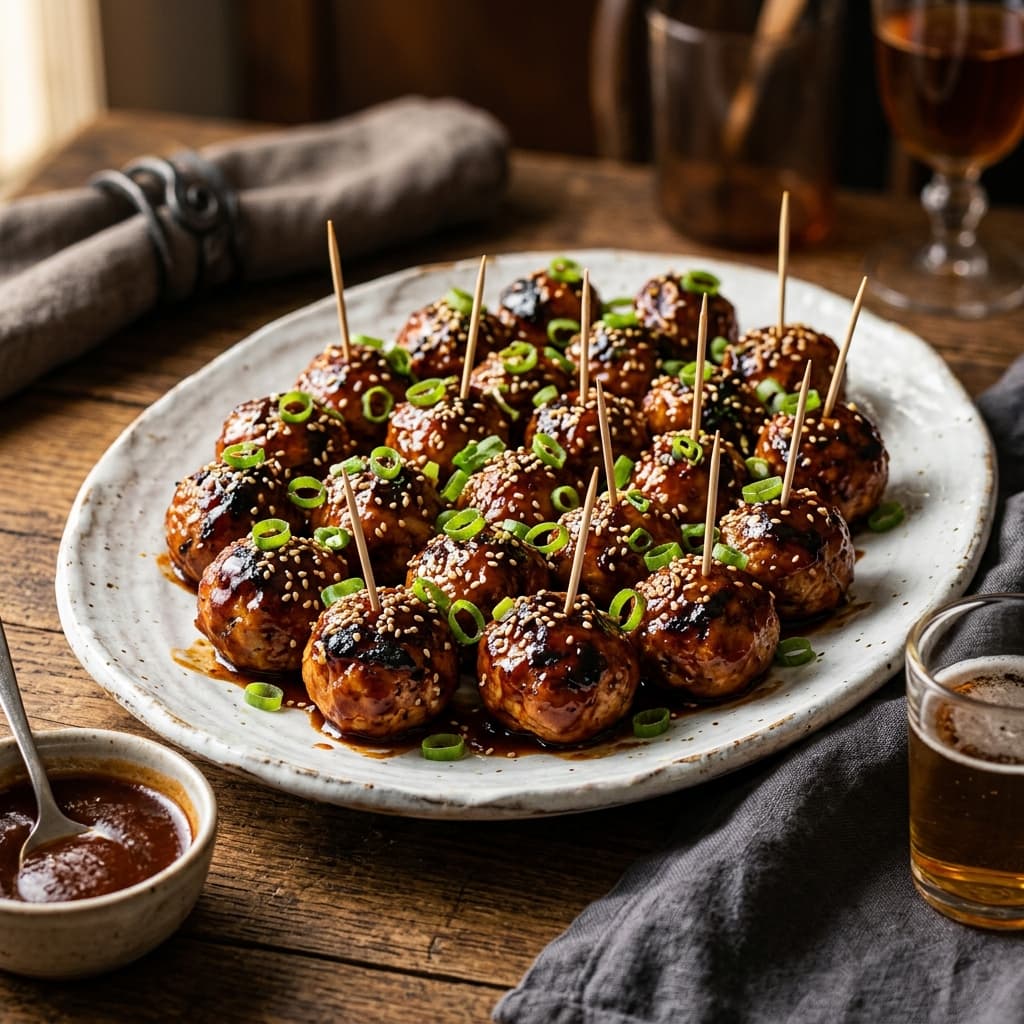
BBQ Chicken Meatballs
Tender, juicy baked ground chicken meatballs seasoned with smoked paprika, garlic, and fresh herbs, glazed in a sticky, sweet-and-tangy scratch barbecue sauce and garnished with scallions and toasted sesame seeds.
Macro Nutrition Profile (Per Serving)
Ingredients
Tender Chicken Meatball Base
Scratch Sticky Sweet-and-Tangy BBQ Glaze
Garnishes & Finishing
Ingredient Substitutions
| Original Ingredient | Healthy Alternative |
|---|---|
| Chicken breast | Turkey breast or extra-firm tofu (1:1 ratio) |
| Dino kale/greens | Baby spinach or Swiss chard (cooks faster, add at the end) |
Instructions
Hydrate the Buttermilk Panade: In a large mixing bowl, combine 1 cup of panko breadcrumbs and 1/3 cup of whole buttermilk (or whole milk). Stir gently with a fork and let stand undisturbed for 5 minutes until the breadcrumbs absorb the liquid completely, forming a soft, moist starch paste.
Add Aromatics and Seasonings: To the bowl with the hydrated panade, add 1 lightly beaten large egg, 1/3 cup of finely grated yellow onion (along with its collected juices), 3 finely grated garlic cloves, 1 tablespoon of Worcestershire sauce, 1 1/2 teaspoons of smoked Spanish paprika, 1 teaspoon of garlic powder, 1 teaspoon of onion powder, 1 teaspoon of kosher salt, 1/2 teaspoon of freshly cracked black pepper, and 2 tablespoons of finely chopped flat-leaf parsley. Whisk these ingredients thoroughly with a fork until they form a smooth, fragrant seasoning paste.
Gently Fold in the Ground Chicken: Add 2 pounds of ground chicken (preferably 90/10 dark/white blend) into the seasoning bowl. Using clean hands or a flexible silicone spatula, fold the meat into the seasoning paste gently from the bottom up. Mix just until the meat and panade are uniformly incorporated. Do not overwork or knead the meat. As soon as the mixture is uniform, stop.
Portion and Roll Meatballs: Preheat your oven to 400°F (204°C) with a rack set in the upper-middle position. Line a large rimmed half-sheet baking pan with parchment paper or nonstick aluminum foil. Lightly coat your palms with olive oil or cold water to prevent sticking. Using a 1 1/2-tablespoon cookie scoop (or measuring spoon), portion the chicken mixture into uniform 1 1/2-inch balls (about 1 ounce each). Gently roll each portion between your palms into a smooth sphere and place on the prepared baking sheet, spacing them roughly 1 inch apart. The recipe yields approximately 28 to 32 meatballs.
Initial High-Heat Roast: Slide the baking sheet into the preheated 400°F (204°C) oven. Bake undisturbed for 14 to 15 minutes until the meatballs are cooked through, firm to the touch, and show pale golden edges (an instant-read thermometer inserted into the center of a meatball should register 160°F / 71°C).
Simmer the Scratch BBQ Glaze: While the meatballs bake, prepare the glaze. In a medium saucepan, combine 1 cup of ketchup, 1/3 cup of packed dark brown sugar, 1/4 cup of apple cider vinegar, 2 tablespoons of blackstrap molasses, 1 tablespoon of Worcestershire sauce, 1 tablespoon of Dijon mustard, 1 teaspoon of smoked paprika, 1/2 teaspoon of garlic powder, 1/4 teaspoon of kosher salt, and 1/4 teaspoon of cayenne pepper. Whisk over medium heat until the sugar dissolves and the sauce comes to a gentle simmer. Cook for 5 to 6 minutes, stirring frequently, until the glaze reduces into a thick, glossy, spoon-coating consistency. Remove from the heat.
Glaze and Caramelize: Remove the baking sheet of meatballs from the oven. Using a silicone pastry brush, generously brush every meatball with the warm BBQ glaze, coating the entire surface. (Reserve roughly 1/3 cup of glaze for serving). Return the baking sheet to the 400°F oven for 3 to 4 minutes (or place under a low broiler for 2 to 3 minutes) until the glaze is bubbling, caramelized, and sticky. Remove from the oven and let rest on the baking sheet for 5 minutes.
Garnish and Serve: Transfer the warm glazed meatballs to a serving platter, shallow stoneware dish, or a warm slow cooker. Drizzle with the remaining warm BBQ glaze. Scatter thinly sliced green onions and toasted white sesame seeds across the top. Insert cocktail toothpicks into the meatballs and serve warm.
The Spicy Honey-Sriracha BBQ Glaze: Add 2 tablespoons of Sriracha chili sauce and 2 tablespoons of clover honey to the barbecue glaze. Garnish with fresh cilantro leaves and thinly sliced red jalapeños for bold sweet-heat contrast.
The Cheddar-Stuffed BBQ Meatball: Cut sharp cheddar cheese into 1/2-inch cubes. Enclose one cheddar cube in the center of each raw chicken meatball before rolling, ensuring the meat completely seals the cheese inside. As they bake, the cheese melts into a molten core.
The Pineapple Teriyaki BBQ Twist: Replace half of the apple cider vinegar with 100% pure pineapple juice. Add 1 teaspoon of finely grated fresh ginger to the meatball mixture.
The Meatballs Are Dry, Tough, and Dense: The Cause: 99% lean white breast meat was used without enough fat, the panade was skipped, or the meat was over-mixed. The Solution: Use 90/10 ground chicken thigh or mixed blend. Always include the buttermilk and panko panade. Fold the ingredients gently just until combined.
The Meatballs Flattened into Discs on the Baking Sheet: The Cause: The mixture was too wet or slack, or the oven was not hot enough to set the exterior quickly. The Solution: Ensure breadcrumbs fully hydrate and absorb the liquid before adding meat. Bake on the upper-middle rack at a solid 400°F (204°C); high ambient heat sets the outer proteins immediately, preserving their spherical shape.
The Glaze Burned and Turned Bitter: The Cause: The glaze was brushed on at the start of baking and exposed to 400°F heat for 18 minutes. The Solution: Bake meatballs plain for 14 minutes. Brush on the sugar-rich glaze only for the final 3 to 4 minutes of cooking.
Tried this recipe?
Let us know how it turned out! Click a star below to leave a review and rate the recipe.
Storage & Freezing Tips
- Refrigerator: Store in an airtight container for up to 2 days. Keep the components separate if possible to preserve texture.
- Reheating: Reheat gently in a skillet on medium-low heat with a splash of olive oil or butter.
- Freezing: Freezing is not recommended for this dish because ingredients like eggs become soggy, rubbery, or mushy when defrosted.
Frequently Asked Questions
Can this recipe be prepared ahead of time?▼
Yes, this meal is excellent for weekly meal prep. Store components separately and assemble before serving.
Is this recipe gluten-free?▼
All ingredients used are naturally gluten-free. If you are highly sensitive, verify that packaged ingredients are certified gluten-free.
Tried this recipe?
Tag @stewartlucas on Instagram and hashtag it #nutriguide!
You Might Also Like
Stewart Lucas
Chief Culinary SpecialistStewart Lucas is the Chief Culinary Specialist and lead recipe developer representing the NutriGuide team. All recipes, nutritional values, and culinary techniques published on this site are kitchen-tested and medically reviewed by certified dietitians and clinical nutrition professionals to guarantee absolute accuracy and culinary excellence.
Community Reviews
Please log in to leave a review.