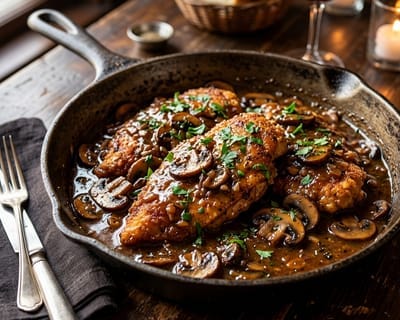
Classic Chicken Marsala (Velvety Mushroom Pan Sauce Masterclass)
The authoritative culinary masterclass for classic Chicken Marsala. Learn the science of pan-dredging cutlets, caramelizing cremini mushrooms, and mounting cold butter (monter au beurre) into a glossy Sicilian wine reduction.
Key Takeaways
- ✓Pound chicken cutlets to a uniform 1/4-inch thickness so they sear in 3 minutes without drying out.
- ✓Brown sliced cremini mushrooms in a dry, uncrowded pan before adding butter to prevent soggy steaming.
- ✓Deglaze the skillet with authentic Sicilian dry Marsala wine, reducing by half to concentrate sugars and umami.
- ✓Swirl in cold butter off the heat (monter au beurre) to create an emulsified, restaurant-glossy pan sauce.
The Story
Chicken Marsala is a celebrated triumph of Sicilian-French culinary fusion that originated in western Sicily during the early 19th century. Marsala wine, a fortified wine produced in the sun-drenched coastal vineyards surrounding the city of Marsala, was originally popularized internationally by English merchant John Woodhouse in 1773 as an alternative to Port and Sherry. Sicilian home cooks and French chefs in the royal Bourbon courts of Naples began incorporating this complex fortified wine into pan sauces for braising wild game and scaloppine.
When Italian immigrants brought the recipe to the United States during the great migration of the early 20th century, Chicken Marsala quickly became a quintessential centerpiece of Italian-American red-sauce trattorias from New York’s Little Italy to Chicago and San Francisco.
Yet, in contemporary home kitchens and lower-tier restaurants, Chicken Marsala is frequently bastardized: thick, rubbery chicken breasts swimming in a watery, overly sweet syrup thickened with cornstarch, drowned in rubbery canned mushrooms.
This masterclass restores Chicken Marsala to its rightful fine-dining glory. By mastering the scaloppine technique, thermal mushroom caramelization, fond deglazing, and the classical French technique of monter au beurre (mounting with cold butter), you will produce tender, fork-cuttable chicken cutlets cloaked in a deeply savory, mahogany-hued mushroom wine reduction worthy of the finest bistros in Palermo.
The Science of Flavor Chemistry & Thermal Dynamics
The magic of a world-class pan sauce lies in four interconnected biochemical transformations:
1. The Starch Dredge & Gelatinization Barrier
Dredging the pounded chicken cutlets in seasoned flour serves two vital thermodynamic purposes:- Moisture Barrier: The flour absorbs surface moisture from the raw cutlet, preventing water droplets from violently exploding when hitting hot oil. As the cutlet fries, the starch gelatinizes and dehydrates, forming an ultra-thin, golden crust that seals internal chicken juices.
- Sauce Thickener: As the chicken sears, micro-particles of toasted flour and browned protein adhere to the bottom of the pan as fond. Later, when wine and broth are poured in, the gelatinized amylose starches dissolve into the simmering liquid, naturally thickening the sauce without requiring a heavy cornstarch slurry.
2. Cremini Mushroom Desiccation & Maillard Browning
Fresh mushrooms are approximately 90% water. If you crowd cold, wet mushrooms into a pan with butter and salt, the salt draws out cell water immediately, causing the mushrooms to boil and steam in their own puddle. They turn gray, spongy, and limp. In this masterclass, we sear the mushrooms in hot oil over medium-high heat with ample pan spacing and zero salt for the first 3 minutes. The surface moisture vaporizes instantly, allowing the temperature to climb past 300°F (150°C), triggering the Maillard reaction. Once deep golden browning occurs, we add butter, shallots, and salt, unlocking profound earthy umami.3. Fond Extraction & Fortified Wine Reduction
As the chicken sears, amino acids and sugars caramelize on the stainless steel or cast iron surface to create the fond. Deglazing with dry Marsala wine dissolves these deeply savory pyrazines and glutamate complexes. Marsala is rich in natural grape sugars, tartaric acid, and complex esters aged in wood casks. Reducing the wine by 50% evaporates the harsh ethanol alcohol while concentrating the sweet, nutty, and savory notes. Adding rich chicken bone broth introduces natural gelatin, which lends luxurious body and mouth-coating viscosity.4. Monter au Beurre: The Physics of Cold Butter Emulsion
The hallmark of an elite sauce is its glossy sheen and velvety body. This is achieved through the classical French technique of monter au beurre. At the very end of cooking, the pan is removed from active heat, and 1 tablespoon of refrigerator-cold unsalted butter is vigorously swirled into the hot reduction. Because the butter is cold, the milk fat globules melt slowly into the water-based wine reduction, while the natural milk proteins (casein) act as an emulsifier, binding the fat and water into a unified, silky suspension that never breaks or turns greasy.Anatomy of the Ingredients & Artisanal Sourcing
To achieve genuine trattoria excellence, source ingredients with an uncompromising standard:
- The Chicken Scaloppine: Use premium organic, air-chilled chicken breast. Air-chilled poultry contains zero retained chlorinated water, allowing the flour dredge to adhere tightly and fry to a crisp amber hue. Pounding the breasts between sheets of plastic wrap to a uniform 1/4-inch thickness breaks down tough muscle fibers and ensures lightning-fast 3-minute searing.
- The Marsala Wine Selection (Dry vs Sweet): This is the single most critical decision in the recipe. Always choose Dry Marsala (Marsala Secco) bearing the DOC seal from Sicily. Never, under any circumstances, use supermarket "cooking wine," which is stripped of natural wine flavors, loaded with excessive sodium (often over 800mg per cup), and chemically preserved with potassium sorbate. Dry Marsala delivers nutty oak and dried fruit complexity without turning cloying.
- The Mushrooms: Cremini (Baby Bella) mushrooms are vastly superior to common white button mushrooms. Cremini mushrooms have a firmer cell wall structure, lower water content, and higher concentrations of glutamic acid, delivering an earthy, woodsy savoriness.
- Bone Broth vs Canned Broth: Use rich, gelatin-packed chicken bone broth. Gelatin is the secret ingredient that gives restaurant sauces that luxurious, lip-smacking viscosity without relying on heavy cream or flour pastes.
Step-by-Step Culinary Masterclass
Step 1: Scaloppine Bisection & Pounding
Lay chicken breasts flat on a sturdy cutting board. Place one hand flat on top and, using a sharp boning or chef's knife, slice horizontally through the center to create 2 even cutlets from each breast (4 cutlets total). Place cutlets between two sheets of heavy plastic wrap. Using the flat side of a meat mallet, gently pound from the center outward until each cutlet is a uniform 1/4-inch thickness throughout.
- Chef's Technique Tip: Uniform thickness is essential; uneven cutlets result in thin edges overcooking into leather while thick centers remain raw.
- Sensory Checkpoint: Four wide, flat cutlets of identical 1/4-inch thickness with smooth, un-torn muscle fibers.
Step 2: Seasoned Flour Dredge Protocol
In a shallow pie dish, whisk together 1/2 cup all-purpose flour, 1 tsp salt, 1/2 tsp black pepper, and 1/2 tsp garlic powder. Pat each chicken cutlet dry with paper towels. Dredge each cutlet in the flour mixture, pressing gently to coat both sides. Lift the cutlet and shake vigorously to dislodge all excess loose flour. Place on a wire rack.
- Chef's Technique Tip: Excess loose flour falls off into the hot skillet, burns into black bitter flecks, and ruins your pan sauce.
- Sensory Checkpoint: A sheer, chalky micro-veil of seasoned flour adhering to the chicken with zero clumping.
Step 3: The High-Heat Cutlet Sear
Heat 2 tbsp olive oil and 1 tbsp butter in a 12-inch heavy stainless steel or cast iron skillet over medium-high heat until the butter stops foaming and begins to shimmer. Lay cutlets into the hot oil away from you. Sear undisturbed for 3 minutes until deep golden brown. Flip and sear the second side for 2 to 3 minutes until cooked through (160°F internal). Transfer cutlets to a warm plate and tent loosely with foil.
- Chef's Technique Tip: Do not crowd the skillet! If your pan cannot comfortably hold all 4 cutlets without touching, sear in two batches with fresh oil.
- Sensory Checkpoint: A shimmering, golden-amber crust on both sides with rich, caramelized fond adhering to the bottom of the skillet.
Step 4: Dry Mushroom Searing (Maillard Activation)
Wipe excess oil from the skillet if necessary, leaving 1 tbsp of fat and the browned fond. Increase heat to medium-high. Add the sliced cremini mushrooms in an even layer. Let cook completely undisturbed for 3 minutes without stirring or salting. Once the bottoms are caramelized and browned, toss and cook 2 more minutes until browned on both sides.
- Chef's Technique Tip: Resist the urge to stir! Mushrooms only brown when left in continuous thermal contact with the hot metal.
- Sensory Checkpoint: Deep mahogany-brown mushroom slices with crisp edges and an intense, earthy aroma.
Step 5: Aromatic Sweating (Shallots & Garlic)
Push the browned mushrooms to the perimeter of the skillet. Add 1 tbsp butter, minced shallot, and minced garlic into the center of the pan. Sauté over medium heat for 60 to 90 seconds, stirring continuously, until the shallots are translucent and fragrant. Stir the mushrooms back into the aromatics.
- Chef's Technique Tip: Garlic burns in 30 seconds at high heat; keep it moving and immediately proceed to deglazing once fragrant.
- Sensory Checkpoint: A heavenly, savory aroma of sweet roasted garlic, shallots, butter, and earthy mushrooms.
Step 6: The Deglazing & Marsala Reduction
Pour 3/4 cup Dry Marsala wine into the skillet. It will boil vigorously upon contact. Use a flat wooden spatula to scrape the bottom of the pan, loosening and dissolving every scrap of caramelized fond into the wine. Simmer vigorously for 4 to 5 minutes over medium-high heat until the wine reduces by half and thickens slightly.
- Chef's Technique Tip: Scraping the fond into the wine is where 80% of the sauce's complex flavor originates.
- Sensory Checkpoint: The wine transforms into a fragrant, syrupy dark-amber reduction with fine bubbling foam.
Step 7: Broth Integration & Viscosity Simmer
Pour in 3/4 cup rich chicken bone broth and add 2 sprigs of fresh thyme. Bring back to a gentle simmer. Cook for 4 to 5 minutes, allowing the liquid to reduce until it coats the back of a spoon (nappe consistency). Season with a pinch of sea salt, black pepper, and 1 tsp fresh lemon juice.
- Chef's Technique Tip: A teaspoon of fresh lemon juice cuts through the rich wine sugars and balances the savory broth.
- Sensory Checkpoint: A glossy, velvety brown sauce that holds a clean line when you swipe your finger across the back of a coated spoon.
Step 8: Monter au Beurre (The Emulsification Swirl)
Turn off the heat completely and remove the pan from the burner. Remove the thyme sprigs. Drop 1 tablespoon of refrigerator-cold butter into the center of the hot sauce. Swirl the skillet gently in a circular motion while whisking with a silicone spatula until the butter completely melts and disappears into the sauce.
- Chef's Technique Tip: Never boil the sauce after adding cold butter; high heat will break the emulsion, separating the butter into clear oil.
- Sensory Checkpoint: The sauce turns from translucent to opaque, gaining a luxurious, mirror-like restaurant sheen.
Step 9: Reintegration & Cutlet Basting
Return the rested chicken cutlets and any accumulated savory juices from the resting plate back into the skillet. Spoon the rich mushroom Marsala sauce generously over the top of each cutlet. Let the chicken warm through in the sauce off the heat for 90 seconds.
- Chef's Technique Tip: Pouring the resting juices back into the pan adds concentrated savory flavor to the sauce.
- Sensory Checkpoint: Glistening, golden chicken cutlets thoroughly enrobed in velvet mushroom sauce.
Step 10: Plating & Garnishing Architecture
Transfer cutlets onto warm dinner plates or a shallow serving platter. Ladle generous mounds of caramelized cremini mushrooms and glossy Marsala sauce over each piece. Garnish with a vibrant shower of freshly chopped Italian flat-leaf parsley. Serve immediately.
- Chef's Technique Tip: Warm your serving plates in a 150°F oven for 5 minutes prior to service to keep the delicate butter sauce silky.
- Sensory Checkpoint: An exquisite, cinematic presentation of mahogany mushrooms, golden scaloppine, and emerald herbs.
Pro-Chef Troubleshooting & Critical Checkpoints
Problem: The Sauce is Too Sweet and Syrupy
- The Root Cause: Sweet Marsala wine was used instead of Dry Marsala, or cheap cooking wine with high added sugar was used.
- The Masterclass Solution: Always verify the bottle says 'Marsala Secco' (Dry). If your sauce turns out too sweet, add 1 to 2 tsp fresh lemon juice or a splash of dry white wine to restore acid balance.
Problem: The Sauce Separated into an Oily Layer
- The Root Cause: The sauce was boiled aggressively after adding the finishing butter, or cold broth was dumped into hot oil.
- The Masterclass Solution: Remove pan from heat before swirling in cold butter (monter au beurre). If broken, whisk in 1 tablespoon of cold water or cream vigorously off the heat to re-emulsify.
Problem: Chicken Turned Tough and Dry
- The Root Cause: Cutlets were sliced too thick, not pounded, or overcooked past 165°F.
- The Masterclass Solution: Pound cutlets to 1/4-inch thickness and sear for only 3 minutes per side. Chicken cutlets cook exceptionally fast.
Problem: Mushrooms Turned Out Rubberwood Spongy and Wet
- The Root Cause: Mushrooms were washed under running water, salted too early, or crowded in a small skillet.
- The Masterclass Solution: Wipe mushrooms clean with a damp towel rather than soaking, sear in an uncrowded pan over medium-high heat, and never salt during the first 3 minutes.
Macro Analysis & Nutritional Optimization
Chicken Marsala provides an exceptional blend of lean macronutrients and powerful botanical micronutrients:
- 44 Grams of Lean Protein: Pounded chicken breast cutlets provide pure, low-fat animal protein containing complete branched-chain amino acids (BCAAs) that accelerate metabolic rate and support muscular recovery.
- Ergothioneine & Beta-Glucans from Cremini Mushrooms: Cremini mushrooms are one of nature's densest sources of ergothioneine, a unique cellular antioxidant that protects mitochondrial membranes against oxidative decay. They also provide immune-modulating beta-glucan polysaccharides.
- Collagen Support via Bone Broth: Simmering with rich gelatinous chicken bone broth infuses the sauce with glycine and proline, amino acids vital for joint connective tissue and gut mucosal integrity.
- Controlled Calories & Moderate Carbs: Delivering trattoria decadence at only 520 kcal and 18g total carbohydrates per generous portion.
- Dietary Variations: Easily adapted to 100% Gluten-Free by dredging with 1:1 gluten-free baking flour (like King Arthur or Bob's Red Mill) or arrowroot starch.
Artisanal Serving & Pairing Architecture
Complement the rich, complex wood-and-grape notes of Marsala pan sauce with classical Italian trattoria pairings:
- Starch Platforms:
- Green Vegetables: Sautéed broccolini with garlic and chili flakes, or roasted asparagus spears with shaved Parmigiano-Reggiano.
- Sommelier Wine Pairings:
Scientific Storage, Meal Prep & Reheating Protocol
Chicken Marsala can be stored and reheated while preserving its silky sauce and tender poultry texture:
- Refrigeration: Place cooled cutlets and mushroom sauce into a shallow airtight glass container. Keep refrigerated for up to 3 to 4 days.
- Freezer Guidelines: Freeze for up to 2 months. Thaw overnight in the refrigerator before reheating.
- The Masterclass Reheating Technique (Low & Slow Pan Warm):
Frequently Asked Questions (Masterclass Edition)
Q: Can I substitute white wine for Marsala wine?
A: No. White wine produces Chicken Piccata or Francese, not Chicken Marsala. Marsala is a unique fortified wine aged in solera barrels, imparting distinct caramel, dried fruit, and oak notes. If Marsala is unavailable, the closest substitute is a blend of dry Madeira wine or dry Sherry with a splash of sweet port.Q: Can I make this with chicken thighs instead of breasts?
A: Yes! Boneless, skinless chicken thighs make an extraordinarily juicy, flavorful Marsala. Pound thighs lightly to an even 1/2-inch thickness and sear for 4 to 5 minutes per side until 175°F internal temperature.Q: Do I need to add heavy cream to Chicken Marsala?
A: Traditional authentic Sicilian Chicken Marsala contains zero heavy cream! The luxurious, creamy texture comes exclusively from the gelatinous stock, reduction, and the cold butter mounted at the end (monter au beurre). If you prefer an Americanized creamy version, stir in 1/4 cup heavy cream along with the broth.Q: Why did my flour coating get gummy and fall off?
A: The chicken cutlets were not patted dry before dredging, or too much loose flour was left on the meat. Pat dry, dredge, and shake off all excess flour before searing in a very hot skillet.Q: Can I use different varieties of mushrooms?
A: Absolutely. A blend of Cremini, Shiitake, Oyster, and Chanterelle mushrooms elevates this dish into an unforgettable wild-mushroom culinary masterclass.Classic Chicken Marsala (Velvety Mushroom Pan Sauce Masterclass)
The authoritative culinary masterclass for classic Chicken Marsala. Learn the science of pan-dredging cutlets, caramelizing cremini mushrooms, and mounting cold butter (monter au beurre) into a glossy Sicilian wine reduction.
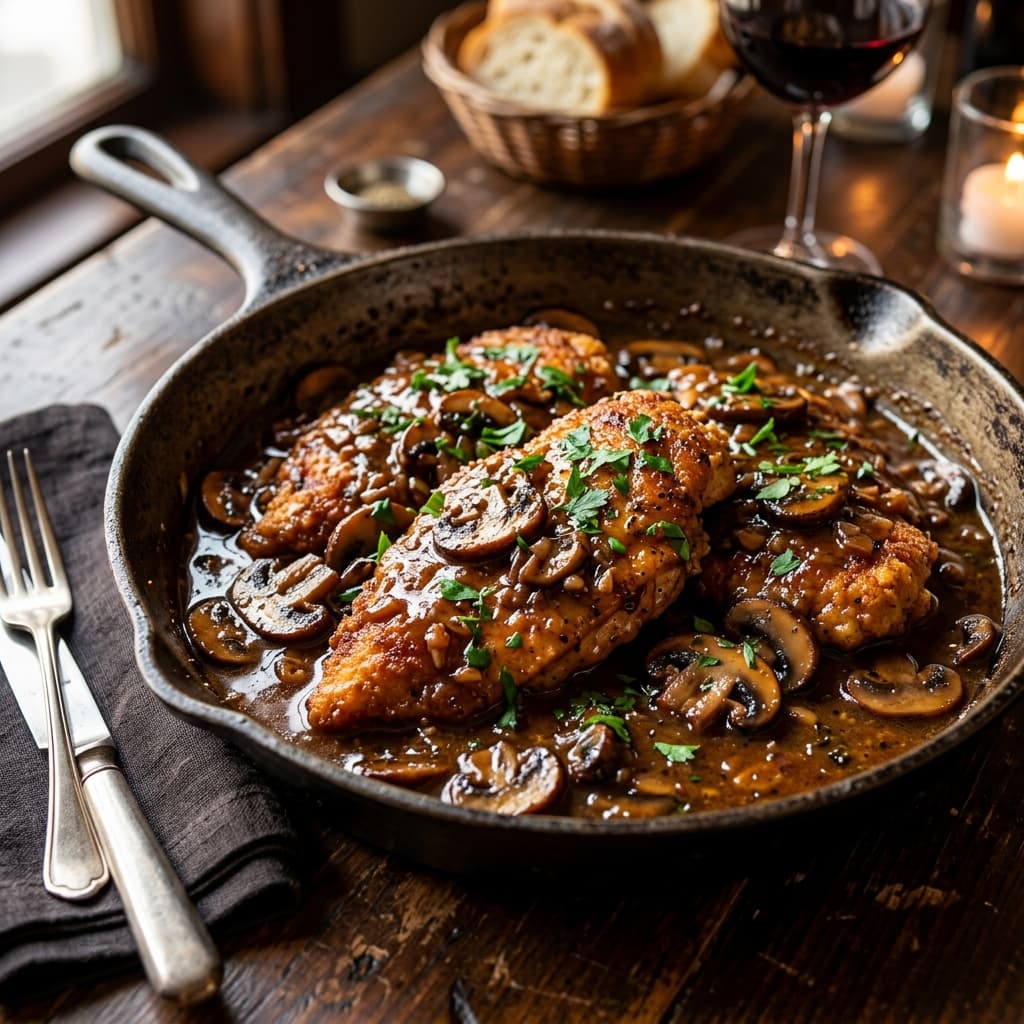
Macro Nutrition Profile (Per Serving)
Ingredients
Ingredient Substitutions
| Original Ingredient | Healthy Alternative |
|---|---|
| Chicken breast | Turkey breast or extra-firm tofu (1:1 ratio) |
| Dino kale/greens | Baby spinach or Swiss chard (cooks faster, add at the end) |
Instructions
Scaloppine Bisection & Pounding: Lay chicken breasts flat on a sturdy cutting board. Place one hand flat on top and, using a sharp boning or chef's knife, slice horizontally through the center to create 2 even cutlets from each breast (4 cutlets total). Place cutlets between two sheets of heavy plastic wrap. Using the flat side of a meat mallet, gently pound from the center outward until each cutlet is a uniform 1/4-inch thickness throughout. Chef's Technique Tip: Uniform thickness is essential; uneven cutlets result in thin edges overcooking into leather while thick centers remain raw. Sensory Checkpoint: Four wide, flat cutlets of identical 1/4-inch thickness with smooth, un-torn muscle fibers.
Seasoned Flour Dredge Protocol: In a shallow pie dish, whisk together 1/2 cup all-purpose flour, 1 tsp salt, 1/2 tsp black pepper, and 1/2 tsp garlic powder. Pat each chicken cutlet dry with paper towels. Dredge each cutlet in the flour mixture, pressing gently to coat both sides. Lift the cutlet and shake vigorously to dislodge all excess loose flour. Place on a wire rack. Chef's Technique Tip: Excess loose flour falls off into the hot skillet, burns into black bitter flecks, and ruins your pan sauce. Sensory Checkpoint: A sheer, chalky micro-veil of seasoned flour adhering to the chicken with zero clumping.
The High-Heat Cutlet Sear: Heat 2 tbsp olive oil and 1 tbsp butter in a 12-inch heavy stainless steel or cast iron skillet over medium-high heat until the butter stops foaming and begins to shimmer. Lay cutlets into the hot oil away from you. Sear undisturbed for 3 minutes until deep golden brown. Flip and sear the second side for 2 to 3 minutes until cooked through (160°F internal). Transfer cutlets to a warm plate and tent loosely with foil. Chef's Technique Tip: Do not crowd the skillet! If your pan cannot comfortably hold all 4 cutlets without touching, sear in two batches with fresh oil. Sensory Checkpoint: A shimmering, golden-amber crust on both sides with rich, caramelized fond adhering to the bottom of the skillet.
Dry Mushroom Searing (Maillard Activation): Wipe excess oil from the skillet if necessary, leaving 1 tbsp of fat and the browned fond. Increase heat to medium-high. Add the sliced cremini mushrooms in an even layer. Let cook completely undisturbed for 3 minutes without stirring or salting. Once the bottoms are caramelized and browned, toss and cook 2 more minutes until browned on both sides. Chef's Technique Tip: Resist the urge to stir! Mushrooms only brown when left in continuous thermal contact with the hot metal. Sensory Checkpoint: Deep mahogany-brown mushroom slices with crisp edges and an intense, earthy aroma.
Aromatic Sweating (Shallots & Garlic): Push the browned mushrooms to the perimeter of the skillet. Add 1 tbsp butter, minced shallot, and minced garlic into the center of the pan. Sauté over medium heat for 60 to 90 seconds, stirring continuously, until the shallots are translucent and fragrant. Stir the mushrooms back into the aromatics. Chef's Technique Tip: Garlic burns in 30 seconds at high heat; keep it moving and immediately proceed to deglazing once fragrant. Sensory Checkpoint: A heavenly, savory aroma of sweet roasted garlic, shallots, butter, and earthy mushrooms.
The Deglazing & Marsala Reduction: Pour 3/4 cup Dry Marsala wine into the skillet. It will boil vigorously upon contact. Use a flat wooden spatula to scrape the bottom of the pan, loosening and dissolving every scrap of caramelized fond into the wine. Simmer vigorously for 4 to 5 minutes over medium-high heat until the wine reduces by half and thickens slightly. Chef's Technique Tip: Scraping the fond into the wine is where 80% of the sauce's complex flavor originates. Sensory Checkpoint: The wine transforms into a fragrant, syrupy dark-amber reduction with fine bubbling foam.
Broth Integration & Viscosity Simmer: Pour in 3/4 cup rich chicken bone broth and add 2 sprigs of fresh thyme. Bring back to a gentle simmer. Cook for 4 to 5 minutes, allowing the liquid to reduce until it coats the back of a spoon (nappe consistency). Season with a pinch of sea salt, black pepper, and 1 tsp fresh lemon juice. Chef's Technique Tip: A teaspoon of fresh lemon juice cuts through the rich wine sugars and balances the savory broth. Sensory Checkpoint: A glossy, velvety brown sauce that holds a clean line when you swipe your finger across the back of a coated spoon.
Monter au Beurre (The Emulsification Swirl): Turn off the heat completely and remove the pan from the burner. Remove the thyme sprigs. Drop 1 tablespoon of refrigerator-cold butter into the center of the hot sauce. Swirl the skillet gently in a circular motion while whisking with a silicone spatula until the butter completely melts and disappears into the sauce. Chef's Technique Tip: Never boil the sauce after adding cold butter; high heat will break the emulsion, separating the butter into clear oil. Sensory Checkpoint: The sauce turns from translucent to opaque, gaining a luxurious, mirror-like restaurant sheen.
Reintegration & Cutlet Basting: Return the rested chicken cutlets and any accumulated savory juices from the resting plate back into the skillet. Spoon the rich mushroom Marsala sauce generously over the top of each cutlet. Let the chicken warm through in the sauce off the heat for 90 seconds. Chef's Technique Tip: Pouring the resting juices back into the pan adds concentrated savory flavor to the sauce. Sensory Checkpoint: Glistening, golden chicken cutlets thoroughly enrobed in velvet mushroom sauce.
Plating & Garnishing Architecture: Transfer cutlets onto warm dinner plates or a shallow serving platter. Ladle generous mounds of caramelized cremini mushrooms and glossy Marsala sauce over each piece. Garnish with a vibrant shower of freshly chopped Italian flat-leaf parsley. Serve immediately. Chef's Technique Tip: Warm your serving plates in a 150°F oven for 5 minutes prior to service to keep the delicate butter sauce silky. Sensory Checkpoint: An exquisite, cinematic presentation of mahogany mushrooms, golden scaloppine, and emerald herbs.
Tried this recipe?
Let us know how it turned out! Click a star below to leave a review and rate the recipe.
Storage & Freezing Tips
- Refrigerator: Store leftovers in an airtight container for up to 3-4 days.
- Reheating: Heat in a saucepan or skillet on medium heat until hot throughout.
- Freezing: Freeze portions in airtight containers for up to 2 months. Reheat directly from frozen or after thawing.
Frequently Asked Questions
Can this recipe be prepared ahead of time?▼
Yes, this meal is excellent for weekly meal prep. Store components separately and assemble before serving.
Is this recipe gluten-free?▼
All ingredients used are naturally gluten-free. If you are highly sensitive, verify that packaged ingredients are certified gluten-free.
Tried this recipe?
Tag @stewartlucas on Instagram and hashtag it #nutriguide!
You Might Also Like

Stewart Lucas
Nutritionist & Recipe DeveloperStewart Lucas is a nutritionist and recipe developer representing the NutriGuide team. All recipes, nutritional values, and diet protocols published on this site are designed and audited by certified dietitians and clinical nutrition professionals to guarantee absolute accuracy.
Community Reviews
Please log in to leave a review.