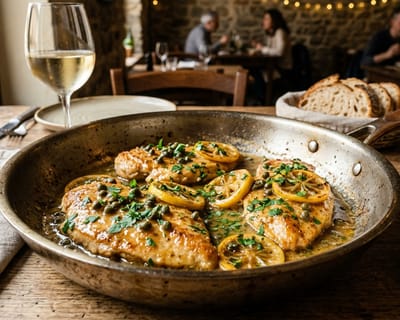
Chicken Piccata
Tender, pan-seared chicken cutlets bathed in a silky, bright pan sauce of reduced dry white wine, fresh lemon juice, briny nonpareil capers, and cold butter monter au beurre, finished with chopped flat-leaf parsley.
Key Takeaways
- ✓Ready in just 15 mins using straightforward, kitchen-tested technique.
- ✓Delivers 34g of muscle-fueling protein per serving for lasting satiety.
- ✓Portion-balanced at 380 calories per serving with wholesome, unrefined ingredients.
- ✓Masterclass temperature checkpoints ensure maximum tenderness and flavor development.
The Story
Chicken Piccata stands as one of the undisputed masterpieces of the classical sauté repertoire. Consisting of thin, tenderized chicken cutlets dredged in seasoned flour, flash-seared in olive oil and butter, and served under a glistening pan sauce composed of reduced dry white wine, fresh lemon juice, briny nonpareil capers, and cold butter monter au beurre, it delivers a dynamic contrast of bright acidity, rich dairy unctuousness, and delicate poultry protein.
Despite its deceptively brief cooking time of under twenty minutes, home cooks and professional kitchens alike frequently run into frustrating pitfalls: cutlets that turn rubbery and tough from uneven thickness, flour coatings that turn pasty and slough off into the pan, broken sauces that separate into a pool of greasy yellow fat, or an overwhelming, sour acidity that masks the delicate chicken rather than elevating it.
Producing restaurant-grade chicken piccata requires mastering cutlet butchery, starch gelatinization in fond development, pan deglazing chemistry, and the delicate physics of cold butter emulsification.
The Historical Evolution of Piccata: From Milanese Veal to American Chicken
The culinary term piccata originates in Italian gastronomy, derived from the word piccato, meaning 'larded,' or associated with the sharp, piquant flavor profile imparted by lemon juice and brined capers. In classical Italian cookery, particularly in the regions of Lombardy and Milan, piccata di vitello (veal piccata) was the standard preparation. Italian butchers traditionally prized milk-fed veal escalopes for their pale color, fine muscle grain, and rapid cooking qualities.
When Italian immigrants arrived in the United States in the late nineteenth and early twentieth centuries, veal was prohibitively expensive compared to plentiful, affordable poultry. Immigrant trattorias and home cooks adapted the time-honored technique to boneless chicken breast.
By butterflying the dense chicken breast horizontally and pounding it paper-thin, they replicated the tender, uniform texture of milk-fed veal scaloppine. Over the subsequent decades, Chicken Piccata evolved into a permanent staple of Italian-American dining, celebrated for its lightning-fast execution and zesty, sun-drenched Mediterranean flavors.
Cutlet Butchery and Meat Science: The Uniform 1/4-Inch Standard
The primary reason home-cooked chicken breast ends up dry and stringy is geometric variation. A whole chicken breast naturally possesses an asymmetrical teardrop profile, measuring up to 1 1/2 inches thick at the cranial end while tapering to less than 1/4 inch at the tail:
1. The Thermal Differential Problem
If you place an un-pounded chicken breast into a hot skillet, thermal energy must conduct inward to the dense center. By the time heat penetrates to bring the thickest core to the pasteurization threshold of 165°F (74°C), the thin edges and outer muscle layers will have soared past 185°F (85°C).- At temperatures above 150°F (66°C), the myofibrillar proteins (actin and myosin) contract violently.
- This contraction wrings intracellular moisture out of the muscle cells like water from a squeezed sponge, leaving the exterior chalky, tough, and desiccated.
2. The Horizontal Butterfly Cut
To solve this, lay the chicken breast flat on a stable cutting board. Place the flat palm of your non-dominant hand firmly on top of the breast. Using a razor-sharp 8-inch chef's knife or boning knife held strictly parallel to the board, slice horizontally through the equator of the breast from the thick outer edge toward the inner margin, stopping roughly 1/2 inch before cutting completely through.- Unfold the breast like an open book (the classic butterfly).
- Slice down the center crease to divide the single breast into two symmetrical, flat cutlets.
3. Mechanical Tenderization (Pounding)
Even after butterflying, slight thickness variations remain. Place the cutlets between two sheets of heavy-duty plastic wrap or inside a 1-gallon zip-top freezer bag:- Using the smooth, flat face of a heavy meat mallet (never the spiked tenderizing face, which tears the delicate poultry muscle into ragged shreds), gently pound the meat with glancing, outward strokes starting from the center and working toward the edges.
- Aim for a uniform thickness of exactly 1/4 inch (6 mm).
- The Structural Advantage: Pounding physically ruptures the tough collagen sheaths enclosing individual muscle bundles, mechanically tenderizing the cutlet while ensuring every square millimeter of the meat cooks at the exact same rate.
The Science of the Flour Dredge: Starch Fond and Sauce Viscosity
Chicken piccata does not use a thick, heavy breading; it requires an imperceptible dusting of unbleached all-purpose flour:
1. Surface Moisture and the Starch Seal
When a raw cutlet hits hot fat, surface water violently boils, creating steam that prevents direct contact between the meat and the pan, hindering browning. Lightly dusting the seasoned cutlet in flour absorbs lingering surface moisture.- As the flour hits the hot oil, its starches rapidly gelatinize and dehydrate, forming a paper-thin, golden crust that seals in internal juices while providing delicate crispness.
2. Fond Generation
During pan-searing, tiny starch particles and proteins from the floured cutlets adhere to the bottom of the stainless-steel or cast-iron skillet, undergoing the Maillard reaction to create rich, caramelized brown sediment known as fond.- This fond contains concentrated amino acids and sugars that form the flavor foundation of the pan sauce.
3. Natural Emulsification and Body
As the skillet is deglazed with white wine and broth, the gelatinized wheat starches embedded in the fond dissolve into the bubbling liquid. These dissolved amylose and amylopectin molecules act as natural secondary thickeners, giving the pan sauce silky body and helping stabilize the cold butter emulsion without needing heavy cornstarch or flour slurries.Pan Selection and Heat Transfer: Why Nonstick Fails
Cooking chicken piccata in a Teflon or ceramic nonstick skillet is one of the most common culinary errors:
- Nonstick coatings are specifically engineered to prevent food from sticking. Consequently, nonstick pans cannot form fond.
- Without fond adhering to the metal surface, deglazing produces a watery, one-dimensional broth devoid of caramelized savory depth.
- The Proper Tool: Use a heavy, 12-inch tri-ply stainless steel skillet or an enameled cast-iron pan. Stainless steel provides excellent thermal conductivity and responds rapidly to heat adjustments, while allowing the floured cutlets to develop deep, golden fond without scorching.
The Chemistry of Deglazing: Wine, Acidity, and Fond Extraction
Deglazing is the chemical process of introducing cold or room-temperature liquid into a searing-hot pan to dissolve caramelized food residues:
1. Ethanol as an Aroma Solvent
Dry white wine is superior to water or broth alone for deglazing because alcohol is an exceptional organic solvent:- Many volatile aromatic flavor compounds present in seared meat and aromatics are soluble in alcohol but insoluble in pure water.
- Introducing white wine captures these fat-soluble aromatic molecules, carrying them into the liquid phase.
- As the wine vigorously boils, the harsh, intoxicating ethanol evaporates away, leaving behind concentrated malic and tartaric fruit acids that brighten the entire dish.
2. Choosing the Right Wine
- The Ideal Choice: Use an un-oaked, high-acid dry white wine such as Pinot Grigio, Sauvignon Blanc, or an Italian Verdicchio.
- Avoid Heavily Oaked Chardonnays: Barrel aging imparts vanilla and lactone compounds that, when reduced down in a skillet, become unpleasantly bitter and overpower the lemon.
- Never Use 'Cooking Wine': Commercial supermarket cooking wines contain added salt, chemical preservatives, and artificial flavorings that ruin delicate sauces. If you would not enjoy drinking a glass of the wine, never pour it into your pan.
Caper Selection: Nonpareil vs. Grumet
Capers are the immature, unopened flower buds of the Capparis spinosa bush, native to the rocky coastlines of the Mediterranean basin. Capers are graded and sized according to their diameter in millimeters:
| Caper Grade | Diameter Size | Culinary Texture & Flavor |
|---|---|---|
| Nonpareil | Up to 7 mm | The smallest, firmest, and most prized grade. Delicate floral crunch, uniform texture, melts smoothly into sauces. |
| Surfines | 7 to 8 mm | Small and firm; common in European imports. |
| Capucines | 8 to 9 mm | Medium size; slightly softer texture. |
| Capotes | 9 to 11 mm | Large buds; noticeably softer with developing seed structures. |
| Fines | 11 to 13 mm | Very large; strong pickled flavor, coarse texture. |
| Grumet | Over 13 mm | The largest grade; mature, loose petal structures, often tough. |
Always rinse brine-packed nonpareil capers in a small fine-mesh sieve under cold running water before adding them to the pan. Rinsing strips away harsh surface salt while preserving the intrinsic glucosinolates that give capers their lively pungency.
The Chemistry of Monter au Beurre: Building the Silky Emulsion
The defining hallmark of a professional chicken piccata sauce is its silky, velvet texture. The sauce should coat the back of a spoon (nappe) with a mirror-like sheen, clinging lovingly to the chicken rather than running off like colored water:
1. Emulsion Fundamentals: Oil-in-Water
A pan sauce is fundamentally an oil-in-water emulsion. The water phase consists of reduced white wine, lemon juice, and chicken stock. The oil phase consists of butterfat. Naturally, oil and water do not mix. If you simply melt butter over high heat, the butterfat separates from the water and milk solids, floating to the surface as an oily yellow slick.2. The Role of Temperature in Monter au Beurre
To achieve a stable emulsion without artificial stabilizers, the butter must be ice cold (straight from the refrigerator, cut into 1/2-inch cubes) and incorporated off the heat or over very low flame:- Cold butter contains solid butterfat crystals surrounded by intact milk proteins (casein) and phospholipids (lecithin), which act as powerful natural emulsifiers.
- As you swirl cold butter cubes into the hot, gently simmering liquid, the butter melts gradually from the outside in.
- The physical motion of vigorous swirling or whisking shears the melting fat into microscopic droplets.
- The natural lecithin and casein proteins immediately coat these micro-droplets, preventing them from coalescing back into a separate oil phase.
- The Result: The liquid transforms within sixty seconds into an opaque, glossy, unctuous sauce that feels feather-light and velvety across the tongue.
Step-by-Step Instructions
Follow these culinary steps to create world-class Chicken Piccata:
Step 1: Butterfly and Pound the Cutlets
Lay 2 large boneless, skinless chicken breasts (about 1 1/2 pounds total) flat on a cutting board.Using a sharp 8-inch chef's knife or boning knife held horizontally, slice through the equator of each breast to butterfly them open, then cut along the hinge to yield 4 cutlets.
Place the cutlets inside a large plastic freezer bag or between two sheets of plastic wrap.
Using the flat side of a heavy meat mallet, pound each cutlet with gentle, outward strokes until uniformly 1/4 inch thick from edge to center.
Step 2: Season and Flour Dredge
Pat the pounded cutlets thoroughly dry with paper towels.Season both sides of each cutlet evenly with 3/4 teaspoon of kosher salt and 1/4 teaspoon of freshly cracked black pepper.
Place 1/2 cup of unbleached all-purpose flour in a shallow dish or wide rimmed plate.
Just before searing, dredge each cutlet in the flour, turning to coat completely. Lift the cutlet and shake off all excess flour vigorously until only an ultra-thin, translucent dusting remains on the surface. (Do not flour cutlets in advance, or the flour will turn gummy).
Step 3: Flash-Sear the Cutlets
Heat 2 tablespoons of extra virgin olive oil and 1 tablespoon of unsalted butter in a heavy 12-inch stainless steel skillet over medium-high heat until the butter is completely melted, foaming, and the foam begins to subside (roughly 375°F / 190°C).Carefully lay 2 cutlets into the hot pan in a single layer without overlapping.
Sear undisturbed for 2 to 3 minutes until the underside is crisp, deeply golden-brown, and releases cleanly from the metal.
Flip using tongs and sear the second side for 1 1/2 to 2 minutes until golden and the center registers 160°F (71°C) on an instant-read thermometer (carryover heat will bring it to the safe 165°F mark).
Transfer the seared cutlets to a warm plate and tent loosely with foil. Add the remaining 1 tablespoon of butter to the skillet and repeat the searing process with the remaining 2 cutlets. Transfer them to the resting plate.
Step 4: Deglaze the Pan with White Wine
Reduce the skillet heat to medium. Pour 1/2 cup of dry white wine (Pinot Grigio or Sauvignon Blanc) into the hot pan. The liquid will boil immediately and release fragrant steam.Using a flat-edged wooden spatula or metal spoon, scrape vigorously across the bottom of the pan to dislodge every trace of caramelized brown fond.
Allow the wine to boil vigorously for 2 to 3 minutes, reducing by half until syrupy and the alcohol odor has completely dissipated.
Step 5: Simmer with Broth, Lemon, and Capers
Pour in 1/2 cup of low-sodium chicken broth and 1/4 cup of freshly squeezed lemon juice.Add 3 tablespoons of drained, rinsed nonpareil capers.
Bring the liquid to a brisk simmer and cook for 3 to 4 minutes, stirring occasionally, until the liquid reduces by roughly one-third and begins to show light bubbling viscosity. Taste the reduction; it should have a sharp, concentrated lemon-caper profile that will soon be mellowed by butter.
Step 6: Emulsify the Sauce (Monter au Beurre)
Turn the heat down to the absolute lowest setting (or remove the pan entirely from the burner if using heavy cast iron).Retrieve 4 tablespoons of cold unsalted butter cubes directly from the refrigerator.
Drop 2 cubes of cold butter into the simmering reduction. Using a wire whisk or silicone spatula, swirl the butter continuously in circular motions until it melts into the liquid.
Immediately add the remaining 2 cubes, swirling rapidly without stopping.
Watch the pan transformation: the clear, bubbling liquid will turn creamy, opaque, and thicken into a glossy, velvety emulsion that coats the back of a spoon. Season with the remaining 1/4 teaspoon of kosher salt and 1/4 teaspoon of black pepper.
Step 7: Warm the Cutlets in the Velvet Sauce
Return the seared chicken cutlets and any accumulated savory resting juices back into the skillet.Spoon the glossy lemon-caper sauce generously over the tops of the cutlets.
Simmer gently on low heat for just 1 minute—only long enough to heat the cutlets through without boiling the sauce. (Do not let the sauce boil rapidly, or the butter emulsion will break).
Remove the pan from the heat. Scatter 1/3 cup of finely chopped fresh flat-leaf parsley across the top.
Step 8: Plate and Garnish
Transfer the warm cutlets to warmed individual dinner plates or a large serving platter.Pour the remaining silky lemon-caper pan sauce generously over the chicken, ensuring each cutlet is adorned with abundant nonpareil capers.
Garnish with fresh, paper-thin lemon rounds and a tiny pinch of flaky Maldon sea salt. Serve immediately while hot and glistening.
Pro-Tips for Masterful Chicken Piccata
- Keep Butter Ice-Cold: Do not leave your mounting butter on the counter while prepping. Butter must be cold from the refrigerator so it melts gradually into the sauce, creating a silky emulsion rather than separating into oily liquid.
- Shake Off Excess Flour: A heavy flour dredge turns into gummy wallpaper paste in the skillet. Shake the cutlet vigorously until only a translucent whisper of flour remains.
- Squeeze Lemons Fresh: Never use bottled lemon juice. Bottled juices contain chemical antioxidants (sodium metabisulfite) and lack volatile lemon terpenes, giving the sauce an astringent, metallic bitterness.
- Pre-Warm the Plating Dishes: Because butter emulsions are sensitive to thermal shock, pouring warm piccata sauce onto an icy ceramic plate can cause the butterfat to congeal prematurely. Warm your dinner plates in a 200°F (93°C) oven for 5 minutes prior to serving.
Flavor Variations and Additions
Make-Ahead, Storage, and Reheating Science
Chicken Piccata is fundamentally a flash-cooked sauté dish, but smart meal-prep strategies preserve its exquisite texture:
Make-Ahead Prep
- Cutlet Butchery: You can butterfly, pound, and wrap the raw chicken cutlets in plastic wrap up to 24 hours in advance. Store chilled at 36°F (2°C).
- Produce Prep: Squeeze the fresh lemons, chop the fresh parsley, and rinse the nonpareil capers up to 8 hours ahead.
- Do Not Pre-Flour: Always dredge the chicken in flour immediately before it hits the hot oil.
Storing Leftovers
Store leftover cooked chicken cutlets with their sauce in an airtight glass container in the refrigerator for up to 3 days.The Gentle Reheating Technique: Preserving the Emulsion
Microwaving leftover chicken piccata is catastrophic: high-frequency radiation overcooks the delicate poultry meat and boils the sauce instantly, causing the butterfat to break into a greasy puddle.- The Skillet Method (Best): Place the cold cutlets and sauce into a stainless steel skillet. Add 2 tablespoons of water or chicken broth to replenish evaporated moisture. Heat over low flame, swirling gently, for 4 to 5 minutes until just warmed through (145°F / 63°C).
- If the sauce appears separated, whisk in 1 tablespoon of ice-cold water or a tiny cube of cold butter off heat to restore the emulsion.
Can You Freeze Chicken Piccata?
Freezing cooked chicken piccata is not recommended. Emulsified pan sauces do not freeze well; ice crystallization breaks the protein-lipid bonds, resulting in a watery, separated sauce upon thawing. If freezing, freeze the raw, pounded cutlets individually between sheets of parchment paper, and make the fresh sauce on demand.Sommelier Wine Pairings
Chicken Piccata demands white wines with crisp natural acidity, citrus-forward aromatic bouquets, and light-to-medium body to match the lemon and caper profile without clashing:
- Italian Pinot Grigio (Alto Adige or Friuli): A classic regional pairing. Northern Italian Pinot Grigio offers crisp green apple, white peach, and chalky minerality with brisk acidity that echoes the lemon juice while cutting through the butter.
- New Zealand or Sancerre Sauvignon Blanc: Brimming with gooseberry, fresh lime zest, and herbal lemongrass notes, Sauvignon Blanc accentuates the briny nonpareil capers and flat-leaf parsley.
- Gavi di Gavi (Cortese grape): Produced in Piedmont, Gavi offers delicate floral aromas, crisp citrus acidity, and a distinctive mineral finish that harmonizes seamlessly with Mediterranean poultry.
- Unoaked Chablis (Chardonnay): Grown in limestone-rich Kimmeridgian soils, Chablis delivers razor-sharp flinty acidity and green orchard fruit without any heavy oak tannins that would fight the capers.
- Non-Alcoholic Refreshers: Chilled sparkling water infused with fresh cucumber and lemon wheels, iced sparkling apple cider with a dash of white balsamic vinegar, or an unsweetened iced green tea with fresh mint leaves.
Nutritional Breakdown and Macro Profile
Per serving (serving size: 1 large prepared cutlet with generous sauce, recipe makes 4 servings):
| Nutrient | Amount per Serving | % Daily Value |
|---|---|---|
| Calories | 380 kcal | — |
| Total Fat | 22 g | 28% |
| Saturated Fat | 10 g | 50% |
| Cholesterol | 125 mg | 42% |
| Sodium | 620 mg | 27% |
| Total Carbohydrates | 12 g | 4% |
| Dietary Fiber | 1 g | 4% |
| Total Sugars | 1 g | — |
| Protein | 34 g | 68% |
| Potassium | 520 mg | 11% |
| Calcium | 35 mg | 3% |
| Iron | 1.8 mg | 10% |
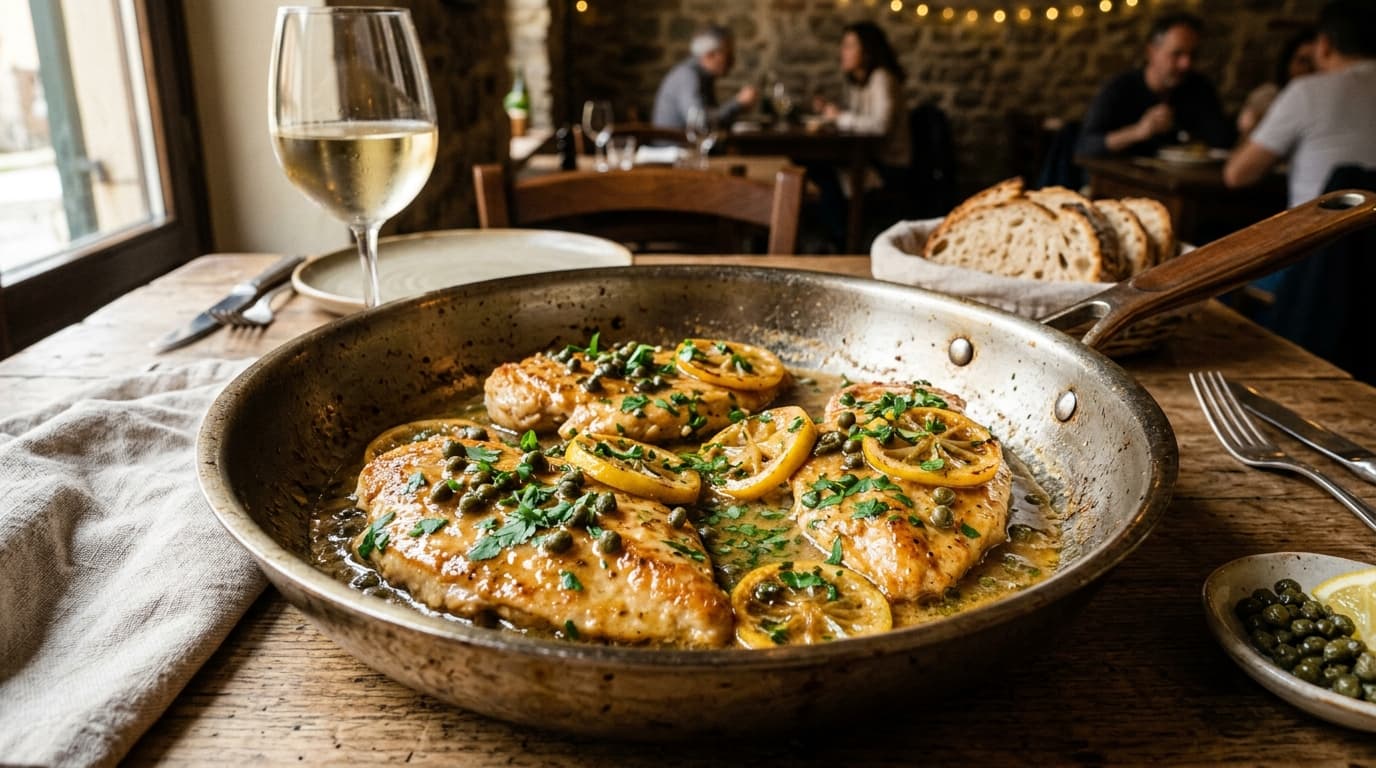
Chicken Piccata
Tender, pan-seared chicken cutlets bathed in a silky, bright pan sauce of reduced dry white wine, fresh lemon juice, briny nonpareil capers, and cold butter monter au beurre, finished with chopped flat-leaf parsley.
Macro Nutrition Profile (Per Serving)
Ingredients
The White Wine & Lemon Pan Sauce
Fresh Finishes & Garnish
Ingredient Substitutions
| Original Ingredient | Healthy Alternative |
|---|---|
| Chicken breast | Turkey breast or extra-firm tofu (1:1 ratio) |
| Dino kale/greens | Baby spinach or Swiss chard (cooks faster, add at the end) |
Instructions
Butterfly and Pound the Cutlets: Lay 2 large boneless, skinless chicken breasts (about 1 1/2 pounds total) flat on a cutting board. Using a sharp 8-inch chef's knife or boning knife held horizontally, slice through the equator of each breast to butterfly them open, then cut along the hinge to yield 4 cutlets. Place the cutlets inside a large plastic freezer bag or between two sheets of plastic wrap. Using the flat side of a heavy meat mallet, pound each cutlet with gentle, outward strokes until uniformly 1/4 inch thick from edge to center.
Season and Flour Dredge: Pat the pounded cutlets thoroughly dry with paper towels. Season both sides of each cutlet evenly with 3/4 teaspoon of kosher salt and 1/4 teaspoon of freshly cracked black pepper. Place 1/2 cup of unbleached all-purpose flour in a shallow dish or wide rimmed plate. Just before searing, dredge each cutlet in the flour, turning to coat completely. Lift the cutlet and shake off all excess flour vigorously until only an ultra-thin, translucent dusting remains on the surface. (Do not flour cutlets in advance, or the flour will turn gummy).
Flash-Sear the Cutlets: Heat 2 tablespoons of extra virgin olive oil and 1 tablespoon of unsalted butter in a heavy 12-inch stainless steel skillet over medium-high heat until the butter is completely melted, foaming, and the foam begins to subside (roughly 375°F / 190°C). Carefully lay 2 cutlets into the hot pan in a single layer without overlapping. Sear undisturbed for 2 to 3 minutes until the underside is crisp, deeply golden-brown, and releases cleanly from the metal. Flip using tongs and sear the second side for 1 1/2 to 2 minutes until golden and the center registers 160°F (71°C) on an instant-read thermometer (carryover heat will bring it to the safe 165°F mark). Transfer the seared cutlets to a warm plate and tent loosely with foil. Add the remaining 1 tablespoon of butter to the skillet and repeat the searing process with the remaining 2 cutlets. Transfer them to the resting plate.
Deglaze the Pan with White Wine: Reduce the skillet heat to medium. Pour 1/2 cup of dry white wine (Pinot Grigio or Sauvignon Blanc) into the hot pan. The liquid will boil immediately and release fragrant steam. Using a flat-edged wooden spatula or metal spoon, scrape vigorously across the bottom of the pan to dislodge every trace of caramelized brown fond. Allow the wine to boil vigorously for 2 to 3 minutes, reducing by half until syrupy and the alcohol odor has completely dissipated.
Simmer with Broth, Lemon, and Capers: Pour in 1/2 cup of low-sodium chicken broth and 1/4 cup of freshly squeezed lemon juice. Add 3 tablespoons of drained, rinsed nonpareil capers. Bring the liquid to a brisk simmer and cook for 3 to 4 minutes, stirring occasionally, until the liquid reduces by roughly one-third and begins to show light bubbling viscosity. Taste the reduction; it should have a sharp, concentrated lemon-caper profile that will soon be mellowed by butter.
Emulsify the Sauce (Monter au Beurre): Turn the heat down to the absolute lowest setting (or remove the pan entirely from the burner if using heavy cast iron). Retrieve 4 tablespoons of cold unsalted butter cubes directly from the refrigerator. Drop 2 cubes of cold butter into the simmering reduction. Using a wire whisk or silicone spatula, swirl the butter continuously in circular motions until it melts into the liquid. Immediately add the remaining 2 cubes, swirling rapidly without stopping. Watch the pan transformation: the clear, bubbling liquid will turn creamy, opaque, and thicken into a glossy, velvety emulsion that coats the back of a spoon. Season with the remaining 1/4 teaspoon of kosher salt and 1/4 teaspoon of black pepper.
Warm the Cutlets in the Velvet Sauce: Return the seared chicken cutlets and any accumulated savory resting juices back into the skillet. Spoon the glossy lemon-caper sauce generously over the tops of the cutlets. Simmer gently on low heat for just 1 minute—only long enough to heat the cutlets through without boiling the sauce. (Do not let the sauce boil rapidly, or the butter emulsion will break). Remove the pan from the heat. Scatter 1/3 cup of finely chopped fresh flat-leaf parsley across the top.
Plate and Garnish: Transfer the warm cutlets to warmed individual dinner plates or a large serving platter. Pour the remaining silky lemon-caper pan sauce generously over the chicken, ensuring each cutlet is adorned with abundant nonpareil capers. Garnish with fresh, paper-thin lemon rounds and a tiny pinch of flaky Maldon sea salt. Serve immediately while hot and glistening.
The Creamy Tuscan Piccata: Stir 1/4 cup of heavy whipping cream into the chicken broth before adding the capers. Fold in 1/2 cup of julienned sun-dried tomatoes (oil-packed, drained) and 2 cups of fresh baby spinach during the final 2 minutes of simmering until wilted.
The Artichoke Heart Piccata: Drain a 14-ounce can of quartered water-packed artichoke hearts and pat dry. Sauté the artichokes in the olive oil and butter for 2 minutes prior to searing the chicken to develop golden roasted edges, then simmer them directly in the white wine sauce.
The Piquant Garlic and Shallot Infusion: Before deglazing with white wine, add 1 finely minced French shallot and 2 thinly sliced garlic cloves to the pan drippings. Sauté for 45 to 60 seconds until fragrant and translucent, then proceed with the wine deglaze.
Piccata di Vitello (Veal Piccata): Substitute 1 1/2 pounds of milk-fed veal top round or veal cutlets pounded to 1/8-inch thickness. Sear for only 90 seconds per side; veal cooks even faster than chicken breast.
Tried this recipe?
Let us know how it turned out! Click a star below to leave a review and rate the recipe.
Storage & Freezing Tips
- Refrigerator: Store leftovers in an airtight container for up to 3-4 days.
- Reheating: Heat in a saucepan or skillet on medium heat until hot throughout.
- Freezing: Freeze portions in airtight containers for up to 2 months. Reheat directly from frozen or after thawing.
Frequently Asked Questions
Can this recipe be prepared ahead of time?▼
Yes, this meal is excellent for weekly meal prep. Store components separately and assemble before serving.
Is this recipe gluten-free?▼
All ingredients used are naturally gluten-free. If you are highly sensitive, verify that packaged ingredients are certified gluten-free.
Tried this recipe?
Tag @stewartlucas on Instagram and hashtag it #nutriguide!
You Might Also Like

Stewart Lucas
Nutritionist & Recipe DeveloperStewart Lucas is a nutritionist and recipe developer representing the NutriGuide team. All recipes, nutritional values, and diet protocols published on this site are designed and audited by certified dietitians and clinical nutrition professionals to guarantee absolute accuracy.
Community Reviews
Please log in to leave a review.