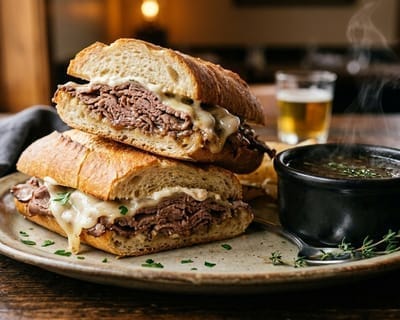
Classic Roast Beef French Dip with Rich Au Jus
Thinly shaved, tender roast beef piled high onto crusty, toasted French rolls with melted provolone cheese, served alongside a piping-hot bowl of rich, savory beef au jus for dipping.
Key Takeaways
- ✓Ready in just 20 mins using straightforward, kitchen-tested technique.
- ✓Delivers 46g of muscle-fueling protein per serving for lasting satiety.
- ✓Portion-balanced at 580 calories per serving with wholesome, unrefined ingredients.
- ✓Masterclass temperature checkpoints ensure maximum tenderness and flavor development.
The Story
The French Dip sandwich is an icon of twentieth-century American culinary heritage. Consisting of thinly shaved, rare or medium-rare roast beef piled into a crusty, toasted French roll, often draped with melted provolone or Swiss cheese, and served with a steaming ramekin of rich, savory beef au jus, it transforms a simple sandwich into an interactive dining experience.
While the sandwich appears straightforward, home preparations often stumble: rolls that disintegrate into a soggy mess upon the first dip, roast beef that turns tough and gray from over-boiling, or a thin, watery broth that lacks the savory depth of an authentic jus.
Understanding the balance between crusty artisan bread, gentle meat warming techniques, and the extraction of gelatin and umami in the dipping broth is what separates an ordinary sandwich from a masterclass French Dip.
The Los Angeles Origins of the French Dip
Despite its name, the French Dip was not invented in France; it was created in downtown Los Angeles in the early twentieth century. The name refers not to the country of origin, but to the style of bread used: the traditional French roll or baguette.
Two historic Los Angeles restaurants fiercely contest the sandwich's invention:
1. Philippe the Original (1918)
The most famous origin story centers on Philippe Mathieu, a French immigrant who opened a modest downtown delicatessen in 1908. According to restaurant lore, during a busy lunch rush in 1918, Mathieu was preparing a roast beef sandwich on a French roll for a local police officer. While slicing the roll, it accidentally slipped from his hands directly into the hot, greasy pan drippings at the bottom of the roasting pan.The officer, in a hurry, insisted on taking the sandwich anyway. He returned the next day accompanied by colleagues, requesting that their sandwiches be dipped into the savory meat juices as well. Philippe Mathieu began offering the sandwich "single-dipped" (one half soaked), "double-dipped" (both halves soaked), or "wet" (the entire sandwich submerged).
2. Cole's Pacific Electric Buffet (1908)
A competing claim comes from Cole's, opened in 1908 inside the Pacific Electric Building by Henry Cole. Cole's contends that its chef, Jack Carstens, invented the dipped sandwich specifically for a customer who was suffering from sore gums and requested that his crusty French bread be dipped in roasting juices to soften it before eating.Regardless of which historic institution served the first dipped roll, the French Dip became a permanent fixture across American lunch counters, taverns, and steakhouses.
The Science of Au Jus: Stock vs. Gravy vs. Jus
In classical French cuisine, the distinction between culinary liquids is precise:
- Bouillon or Stock: The unseasoned, strained liquid resulting from simmering bones, meat, water, and aromatics (mirepoix).
- Gravy: A sauce built by binding meat broth with a cooked flour-and-fat roux or cornstarch slurry, yielding an opaque, thick, viscous consistency.
- Jus (Au Jus): Literally translating to "with juice," jus refers to the natural, un-thickened juices released by roasted meat during cooking, deglazed from the pan and reduced to concentrate its flavors.
If the liquid is thick like gravy, its viscosity prevents it from penetrating the bread; the sauce simply clings to the exterior of the roll, leaving the interior dry.
An authentic au jus must remain thin, clear, and fluid. When the toasted sandwich is submerged, capillary action immediately draws the hot, savory broth deep into the open crumb of the bread, infusing every bite with rich moisture and beef flavor.
Building Deep Umami Without a 12-Hour Roast
In a restaurant setting, au jus is prepared from the pan drippings of a massive 20-pound prime rib roast. When making French Dips at home using deli-shaved beef, you must build that complex savory profile intentionally in a saucepan:- The Fond Foundation: Sautéing finely minced shallots and garlic in butter begins the flavor base, while deglazing with dry red wine dissolves any caramelized sugars and adds vital acidity that cuts through beef fat.
- Glutamate Synergy: High-quality beef bone broth provides liquid and natural collagen gelatin. To replicate hours of roasting depth, incorporate small quantities of Worcestershire sauce (fermented anchovies and tamarind) and low-sodium soy sauce (fermented soybeans). These ingredients supply free glutamates and inosinate nucleotides, which bond together on the tongue's taste receptors, multiplying the perceived savory "meatiness" of the broth by up to eight times.
- Herbal Aromatics: Simmering whole sprigs of fresh rosemary and thyme in the broth extracts fat-soluble essential oils (pinene, thymol, and carvacrol) that perfume the steam rising from the dipping bowl.
Bread Physics: The Crumb, Crust, and Structural Integrity
The choice of bread dictates whether your French Dip is a triumph or a culinary disaster.
When bread contacts hot broth (roughly 160°F / 71°C), the liquid immediately hydrates the gelatinized wheat starches in the crumb. If the bread is soft and low in gluten—such as standard hot dog buns, hamburger buns, or commercial sliced sandwich bread—the starch cell walls rupture under the weight of the water. The bread collapses into a soggy, disintegrating mush that tears apart in your hands.
The Anatomy of the Ideal French Roll
An authentic French Dip requires bread with two distinct structural characteristics:- A Resilient, Open Crumb: Artisan French baguettes and quality bakery hoagie rolls are crafted from high-protein unbleached wheat flour (roughly 12% to 14% protein) with long fermentation times. This creates strong gluten webs and an open, airy crumb with large alveoli (air pockets). When dipped, these pockets act as reservoirs that hold the liquid broth without the gluten walls dissolving.
- A Crisp, Sturdy Exterior Crust: A crackly, hard exterior crust provides mechanical strength. It acts as an impermeable outer shield that allows you to grip the sandwich firmly even when the interior crumb is saturated with broth.
Toasting with Garlic Butter
Splitting the rolls and toasting them under a broiler with melted garlic butter serves a dual purpose:- It creates Maillard browning, adding roasted, buttery allium flavor.
- The melted butter fats soak into the immediate surface layer of the crumb, creating a temporary hydrophobic (water-repelling) barrier. This prevents the bread from turning soggy prematurely during assembly, ensuring it retains its crisp bite until the moment you dip it into the jus.
The Meat: Slicing Geometry and Warming Dynamics
Whether you roast a whole beef chuck roast or purchase high-grade cooked roast beef from the butcher, the geometry of how the meat is sliced determines its tenderness.
Shaved Across the Grain
Even the most tender cut of beef is composed of thousands of parallel muscle fibers bound together by connective tissue. If you cut beef into thick slices, or slice parallel to the grain, your teeth must exert significant force to tear the long fibers apart, resulting in a rubbery, chewy sandwich.The meat must be sliced paper-thin—often described as "shaved"—strictly across the grain. Shaving cuts the muscle fibers into microscopic segments. When piled high in loose, ribbon-like folds on a roll, the shaved beef compresses effortlessly when bitten, delivering maximum tenderness.
The Gentle Warm (Do Not Boil)
Cold roast beef straight from the refrigerator will chill the sandwich and solidify the cheese. However, simmering the delicate shaved meat in boiling broth overcooks the proteins, turning pink beef gray, dry, and tough in under 60 seconds.The correct technique is gentle poaching off the heat:
- Bring your seasoned au jus to a gentle simmer on the stove.
- Reduce the heat to the lowest possible setting, or turn the burner off completely.
- Using metal tongs, submerge the shaved beef into the hot broth for only 45 to 60 seconds.
- The hot broth instantly warms the meat, renders surface fats, and coats every fold in savory juices without cooking out internal moisture.
- Lift the beef out, letting excess broth drain back into the pot for 2 seconds, and transfer it immediately onto the toasted roll.
Choosing the Right Cheese
While purists from 1908 enjoyed their sandwiches plain ("without cheese"), modern American tavern culture universally embraces melted cheese on a French Dip.
- Provolone (The Traditional Standard): Aged Italian-style provolone provides a smooth, elastic melt with a mild, slightly sharp finish that pairs cleanly with beef without overpowering the flavor of the au jus.
- Swiss / Gruyère (The Nutty Alternative): Swiss cheese brings sweet, nutty undertones that complement the caramelized onions in the au jus.
- Melt Placement: Place the cheese slices directly over the warm, glistening beef on the roll, then return the open-faced sandwich under the oven broiler for 60 to 90 seconds. The direct radiant heat melts the cheese into a bubbling, molten blanket that locks the shaved beef ribbons in place.
Essential Equipment
- Medium Saucepan: For simmering the shallots, wine, beef bone broth, and herbs into the au jus.
- Fine-Mesh Metal Sieve: Essential for straining the au jus before serving, removing all shallot bits, herb stems, and bay leaves so the dipping liquid is clear and silky.
- Rimmed Baking Sheet: For toasting the garlic buttered rolls and melting the provolone cheese under the broiler.
- Metal Kitchen Tongs: For quickly dipping and retrieving the shaved roast beef from the hot au jus without tearing the meat ribbons.
- Small Ceramic Ramekins or Bowls: Individual 4-to-6-ounce heat-safe ramekins for serving the steaming au jus alongside each sandwich.
Step-by-Step Instructions
Step 1: Build the Aromatic Au Jus Base
Melt 1 tablespoon of unsalted butter in a medium saucepan over medium heat.Add 1 finely minced shallot (or 1/2 small diced yellow onion) and cook for 3 to 4 minutes, stirring frequently with a wooden spoon, until the shallot is soft, translucent, and sweet.
Add 2 cloves of finely minced fresh garlic and cook for 45 seconds until fragrant, taking care not to brown the garlic.
Step 2: Deglaze and Reduce
Pour in 1/3 cup of dry red wine (such as Cabernet Sauvignon) to deglaze the saucepan.Using your wooden spoon, scrape any caramelized bits from the bottom of the pan. Bring the wine to a lively simmer and let it reduce by half, about 2 minutes. Reducing the wine evaporates harsh alcohol fumes while concentrating acidity and grape tannins.
Step 3: Simmer the Au Jus
Pour in 3 cups of rich beef bone broth or high-quality beef stock.Add 1 tablespoon of Worcestershire sauce, 1 teaspoon of low-sodium soy sauce, 1/2 teaspoon of onion powder, 1/4 teaspoon of freshly cracked black pepper, 1 sprig of fresh rosemary, 3 sprigs of fresh thyme, and 1 dried bay leaf.
Bring the liquid to a rolling boil over medium-high heat. Immediately reduce the heat to medium-low, cover loosely with a lid, and simmer gently for 15 minutes to allow the herbs and aromatics to infuse into the broth.
Step 4: Strain the Au Jus
Set a fine-mesh metal sieve over a clean bowl or measuring pitcher. Pour the hot au jus through the sieve, pressing gently on the shallots and herbs with the back of a ladle to extract all flavorful juices. Discard the solids.Return the clear, strained broth to the saucepan and keep over the lowest possible heat setting. Taste the broth and adjust with a small pinch of kosher salt if needed.
Step 5: (Optional) Mix the Creamy Horseradish Sauce
In a small bowl, whisk together 1/2 cup of sour cream, 2 tablespoons of prepared drained horseradish, 1 teaspoon of Dijon mustard, 1 teaspoon of fresh lemon juice, and a pinch of kosher salt and black pepper. Cover and refrigerate until assembly. The cool, nasal heat of the horseradish cuts through the rich beef fat.Step 6: Toast the Rolls with Garlic Butter
Adjust your oven rack to the top position (about 6 inches below the broiler element) and turn on the broiler to HIGH.Slice 4 crusty French rolls or hoagie rolls lengthwise, cutting roughly three-quarters of the way through so the rolls open like a book (hinged).
In a small ramekin, mix 3 tablespoons of softened butter with 2 cloves of minced garlic (or 1/2 teaspoon garlic powder). Spread the garlic butter evenly across the cut faces of all 4 rolls.
Place the buttered rolls cut-side up on a large rimmed baking sheet. Slide under the broiler for 1 to 2 minutes. Watch constantly: the bread should turn pale golden brown with toasted, crisp edges. Remove from the oven and set aside.
Step 7: Poach the Shaved Roast Beef
Turn off the burner under your saucepan of hot au jus (the liquid should be steaming hot, around 160°F to 170°F / 71°C to 77°C, but not boiling).Working in two batches, use tongs to submerge half of the thinly shaved roast beef directly into the hot au jus.
Gently swish the meat in the broth for 45 to 60 seconds. The meat will instantly warm through, turning glossy and juicy as it drinks in the savory broth.
Lift the beef from the broth using tongs, allowing excess liquid to drip back into the pot for 2 seconds.
Step 8: Assemble and Melt the Cheese
Divide the warm, dripping beef evenly among the toasted rolls, piling the shaved ribbons high across the bottom half of each roll.Drape 2 slices of provolone cheese (or Swiss cheese) overlapping across the hot meat on each sandwich.
Return the open sandwiches on the baking sheet under the broiler for 60 to 90 seconds. The provolone will melt into a bubbling, molten blanket over the meat, and the crusty roll edges will darken to a deep golden brown.
Step 9: Portion the Au Jus and Serve
Carefully remove the baking sheet from the oven. If desired, spread 1 to 2 tablespoons of the creamy horseradish sauce across the inside top bun of each sandwich. Close the sandwiches firmly.Using a sharp chef's knife or serrated knife, slice each sandwich diagonally in half.
Ladle the piping-hot, strained au jus into 4 small individual ceramic ramekins or dipping bowls.
Place each sandwich on a dinner plate alongside a bowl of steaming au jus. Serve immediately while hot and crackly.
Critical Mistakes and How to Avoid Them
The Roll Turns to Soggy Mush Immediately
- The Cause: Using soft, commercial hot dog or sub rolls, skipping the toasting step, or leaving the assembled sandwich sitting on the plate for too long before eating.
- The Solution: Use artisan crusty French rolls or baguettes with an open crumb and firm crust. Always toast the cut face under the broiler with butter to create a moisture barrier, and serve immediately.
The Roast Beef is Gray, Dry, and Tough
- The Cause: Boiling the beef vigorously in the broth on high heat, or using thick, poorly sliced meat cut along the grain.
- The Solution: Ask the butcher to shave rare roast beef paper-thin across the grain. Turn off the heat before adding the beef to the au jus, submerging it for only 45 to 60 seconds just to take the chill off.
The Au Jus is Bland and Watery
- The Cause: Using plain water or low-flavor carton broth without building a flavor base.
- The Solution: Sauté shallots and garlic in butter, deglaze with dry red wine, and simmer with fresh thyme, rosemary, soy sauce, and Worcestershire to build deep umami and aromatic richness.
Variations and Recipe Customizations
Storage, Freezing, and Reheating Science
French Dip sandwiches are best assembled and enjoyed fresh, but components can be prepared well in advance.
Make-Ahead Storage
- The Au Jus: Store the strained au jus in an airtight glass jar in the refrigerator for up to 4 days. Any solidified fat that rises to the top can be lifted off with a spoon.
- The Roast Beef: Keep shaved roast beef tightly wrapped in butcher paper and sealed in an airtight container in the refrigerator for up to 3 days.
Reheating Instructions
- Reheating the Jus: Pour the au jus into a saucepan and bring to a gentle simmer over medium heat.
- Reheating the Beef: Never microwave roast beef on high power, which toughens the protein. Turn off the burner under the simmering au jus and submerge the portion of cold beef for 60 seconds to warm through gently.
- Reheating the Rolls: Toast fresh rolls under the broiler right before assembling. If you have leftover assembled sandwiches, reheat them in a 350°F (175°C) toaster oven for 6 to 8 minutes to recrisp the crust.
Nutritional Breakdown and Macros
The Classic Roast Beef French Dip delivers dense, complete animal protein and essential minerals balanced with complex carbohydrates from crusty artisan bread.
| Nutrient | Amount per Serving (1 Whole Sandwich with Au Jus) | Daily Value (%) |
|---|---|---|
| Calories | 580 kcal | 29% |
| Protein | 46 g | 92% |
| Total Fat | 22 g | 28% |
| Saturated Fat | 10 g | 50% |
| Carbohydrates | 48 g | 17% |
| Dietary Fiber | 2 g | 7% |
| Sugars | 3 g | - |
| Sodium | 1,120 mg | 49% |
| Cholesterol | 115 mg | 38% |
| Potassium | 680 mg | 14% |
| Calcium | 290 mg | 22% |
| Iron | 4.6 mg | 26% |
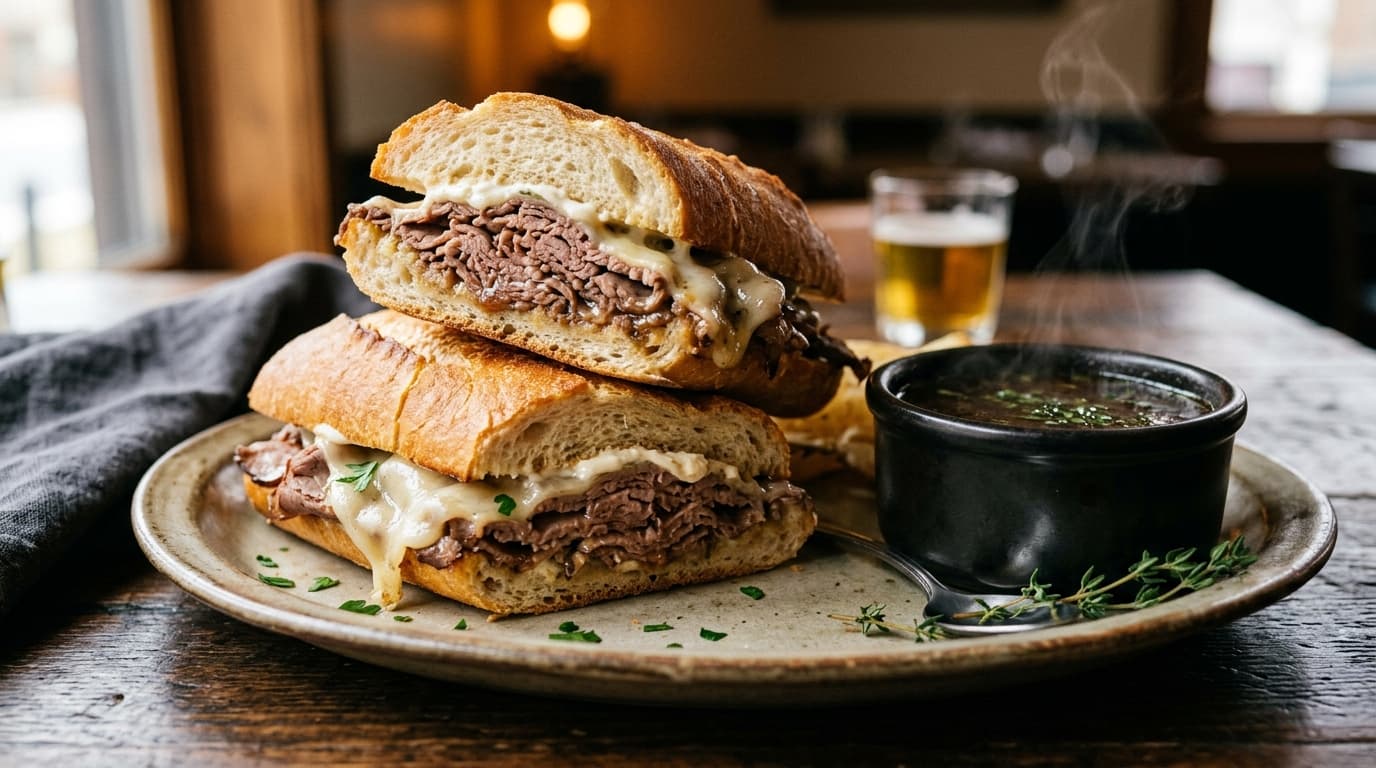
Classic Roast Beef French Dip with Rich Au Jus
Thinly shaved, tender roast beef piled high onto crusty, toasted French rolls with melted provolone cheese, served alongside a piping-hot bowl of rich, savory beef au jus for dipping.
Macro Nutrition Profile (Per Serving)
Ingredients
Rich Beef Au Jus
Optional Creamy Horseradish Sauce
Ingredient Substitutions
| Original Ingredient | Healthy Alternative |
|---|---|
| Animal protein | Firm tofu, tempeh, or organic chickpeas |
| Cooking fat | Extra virgin olive oil or grass-fed butter |
Instructions
Build the Aromatic Au Jus Base: Melt 1 tablespoon of unsalted butter in a medium saucepan over medium heat. Add 1 finely minced shallot (or 1/2 small diced yellow onion) and cook for 3 to 4 minutes, stirring frequently with a wooden spoon, until the shallot is soft, translucent, and sweet. Add 2 cloves of finely minced fresh garlic and cook for 45 seconds until fragrant, taking care not to brown the garlic.
Deglaze and Reduce: Pour in 1/3 cup of dry red wine (such as Cabernet Sauvignon) to deglaze the saucepan. Using your wooden spoon, scrape any caramelized bits from the bottom of the pan. Bring the wine to a lively simmer and let it reduce by half, about 2 minutes. Reducing the wine evaporates harsh alcohol fumes while concentrating acidity and grape tannins.
Simmer the Au Jus: Pour in 3 cups of rich beef bone broth or high-quality beef stock. Add 1 tablespoon of Worcestershire sauce, 1 teaspoon of low-sodium soy sauce, 1/2 teaspoon of onion powder, 1/4 teaspoon of freshly cracked black pepper, 1 sprig of fresh rosemary, 3 sprigs of fresh thyme, and 1 dried bay leaf. Bring the liquid to a rolling boil over medium-high heat. Immediately reduce the heat to medium-low, cover loosely with a lid, and simmer gently for 15 minutes to allow the herbs and aromatics to infuse into the broth.
Strain the Au Jus: Set a fine-mesh metal sieve over a clean bowl or measuring pitcher. Pour the hot au jus through the sieve, pressing gently on the shallots and herbs with the back of a ladle to extract all flavorful juices. Discard the solids. Return the clear, strained broth to the saucepan and keep over the lowest possible heat setting. Taste the broth and adjust with a small pinch of kosher salt if needed.
(Optional) Mix the Creamy Horseradish Sauce: In a small bowl, whisk together 1/2 cup of sour cream, 2 tablespoons of prepared drained horseradish, 1 teaspoon of Dijon mustard, 1 teaspoon of fresh lemon juice, and a pinch of kosher salt and black pepper. Cover and refrigerate until assembly. The cool, nasal heat of the horseradish cuts through the rich beef fat.
Toast the Rolls with Garlic Butter: Adjust your oven rack to the top position (about 6 inches below the broiler element) and turn on the broiler to HIGH. Slice 4 crusty French rolls or hoagie rolls lengthwise, cutting roughly three-quarters of the way through so the rolls open like a book (hinged). In a small ramekin, mix 3 tablespoons of softened butter with 2 cloves of minced garlic (or 1/2 teaspoon garlic powder). Spread the garlic butter evenly across the cut faces of all 4 rolls. Place the buttered rolls cut-side up on a large rimmed baking sheet. Slide under the broiler for 1 to 2 minutes. Watch constantly: the bread should turn pale golden brown with toasted, crisp edges. Remove from the oven and set aside.
Poach the Shaved Roast Beef: Turn off the burner under your saucepan of hot au jus (the liquid should be steaming hot, around 160°F to 170°F / 71°C to 77°C, but not boiling). Working in two batches, use tongs to submerge half of the thinly shaved roast beef directly into the hot au jus. Gently swish the meat in the broth for 45 to 60 seconds. The meat will instantly warm through, turning glossy and juicy as it drinks in the savory broth. Lift the beef from the broth using tongs, allowing excess liquid to drip back into the pot for 2 seconds.
Assemble and Melt the Cheese: Divide the warm, dripping beef evenly among the toasted rolls, piling the shaved ribbons high across the bottom half of each roll. Drape 2 slices of provolone cheese (or Swiss cheese) overlapping across the hot meat on each sandwich. Return the open sandwiches on the baking sheet under the broiler for 60 to 90 seconds. The provolone will melt into a bubbling, molten blanket over the meat, and the crusty roll edges will darken to a deep golden brown.
Portion the Au Jus and Serve: Carefully remove the baking sheet from the oven. If desired, spread 1 to 2 tablespoons of the creamy horseradish sauce across the inside top bun of each sandwich. Close the sandwiches firmly. Using a sharp chef's knife or serrated knife, slice each sandwich diagonally in half. Ladle the piping-hot, strained au jus into 4 small individual ceramic ramekins or dipping bowls. Place each sandwich on a dinner plate alongside a bowl of steaming au jus. Serve immediately while hot and crackly.
Tried this recipe?
Let us know how it turned out! Click a star below to leave a review and rate the recipe.
Storage & Freezing Tips
- Refrigerator: Store leftovers in an airtight container for up to 3-4 days.
- Reheating: Heat in a saucepan or skillet on medium heat until hot throughout.
- Freezing: Freeze portions in airtight containers for up to 2 months. Reheat directly from frozen or after thawing.
Frequently Asked Questions
Can this recipe be prepared ahead of time?▼
Yes, this meal is excellent for weekly meal prep. Store components separately and assemble before serving.
Is this recipe gluten-free?▼
All ingredients used are naturally gluten-free. If you are highly sensitive, verify that packaged ingredients are certified gluten-free.
Tried this recipe?
Tag @stewartlucas on Instagram and hashtag it #nutriguide!
You Might Also Like

Stewart Lucas
Nutritionist & Recipe DeveloperStewart Lucas is a nutritionist and recipe developer representing the NutriGuide team. All recipes, nutritional values, and diet protocols published on this site are designed and audited by certified dietitians and clinical nutrition professionals to guarantee absolute accuracy.
Community Reviews
Please log in to leave a review.