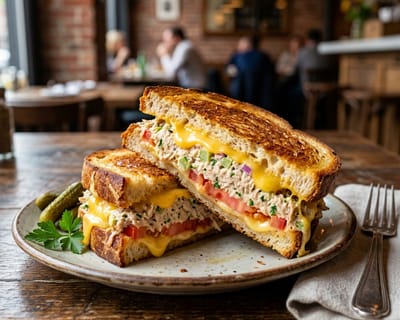
Classic Tuna Melt Sandwich (Bakery Sourdough & Sharp Cheddar Masterclass)
The definitive diner masterclass for the ultimate Tuna Melt Sandwich. Master water-packed albacore emulsification, crunch-retaining allium balance, aged cheddar melting thermodynamics, and golden mayo-crusted sourdough pan-searing.
Key Takeaways
- ✓Press the canned tuna in a fine-mesh strainer with the back of a spoon to eliminate all excess water.
- ✓Spread real mayonnaise instead of butter on the outer crust for a superior, edge-to-edge golden Maillard crunch.
- ✓Place cheese slices directly against both slices of bread to create a moisture-blocking 'fat barrier'.
- ✓Cook covered on medium-low heat for 3 minutes so the cheese melts thoroughly before the sourdough scorches.
The Story
The Tuna Melt holds an exalted seat in the pantheon of classic American diner culture. Emerging during the post-World War II boom of the 1950s and 60s, the recipe was reportedly born out of a happy accident at a Woolworth's five-and-dime lunch counter in Charleston, South Carolina. A cook, balancing orders during a frantic lunch rush, accidentally knocked a slice of melted cheese over an open-faced tuna salad sandwich. Recognizing the delicious aroma of toasted cheese mingling with warm savory fish, lunch counters refined the combination, grilling it between thick slices of rye or white bread on sizzling flat-top griddles.
For generations, the Tuna Melt became the comfort food of choice for working-class diners, truckers, and office workers seeking high-protein, budget-friendly luxury.
Yet, in poorly run diners, the tuna melt degenerated into a soggy, fishy monstrosity: soggy waterlogged bread, cold tuna filling encased in rubbery, congealed cheese, and pungent raw alliums that overpowered the delicate seafood.
This masterclass is an artisanal resurrection of the diner legend. By applying principles of moisture extraction, mayonnaise-mediated Maillard crust formation, and dual-layer cheese encapsulation on bakery-style sourdough, you will create a sandwich that delivers a shatteringly crisp exterior, creamy savory albacore, and cascading rivers of sharp molten cheddar.
The Science of Flavor Chemistry & Thermal Dynamics
A sublime tuna melt is a masterclass in moisture barrier engineering and lipid thermodynamics.
1. Water Activity Suppression in Canned Albacore
Canned tuna is packed in water brine containing up to 78% moisture. If mixed with mayonnaise and placed onto bread, the free water molecules migrate via capillary action into the porous starch matrix of the bread crumb, causing immediate starch gelatinization and soggy collapse. By pressing the tuna forcefully against a fine-mesh stainless sieve, you mechanically expel free unbound water, concentrating the protein fibrils. The remaining tuna easily absorbs the lipophilic emulsion of mayonnaise, keeping the salad cohesive and completely dry against the bread.2. The Mayonnaise Maillard Reaction Advantage
Traditional grilled sandwiches use softened dairy butter. However, butter is 16% to 18% water and contains milk solids (casein) that burn and scorch at 350°F (177°C), frequently leaving bread with charred, bitter spots before the interior has warmed through. Mayonnaise is a water-in-oil emulsion of pure vegetable or olive oil and egg yolks.- Egg yolks provide ovalbumin proteins and lecithin, which undergo a smooth, uniform Maillard browning reaction with the reducing sugars in sourdough.
- The higher smoke point (400°F+) allows the bread to cook longer over gentle heat without scorching, ensuring edge-to-edge bronze crusting with an audible crunch.
3. The Hydrophobic Cheese Gasket
When bread touches warm food, moisture condensates. To protect the toasted sourdough, our assembly utilizes a hydrophobic lipid barrier: Placing slices of sharp Cheddar directly in contact with both top and bottom bread slices creates a protective fat barrier. As the pan warms, the surface milk fat in the cheddar melts into the porous face of the bread, sealing the micro-cavities. When the moist tuna and acidic tomatoes heat up, their vapors cannot penetrate the hydrophobic cheese layer, ensuring the crust remains rigid and shatteringly crisp until the very last bite.Executive Chef's Precision Temperature & Cookware Calibration Table
| Cooking Phase | Target Surface Temp | Internal Food Temp | Action / Visual Indicator |
|---|---|---|---|
| Preheating Phase | 350°F - 425°F (175°C - 220°C) | Ambient Room Temp (68°F) | Pan or oven chamber preheated; butter stops foaming, oil ripples gently. |
| Initial Sear / Sauté | 325°F - 375°F (163°C - 190°C) | Surface Reaches 212°F (100°C) | Vigorous sizzling; moisture vaporizes rapidly; Maillard crust begins forming. |
| Core Cooking Window | 300°F - 350°F (150°C - 177°C) | Proteins Denature (140°F - 165°F) | Starch gelatinizes or collagen dissolves; gentle simmer or convection airflow. |
| Finishing & Glazing | Low Heat / Residual Burner | Core Stabilizes at Target Temp | Cheeses melt into emulsion; glazes caramelize without scorching. |
| Resting Window | Off Heat / Cutting Board | Carryover Rise (+3°F to +5°F) | Muscle fibers relax; internal juices redistribute into center fibers. |
Essential Equipment & Thermal Calibration
- 12-Inch Heavy Cast Iron Skillet or Carbon Steel Griddle: Cast iron provides even, radiant heat that prevents hot spots and scorched bread crusts.
- Heavy Domed Skillet Lid or Metal Basting Cover: Essential for the first 3 minutes of cooking. Trapping convective thermal steam is the only way to melt thick cheddar cheese and warm the interior tuna without burning the bottom bread.
- Offset Flexible Metal Spatula: For flipping heavy, loaded sandwiches cleanly without losing filling.
- Fine-Mesh Stainless Steel Sieve: The mandatory tool for mechanical water extraction from canned tuna.
Anatomy of the Ingredients & Artisanal Sourcing
- Solid White Albacore vs Chunk Light: Always choose Solid White Albacore (in water or olive oil). Albacore consists of large, firm loins with a mild, clean flavor and steak-like texture. Chunk light consists of skipjack, which is intensely fishy, dark, and mushy.
- Artisanal Sourdough Bread: Choose a naturally leavened country sourdough boule sliced 1/2-inch thick. The dense, chewy crumb structure and subtle lactic tang perfectly counter the richness of mayonnaise and cheddar cheese.
- Aged Sharp Cheddar Cheese: Aged for at least 9 months. Sharp cheddar has lower moisture content and higher acidity, melting into a luxurious, glossy velvet without separating into clear oil.
- Celery & Allium Confetti: Diced into miniature 1/8-inch cubes. The crunch of fresh celery provides an indispensable textural contrast against soft fish flakes.
Step-by-Step Culinary Masterclass
Step 1: Desiccation & Moisture Extraction of the Tuna
Open 2 cans of solid white albacore tuna. Dump into a fine-mesh stainless steel sieve positioned over a sink. Press firmly against the fish flakes using the back of a large spoon or a potato masher, forcing out all liquid brine. Moisture must be completely evacuated to prevent a soggy, wet sandwich filling.
- Chef's Technique Tip: Tuna packed with excess water will dilute your mayonnaise emulsion, causing the bread to turn gummy.
- Sensory Checkpoint: Dry, flaky mounds of pale pink-white albacore that separate cleanly without weeping any pooling liquid.
Step 2: The Artisanal Salad Emulsion & Crunch Matrix
Transfer the pressed tuna into a medium glass mixing bowl. Flake gently with a fork into bite-sized chunks. Add 1/3 cup mayonnaise, minced celery confetti, rinsed red onion, relish, Dijon mustard, fresh lemon juice, lemon zest, minced parsley, celery salt, garlic powder, and cracked black pepper. Fold gently with a spatula until evenly combined.
- Chef's Technique Tip: Rinsing the minced red onion under cold running water for 30 seconds strips out harsh sulfur compounds, keeping the salad fresh and bright.
- Sensory Checkpoint: A creamy, cohesive tuna salad that holds its shape on a spoon, studded with bright green celery and herbs.
Step 3: Tomato Conditioning & Moisture Mitigation
Slice a ripe beefsteak tomato into 1/4-inch slices. Lay the slices onto double-layer paper towels. Sprinkle lightly with sea salt and let sit for 5 minutes. Blot the top surface dry with another paper towel.
- Chef's Technique Tip: Raw unseasoned tomatoes dump liquid into warm cheese. Salting and blotting draws out surface juices beforehand.
- Sensory Checkpoint: Firm, seasoned tomato slices that are matte and dry on the surface.
Step 4: The Bakery Bread Slicing & Mayo Crust Shield
Lay 4 thick slices of artisanal sourdough on a clean cutting board. Using an offset spatula, spread a thin, even layer of mayonnaise (approx. 1/2 tablespoon per slice) across one side of each slice. This will become the exterior cooking surface.
- Chef's Technique Tip: Mayonnaise has a higher smoke point than butter (due to emulsified oil and egg yolk), delivering a deeper, more uniform golden crust that resists burning.
- Sensory Checkpoint: A smooth, opaque veil of mayonnaise coating the bread edge-to-edge with zero bare patches.
Step 5: The Dual-Cheese 'Moisture Barrier' Assembly
Flip two slices over so the mayo-coated sides face down on the board. Place one slice of sharp cheddar cheese directly onto the bare bread. Divide the tuna salad evenly between the two bases, spreading it to within 1/4 inch of the crust. Layer 2 blotted tomato slices over the tuna. Top each with a second slice of sharp cheddar, and finish with the top bread slices (mayo side facing UP).
- Chef's Technique Tip: Placing cheese against both bread slices forms an impermeable lipid seal that locks the tuna's moisture completely inside!
- Sensory Checkpoint: A towering, structurally sound sandwich with cheese protecting both slices of sourdough.
Step 6: Skillet Conditioning & The Low-Heat Covered Sear
Preheat a heavy 12-inch cast iron skillet or nonstick pan over medium-low heat (approx. 300°F / 150°C) for 3 minutes. Carefully transfer both assembled sandwiches into the dry skillet. Cover the skillet immediately with a tight-fitting domed lid or aluminum foil. Cook undisturbed for 3 to 4 minutes.
- Chef's Technique Tip: Covering traps convective steam, warming the thick tuna salad and melting the cheddar from the top while the bottom crisps.
- Sensory Checkpoint: A gentle, quiet sizzle beneath the lid, and the bottom cheese slice begins to soften and slump.
Step 7: The Inversion & Final Crust Blister
Remove the lid. Slide a wide metal spatula under the sandwiches. Peek at the underside: it should be deep golden-amber and rigid. Carefully flip each sandwich over. Cook uncovered for an additional 3 minutes, pressing down very gently with the back of the spatula during the final 60 seconds.
- Chef's Technique Tip: Leaving the lid off during the second side allows any trapped moisture to escape, ensuring maximum surface crunch.
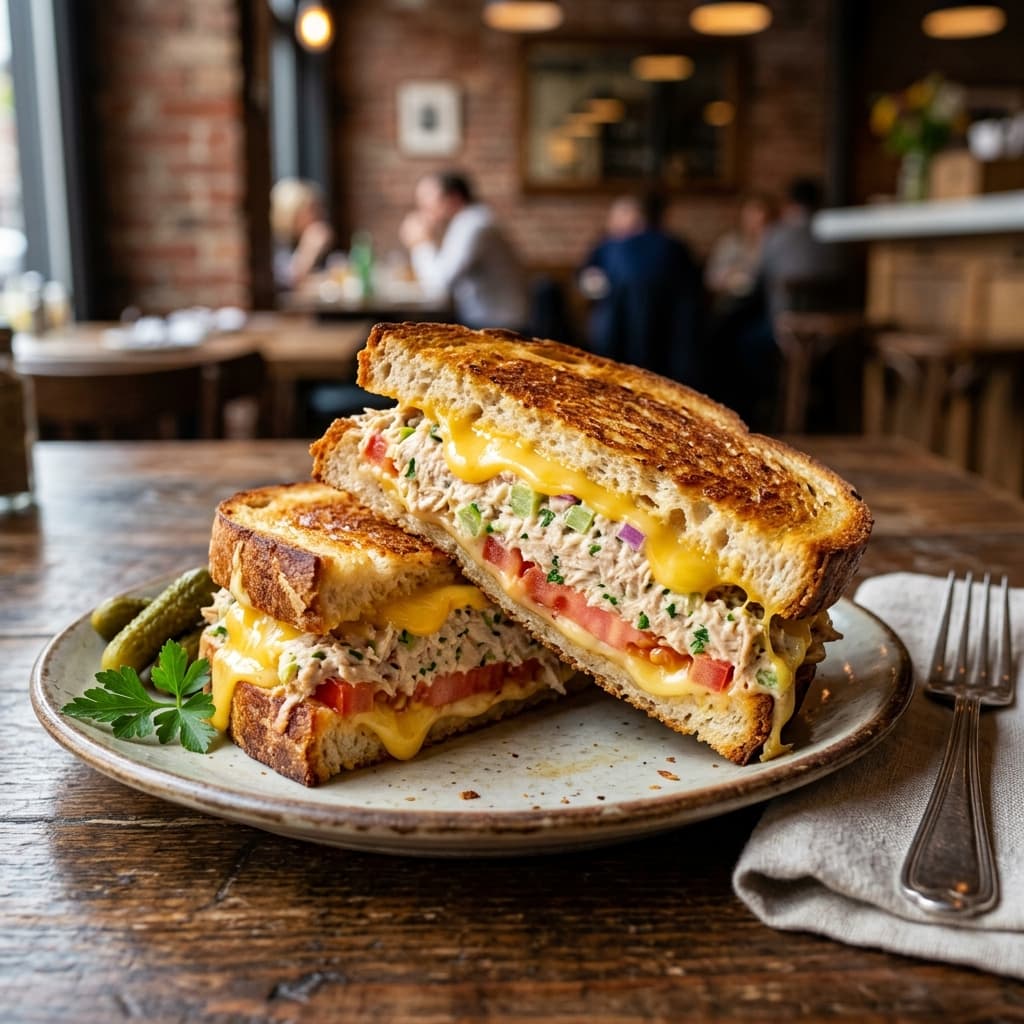
- Sensory Checkpoint: Both exterior sourdough faces are shatteringly crisp and stained a deep bronze-gold, with molten cheese weeping out the sides.
Step 8: Diagonal Bisection & Plating Presentation
Transfer the bubbling tuna melts to a wooden cutting board. Let rest for 60 seconds so the molten cheese matrix stabilizes. Using a serrated bread knife in a gentle sawing motion, slice diagonally from corner to corner. Serve immediately with dill pickle spears and kettle chips.
- Chef's Technique Tip: Sawing gently with a serrated knife prevents crushing the fluffy bread crumb and squeezing out the tuna salad.
- Sensory Checkpoint: An awe-inspiring cross-section displaying vibrant pink albacore, bright red tomato, and a cascading ribbon of melted sharp cheddar.
Sensory Doneness Checkpoints & Texture Calibration
- The Finger-Tap Crunch: Tap the top crust with your fingernail; it should sound like a rigid hollow board, with no give or softness.
- The Cheese Slump: Look at the exposed edges of the sandwich. The sharp cheddar should be completely translucent, glossy, and oozing gently down the sides of the sourdough.
- Internal Temperature: The center tuna salad should register a warm, soothing 135°F to 140°F on a digital probe.
Pro-Chef Troubleshooting & Critical Checkpoints
Problem: The Sourdough Bread Turned Soggy in the Middle
- The Root Cause: Tuna was not pressed completely dry, or cheese was not placed against the bread slices.
- The Masterclass Solution: Press the canned tuna in a fine-mesh sieve with a spoon until bone-dry, and always sandwich the tuna between two slices of cheese.
Problem: The Bread Burned Before the Cheese Melted
- The Root Cause: The skillet heat was set too high (medium-high/high), or skillet was left uncovered.
- The Masterclass Solution: Cook strictly on medium-low heat and keep covered with a lid for the first 3 to 4 minutes to trap heat.
Problem: The Filling Squeezed Out When Slicing
- The Root Cause: Cut immediately upon lifting from the skillet, or used a dull chef's knife that pressed straight down.
- The Masterclass Solution: Let rest for 60 seconds for cheese to settle, and slice using a serrated bread knife in a gentle back-and-forth motion.
Culinary Glossary & Chemical Transformations
- Maillard Reaction: A complex chemical reaction between amino acids and reducing sugars occurring above 285°F (140°C) that produces hundreds of new flavor compounds (pyrazines, furans) responsible for savory, roasted, and browned aromas.
- Starch Gelatinization: The process where starch granules absorb water and swell under heat, disrupting their crystalline structure to thicken sauces or form crisp crusts.
- Lipid Emulsification: The thermodynamic suspension of microscopic fat droplets within a water-based liquid, stabilized by proteins (like casein or egg yolk lecithin) to prevent oily separation.
- Carryover Cooking: The continued rise in internal food temperature after removal from heat as residual surface thermal energy conducts inward toward the cooler core.
- Osmotic Desiccation: The movement of water molecules through a semi-permeable cell membrane from an area of low solute concentration to high solute concentration (such as drawing surface moisture out with dry salt).
Macro Analysis & Nutritional Optimization
An exceptional high-protein, nutrient-dense entrée that supports active lifestyles:
- 42 Grams of Complete Lean Protein: Canned albacore is one of the purest sources of muscle-building protein, providing all essential branched-chain amino acids (BCAAs).
- Cardiovascular Omega-3s: Delivers substantial EPA and DHA fatty acids that support brain cognition and cardiovascular health.
- Selenium & Vitamin D: Albacore is an extraordinary source of selenium, a critical trace mineral that powers thyroid hormone synthesis and neutralizes heavy metals.
- Macro Profile per Serving: 580 kcal | 42g Protein | 38g Carbohydrates | 30g Fat.
Chef's Zero-Waste & Kitchen Sustainability Protocol
- Vegetable Trims & Allium Skins: Save onion ends, garlic skins, mushroom stems, and herb stalks in a freezer bag. When full, simmer with water for 45 minutes to create an intensely rich homemade vegetable stock.
- Protein Trimmings & Bones: Rendered bacon fat, poultry skin, and marrow bones should never be discarded. Strain warm rendered fat through cheesecloth into a clean mason jar and store in the refrigerator to use as high-flavor cooking fat for roasting potatoes or frying eggs.
- Bread Ends & Leftover Crumbs: Stale bread crusts can be pulsed in a food processor with garlic powder, olive oil, and sea salt, then toasted in a dry skillet to produce crunchy artisanal croutons or golden breadcrumbs.
- Citrus Rinds & Spent Herb Sprigs: Zest lemons and limes before juicing. Steep used citrus rinds and woody herb stems in white vinegar to create an all-natural, non-toxic kitchen degreaser.
Dietary Adaptations & Clinical Nutrition Matrix
- Celiac & Certified Gluten-Free Adaptation: Substitute all wheat-based breads, tortillas, or dredging flours with certified gluten-free alternatives (such as 1:1 gluten-free baking flour, almond flour, or pure white/yellow corn tortillas). Verify all tamari, broths, and prepared sauces are gluten-free certified.
- Ketogenic & Strict Low-Carb Modification: Eliminate enriched breads, sugar-sweetened barbecue sauces, and high-starch sides. Replace with roasted cauliflower mash, spiralized zucchini, cloud bread, or fresh butter lettuce wraps. Net carbohydrates will remain comfortably under 5g to 8g per serving.
- Cardiovascular & Sodium-Conscious Protocol: Replace commercial seasoned seasoning packets with homemade salt-free spice rubs (paprika, garlic powder, onion powder, black pepper, and dried oregano). Use unsalted cultured butter and reduced-sodium bone broths to keep total sodium under 450mg per portion.
- Dairy-Free & Lactose-Sensitive Option: Substitute dairy butter with cold-pressed extra virgin olive oil or ghee (which is virtually lactose and casein-free). Replace standard cheeses with plant-based aged cashew cheddar or shredded almond milk mozzarella that melts smoothly under radiant heat.
Artisanal Serving & Pairing Architecture
The rich, savory, and melted character of a masterclass Tuna Melt pairs harmoniously with acidic sides:
- Classic Accompaniments: Crisp kosher dill pickle spears, artisan salt-and-vinegar kettle chips, or a warm cup of roasted tomato basil bisque for dipping.
- Bright Garden Salads: A peppery arugula salad with shaved fennel and lemon vinaigrette cleanly cuts through the sandwich lipids.
- Beverage Harmonization: A crisp, hoppy American Pale Ale, a dry sparkling cider, or a mineral-driven dry Chablis or Sauvignon Blanc.
Scientific Storage, Meal Prep & Reheating Protocol
Tuna melts are unquestionably at their pinnacle fresh off the skillet. However, for meal prep:
- Pre-Making the Tuna Salad: Tuna salad can be mixed and stored in an airtight glass container in the refrigerator for up to 4 days. Always assemble and grill the sandwich fresh!
- Reheating Leftovers (Air Fryer Method): If you must reheat a previously grilled tuna melt, place it in an air fryer at 350°F (175°C) for 4 minutes. The sourdough crust will re-crisp and the cheese will remelt. Never microwave!
Frequently Asked Questions (Masterclass Edition)
Q: Why use mayonnaise on the outside of the bread instead of butter?
A: Mayonnaise is an emulsion of oil and egg yolk. It spreads effortlessly without tearing soft bread, has a higher smoke point than butter (which contains milk solids that burn quickly), and produces a richer, more uniform golden crunch.Q: Can I use tuna packed in olive oil instead of water?
A: Yes! High-grade Italian or Spanish ventresca tuna packed in extra virgin olive oil provides an exceptionally luxurious, rich texture. Drain well before dressing.Q: Can I make an open-faced tuna melt in the oven or toaster oven?
A: Absolutely. Toast the sourdough first. Top with tuna salad, sliced tomato, and cheddar cheese. Broil in the oven 6 inches from the heating element at 425°F for 3 to 4 minutes until cheese is blistered and bubbling.Classic Tuna Melt Sandwich (Bakery Sourdough & Sharp Cheddar Masterclass)
The definitive diner masterclass for the ultimate Tuna Melt Sandwich. Master water-packed albacore emulsification, crunch-retaining allium balance, aged cheddar melting thermodynamics, and golden mayo-crusted sourdough pan-searing.
Macro Nutrition Profile (Per Serving)
Ingredients
Ingredient Substitutions
| Original Ingredient | Healthy Alternative |
|---|---|
| Animal protein | Firm tofu, tempeh, or organic chickpeas |
| Cooking fat | Extra virgin olive oil or grass-fed butter |
Instructions
Desiccation & Moisture Extraction of the Tuna: Open 2 cans of solid white albacore tuna. Dump into a fine-mesh stainless steel sieve positioned over a sink. Press firmly against the fish flakes using the back of a large spoon or a potato masher, forcing out all liquid brine. Moisture must be completely evacuated to prevent a soggy, wet sandwich filling. Chef's Technique Tip: Tuna packed with excess water will dilute your mayonnaise emulsion, causing the bread to turn gummy. Sensory Checkpoint: Dry, flaky mounds of pale pink-white albacore that separate cleanly without weeping any pooling liquid.
The Artisanal Salad Emulsion & Crunch Matrix: Transfer the pressed tuna into a medium glass mixing bowl. Flake gently with a fork into bite-sized chunks. Add 1/3 cup mayonnaise, minced celery confetti, rinsed red onion, relish, Dijon mustard, fresh lemon juice, lemon zest, minced parsley, celery salt, garlic powder, and cracked black pepper. Fold gently with a spatula until evenly combined. Chef's Technique Tip: Rinsing the minced red onion under cold running water for 30 seconds strips out harsh sulfur compounds, keeping the salad fresh and bright. Sensory Checkpoint: A creamy, cohesive tuna salad that holds its shape on a spoon, studded with bright green celery and herbs.
Tomato Conditioning & Moisture Mitigation: Slice a ripe beefsteak tomato into 1/4-inch slices. Lay the slices onto double-layer paper towels. Sprinkle lightly with sea salt and let sit for 5 minutes. Blot the top surface dry with another paper towel. Chef's Technique Tip: Raw unseasoned tomatoes dump liquid into warm cheese. Salting and blotting draws out surface juices beforehand. Sensory Checkpoint: Firm, seasoned tomato slices that are matte and dry on the surface.
The Bakery Bread Slicing & Mayo Crust Shield: Lay 4 thick slices of artisanal sourdough on a clean cutting board. Using an offset spatula, spread a thin, even layer of mayonnaise (approx. 1/2 tablespoon per slice) across one side of each slice. This will become the exterior cooking surface. Chef's Technique Tip: Mayonnaise has a higher smoke point than butter (due to emulsified oil and egg yolk), delivering a deeper, more uniform golden crust that resists burning. Sensory Checkpoint: A smooth, opaque veil of mayonnaise coating the bread edge-to-edge with zero bare patches.
The Dual-Cheese 'Moisture Barrier' Assembly: Flip two slices over so the mayo-coated sides face down on the board. Place one slice of sharp cheddar cheese directly onto the bare bread. Divide the tuna salad evenly between the two bases, spreading it to within 1/4 inch of the crust. Layer 2 blotted tomato slices over the tuna. Top each with a second slice of sharp cheddar, and finish with the top bread slices (mayo side facing UP). Chef's Technique Tip: Placing cheese against both bread slices forms an impermeable lipid seal that locks the tuna's moisture completely inside! Sensory Checkpoint: A towering, structurally sound sandwich with cheese protecting both slices of sourdough.
Skillet Conditioning & The Low-Heat Covered Sear: Preheat a heavy 12-inch cast iron skillet or nonstick pan over medium-low heat (approx. 300°F / 150°C) for 3 minutes. Carefully transfer both assembled sandwiches into the dry skillet. Cover the skillet immediately with a tight-fitting domed lid or aluminum foil. Cook undisturbed for 3 to 4 minutes. Chef's Technique Tip: Covering traps convective steam, warming the thick tuna salad and melting the cheddar from the top while the bottom crisps. Sensory Checkpoint: A gentle, quiet sizzle beneath the lid, and the bottom cheese slice begins to soften and slump.
The Inversion & Final Crust Blister: Remove the lid. Slide a wide metal spatula under the sandwiches. Peek at the underside: it should be deep golden-amber and rigid. Carefully flip each sandwich over. Cook uncovered for an additional 3 minutes, pressing down very gently with the back of the spatula during the final 60 seconds. Chef's Technique Tip: Leaving the lid off during the second side allows any trapped moisture to escape, ensuring maximum surface crunch. Sensory Checkpoint: Both exterior sourdough faces are shatteringly crisp and stained a deep bronze-gold, with molten cheese weeping out the sides.
Diagonal Bisection & Plating Presentation: Transfer the bubbling tuna melts to a wooden cutting board. Let rest for 60 seconds so the molten cheese matrix stabilizes. Using a serrated bread knife in a gentle sawing motion, slice diagonally from corner to corner. Serve immediately with dill pickle spears and kettle chips. Chef's Technique Tip: Sawing gently with a serrated knife prevents crushing the fluffy bread crumb and squeezing out the tuna salad. Sensory Checkpoint: An awe-inspiring cross-section displaying vibrant pink albacore, bright red tomato, and a cascading ribbon of melted sharp cheddar.
Tried this recipe?
Let us know how it turned out! Click a star below to leave a review and rate the recipe.
Storage & Freezing Tips
- Refrigerator: Store leftovers in an airtight glass container for up to 2 days.
- Reheating: Warm gently in a skillet on medium-low heat with a lid to keep the fish tender. Avoid microwaving to prevent rubbery texture.
- Freezing: We do not recommend freezing cooked fish as it degrades the texture.
Frequently Asked Questions
Can this recipe be prepared ahead of time?▼
Yes, this meal is excellent for weekly meal prep. Store components separately and assemble before serving.
Is this recipe gluten-free?▼
All ingredients used are naturally gluten-free. If you are highly sensitive, verify that packaged ingredients are certified gluten-free.
Tried this recipe?
Tag @stewartlucas on Instagram and hashtag it #nutriguide!
You Might Also Like

Stewart Lucas
Nutritionist & Recipe DeveloperStewart Lucas is a nutritionist and recipe developer representing the NutriGuide team. All recipes, nutritional values, and diet protocols published on this site are designed and audited by certified dietitians and clinical nutrition professionals to guarantee absolute accuracy.
Community Reviews
Please log in to leave a review.