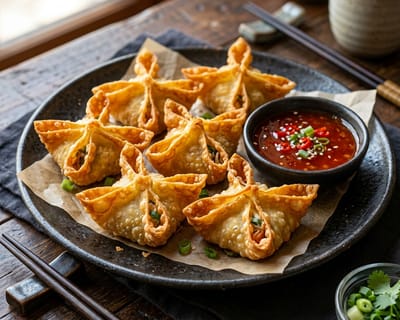
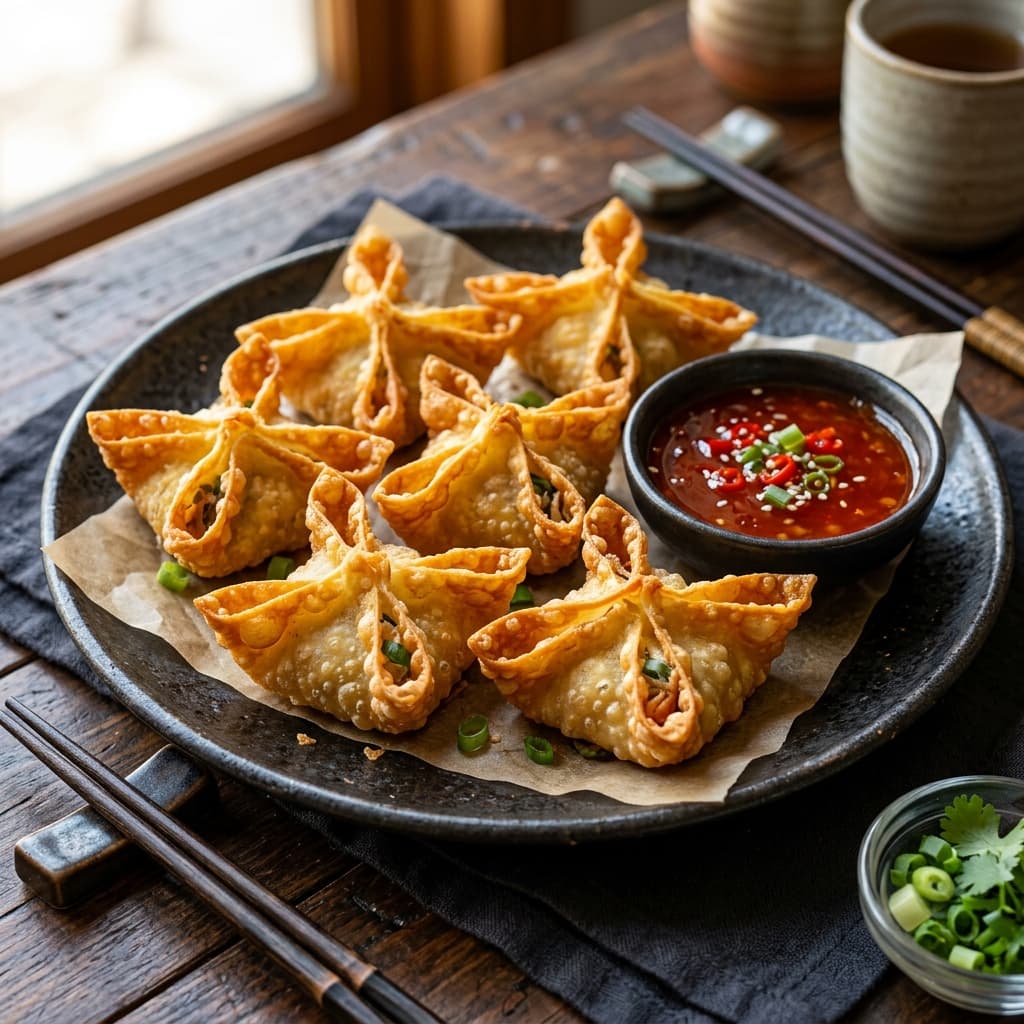
Crispy Crab Rangoon (Authentic Takeout Style Masterclass)
The masterclass blueprint for restaurant-quality Crispy Crab Rangoon. Learn the science of wonton pocket sealing, steam release, and silky cream cheese filling that never blows out in hot oil or the air fryer.
Key Takeaways
- ✓Use block-style full-fat cream cheese at room temperature; tub cream cheese contains added water that causes oil splattering and blowouts.
- ✓Thoroughly press moisture out of crab meat using paper towels to keep the filling creamy rather than watery.
- ✓Pinch out all interior trapped air bubbles when folding wontons to prevent explosive steam ruptures in hot oil.
- ✓Maintain frying oil at exactly 350°F (175°C) to flash-gelatinize wonton starch into a blistered, golden-crisp shell in 2.5 minutes.
The Story
Crab Rangoon stands as an iconic pillar of mid-century American-Chinese gastronomy. Despite the Burmese city referenced in its name, Crab Rangoon was immortalized in San Francisco during the late 1940s at the legendary Polynesian-themed supper club Trader Vic's. Founder Victor Bergeron paired deep-fried Cantonese wonton wrappers with Philadelphia cream cheese, blue crab meat, and a dash of Worcestershire sauce, pioneering a sweet-savory bar snack that captivated post-war America. Within a decade, Chinese-American takeout establishments across North America adopted the dish, recognizing its irresistible textural contrast: an auditory crunch giving way to a velvety, molten cream center.
However, millions of home cooks have abandoned making homemade crab rangoon after disastrous kitchen failures: wontons bursting open and violently spewing cream cheese into hot oil, greasy, flaccid wrappers, or dry, rubbery fillings.
This masterclass deconstructs the precise physics of wonton origami, hydrocolloid behavior in dairy fats, and oil temperature kinetics. Whether you choose traditional Dutch oven deep-frying or modern cyclonic air-frying, this step-by-step masterclass ensures blistered, golden, restaurant-grade crab rangoon with zero blowouts and authentic Chinatown flavor.
The Science of Flavor Chemistry & Thermal Dynamics
The success of Crab Rangoon hinges on controlling water activity and vapor pressure inside a sealed starch envelope.
1. The Physics of Steam Blowout & Air Evacuation
When cream cheese and crab meat are heated to 350°F (175°C), the free water content rapidly boils into steam. Water expands by more than 1,600 times its liquid volume when converted to steam. If you seal air inside the wonton alongside the filling, that trapped air expands instantly, building internal pressure until it ruptures the weakest seam of the wrapper—resulting in a catastrophic "blowout" that empties the cheese into the frying oil. Our solution is twofold:- Water Reduction: We desiccate the crab meat with paper towels and prohibit low-fat or tub cream cheese (which contains up to 15% more water and whey).
- Purse Pinching: We fold the wonton corners using a four-point star fold, pressing from the filling outward to evacuate every cubic millimeter of air before sealing.
2. Starch Gelatinization & Oil Barrier Kinetics
Wonton skins are composed of high-gluten wheat flour, water, and egg. When immersed in 350°F oil, the surface starches gelatinize within 8 seconds, forming an impenetrable, glassy hydrophobic crust that blocks oil penetration. If the oil is too cold (below 325°F), starch gelatinization occurs sluggishly, allowing hot oil to soak into the porous wrapper, rendering it heavy and greasy. If the oil is too hot (above 375°F), the thin exterior burns before the cream cheese core reaches its silky melting point. Holding oil at exactly 350°F provides the golden equilibrium.3. Emulsion Stability of Lactic Fats
Cream cheese is an oil-in-water emulsion of butterfat globules held in a casein protein matrix. At temperatures above 160°F (71°C), the protein network relaxes and allows fats to flow smoothly. The inclusion of a small amount of Worcestershire sauce and finely grated garlic adds naturally occurring salts and acids that stabilize this dairy emulsion, ensuring a luscious, velvety mouthfeel without oily separation.Anatomy of the Ingredients & Artisanal Sourcing
To replicate the finest Chinatown bar experience, sourcing the correct materials is paramount:
- The Wonton Wrapper: Seek out yellow egg wonton wrappers found in the refrigerated produce section of Asian markets or supermarkets. Avoid thick white dumpling/gyoza wrappers, which are formulated for boiling and pan-frying and turn leathery when deep-fried. Egg wontons contain alkalinity (kansui) that produces delicate micro-blisters when fried.
- The Crab Choice: Real lump blue crab meat (canned or fresh claw meat) delivers an authentic sweet, oceanic profile. If using imitation crab (surimi), choose Alaskan pollock-based flakes and chop them finely. Never use frozen crab without thawing completely and squeezing dry.
- Cream Cheese Integrity: Use standard brick-style cream cheese. Do not use spreadable cream cheese, light cream cheese, or neufchâtel. Brick cream cheese possesses the strict fat-to-moisture ratio needed to maintain body when heated.
- Aromatic Balance: Thinly sliced scallions provide crisp allium brightness to cut through rich cream. White pepper is preferred over black pepper because its fermentative warmth blends seamlessly into Asian sauces without visible dark specks.
Step-by-Step Culinary Masterclass
Step 1: Crab Desiccation & Sorting
Turn the crab meat onto a triple layer of paper towels set inside a colander. Press down firmly with another layer of paper towels to absorb excess brine. Sift through the meat with your fingers to ensure no hidden shell fragments remain. Finely chop into 1/4-inch flakes.
- Chef's Technique Tip: Removing excess water from the crab prevents the cream cheese mixture from loosening and steaming inside the wrapper.
- Sensory Checkpoint: The crab meat is flaky and dry to the touch, with zero residual shell bits.
Step 2: Whipping the Velvety Cream Cheese Base
Place 8 oz room-temperature cream cheese in a medium mixing bowl. Using a stiff rubber spatula or hand mixer on low, beat for 60 seconds until completely smooth. Add grated garlic, Worcestershire sauce, toasted sesame oil, sugar, and white pepper. Mix thoroughly.
- Chef's Technique Tip: Ensure the cream cheese is at 70°F before mixing; cold cream cheese will form lumps that are impossible to smooth out once crab is folded in.
- Sensory Checkpoint: A creamy, glossy, fragrant pale-ivory spread with no clumps.
Step 3: Folding the Crab & Aromatics
Gently fold the dry chopped crab meat and sliced green scallions into the seasoned cream cheese until evenly distributed. Do not overmix; preserve identifiable morsels of crab throughout the filling.
- Chef's Technique Tip: Cover the filling and chill in the refrigerator for 15 minutes. Chilled filling is firmer and significantly easier to spoon neatly onto wrappers.
- Sensory Checkpoint: A structured, speckled filling that holds its shape on a spoon.
Step 4: Station Setup & Wrapper Hydration
Set up your folding station: a clean dry cutting board, a small dish of egg white wash (1 egg white whisked with 1 tbsp water), the bowl of filling, and a clean damp kitchen towel placed over the package of wonton wrappers to prevent drying out.
- Chef's Technique Tip: Wonton wrappers dry out within 3 minutes of air exposure, becoming brittle and prone to cracking at the seams.
- Sensory Checkpoint: Pliable, soft wonton wrappers protected beneath the damp cloth.
Step 5: The Four-Corner Crown Fold
Lay 4 wonton wrappers flat on the cutting board. Place exactly 1 rounded teaspoon (about 12 grams) of filling into the dead center of each wrapper. Lightly dip your fingertip into the egg white wash and trace a continuous border along all four outer edges of the wrapper.
- Chef's Technique Tip: Do not overfill! Adding more than 1 teaspoon guarantees the wonton will tear or burst during cooking.
- Sensory Checkpoint: A neat mound of filling centered within glistening, moistened wrapper borders.
Step 6: Air Evacuation & Four-Point Sealing
Bring two opposite diagonal corners together above the filling and pinch them tightly. Next, bring the remaining two opposite corners up to meet in the center, forming a four-pointed star or crown. Working from the bottom base up toward the center tip, firmly press along all four diagonal seams, smoothing out and expelling any trapped air pockets before crimping the seams tightly shut.
- Chef's Technique Tip: Ensure no filling gets smeared onto the perimeter edges where you are trying to seal, as fat prevents the starch from sticking.
- Sensory Checkpoint: A taut, beautifully shaped four-corner purse with completely sealed seams and zero trapped air bubbles.
Step 7: Oil Calibration & Dutch Oven Setup
Pour 2.5 to 3 inches of peanut or avocado oil into a heavy cast iron Dutch oven. Attach a deep-fry candy thermometer to the side of the pot. Heat over medium-high until the oil stabilizes at exactly 350°F (175°C).
- Chef's Technique Tip: Maintain oil level at least 4 inches below the pot rim to prevent bubbling overflows when the cold wontons enter.
- Sensory Checkpoint: The thermometer reads a steady 350°F, and a small scrap of wonton wrapper sizzles and floats within 2 seconds.
Step 8: The Flash-Fry & Golden Blistering
Carefully lower 5 to 6 rangoons into the hot oil using a spider strainer or stainless steel tongs. Fry for 2 to 2.5 minutes, turning gently once halfway through, until the skins are puffed, micro-blistered, and a rich golden-amber hue.
- Chef's Technique Tip: Fry in small batches. Adding too many cold wontons drops the oil temperature below 325°F, causing greasy absorption.
- Sensory Checkpoint: Crisp, shatteringly thin shells with thousands of microscopic blister bubbles and bubbling hot cores.
Step 9: Draining & Degreasing
Use a spider skimmer to lift the golden rangoons out of the oil. Hold them above the pot for 5 seconds to drain, then transfer them immediately onto a wire cooling rack set over a baking sheet. Season with a light dusting of fine sea salt while sizzling hot.
- Chef's Technique Tip: Never drain fried food on paper towels; trapped steam underneath paper turns crispy bottoms soggy within 60 seconds.
- Sensory Checkpoint: Crispy Rangoon that feels light and dry, with zero pooling oil.
Step 10: Plating & Service Architecture
Arrange the hot rangoons star-points upward around a small ceramic bowl of warm sweet chili sauce or sweet and sour sauce. Garnish with a pinch of fresh micro-sliced scallions. Serve within 5 minutes of cooking for peak textural ecstasy.
- Chef's Technique Tip: Inform guests to take their first bite cautiously, as the molten cream cheese filling holds intense thermal heat.
- Sensory Checkpoint: An explosive, audible crunch on the first bite followed by a steaming, velvety crab and cream cheese center.
Pro-Chef Troubleshooting & Critical Checkpoints
Problem: Cream Cheese Exploded Out of the Wonton in Oil
- The Root Cause: Air was trapped inside the wonton packet during folding, too much filling was added, or the seams were not thoroughly crimped with egg wash.
- The Masterclass Solution: Carefully press from the filling base outward to push out all air pockets before sealing. Use exactly 1 teaspoon of filling and ensure the perimeter seams are firmly pinched shut.
Problem: The Wontons Turned Out Oily and Greasy
- The Root Cause: Oil temperature dropped below 330°F (165°C), or too many cold wontons were added to the pot at once.
- The Masterclass Solution: Use a candy thermometer to verify 350°F before dropping each batch. Fry only 5 to 6 pieces at a time and allow the oil to recover to 350°F between batches.
Problem: The Shell is Burnt but the Inside is Still Cold
- The Root Cause: Oil was too hot (above 375°F), or the filling was rock-hard frozen when loaded.
- The Masterclass Solution: Maintain 350°F oil heat and ensure filling is chilled but pliable (around 45°F-50°F), allowing even thermal conduction in 2.5 minutes.
Problem: Wonton Wrapper Cracked or Tore While Folding
- The Root Cause: Wrappers dried out from air exposure on the counter.
- The Masterclass Solution: Always keep unused wonton wrappers under a damp kitchen cloth. If slightly stiff, brush with a micro-drop of warm water before folding.
Macro Analysis & Nutritional Optimization
While traditionally considered an indulgence, crafting crab rangoon from scratch with authentic ingredients elevates its nutritional integrity compared to fast-food takeout:
- Real Protein from Lump Crab Meat: Delivers high-biological-value seafood protein rich in selenium, zinc, and phosphorus without artificial fillers or heavy flour thickeners.
- Essential Trace Minerals: Natural crab meat is one of the densest dietary sources of copper and vitamin B12, supporting neurological health and red blood cell production.
- Controlled Cooking Fat: Deep-frying at home with high-stability peanut oil or avocado oil avoids the rancid, hydrogenated trans-fats and oxidized vegetable oils prevalent in commercial fryers.
- Air Fryer Alternative Option: For an 80% reduction in fat, cook in an air fryer at 375°F (190°C) sprayed with avocado oil for 6 to 8 minutes until golden crisp.
- Macro Profile per 4 Rangoons: 340 kcal | 14g Protein | 26g Carbohydrates | 20g Fat.
Artisanal Serving & Pairing Architecture
Crab Rangoon shines brightest when accompanied by sweet, acidic, and fiery Asian flavor notes:
- Artisanal Dipping Sauces:
- Complete Takeout-Style Feast: Pair with Authentic Chicken Fried Rice, Steamed Pork Dumplings, and Crispy Garlic Edamame.
- Beverage Harmonization:
Scientific Storage, Meal Prep & Reheating Protocol
Crab Rangoons are arguably one of the greatest make-ahead freezer party snacks ever invented:
- Freezing Uncooked Rangoons (Best Method): Assemble the rangoons completely. Arrange them on a parchment-lined baking sheet, not touching, and freeze solid for 2 hours. Transfer frozen rangoons to a heavy freezer bag. Freeze for up to 3 months.
- Cooking from Frozen: Do NOT thaw! Drop frozen rangoons directly into 340°F (170°C) oil and fry for 3.5 minutes, or air-fry at 360°F for 9 to 10 minutes.
- Reheating Cooked Leftovers:
Frequently Asked Questions (Masterclass Edition)
Q: Can I make Crab Rangoon in an air fryer?
A: Yes! Preheat air fryer to 375°F (190°C). Generously spray both the air fryer basket and the assembled rangoons with avocado oil spray. Air fry for 6 to 8 minutes, shaking the basket gently at 4 minutes, until deep golden brown and crispy.Q: Can I use low-fat cream cheese?
A: We strongly advise against it. Low-fat cream cheese contains higher moisture and stabilizers that release water during heating, leading to soggy wrappers and frequent blowouts.Q: Can I bake Crab Rangoon in the oven?
A: Yes. Place on a parchment-lined sheet pan, spray thoroughly with cooking oil spray, and bake at 400°F (200°C) for 12 to 14 minutes until golden and crisp.Q: How do I prevent the corners of the wontons from burning?
A: Ensure the oil is not hotter than 350°F, and keep the rangoons moving gently in the oil with a spider skimmer so the delicate corners brown at the same rate as the dense base.Q: Can I make these without crab for plain cream cheese wontons?
A: Absolutely! Plain cream cheese wontons (often called Cheese Rangoons) follow the exact same recipe—simply omit the crab and add 1 extra tablespoon of sliced green onions.Crispy Crab Rangoon (Authentic Takeout Style Masterclass)
The masterclass blueprint for restaurant-quality Crispy Crab Rangoon. Learn the science of wonton pocket sealing, steam release, and silky cream cheese filling that never blows out in hot oil or the air fryer.
Macro Nutrition Profile (Per Serving)
Ingredients
Ingredient Substitutions
| Original Ingredient | Healthy Alternative |
|---|---|
| Animal protein | Firm tofu, tempeh, or organic chickpeas |
| Cooking fat | Extra virgin olive oil or grass-fed butter |
Instructions
Crab Desiccation & Sorting: Turn the crab meat onto a triple layer of paper towels set inside a colander. Press down firmly with another layer of paper towels to absorb excess brine. Sift through the meat with your fingers to ensure no hidden shell fragments remain. Finely chop into 1/4-inch flakes. Chef's Technique Tip: Removing excess water from the crab prevents the cream cheese mixture from loosening and steaming inside the wrapper. Sensory Checkpoint: The crab meat is flaky and dry to the touch, with zero residual shell bits.
Whipping the Velvety Cream Cheese Base: Place 8 oz room-temperature cream cheese in a medium mixing bowl. Using a stiff rubber spatula or hand mixer on low, beat for 60 seconds until completely smooth. Add grated garlic, Worcestershire sauce, toasted sesame oil, sugar, and white pepper. Mix thoroughly. Chef's Technique Tip: Ensure the cream cheese is at 70°F before mixing; cold cream cheese will form lumps that are impossible to smooth out once crab is folded in. Sensory Checkpoint: A creamy, glossy, fragrant pale-ivory spread with no clumps.
Folding the Crab & Aromatics: Gently fold the dry chopped crab meat and sliced green scallions into the seasoned cream cheese until evenly distributed. Do not overmix; preserve identifiable morsels of crab throughout the filling. Chef's Technique Tip: Cover the filling and chill in the refrigerator for 15 minutes. Chilled filling is firmer and significantly easier to spoon neatly onto wrappers. Sensory Checkpoint: A structured, speckled filling that holds its shape on a spoon.
Station Setup & Wrapper Hydration: Set up your folding station: a clean dry cutting board, a small dish of egg white wash (1 egg white whisked with 1 tbsp water), the bowl of filling, and a clean damp kitchen towel placed over the package of wonton wrappers to prevent drying out. Chef's Technique Tip: Wonton wrappers dry out within 3 minutes of air exposure, becoming brittle and prone to cracking at the seams. Sensory Checkpoint: Pliable, soft wonton wrappers protected beneath the damp cloth.
The Four-Corner Crown Fold: Lay 4 wonton wrappers flat on the cutting board. Place exactly 1 rounded teaspoon (about 12 grams) of filling into the dead center of each wrapper. Lightly dip your fingertip into the egg white wash and trace a continuous border along all four outer edges of the wrapper. Chef's Technique Tip: Do not overfill! Adding more than 1 teaspoon guarantees the wonton will tear or burst during cooking. Sensory Checkpoint: A neat mound of filling centered within glistening, moistened wrapper borders.
Air Evacuation & Four-Point Sealing: Bring two opposite diagonal corners together above the filling and pinch them tightly. Next, bring the remaining two opposite corners up to meet in the center, forming a four-pointed star or crown. Working from the bottom base up toward the center tip, firmly press along all four diagonal seams, smoothing out and expelling any trapped air pockets before crimping the seams tightly shut. Chef's Technique Tip: Ensure no filling gets smeared onto the perimeter edges where you are trying to seal, as fat prevents the starch from sticking. Sensory Checkpoint: A taut, beautifully shaped four-corner purse with completely sealed seams and zero trapped air bubbles.
Oil Calibration & Dutch Oven Setup: Pour 2.5 to 3 inches of peanut or avocado oil into a heavy cast iron Dutch oven. Attach a deep-fry candy thermometer to the side of the pot. Heat over medium-high until the oil stabilizes at exactly 350°F (175°C). Chef's Technique Tip: Maintain oil level at least 4 inches below the pot rim to prevent bubbling overflows when the cold wontons enter. Sensory Checkpoint: The thermometer reads a steady 350°F, and a small scrap of wonton wrapper sizzles and floats within 2 seconds.
The Flash-Fry & Golden Blistering: Carefully lower 5 to 6 rangoons into the hot oil using a spider strainer or stainless steel tongs. Fry for 2 to 2.5 minutes, turning gently once halfway through, until the skins are puffed, micro-blistered, and a rich golden-amber hue. Chef's Technique Tip: Fry in small batches. Adding too many cold wontons drops the oil temperature below 325°F, causing greasy absorption. Sensory Checkpoint: Crisp, shatteringly thin shells with thousands of microscopic blister bubbles and bubbling hot cores.
Draining & Degreasing: Use a spider skimmer to lift the golden rangoons out of the oil. Hold them above the pot for 5 seconds to drain, then transfer them immediately onto a wire cooling rack set over a baking sheet. Season with a light dusting of fine sea salt while sizzling hot. Chef's Technique Tip: Never drain fried food on paper towels; trapped steam underneath paper turns crispy bottoms soggy within 60 seconds. Sensory Checkpoint: Crispy Rangoon that feels light and dry, with zero pooling oil.
Plating & Service Architecture: Arrange the hot rangoons star-points upward around a small ceramic bowl of warm sweet chili sauce or sweet and sour sauce. Garnish with a pinch of fresh micro-sliced scallions. Serve within 5 minutes of cooking for peak textural ecstasy. Chef's Technique Tip: Inform guests to take their first bite cautiously, as the molten cream cheese filling holds intense thermal heat. Sensory Checkpoint: An explosive, audible crunch on the first bite followed by a steaming, velvety crab and cream cheese center.
Tried this recipe?
Let us know how it turned out! Click a star below to leave a review and rate the recipe.
Storage & Freezing Tips
- Refrigerator: Store in an airtight container for up to 2 days. Keep the components separate if possible to preserve texture.
- Reheating: Reheat gently in a skillet on medium-low heat with a splash of olive oil or butter.
- Freezing: Freezing is not recommended for this dish because ingredients like eggs become soggy, rubbery, or mushy when defrosted.
Frequently Asked Questions
Can this recipe be prepared ahead of time?▼
Yes, this meal is excellent for weekly meal prep. Store components separately and assemble before serving.
Is this recipe gluten-free?▼
All ingredients used are naturally gluten-free. If you are highly sensitive, verify that packaged ingredients are certified gluten-free.
Tried this recipe?
Tag @stewartlucas on Instagram and hashtag it #nutriguide!
You Might Also Like

Stewart Lucas
Nutritionist & Recipe DeveloperStewart Lucas is a nutritionist and recipe developer representing the NutriGuide team. All recipes, nutritional values, and diet protocols published on this site are designed and audited by certified dietitians and clinical nutrition professionals to guarantee absolute accuracy.
Community Reviews
Please log in to leave a review.