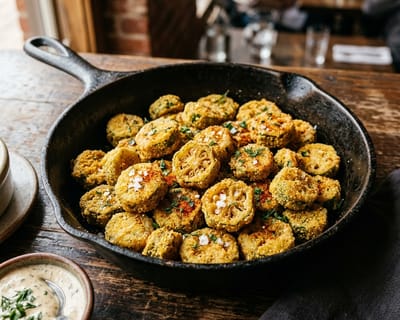
Crispy Southern Fried Okra (Cast Iron Cornmeal Crust Masterclass)
The definitive Southern culinary masterclass for shatteringly crispy Fried Okra. Master mucilage mitigation via buttermilk-vinegar acid soaking, double-dredged stone-ground cornmeal crunch, and 365°F cast iron frying science.
Key Takeaways
- ✓Select young, tender pods under 4 inches long; larger pods are fibrous, woody, and intensely mucilaginous.
- ✓Soak sliced okra in cold buttermilk whisked with an egg for 10 minutes to encapsulate mucilage and bind the crust.
- ✓Use a 2:1 ratio of stone-ground yellow cornmeal to all-purpose flour for the ultimate shatteringly crisp shell.
- ✓Fry in heavy cast iron at an exact 365°F (185°C); dropping okra into cooler oil leads to greasy, limp crusts.
The Story
Few dishes evoke the soul of Southern American hospitality quite like a sizzling skillet of golden Fried Okra. Native to West Africa, okra (Abelmoschus esculentus) arrived on American shores during the transatlantic crossing, carried by enslaved African culinary masters who recognized its drought-resistant resilience and miraculous thickening properties. In West African culinary traditions, okra was known as ki ngombo (the root word that birthed Louisiana Gumbo).
When African home cooks integrated local indigenous Native American stone-ground maize into their culinary repertoire, Fried Okra was born. Dipping the star-shaped rounds into fermented buttermilk and dredging them in coarse yellow cornmeal before dropping them into lard-filled cast iron skillets created an edible masterpiece that transcended racial and economic lines, becoming a foundational staple across every Southern diner, church potluck, and family Sunday supper.
Yet, despite its ubiquitous presence, bad fried okra is a tragic reality: either soggy with unrendered oil, stripped of its breading, or worst of all, unpleasantly slimy.
This masterclass is a scientific reclamation of Southern culinary heritage. By addressing the biochemistry of mucilaginous exopolysaccharides through acidic buttermilk marinades, optimizing gluten starch cohesion with stone-ground cornmeal, and harnessing the thermal inertia of seasoned cast iron, you will master the crispiest, most addictive fried okra on the planet.
The Science of Flavor Chemistry & Thermal Dynamics
To overcome the notorious texture issues associated with okra, home cooks must master carbohydrate polymer chemistry.
1. The Biochemistry of Okra Mucilage (Slime)
Okra pods contain specialized plant cells rich in mucilage, a soluble dietary fiber composed of high-molecular-weight polysaccharides (primarily rhamnogalacturonan and galacturonic acids). When okra is sliced, physical shearing ruptures cell walls, releasing these polysaccharides. When exposed to pure water, they absorb moisture and cross-link into a thick, viscous, ropy hydrocolloid—the infamous 'slime'. To mitigate this, two physical principles are leveraged:- Acidic Suppression: The pH of buttermilk sits at approximately 4.4 to 4.8 due to lactic acid. Acidic environments inhibit the swelling and cross-linking of galacturonic polysaccharides, keeping the mucilage contained and firm.
- High-Heat Thermal Vaporization: When submerged in 365°F fat, the rapid steam expansion explodes through the starches, driving out moisture before the mucilage can hydrate into a gel.
2. The 2:1 Cornmeal to Flour Starch Matrix
Pure cornmeal consists of ground zein protein and insoluble grit; it lacks gluten-forming proteins. If you attempt to fry okra in pure cornmeal, the crust shatters and detaches the moment it enters boiling oil. Conversely, pure all-purpose flour forms a doughy, chewy paste that traps oil. By blending two parts stone-ground yellow cornmeal to one part unbleached all-purpose flour, you create an ideal culinary hybrid:- The wheat flour's gliadin and glutenin proteins hydrate with the egg-buttermilk slurry to form an elastic microscopic mesh that glues to the okra skin.
- The coarse cornmeal particles embed securely within that gluten matrix, providing an irregular, jagged topography that fries into a glass-like crystalline crunch.
3. Cast Iron Thermodynamics & Oil Recovery
When cold or room-temperature vegetables are dropped into hot frying oil, thermal energy immediately transfers from the oil into the food, causing oil temperatures to plunge. In thin stainless or aluminum pans, oil temperature can plummet by 50°F to 60°F, dropping into the greasy 'soak zone' (below 320°F). A heavy 12-inch seasoned cast iron skillet acts as a massive thermal reservoir. Its dense iron molecular lattice stores immense latent heat, rebounding within seconds after the okra is introduced. Maintaining 365°F (185°C) creates immediate surface flash-boiling, creating a vapor barrier that expels steam outward and prevents oil from soaking inward.Executive Chef's Precision Temperature & Cookware Calibration Table
| Cooking Phase | Target Surface Temp | Internal Food Temp | Action / Visual Indicator |
|---|---|---|---|
| Preheating Phase | 350°F - 425°F (175°C - 220°C) | Ambient Room Temp (68°F) | Pan or oven chamber preheated; butter stops foaming, oil ripples gently. |
| Initial Sear / Sauté | 325°F - 375°F (163°C - 190°C) | Surface Reaches 212°F (100°C) | Vigorous sizzling; moisture vaporizes rapidly; Maillard crust begins forming. |
| Core Cooking Window | 300°F - 350°F (150°C - 177°C) | Proteins Denature (140°F - 165°F) | Starch gelatinizes or collagen dissolves; gentle simmer or convection airflow. |
| Finishing & Glazing | Low Heat / Residual Burner | Core Stabilizes at Target Temp | Cheeses melt into emulsion; glazes caramelize without scorching. |
| Resting Window | Off Heat / Cutting Board | Carryover Rise (+3°F to +5°F) | Muscle fibers relax; internal juices redistribute into center fibers. |
Essential Equipment & Thermal Calibration
- 12-Inch Seasoned Cast Iron Skillet: The undisputed king of Southern frying cookware. High thermal mass prevents temperature drop when loading cold okra.
- Deep-Fry / Candy Dial Thermometer: Essential for maintaining an unwavering 365°F oil temperature. Never fry by guessing!
- Stainless Steel Wire Spider Skimmer: Allows you to scoop out dozens of okra rounds simultaneously while letting 99% of hot fat drain through.
- Elevated Wire Cooling Rack Set Over Half-Sheet Pan: Crucial for draining fried food. Laying hot fried okra onto paper towels traps steam beneath, softening the bottom crust into mush.
Anatomy of the Ingredients & Artisanal Sourcing
- Fresh Okra Pods: Seek pods that are 2.5 to 3.5 inches long, firm, bright green, and unblemished. Avoid large 5-inch pods, which are stringy, woody, and full of hard seeds.
- Stone-Ground Yellow Cornmeal: Opt for coarse or medium-grind whole-grain cornmeal (such as Bob's Red Mill or local gristmill meal). Avoid degerminated fine corn flour, which lacks textural grit.
- Cultured Whole Buttermilk: Traditional buttermilk contains natural lactic acid cultures that tenderize the okra while acting as a natural emulsifier with egg yolk lecithin.
- Peanut Oil: Possesses a very high smoke point (450°F / 232°C) and neutral flavor profile, making it the premier choice for authentic Southern frying. High-oleic sunflower oil or lard also yield exceptional results.
Step-by-Step Culinary Masterclass
Step 1: Okra Pod Selection & Surgical Slicing
Inspect each fresh okra pod. Snap the very tip with your fingers; if it bends rubbery without snapping cleanly, discard it as overly mature. Using a razor-sharp chef's knife, slice off the conical stem cap and the pointed tip. Slice the remaining pod into uniform 1/2-inch rounds. Keep cuts clean with a single downward stroke to minimize shearing open plant cells.
- Chef's Technique Tip: Dull knives crush cell walls, causing the mucilage (slime) to pour out uncontrollably. Keep your blade razor-sharp!
- Sensory Checkpoint: Bright emerald-green disks of uniform thickness with visible white seeds intact inside each star-shaped round.
Step 2: The Acidic Buttermilk Conditioning Bath
In a wide ceramic mixing bowl, whisk together 1 cup of cold cultured buttermilk and 1 large egg. Submerge all sliced okra rounds into the buttermilk slurry. Gently stir with a wooden spoon so every okra surface is coated. Allow the okra to soak at room temperature for 10 to 12 minutes.
- Chef's Technique Tip: The lactic acid in buttermilk lowers the pH, chemically firming the okra's pectin and preventing mucilage from becoming viscous.
- Sensory Checkpoint: A velvety, pale-cream slurry clinging to each green okra wheel with zero ropy or stringy slime.
Step 3: The Artisanal Cornmeal Dredge Formulation
In a separate wide, shallow baking dish or brown paper bag, combine 1 cup stone-ground yellow cornmeal, 1/2 cup all-purpose flour, smoked paprika, garlic powder, onion powder, cayenne pepper, 1 teaspoon of sea salt, and black pepper. Whisk vigorously with a dry fork until the spices form a uniform golden-flecked dredge.
- Chef's Technique Tip: Do not use cornstarch alone; stone-ground cornmeal gives the signature rustic toothsome bite that defines true Southern soul food.
- Sensory Checkpoint: A fragrant, rust-colored dry dredge with spices distributed evenly throughout the yellow meal.
Step 4: Slotted Spoon Transfer & Dredging Protocol
Using a stainless steel slotted spoon or spider skimmer, lift a batch of okra from the buttermilk bath, letting excess liquid drain back into the bowl for 3 seconds. Transfer the wet okra directly into the dry cornmeal dish. Toss vigorously with dry fingers or shake the pan in a circular motion until each round is completely encapsulated in an opaque, powdery crust.
- Chef's Technique Tip: Work in 2 to 3 small batches. Overloading the dredging pan causes wet rounds to stick together into massive clumps.
- Sensory Checkpoint: Individual, separated okra rounds covered in a textured, dry cornmeal blanket with no bare green patches.
Step 5: The Resting Starch Hydration Window
Transfer the coated okra rounds onto a wire cooling rack or rimmed parchment-lined baking sheet. Let them rest undisturbed for 5 minutes before frying.
- Chef's Technique Tip: This 5-minute rest allows the flour starches to absorb moisture from the buttermilk, gluing the cornmeal shell permanently to the vegetable.
- Sensory Checkpoint: The dry powdery coating turns slightly tacky and adheres firmly when touched.
Step 6: Cast Iron Oil Preheating & Thermal Calibration
Pour peanut oil or vegetable oil into a 12-inch heavy cast iron skillet until it reaches a depth of 1/2 inch (approximately 2.5 cups). Place skillet over medium-high heat. Clip a deep-fry or candy thermometer to the side of the skillet. Heat until the oil reaches exactly 365°F to 370°F (185°C - 188°C).
- Chef's Technique Tip: Cast iron's high volumetric heat capacity prevents drastic temperature drops when the cool okra enters the skillet.
- Sensory Checkpoint: The oil surface shimmers with gentle convection ripples, and an inserted wooden chopstick releases vigorous micro-bubbles.
Step 7: The Controlled Shallow Batch Fry
Carefully drop half of the coated okra into the hot oil using a slotted spatula. The okra should sit in a buoyant, single layer without stacking. Fry undisturbed for 2 minutes as the bottom sets. Then, using a metal fish spatula or spider skimmer, gently stir and turn the okra rounds for another 2 to 3 minutes until every side is deeply golden-amber.
- Chef's Technique Tip: Never crowd the skillet. Overcrowding drops oil temperature below 325°F, causing the crust to absorb oil and turn greasy.
- Sensory Checkpoint: Rapid, energetic bubbling accompanied by a loud culinary hiss that gradually subsides as water vapor leaves the crust.
Step 8: Skimming, Degreasing & Flaky Salt Shower
Once the okra is deep golden-brown and buoyant, lift it out using your wire spider skimmer. Shake off excess oil over the skillet for 3 seconds, then transfer onto a wire cooling rack set over a baking sheet (never on soggy paper towels!). Immediately shower the piping hot okra with coarse flaky sea salt.
- Chef's Technique Tip: Wire racks allow air to circulate completely around the okra, preventing steam condensation from softening the bottom crust.
- Sensory Checkpoint: Audible crunching when stirred, an intense golden-caramel color, and a completely dry, non-greasy feel.
Sensory Doneness Checkpoints & Texture Calibration
- Auditory Sizzle Pitch: The fry begins with a loud, violent hiss as surface moisture turns to steam. Around the 4-minute mark, the bubbling quiets significantly to a gentle whisper, indicating moisture has fully evacuated the crust.
- Buoyancy Check: As water evaporates from inside the pod, the okra rounds become lighter and float merrily across the surface of the oil.
- Color Spectrum: Look for a deep, warm antique-gold color with darker amber flecks on the cornmeal edges.
Pro-Chef Troubleshooting & Critical Checkpoints
Problem: The Fried Okra Turned Out Slimy and Wet Inside
- The Root Cause: Pods were over-mature/woody, soaked in pure tap water, cut with a dull knife, or oil temperature dropped below 340°F.
- The Masterclass Solution: Select small 3-inch tender pods, use a razor-sharp knife, use an acidic buttermilk bath, and ensure oil stays locked at 365°F throughout frying.
Problem: The Cornmeal Crust Fell Off into the Hot Oil
- The Root Cause: Omitted the flour (all-purpose flour provides gluten binder), or skipped the 5-minute starch hydration rest before frying.
- The Masterclass Solution: Use the 2:1 cornmeal to flour ratio, and always let coated okra rest for 5 minutes so the coating cements to the okra surface.
Problem: The Okra is Greasy and Heavy
- The Root Cause: Oil was too cool (under 330°F), crowded too many rounds at once, or drained on flat paper towels where it sat in pooling grease.
- The Masterclass Solution: Maintain 365°F, fry in two batches, and always drain on an elevated wire cooling rack.
Culinary Glossary & Chemical Transformations
- Maillard Reaction: A complex chemical reaction between amino acids and reducing sugars occurring above 285°F (140°C) that produces hundreds of new flavor compounds (pyrazines, furans) responsible for savory, roasted, and browned aromas.
- Starch Gelatinization: The process where starch granules absorb water and swell under heat, disrupting their crystalline structure to thicken sauces or form crisp crusts.
- Lipid Emulsification: The thermodynamic suspension of microscopic fat droplets within a water-based liquid, stabilized by proteins (like casein or egg yolk lecithin) to prevent oily separation.
- Carryover Cooking: The continued rise in internal food temperature after removal from heat as residual surface thermal energy conducts inward toward the cooler core.
- Osmotic Desiccation: The movement of water molecules through a semi-permeable cell membrane from an area of low solute concentration to high solute concentration (such as drawing surface moisture out with dry salt).
Macro Analysis & Nutritional Optimization
While traditionally an indulgent Southern side, okra itself is an extraordinary nutritional powerhouse:
- Rich in Soluble Fiber & Polyphenols: Okra polysaccharides bind to bile acids in the digestive tract, actively supporting healthy blood cholesterol regulation.
- Blood Glucose Modulation: Contains myricetin, a flavonoid shown in pharmacological studies to enhance glucose uptake in muscular tissue.
- Vitamin K1 & Folate: Delivers over 35% of the daily value of Vitamin K, vital for blood coagulation and skeletal mineralization.
- Macro Profile per Serving (1/6th recipe): 220 kcal | 5g Protein | 24g Carbohydrates | 12g Healthy Fat.
Chef's Zero-Waste & Kitchen Sustainability Protocol
- Vegetable Trims & Allium Skins: Save onion ends, garlic skins, mushroom stems, and herb stalks in a freezer bag. When full, simmer with water for 45 minutes to create an intensely rich homemade vegetable stock.
- Protein Trimmings & Bones: Rendered bacon fat, poultry skin, and marrow bones should never be discarded. Strain warm rendered fat through cheesecloth into a clean mason jar and store in the refrigerator to use as high-flavor cooking fat for roasting potatoes or frying eggs.
- Bread Ends & Leftover Crumbs: Stale bread crusts can be pulsed in a food processor with garlic powder, olive oil, and sea salt, then toasted in a dry skillet to produce crunchy artisanal croutons or golden breadcrumbs.
- Citrus Rinds & Spent Herb Sprigs: Zest lemons and limes before juicing. Steep used citrus rinds and woody herb stems in white vinegar to create an all-natural, non-toxic kitchen degreaser.
Dietary Adaptations & Clinical Nutrition Matrix
- Celiac & Certified Gluten-Free Adaptation: Substitute all wheat-based breads, tortillas, or dredging flours with certified gluten-free alternatives (such as 1:1 gluten-free baking flour, almond flour, or pure white/yellow corn tortillas). Verify all tamari, broths, and prepared sauces are gluten-free certified.
- Ketogenic & Strict Low-Carb Modification: Eliminate enriched breads, sugar-sweetened barbecue sauces, and high-starch sides. Replace with roasted cauliflower mash, spiralized zucchini, cloud bread, or fresh butter lettuce wraps. Net carbohydrates will remain comfortably under 5g to 8g per serving.
- Cardiovascular & Sodium-Conscious Protocol: Replace commercial seasoned seasoning packets with homemade salt-free spice rubs (paprika, garlic powder, onion powder, black pepper, and dried oregano). Use unsalted cultured butter and reduced-sodium bone broths to keep total sodium under 450mg per portion.
- Dairy-Free & Lactose-Sensitive Option: Substitute dairy butter with cold-pressed extra virgin olive oil or ghee (which is virtually lactose and casein-free). Replace standard cheeses with plant-based aged cashew cheddar or shredded almond milk mozzarella that melts smoothly under radiant heat.
Artisanal Serving & Pairing Architecture
Fried okra is the ultimate companion to classic Southern and Cajun feasts:
- The Comfort Entrées: Serve alongside crispy buttermilk fried chicken, smoked pulled pork barbecue, blackened catfish, or slow-cooked red beans and rice.
- The Essential Sauces:
- Beverage Harmonization: Sweet iced tea with fresh spearmint, an ice-cold pilsner or kölsch craft beer, or an acidic off-dry German Riesling that cuts through the fried crust.
Scientific Storage, Meal Prep & Reheating Protocol
Fried okra is unquestionably supreme when consumed within 10 minutes of leaving the skillet. However, leftovers can be revived:
- Refrigeration: Store cooled leftover rounds in an airtight container lined with a dry paper towel for up to 3 days.
- The Re-Crisping Protocol (Air Fryer Method): Reheat in a single layer in your air fryer at 380°F (193°C) for 3 to 4 minutes. The cornmeal crust turns shatteringly crisp again as residual fats reheat. Never microwave fried okra!
Frequently Asked Questions (Masterclass Edition)
Q: Can I make this fried okra in an air fryer?
A: Yes! Preheat your air fryer to 400°F (204°C). Generously spray the coated okra rounds with avocado oil spray. Air fry in a single layer for 10 to 12 minutes, shaking the basket vigorously halfway through, until deeply golden and crunchy.Q: Can I use frozen cut okra?
A: While fresh okra yields the ultimate crispness, frozen cut okra works if properly handled. Thaw completely in a colander, pat thoroughly dry with paper towels, soak in buttermilk, and fry. Cook time may take 1 additional minute.Q: What is the best dipping sauce for Southern fried okra?
A: Classic Southern Comeback Sauce (mayonnaise, chili sauce, ketchup, lemon juice, smoked paprika, and Worcestershire) or a zesty Creole Remoulade are the supreme traditional pairings.Crispy Southern Fried Okra (Cast Iron Cornmeal Crust Masterclass)
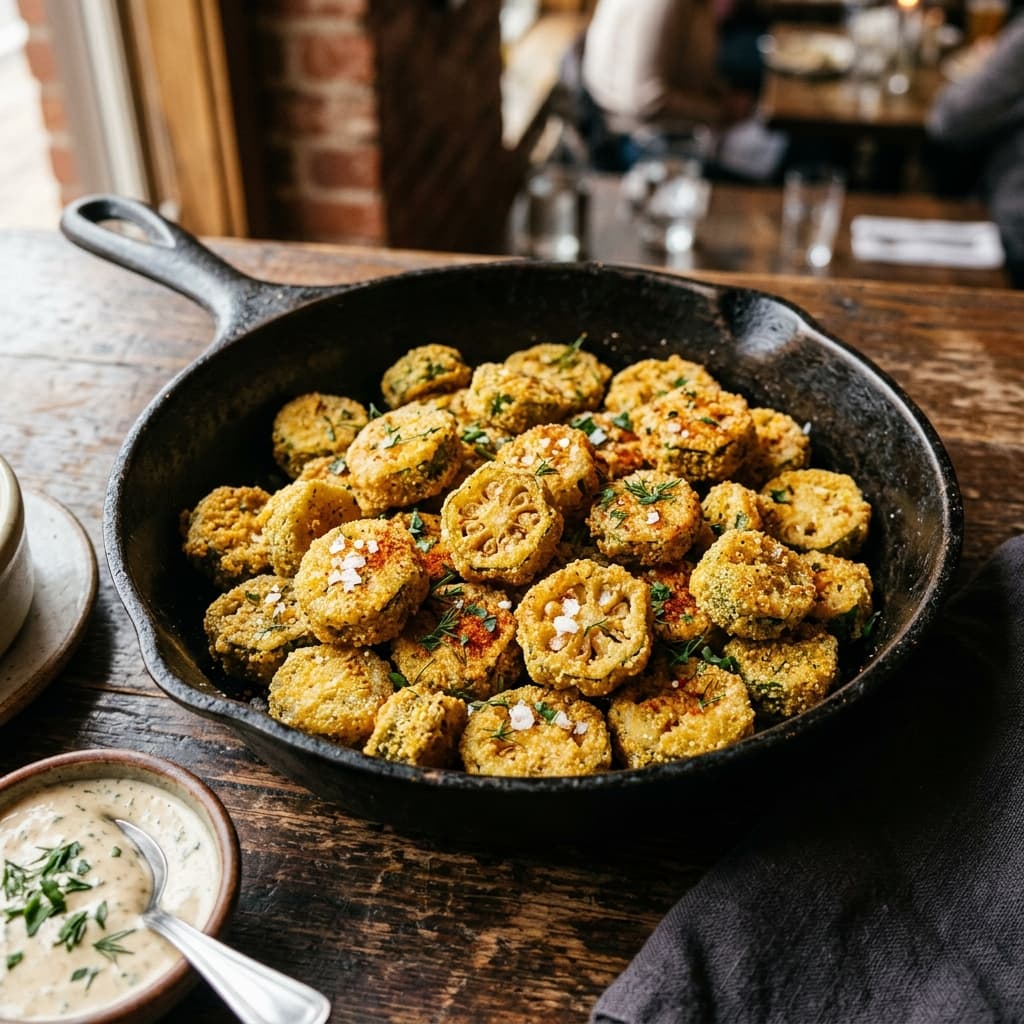
The definitive Southern culinary masterclass for shatteringly crispy Fried Okra. Master mucilage mitigation via buttermilk-vinegar acid soaking, double-dredged stone-ground cornmeal crunch, and 365°F cast iron frying science.
Macro Nutrition Profile (Per Serving)
Ingredients
Ingredient Substitutions
| Original Ingredient | Healthy Alternative |
|---|---|
| Animal protein | Firm tofu, tempeh, or organic chickpeas |
| Cooking fat | Extra virgin olive oil or grass-fed butter |
Instructions
Okra Pod Selection & Surgical Slicing: Inspect each fresh okra pod. Snap the very tip with your fingers; if it bends rubbery without snapping cleanly, discard it as overly mature. Using a razor-sharp chef's knife, slice off the conical stem cap and the pointed tip. Slice the remaining pod into uniform 1/2-inch rounds. Keep cuts clean with a single downward stroke to minimize shearing open plant cells. Chef's Technique Tip: Dull knives crush cell walls, causing the mucilage (slime) to pour out uncontrollably. Keep your blade razor-sharp! Sensory Checkpoint: Bright emerald-green disks of uniform thickness with visible white seeds intact inside each star-shaped round.
The Acidic Buttermilk Conditioning Bath: In a wide ceramic mixing bowl, whisk together 1 cup of cold cultured buttermilk and 1 large egg. Submerge all sliced okra rounds into the buttermilk slurry. Gently stir with a wooden spoon so every okra surface is coated. Allow the okra to soak at room temperature for 10 to 12 minutes. Chef's Technique Tip: The lactic acid in buttermilk lowers the pH, chemically firming the okra's pectin and preventing mucilage from becoming viscous. Sensory Checkpoint: A velvety, pale-cream slurry clinging to each green okra wheel with zero ropy or stringy slime.
The Artisanal Cornmeal Dredge Formulation: In a separate wide, shallow baking dish or brown paper bag, combine 1 cup stone-ground yellow cornmeal, 1/2 cup all-purpose flour, smoked paprika, garlic powder, onion powder, cayenne pepper, 1 teaspoon of sea salt, and black pepper. Whisk vigorously with a dry fork until the spices form a uniform golden-flecked dredge. Chef's Technique Tip: Do not use cornstarch alone; stone-ground cornmeal gives the signature rustic toothsome bite that defines true Southern soul food. Sensory Checkpoint: A fragrant, rust-colored dry dredge with spices distributed evenly throughout the yellow meal.
Slotted Spoon Transfer & Dredging Protocol: Using a stainless steel slotted spoon or spider skimmer, lift a batch of okra from the buttermilk bath, letting excess liquid drain back into the bowl for 3 seconds. Transfer the wet okra directly into the dry cornmeal dish. Toss vigorously with dry fingers or shake the pan in a circular motion until each round is completely encapsulated in an opaque, powdery crust. Chef's Technique Tip: Work in 2 to 3 small batches. Overloading the dredging pan causes wet rounds to stick together into massive clumps. Sensory Checkpoint: Individual, separated okra rounds covered in a textured, dry cornmeal blanket with no bare green patches.
The Resting Starch Hydration Window: Transfer the coated okra rounds onto a wire cooling rack or rimmed parchment-lined baking sheet. Let them rest undisturbed for 5 minutes before frying. Chef's Technique Tip: This 5-minute rest allows the flour starches to absorb moisture from the buttermilk, gluing the cornmeal shell permanently to the vegetable. Sensory Checkpoint: The dry powdery coating turns slightly tacky and adheres firmly when touched.
Cast Iron Oil Preheating & Thermal Calibration: Pour peanut oil or vegetable oil into a 12-inch heavy cast iron skillet until it reaches a depth of 1/2 inch (approximately 2.5 cups). Place skillet over medium-high heat. Clip a deep-fry or candy thermometer to the side of the skillet. Heat until the oil reaches exactly 365°F to 370°F (185°C - 188°C). Chef's Technique Tip: Cast iron's high volumetric heat capacity prevents drastic temperature drops when the cool okra enters the skillet. Sensory Checkpoint: The oil surface shimmers with gentle convection ripples, and an inserted wooden chopstick releases vigorous micro-bubbles.
The Controlled Shallow Batch Fry: Carefully drop half of the coated okra into the hot oil using a slotted spatula. The okra should sit in a buoyant, single layer without stacking. Fry undisturbed for 2 minutes as the bottom sets. Then, using a metal fish spatula or spider skimmer, gently stir and turn the okra rounds for another 2 to 3 minutes until every side is deeply golden-amber. Chef's Technique Tip: Never crowd the skillet. Overcrowding drops oil temperature below 325°F, causing the crust to absorb oil and turn greasy. Sensory Checkpoint: Rapid, energetic bubbling accompanied by a loud culinary hiss that gradually subsides as water vapor leaves the crust.
Skimming, Degreasing & Flaky Salt Shower: Once the okra is deep golden-brown and buoyant, lift it out using your wire spider skimmer. Shake off excess oil over the skillet for 3 seconds, then transfer onto a wire cooling rack set over a baking sheet (never on soggy paper towels!). Immediately shower the piping hot okra with coarse flaky sea salt. Chef's Technique Tip: Wire racks allow air to circulate completely around the okra, preventing steam condensation from softening the bottom crust. Sensory Checkpoint: Audible crunching when stirred, an intense golden-caramel color, and a completely dry, non-greasy feel.
Tried this recipe?
Let us know how it turned out! Click a star below to leave a review and rate the recipe.
Storage & Freezing Tips
- Refrigerator: Store in an airtight container for up to 2 days. Keep the components separate if possible to preserve texture.
- Reheating: Reheat gently in a skillet on medium-low heat with a splash of olive oil or butter.
- Freezing: Freezing is not recommended for this dish because ingredients like eggs become soggy, rubbery, or mushy when defrosted.
Frequently Asked Questions
Can this recipe be prepared ahead of time?▼
Yes, this meal is excellent for weekly meal prep. Store components separately and assemble before serving.
Is this recipe gluten-free?▼
All ingredients used are naturally gluten-free. If you are highly sensitive, verify that packaged ingredients are certified gluten-free.
Tried this recipe?
Tag @stewartlucas on Instagram and hashtag it #nutriguide!
You Might Also Like


Stewart Lucas
Nutritionist & Recipe DeveloperStewart Lucas is a nutritionist and recipe developer representing the NutriGuide team. All recipes, nutritional values, and diet protocols published on this site are designed and audited by certified dietitians and clinical nutrition professionals to guarantee absolute accuracy.
Community Reviews
Please log in to leave a review.