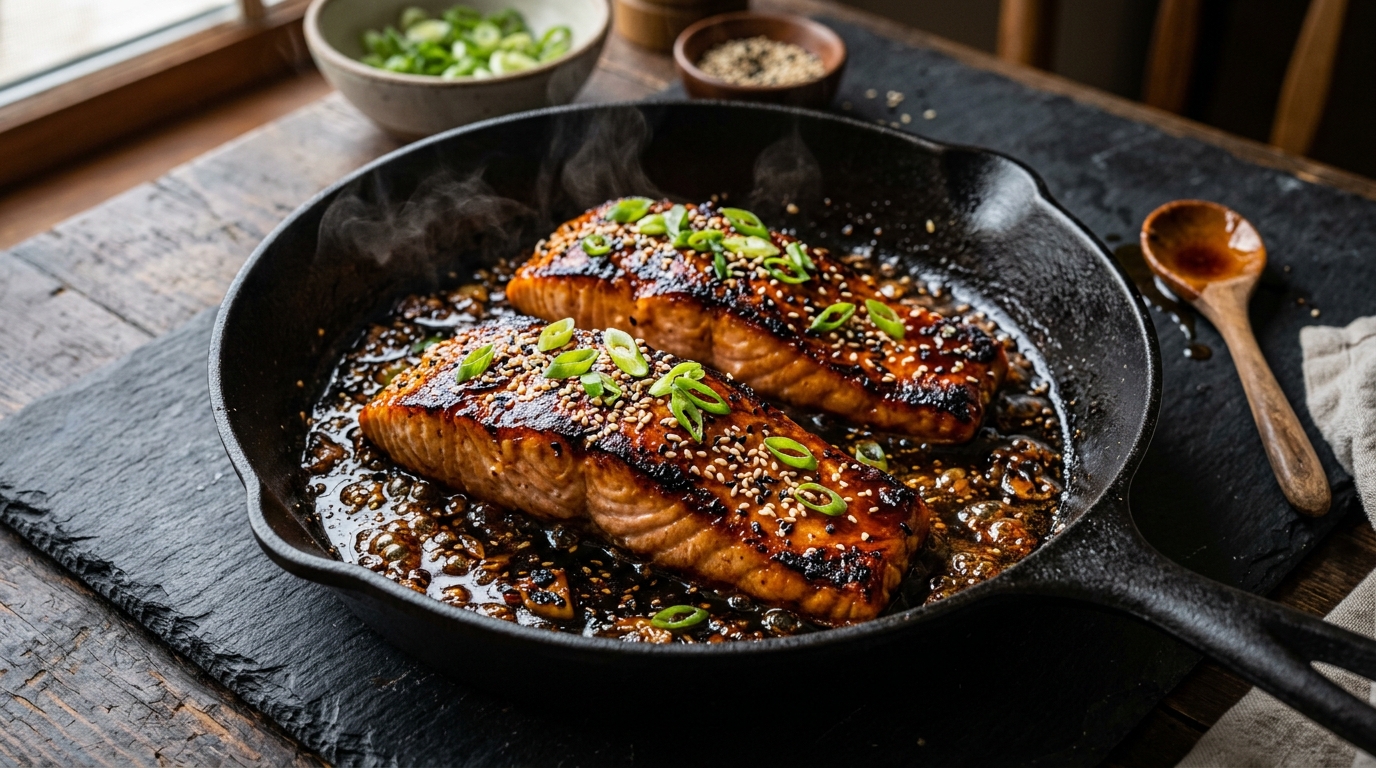
Honey Garlic Salmon (Sticky Pan-Seared Fillets Masterclass)
The definitive culinary masterclass for Pan-Seared Honey Garlic Salmon with a glossy, sticky lacquer glaze. Master sugar pyrolysis kinetics, dual-phase searing, pan-spoon basting (arros�), and preventing albumin extrusion for buttery medium-rare center flakes in 15 minutes.
Key Takeaways
- ✓Never marinate salmon in high-sugar honey prior to searing; sugar pyrolyzes and scorches black at 300�F long before the salmon cooks through.
- ✓Sear the salmon completely unglazed in screaming-hot oil first to establish a crisp crust and build structural integrity.
- ✓Pour the honey-soy glaze into the pan only during the final 2 minutes over medium-low heat, rapidly bubbling into a thick, sticky syrup.
- ✓Baste continuously with a large metal spoon (*arros�*), draping hot bubbling glaze over the fillets to cook the top gently and create a glistening lacquer.
- ✓Pull the salmon off the heat when an instant-read thermometer registers 125�F to 130�F (52�C to 54�C) for succulent, melt-in-your-mouth flakes.
The Story
The Story: Culinary Heritage & Masterclass Philosophy
Pan-seared salmon with a sticky honey-garlic glaze represents an ingenious cross-cultural fusion of Asian glaze chemistry and Western classical pan-searing. The concept traces its ancestry to classical Japanese teriyaki (literally meaning "shine-broil," where soy sauce, mirin, and sugar are reduced to coat fish with a mirror-like sheen) merged with the bold, rustic garlic-butter traditions of coastal French and American pan-roasting.
Despite its global popularity as a restaurant and home favorite, it is notoriously prone to execution failure in everyday domestic kitchens. Home cooks frequently make the mistake of marinating raw salmon in honey and garlic before dropping it into a searing hot skillet. Honey contains high concentrations of simple fructose and glucose sugars. When raw honey encounters a 400�F cast iron pan, the sugars caramelize and undergo pyrolysis (carbonization) in less than 60 seconds, filling the kitchen with acrid smoke and coating the exterior in a bitter, blackened char while the salmon core remains raw, cold, and uncooked.
This masterclass deconstructs the thermal kinetics of sugar caramelization. By employing a dual-phase cooking protocol�searing the naked salmon to achieve Maillard browning and crisp skin first, and introducing the artisanal honey-garlic glaze only in the concluding 120 seconds with rapid pan basting�you will achieve a flawless, glistening mahogany lacquer that clings to the salmon like stained glass, over tender, translucent, buttery flakes.
The Science of Flavor Chemistry & Thermal Dynamics
Mastering this dish requires understanding the competing reaction kinetics of sugar pyrolysis, amino acid browning, and fish myotome contraction.
1. Sugar Pyrolysis vs. The Maillard Threshold
Sugar and meat proteins behave completely differently under thermal energy:- Maillard Reaction: Occurs between amino acids and reducing sugars at approximately 280�F to 330�F (138�C to 165�C), generating savory, complex, roasted flavor compounds.
- Caramelization & Pyrolysis of Honey: Honey is comprised of approximately 40% fructose, 30% glucose, and 18% water. Fructose begins thermal caramelization at a low 230�F (110�C). However, once temperature exceeds 320�F (160�C), simple sugars undergo rapid pyrolysis�thermal decomposition that breaks molecular bonds into elemental carbon, producing acrid polycyclic aromatic hydrocarbons (soot and bitterness).
2. The Art of Arros� (Continuous Spoon Basting)
In classical French saucier technique, arros� refers to the practice of repeatedly spooning hot pan fats and liquids over the top surface of a protein as it cooks.When the honey, soy, garlic, and butter mixture enters the pan, it creates a bubbling, turbulent foam. By tilting the skillet toward you and scooping this hot 250�F foam continuously over the crown of the salmon fillets with a large spoon, you accomplish two critical culinary tasks simultaneously:
- Gentle Convection Cooking: The hot glaze gently poaches the delicate upper flesh without exposing it to harsh direct conductive metal heat.
- Layered Lacquer Formation: Each layer of glaze partially dehydrates on contact with the warm salmon flesh, building up a deep, glossy, adhesive film that clings tenaciously rather than running off onto the plate.
3. The Science of Salmon Albumin Prevention
Salmon muscle fibers (myotomes) are separated by thin sheets of collagenous connective tissue called myocommata. As salmon cooks past 135�F (57�C), these myotomes contract aggressively, squeezing intracellular fluid containing dissolved albumin out of the cells. As this protein-laden liquid hits the hot surface of the fish, it coagulates into unsightly, spongy white clumps.To minimize albumin leakage:
- Dry Brine: Season the salmon with coarse salt 10 minutes before cooking. The salt dissolves into the surface moisture, denatures a micro-thin layer of surface proteins, and forms an elastic barrier that prevents internal juices from breaching the surface.
- Precision Core Temperature: Pull the salmon when internal core temperature reaches 125�F to 130�F (52�C to 54�C). The meat will coast to a perfect, tender 132�F during carryover resting, remaining buttery, pink, and completely free of albumin curd.
4. Umami Synergy: Inosinate & Glutamate
This dish achieves mind-blowing depth of flavor due to biochemical umami synergy. Salmon flesh is naturally rich in disodium inosinate (IMP), a nucleotide that signals savory deliciousness. Soy sauce and tamari are teeming with free glutamate (MSG) produced through bacterial fermentation of soy proteins.When inosinate and glutamate molecules bind simultaneously to human T1R1/T1R3 taste receptors on the tongue, they don't simply add their flavors�they multiply the perceived savory sensation by a factor of eight. The honey balances this intense umami wave with sweetness, while the garlic provides punchy organosulfur depth.
Essential Equipment & Thermal Calibration
Essential culinary tools for achieving pan-seared salmon perfection:
- Heavy-Gauge Cast Iron Skillet (12-inch) or Carbon Steel Pan: Carbon steel and cast iron distribute heat evenly and maintain high surface temperatures, allowing the salmon skin to crisp instantly without sticking.
- Thin Flexible Slotted Fish Spatula: The beveled, flexible edge of a fish spatula slips beneath delicate salmon skin without tearing it from the flesh.
- Deep Sauce Basting Spoon: A large, deep stainless steel spoon allows you to scoop substantial volumes of bubbling honey-garlic glaze and cascade it over the fillets in rapid succession.
- Instant-Read Digital Thermometer: A precision thermocouple probe (like a Thermapen) inserted into the thickest center of the fillet removes all guesswork, ensuring salmon is pulled at the exact degree of succulent perfection.
Anatomy of the Ingredients & Artisanal Sourcing
Ingredient selection dictates the final harmony of this recipe:
- Center-Cut Atlantic or King Salmon Fillets: Request center-cut fillets of uniform thickness (approximately 1 to 1.25 inches thick). Tail fillets taper down to a thin sliver and will overcook long before the center-cut reaches temperature. King (Chinook) or Atlantic salmon possess superior intramuscular fat content compared to wild Sockeye or Coho, making them exceptionally forgiving, juicy, and buttery under high heat.
- Raw Unfiltered Clover or Wildflower Honey: Commercial pasteurized clover honey is often stripped of pollen and blended with high-fructose corn syrup. Authentic raw honey contains natural floral notes, organic acids, and enzymes that caramelize into complex butterscotch and toffee aromas when reduced.
- Naturally Brewed Low-Sodium Tamari: Tamari is a Japanese soy sauce brewed exclusively with fermented soybeans (gluten-free) and little to no wheat. It delivers a darker color, thicker viscosity, and deeper umami presence than conventional Chinese or American soy sauces. Using low-sodium tamari is mandatory because as the pan sauce reduces, water evaporates; standard soy sauce will concentrate into an unpalatably salty brine.
- Fresh Grated Ginger Root: Fresh ginger contains zingibain, a proteolytic enzyme and aromatic gingerol compound that cuts through the oily richness of salmon, leaving a clean, zesty, warming finish on the palate.
- Unseasoned Japanese Rice Vinegar or Fresh Lemon Juice: Acid is the master balancer. Rice vinegar provides gentle 4.5% acetic acid with a mild sweetness that harmonizes with honey, preventing the sauce from becoming cloying.
Step-by-Step Culinary Masterclass
Step 1: Salmon Prep, Pin-Bone Inspection & Surface Desiccation
Run your fingertips along the center ridge of each salmon fillet to check for pin bones. Remove any with fish tweezers. Sprinkle the flesh with 1 tsp of Kosher salt and 1/2 tsp of freshly cracked black pepper. Allow the fillets to sit at room temperature for 10 minutes. Using heavy-duty paper towels, aggressively blot the skin and flesh surfaces until they are bone-dry and tacky to the touch. In a medium glass bowl, whisk together the 1/3 cup raw honey, 3 tbsp low-sodium tamari, 2 tbsp rice vinegar or lemon juice, 1 tbsp toasted sesame oil, and 1 tbsp microplaned fresh ginger until smooth.
- Chef's Technique Tip: Bringing the salmon out of the refrigerator 15 minutes before cooking prevents thermal shock, allowing the center to cook evenly without scorching the exterior.
- Sensory Checkpoint: The salmon surface is matte and dry, with no visible surface moisture, and the honey glaze is smoothly whisked.
Step 2: Preheating Cast Iron & Blistering the Skin
Heat a heavy 12-inch cast iron skillet over medium-high heat for 3 to 4 minutes until hot. Add 2 tablespoons of avocado oil and swirl to coat the pan. When the oil begins to shimmer, carefully place the salmon fillets into the skillet skin-side down (laying them away from you to prevent oil splash). Immediately press down gently on each fillet with the back of your fish spatula for 10 seconds to counteract the natural tendon curling. Sear undisturbed over medium-high heat for 4 minutes.
- Chef's Technique Tip: Do not attempt to move or slide the salmon during the first 3 minutes. The skin will release naturally from the metal once it has completely desiccated and crisped.
- Sensory Checkpoint: The skin develops a deep golden-brown, crackling crust, and the flesh opacity creeps halfway up the sides of the fillet.
Step 3: The Gentle Flip & Flesh Searing
Slide your fish spatula beneath the skin of each fillet. In one smooth motion, gently flip the salmon onto its flesh side. Sear on medium heat for precisely 2 minutes. The top flesh will develop a light golden crust while the interior continues to warm through gentle conduction.
- Chef's Technique Tip: Use a gentle hand when flipping to avoid bruising the delicate salmon myotomes or detaching the crispy skin.
- Sensory Checkpoint: The flesh side develops a delicate amber sear, and the salmon feels gently firm with slight spring when pressed.
Step 4: Introducing Aromatics & Glaze Reduction
Reduce burner heat to medium-low. Flip the salmon fillets back onto their skin side (or onto their edge). Scatter the 6 cloves of minced garlic and 1/2 tsp of crushed red pepper flakes into the open spaces of the skillet. Saut� for 30 seconds until aromatic and pale golden. Immediately pour the prepared honey-tamari-ginger mixture into the skillet. The sauce will bubble vigorously and begin foaming around the fillets.
- Chef's Technique Tip: Ensure the pan temperature is moderate before the honey hits; it should foam and bubble gently like syrup, not smoke or scorch.
- Sensory Checkpoint: The honey glaze will bubble vigorously into a fragrant, golden-mahogany foam perfuming the kitchen with sweet garlic and ginger.
Step 5: The Basting Technique (Arros�) & Glaze Lacquer
Add 2 tablespoons of chilled butter into the bubbling glaze. As the butter melts into the sauce, tilt the skillet slightly toward you. Using a large metal spoon, continuously scoop up the bubbling honey-garlic glaze and cascade it over the top and sides of the salmon fillets. Continue basting for 90 seconds to 2 minutes as the glaze thickens into a glossy, sticky reduction that coats the back of a spoon. Insert a digital probe into the center of the thickest fillet; remove from heat the moment it registers 125�F to 128�F (52�C to 53�C).
- Chef's Technique Tip: The continuous shower of bubbling glaze cooks the crown of the salmon gently while building an exquisite, mirror-like lacquer.
- Sensory Checkpoint: The glaze transforms into a thick, sticky, mahogany lacquer clinging to the fillets, and the salmon flakes tenderly when tested.
Step 6: Finishing Touches & Table Presentation
Transfer the glazed salmon fillets carefully to a warm serving platter or onto individual mounds of steamed Jasmine rice. Spoon remaining thick, sticky garlic glaze from the skillet generously over each fillet. Shower the tops with toasted white sesame seeds and a generous handful of thinly sliced fresh scallions. Serve immediately with fresh lemon or lime wedges.
- Chef's Technique Tip: Serve promptly while the glaze is piping hot and fluid; as it cools, the honey-soy reduction thickens into a luscious candy-like coating.
- Sensory Checkpoint: Vivid contrast of dark mahogany caramelized glaze, crisp green scallions, ivory sesame seeds, and rich pink-orange salmon.
Pro-Chef Troubleshooting & Critical Checkpoints
Problem: The Honey Glaze Burned Black and Tastes Bitter
- The Root Cause: The glaze was added at high searing heat (>320�F) or left bubbling too long on an aggressive burner, causing sugar pyrolysis.
- The Masterclass Solution: Always lower burner heat to medium-low before introducing the honey mixture, and pull the skillet off the flame as soon as the glaze thickens to syrup.
Problem: White Curd (Albumin) Seeped Out All Over the Salmon
- The Root Cause: The salmon was overcooked past 140�F (60�C) or heated too rapidly from refrigerator-cold temperature, forcing muscle fibers to seize.
- The Masterclass Solution: Rest salmon at room temperature for 10 minutes with a dry brine, and pull the fillets at 125�F-128�F internal temperature so they finish gently via carryover heat.
Problem: The Salmon Skin Stuck to the Pan and Tore Off
- The Root Cause: The pan was not sufficiently preheated, the skin was wet, or you attempted to flip the fish before the skin naturally released.
- The Masterclass Solution: Blot the skin completely dry with paper towels, preheat cast iron until smoking, and wait a full 4 minutes before touching the spatula; the skin will release itself when crisp.
Problem: The Glaze is Too Thin and Runny
- The Root Cause: Too much liquid was added, or the glaze was not simmered long enough to evaporate excess water from the soy sauce and vinegar.
- The Masterclass Solution: Simmer the glaze vigorously for an additional 60 to 90 seconds while basting; the natural sugars and cold butter will reduce it to a glossy coating consistency.
Problem: The Sauce is Too Intensely Salty
- The Root Cause: Regular dark or light soy sauce was used instead of low-sodium tamari; as water evaporates during boiling, sodium concentrations skyrocket.
- The Masterclass Solution: Always use low-sodium tamari or soy sauce. If too salty, whisk in 1 tablespoon of warm water and an extra squeeze of fresh lemon juice or a knob of unsalted butter.
Macro Analysis & Nutritional Optimization
Honey garlic salmon provides an exceptional spectrum of functional nutrients:
- Long-Chain Omega-3 Fatty Acids (EPA & DHA): Salmon is among the richest natural sources of eicosapentaenoic acid (EPA) and docosahexaenoic acid (DHA). These essential fatty acids integrate into cell membranes, reducing production of inflammatory eicosanoids and cytokines, optimizing cognitive function, and maintaining arterial elasticity.
- Complete High-Biodegradability Marine Protein: A 6-ounce fillet yields over 40 grams of complete protein, delivering an ideal ratio of amino acids necessary for muscle maintenance, bone density, and tissue regeneration.
- Bioactive Micronutrients (Vitamin D & B12): One serving provides over 100% of the recommended daily intake of Vitamin D3 (cholecalciferol), vital for calcium homeostasis and immune surveillance, alongside high concentrations of Vitamin B12 (cobalamin) required for erythrocyte formation and myelin sheath integrity.
- Raw Honey Antimicrobial Phytochemicals: Pure raw honey delivers phenolic acids and flavonoids (quercetin, chrysin) that exhibit antioxidant and gut-soothing bioactivity.
Artisanal Serving & Pairing Architecture
Because of the sticky, sweet, savory, and umami-rich nature of honey garlic salmon, accompaniments should provide neutral starch absorption and crisp vegetal bitterness:
- Starch Bases:
- Vegetable Sides:
- Wine & Beverage Pairings:
Scientific Storage, Meal Prep & Reheating Protocol
Proper preservation and reheating safeguards the delicate texture of glazed salmon:
- Refrigeration: Cool leftover fillets to room temperature within 30 minutes. Transfer to an airtight glass storage container along with any remaining pan glaze. Store in the refrigerator at 36�F-38�F (2�C-3�C) for up to 3 days.
- The Microwave Hazard: Microwaving glazed salmon is disastrous; the high-frequency radiation superheats the honey glaze into boiling syrup while turning the salmon flesh dry and chalky.
- The Low-Oven Reheating Method: Preheat an oven or toaster oven to 300�F (150�C). Place the leftover salmon on a parchment-lined baking sheet. Spoon any cold solidified glaze over the top. Cover loosely with aluminum foil to trap moisture. Warm for 8 to 10 minutes until heated through (internal temp ~120�F).
- Cold Culinary Applications: Chilled honey garlic salmon is spectacular flaked cold over a soba noodle salad, wrapped in rice paper summer rolls with cucumber and mint, or folded into fresh rice bowls with avocado and edamame.
Frequently Asked Questions (Masterclass Edition)
Q: Can I use maple syrup or brown sugar instead of honey?
A: Yes. Pure dark Grade A maple syrup is an excellent 1:1 substitute for honey, offering deep caramel and woodsy notes. Brown sugar can also be used (dissolved in 1 tablespoon of warm water first), though raw honey yields the most luxurious, glossy lacquer.Q: Can I make this with skinless salmon fillets?
A: Absolutely. If using skinless fillets, sear on the first side for 3 minutes until golden brown, flip gently with your fish spatula, and sear on the second side for 2 minutes before lowering heat and adding the glaze and aromatics.Q: Is this recipe gluten-free?
A: Yes, provided you use certified gluten-free low-sodium tamari or coconut aminos instead of conventional soy sauce (which contains fermented wheat).Q: How do I know when the salmon is cooked without a thermometer?
A: Gently press down on the center of the fillet with your fingertip. If the fish feels mushy, it is raw; if it feels hard and rigid, it is overcooked. Perfectly medium-cooked salmon will yield with gentle springiness and the individual flakes (myotomes) will begin to separate slightly.Q: Can I make the glaze in advance?
A: Yes! Whisk together the honey, tamari, vinegar, sesame oil, and ginger in a mason jar. Seal and refrigerate for up to 5 days. When ready to cook, simply shake the jar and pour it into the skillet as directed.Honey Garlic Salmon (Sticky Pan-Seared Fillets Masterclass)
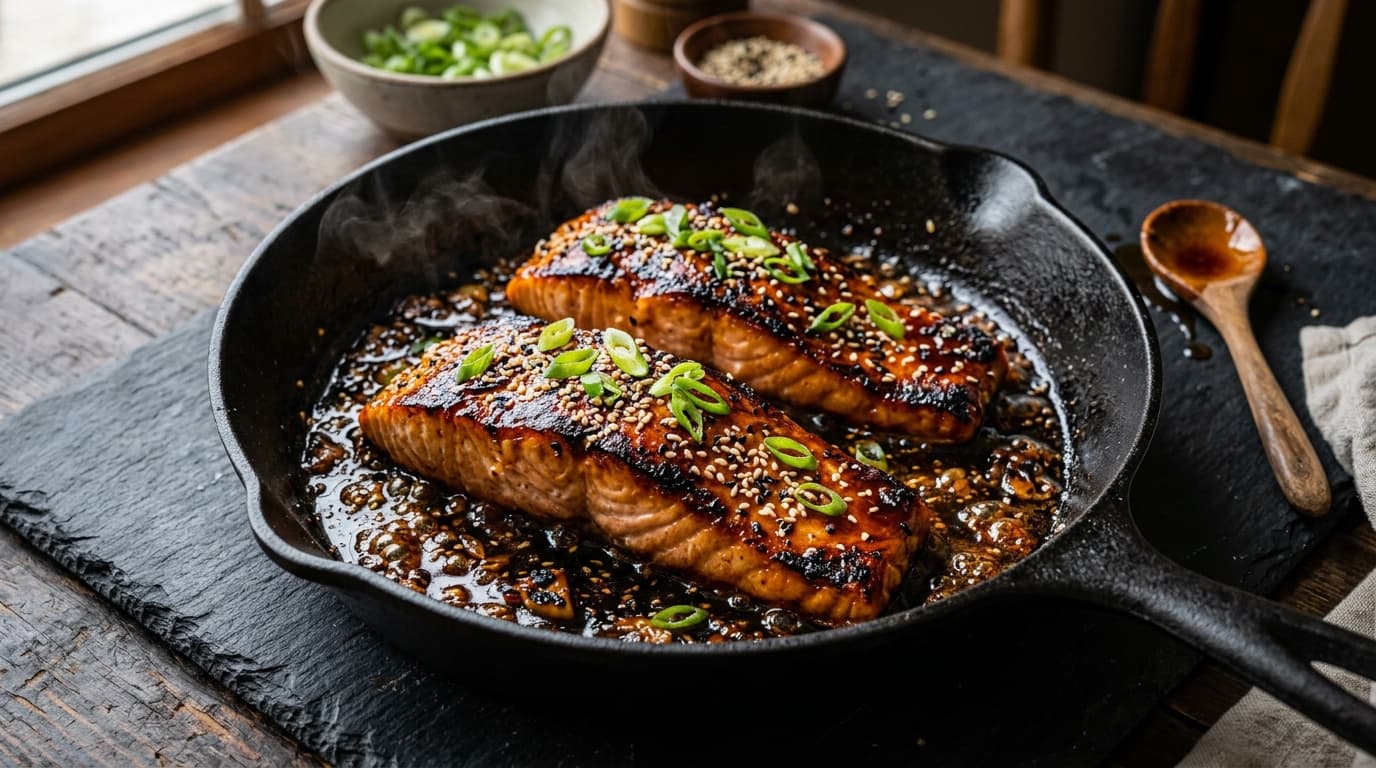
The definitive culinary masterclass for Pan-Seared Honey Garlic Salmon with a glossy, sticky lacquer glaze. Master sugar pyrolysis kinetics, dual-phase searing, pan-spoon basting (arros�), and preventing albumin extrusion for buttery medium-rare center flakes in 15 minutes.
Macro Nutrition Profile (Per Serving)
Ingredients
Ingredient Substitutions
| Original Ingredient | Healthy Alternative |
|---|---|
| Salmon/Cod | Steelhead trout, halibut, or sea bass (baking times may vary) |
| Asparagus/Veg | Zucchini slices, broccoli florets, or green beans (roast at same temperature) |
Instructions
Salmon Prep, Pin-Bone Inspection & Surface Desiccation: Run your fingertips along the center ridge of each salmon fillet to check for pin bones. Remove any with fish tweezers. Sprinkle the flesh with 1 tsp of Kosher salt and 1/2 tsp of freshly cracked black pepper. Allow the fillets to sit at room temperature for 10 minutes. Using heavy-duty paper towels, aggressively blot the skin and flesh surfaces until they are bone-dry and tacky to the touch. In a medium glass bowl, whisk together the 1/3 cup raw honey, 3 tbsp low-sodium tamari, 2 tbsp rice vinegar or lemon juice, 1 tbsp toasted sesame oil, and 1 tbsp microplaned fresh ginger until smooth. Chef's Technique Tip: Bringing the salmon out of the refrigerator 15 minutes before cooking prevents thermal shock, allowing the center to cook evenly without scorching the exterior. Sensory Checkpoint: The salmon surface is matte and dry, with no visible surface moisture, and the honey glaze is smoothly whisked.
Preheating Cast Iron & Blistering the Skin: Heat a heavy 12-inch cast iron skillet over medium-high heat for 3 to 4 minutes until hot. Add 2 tablespoons of avocado oil and swirl to coat the pan. When the oil begins to shimmer, carefully place the salmon fillets into the skillet skin-side down (laying them away from you to prevent oil splash). Immediately press down gently on each fillet with the back of your fish spatula for 10 seconds to counteract the natural tendon curling. Sear undisturbed over medium-high heat for 4 minutes. Chef's Technique Tip: Do not attempt to move or slide the salmon during the first 3 minutes. The skin will release naturally from the metal once it has completely desiccated and crisped. Sensory Checkpoint: The skin develops a deep golden-brown, crackling crust, and the flesh opacity creeps halfway up the sides of the fillet.
The Gentle Flip & Flesh Searing: Slide your fish spatula beneath the skin of each fillet. In one smooth motion, gently flip the salmon onto its flesh side. Sear on medium heat for precisely 2 minutes. The top flesh will develop a light golden crust while the interior continues to warm through gentle conduction. Chef's Technique Tip: Use a gentle hand when flipping to avoid bruising the delicate salmon myotomes or detaching the crispy skin. Sensory Checkpoint: The flesh side develops a delicate amber sear, and the salmon feels gently firm with slight spring when pressed.
Introducing Aromatics & Glaze Reduction: Reduce burner heat to medium-low. Flip the salmon fillets back onto their skin side (or onto their edge). Scatter the 6 cloves of minced garlic and 1/2 tsp of crushed red pepper flakes into the open spaces of the skillet. Saut� for 30 seconds until aromatic and pale golden. Immediately pour the prepared honey-tamari-ginger mixture into the skillet. The sauce will bubble vigorously and begin foaming around the fillets. Chef's Technique Tip: Ensure the pan temperature is moderate before the honey hits; it should foam and bubble gently like syrup, not smoke or scorch. Sensory Checkpoint: The honey glaze will bubble vigorously into a fragrant, golden-mahogany foam perfuming the kitchen with sweet garlic and ginger.
Finishing Touches & Table Presentation: Transfer the glazed salmon fillets carefully to a warm serving platter or onto individual mounds of steamed Jasmine rice. Spoon remaining thick, sticky garlic glaze from the skillet generously over each fillet. Shower the tops with toasted white sesame seeds and a generous handful of thinly sliced fresh scallions. Serve immediately with fresh lemon or lime wedges. Chef's Technique Tip: Serve promptly while the glaze is piping hot and fluid; as it cools, the honey-soy reduction thickens into a luscious candy-like coating. Sensory Checkpoint: Vivid contrast of dark mahogany caramelized glaze, crisp green scallions, ivory sesame seeds, and rich pink-orange salmon.
Tried this recipe?
Let us know how it turned out! Click a star below to leave a review and rate the recipe.
Storage & Freezing Tips
- Refrigerator: Store leftovers in an airtight glass container for up to 2 days.
- Reheating: Warm gently in a skillet on medium-low heat with a lid to keep the fish tender. Avoid microwaving to prevent rubbery texture.
- Freezing: We do not recommend freezing cooked fish as it degrades the texture.
Frequently Asked Questions
How do I prevent the fish from sticking to the pan?▼
Ensure your baking dish is lightly oiled or lined with parchment paper, and make sure the oven is fully preheated before cooking.
Can I make this recipe with frozen fish?▼
Yes. Thaw the fish completely in the refrigerator overnight, then pat it dry thoroughly with a paper towel before adding seasonings.
Tried this recipe?
Tag @stewartlucas on Instagram and hashtag it #nutriguide!
You Might Also Like

Stewart Lucas
Nutritionist & Recipe DeveloperStewart Lucas is a nutritionist and recipe developer representing the NutriGuide team. All recipes, nutritional values, and diet protocols published on this site are designed and audited by certified dietitians and clinical nutrition professionals to guarantee absolute accuracy.
Community Reviews
Please log in to leave a review.