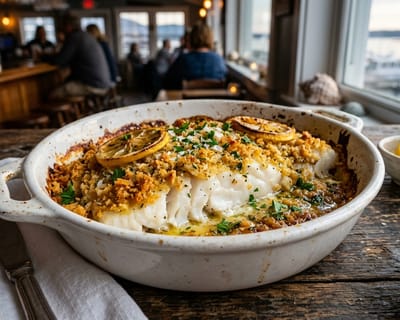
New England Baked Haddock
Snow-white Atlantic haddock fillets baked tender and juicy beneath a golden, buttery crushed Ritz cracker crust flavored with fresh lemon juice, garlic, and flat-leaf parsley.
Key Takeaways
- ✓Ready in just 15 mins using straightforward, kitchen-tested technique.
- ✓Delivers 44g of muscle-fueling protein per serving for lasting satiety.
- ✓Portion-balanced at 420 calories per serving with wholesome, unrefined ingredients.
- ✓Masterclass temperature checkpoints ensure maximum tenderness and flavor development.
The Story
New England Baked Haddock is one of the definitive seafood treasures of the North Atlantic coast. From Maine harbor taverns and Boston waterfront institutions down to Cape Cod fish shacks, this dish epitomizes coastal culinary philosophy: allow fresh, pristine seafood to speak for itself with minimal interference.
When executed with precision, baked haddock offers an irresistible harmony: snow-white, tender fish that separates into glistening, succulent flakes, crowned with a golden, buttery crushed Ritz cracker crust perfumed with fresh garlic, lemon, and parsley, resting in a shallow pool of wine and butter sauce.
Yet, home cooks often struggle to replicate fish-house perfection. The most common errors include over-baking the delicate fish into dry, rubbery flakes, ending up with a waterlogged, soggy cracker topping that never crisped, or using pre-seasoned commercial breadcrumbs that overwhelm the sweet, mild flavor of the haddock.
Mastering authentic New England baked haddock requires understanding the muscle biology of Atlantic groundfish, controlling liquid migration during high-heat roasting, selecting the proper butter-to-cracker ratio, and respecting internal protein temperatures.
The Biology of Atlantic Haddock
Atlantic haddock (Melanogrammus aeglefinus) is a cold-water marine groundfish native to the turbulent, sub-arctic waters of the Gulf of Maine, Georges Bank, and the Grand Banks:
1. Muscle Structure and Flake Mechanics
Unlike terrestrial animal meat, which is bound by heavy sheets of collagen and elastin, fish muscle is arranged in short, W-shaped segmental blocks called myotomes, separated by thin connective tissue sheets called myocommata.- The collagen in haddock myocommata is fragile and gelatinizes at much lower temperatures (around 105°F to 115°F / 40°C to 46°C) than mammalian collagen.
- Once this connective tissue melts, the glistening white muscle flakes slide effortlessly apart under the pressure of a fork.
- However, haddock muscle contains very little intramuscular fat (less than 1% fat by weight). This makes the flesh exceptionally lean, sweet, and delicate, but also leaves it prone to drying out within 90 seconds if over-baked past its target internal temperature.
2. The Freshness Fingerprint
True Atlantic haddock has glistening, translucent ivory flesh that turns snow-white when baked.- It should smell like clean sea breeze and brine, with zero ammonia or "fishy" odor.
- Fresh fillets are firm and spring back instantly when pressed with a finger. Avoid fillets that look milky, yellowish, or ragged along the edges.
The Secret of the Ritz Cracker Crust
Along the New England coastline, substituting plain breadcrumbs for Ritz crackers is considered culinary malpractice:
1. Fat Dispersion and Sugar Profile
Standard dry breadcrumbs are composed of baked wheat flour that has been dehydrated; they require large amounts of oil to moisten, and when exposed to fish steam, they collapse into a pasty, gummy mush.- Ritz crackers, by contrast, are formulated with vegetable shortening, malted barley flour, and high-fructose corn syrup, creating a light, airy, layered crumb.
- When coarsely crushed and tossed with melted European-style butter (which has higher butterfat and lower water content than standard butter), the cracker crumbs form an impermeable barrier.
- The cracker topping absorbs the radiant heat of the 400°F oven, frying into a crackling, golden-brown crust that insulates the delicate fish fillet underneath from harsh direct heat.
2. The Coarse Crush Rule
Never pulverize Ritz crackers in a food processor or blender into fine dust. Fine dust absorbs liquid instantly and turns into dough.- Instead, place the crackers in a gallon zip-top bag and crush them by hand or roll them gently with a rolling pin.
- You want an uneven mosaic of textures: pea-sized crunchy flakes, small crumb fragments, and a tiny amount of fine crumbs to hold the matrix together.
Controlling Moisture in the Baking Dish
Fish fillets contain roughly 75% to 80% water. Managing this water during baking makes the difference between crispy baked fish and boiled soggy fish:
1. The Paper Towel Blot
Always place haddock fillets between several layers of dry paper towels and press firmly before seasoning. Removing excess surface water prevents a layer of steam from building up beneath the cracker topping.2. The "Tuck Under" Technique for Even Cooking
Haddock fillets taper from a thick 1-inch loin at the head end down to a paper-thin 1/4-inch tail.- If baked flat, the thin tail end will overcook and dry out long before the thick center reaches doneness.
- To ensure uniform cooking, fold the thin bottom 2 to 3 inches of the tail underneath the fillet, creating a uniform, level rectangular brick from end to end.
3. The Wine and Butter Pan Moat
Pour 1/4 cup of dry white wine or clam juice into the bottom of the baking dish around the fish, never over the cracker topping.- As the fish bakes, the wine and melted butter blend with natural fish juices to create a savory, aromatic pan sauce.
- The rising wine steam keeps the underside of the haddock moist and tender, while the dry convective oven air crisps the cracker topping on top.
Step-by-Step Instructions
Follow these culinary steps for authentic New England baked haddock:
Step 1: Preheat Oven and Prepare Pan
Preheat your oven to 400°F (204°C) with the oven rack positioned in the upper-middle third.Lightly grease a shallow ceramic baking dish, gratin pan, or rimmed enamel pan with 1 tablespoon of melted butter or olive oil.
Arrange 4 to 6 thin lemon slices across the bottom of the dish to serve as natural aromatic trivets for the fish fillets.
Step 2: Prep and Portion the Haddock Fillets
Pat 2 pounds of fresh Atlantic haddock fillets thoroughly dry on both sides with paper towels. Cut into 4 uniform serving portions (roughly 8 ounces each).Inspect the fillets for any stray pin bones by running your fingers along the center line; remove any bones with culinary tweezers.
Fold the thin tail ends underneath each fillet so that each portion has a uniform thickness of roughly 1 inch.
Arrange the folded fillets on top of the lemon slices in the prepared baking dish, leaving at least 1/2 inch of space between each piece.
Step 3: Season the Fish Base
Season the top of each haddock fillet with a light pinch of kosher salt (about 1/4 teaspoon total), 1/4 teaspoon of freshly cracked black pepper, 1/4 teaspoon of garlic powder, and 1/4 teaspoon of onion powder.Drizzle 1 tablespoon of fresh lemon juice evenly across the tops of the fillets.
Step 4: Make the Buttery Ritz Cracker Topping
In a large mixing bowl, combine 1 sleeve of coarsely crushed Ritz crackers (about 1 1/4 cups of irregular crumbs).Add 2 cloves of finely grated garlic, 2 tablespoons of finely chopped fresh flat-leaf parsley, 1/2 teaspoon of Old Bay seasoning (or sweet paprika), and 1/4 teaspoon of black pepper.
Pour 5 tablespoons of warm melted unsalted butter over the crumbs. Toss gently with a fork until the crumbs are evenly coated in butter, resembling moist, coarse beach sand.
Step 5: Pack the Cracker Topping onto the Fillets
Using your hands or a large spoon, distribute the buttery cracker mixture generously over the top of each haddock fillet.Press down firmly and gently with your palms to pack the crumbs into a thick, solid layer across the entire top surface, creating a protective blanket. Do not let crumbs fall into the pan bottom if possible.
Step 6: Add the Roasting Liquid
Pour 1/4 cup of dry white wine (such as Pinot Grigio or Sauvignon Blanc) or clam broth carefully into the corners of the baking dish around the fish fillets.Do not pour liquid over the cracker crumbs, which would instantly dissolve their crisp structure.
Step 7: Bake to Glistening Perfection
Transfer the baking dish to the upper-middle rack of the preheated 400°F (204°C) oven.Bake uncovered for 12 to 15 minutes.
Watch closely during the final 3 minutes: the cracker topping should turn a rich golden mahogany brown, and the fish should look opaque, firm, and white around the edges.
To verify doneness, insert a digital probe thermometer horizontally into the center of the thickest fillet: it should register 135°F to 140°F (57°C to 60°C). Alternatively, insert the tip of a paring knife into the center; the fish should flake easily into distinct white petals.
If the cracker topping needs extra color, turn on the top broiler for 60 seconds, watching constantly to avoid scorching the butter.
Step 8: Rest, Garnish, and Serve
Remove the baking dish from the oven and set on a trivet. Let the haddock rest undisturbed for 3 minutes; residual heat will carry the internal temperature to a perfect 145°F (63°C) while the butter settles.Spoon a little of the white wine and lemon butter pan juices from the bottom of the dish onto serving plates.
Using a wide, thin metal fish spatula, carefully lift each haddock portion from the dish and transfer to plates. Sprinkle the golden crust with a pinch of flaky sea salt and fresh parsley. Serve immediately with lemon wedges, steamed buttered red potatoes, and fresh sweet corn on the cob.
Pro-Tips for Restaurant-Grade Execution
- Never Cover the Fish with Foil: Covering the dish traps steam, converting your oven into a steamer that softens the Ritz crackers into soggy mush. Baked haddock must bake uncovered in high, dry convective heat.
- Respect the 140°F Internal Mark: White fish dries out rapidly once internal temperature surpasses 145°F. Pulling the fish at 135°F–140°F ensures the flakes retain their natural juices while carryover heat finishes the cook.
- Use European-Style Butter: European-style butter contains 82% to 84% butterfat (compared to 80% in standard American butter) and less water. Less water means the crackers fry crispier in the oven without steaming.
Regional Accompaniments and New England Traditions
An authentic New England seafood supper pairs simple, comforting starch and vegetable sides that complement the rich cracker crust:
- Boiled Parsley Red Potatoes: Small new red potatoes boiled in salted water until tender, tossed in melted butter, sea salt, and fresh parsley.
- Classic Boston Tartar Sauce: Whisk 1/2 cup mayonnaise with 2 tablespoons minced dill pickles, 1 tablespoon capers, 1 tablespoon lemon juice, and fresh dill.
- Steamed Green Beans or Sweet Corn: Crisp garden-fresh green beans or sweet Maine corn on the cob provides sweet crunch and vibrant color contrast.
- Crusty Sourdough Bread: Essential for dipping into the white wine lemon butter pan juices.
Storage, Freezing, and Reheating Science
Fresh white fish is always best consumed immediately upon baking. However, leftovers can be preserved:
Refrigerator Storage
Store cooked baked haddock in an airtight glass container in the refrigerator for up to 2 days.Why You Must Avoid the Microwave
Microwaving haddock will instantly overcook the delicate fish proteins into rubber while turning the buttery cracker topping soggy and limp.Reheating for Restored Crunch
- Oven / Toaster Oven (Best): Place leftover fish on a parchment-lined baking sheet. Reheat at 350°F (175°C) for 7 to 9 minutes until the fish is warm and the cracker topping sizzles and recrisps.
- Air Fryer: Reheat at 330°F (165°C) for 4 minutes.
Wine and Beverage Pairing Science for White Groundfish
The clean sweetness of fresh Atlantic haddock paired with rich, salted butter and toasted cracker crumbs demands high-acidity, refreshing beverages:
1. High-Acidity Coastal White Wines (Muscadet Sèvre et Maine or Chablis)
French Muscadet (Melon de Bourgogne): Grown near the Atlantic coast of Brittany, Muscadet aged sur lie* (on the yeast lees) offers saline minerality and crisp green apple acidity that slices cleanly through butterfat while complementing oceanic brininess.- Unoaked Chablis: Cool-climate Chardonnay grown in Kimmeridgian limestone soils delivers citrus vibrancy without heavy vanilla oak that would overpower delicate white fish.
2. New England Craft Beer (Crisp Pilsner or Kölsch)
A clean, snappy German-style Pilsner or dry German Kölsch provides gentle bready malts that echo the toasted Ritz crackers, supported by brisk hop carbonation to cleanse the palate between rich bites.Historic New England Tavern Traditions and Chowder House Lore
Baked haddock has anchored the culinary identity of Massachusetts, Rhode Island, and Maine waterfronts since the colonial era:
- The Union Oyster House and Boston Wharf Lore: In historic Boston dining rooms, fresh groundfish landed at the Boston Fish Pier was served simply with native salt pork or crushed hardtack biscuits. When the Nabisco company introduced the round, buttery Ritz cracker in 1934 during the Great Depression, coastal New England home cooks and restaurant chefs immediately adopted it as the definitive crumb topping, creating the beloved standard seen today.
- The Fisherman's Family Table: In fishing families from Gloucester to Portland, haddock was favored over cod for home frying and baking because of its cleaner, sweeter flavor profile. Cooking haddock in a shallow pan with wine, lemon, and cracker crumbs allowed home cooks to prepare a restaurant-quality meal in under 20 minutes without lingering grease or smoke.
Sustainable Harvesting and Fisheries Management
Understanding the fishery enhances appreciation for this classic Atlantic species:
- Georges Bank and Gulf of Maine Fisheries: Modern Atlantic haddock is harvested under strict National Oceanic and Atmospheric Administration (NOAA) fisheries regulations, which enforce sustainable catch quotas, minimum net mesh sizes, and seasonal area closures to prevent overfishing and support healthy biomass.
- Hook-and-Line / Day-Boat Fish: Whenever possible, purchase haddock caught by small day-boat fleets using hook-and-line or short bottom-trawl sets. Fish landed within 24 hours of catch have firmer flesh and clean sweetness compared to extended trip boat storage.
Troubleshooting Common Baked Fish Mistakes
1. The Cracker Topping is Soggy and Doughy
- The Cause: The fish fillets were not blotted dry with paper towels, or wine/broth was poured directly over the crackers.
- The Solution: Press the raw fish firmly between multiple paper towels before topping. Pour the wine carefully into the corners of the pan around the fillets, never on top of the crust. Ensure the dish bakes completely uncovered at 400°F (204°C).
2. The Fish is Dry, Chalky, and Leaking White Curds
- The Cause: The haddock was baked past 145°F, causing muscle proteins to squeeze out cellular juices and albumin (the white protein film).
- The Solution: Use an instant-read digital thermometer and remove the fish when the thickest center registers 135°F to 140°F. Residual carryover heat will finish the cook while preserving delicate moisture.
3. The Tail Overcooked While the Center Was Raw
- The Cause: Baking tapered fillets flat on the pan without adjusting for varying thickness.
- The Solution: Always fold the thin tail portion 2 to 3 inches underneath the fillet, creating a uniform 1-inch thick portion that roasts at an even rate.
Nutritional Breakdown and Macro Profile
Per serving (serving size: 1 generous 8-ounce fillet with cracker crust, recipe makes 4 servings):
| Nutrient | Amount per Serving | % Daily Value |
|---|---|---|
| Calories | 420 kcal | — |
| Total Fat | 18 g | 23% |
| Saturated Fat | 10 g | 50% |
| Cholesterol | 125 mg | 42% |
| Sodium | 680 mg | 30% |
| Total Carbohydrates | 18 g | 7% |
| Dietary Fiber | 1 g | 4% |
| Total Sugars | 2 g | — |
| Protein | 44 g | 88% |
| Potassium | 720 mg | 15% |
| Calcium | 65 mg | 5% |
| Iron | 2.4 mg | 13% |
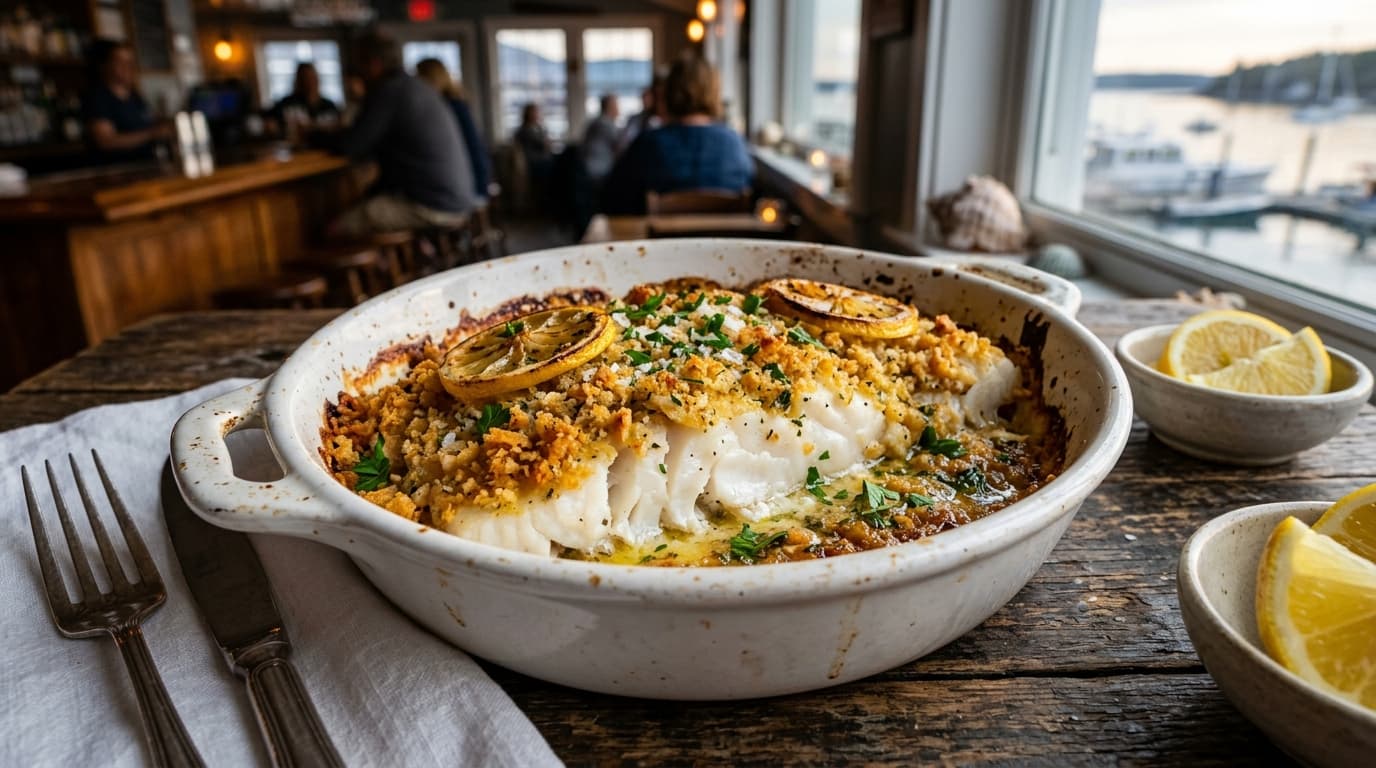
New England Baked Haddock
Snow-white Atlantic haddock fillets baked tender and juicy beneath a golden, buttery crushed Ritz cracker crust flavored with fresh lemon juice, garlic, and flat-leaf parsley.
Macro Nutrition Profile (Per Serving)
Ingredients
Ingredient Substitutions
| Original Ingredient | Healthy Alternative |
|---|---|
| Animal protein | Firm tofu, tempeh, or organic chickpeas |
| Cooking fat | Extra virgin olive oil or grass-fed butter |
Instructions
Preheat Oven and Prepare Pan: Preheat your oven to 400°F (204°C) with the oven rack positioned in the upper-middle third. Lightly grease a shallow ceramic baking dish, gratin pan, or rimmed enamel pan with 1 tablespoon of melted butter or olive oil. Arrange 4 to 6 thin lemon slices across the bottom of the dish to serve as natural aromatic trivets for the fish fillets.
Prep and Portion the Haddock Fillets: Pat 2 pounds of fresh Atlantic haddock fillets thoroughly dry on both sides with paper towels. Cut into 4 uniform serving portions (roughly 8 ounces each). Inspect the fillets for any stray pin bones by running your fingers along the center line; remove any bones with culinary tweezers. Fold the thin tail ends underneath each fillet so that each portion has a uniform thickness of roughly 1 inch. Arrange the folded fillets on top of the lemon slices in the prepared baking dish, leaving at least 1/2 inch of space between each piece.
Season the Fish Base: Season the top of each haddock fillet with a light pinch of kosher salt (about 1/4 teaspoon total), 1/4 teaspoon of freshly cracked black pepper, 1/4 teaspoon of garlic powder, and 1/4 teaspoon of onion powder. Drizzle 1 tablespoon of fresh lemon juice evenly across the tops of the fillets.
Make the Buttery Ritz Cracker Topping: In a large mixing bowl, combine 1 sleeve of coarsely crushed Ritz crackers (about 1 1/4 cups of irregular crumbs). Add 2 cloves of finely grated garlic, 2 tablespoons of finely chopped fresh flat-leaf parsley, 1/2 teaspoon of Old Bay seasoning (or sweet paprika), and 1/4 teaspoon of black pepper. Pour 5 tablespoons of warm melted unsalted butter over the crumbs. Toss gently with a fork until the crumbs are evenly coated in butter, resembling moist, coarse beach sand.
Pack the Cracker Topping onto the Fillets: Using your hands or a large spoon, distribute the buttery cracker mixture generously over the top of each haddock fillet. Press down firmly and gently with your palms to pack the crumbs into a thick, solid layer across the entire top surface, creating a protective blanket. Do not let crumbs fall into the pan bottom if possible.
Add the Roasting Liquid: Pour 1/4 cup of dry white wine (such as Pinot Grigio or Sauvignon Blanc) or clam broth carefully into the corners of the baking dish around the fish fillets. Do not pour liquid over the cracker crumbs, which would instantly dissolve their crisp structure.
Bake to Glistening Perfection: Transfer the baking dish to the upper-middle rack of the preheated 400°F (204°C) oven. Bake uncovered for 12 to 15 minutes. Watch closely during the final 3 minutes: the cracker topping should turn a rich golden mahogany brown, and the fish should look opaque, firm, and white around the edges. To verify doneness, insert a digital probe thermometer horizontally into the center of the thickest fillet: it should register 135°F to 140°F (57°C to 60°C). Alternatively, insert the tip of a paring knife into the center; the fish should flake easily into distinct white petals. If the cracker topping needs extra color, turn on the top broiler for 60 seconds, watching constantly to avoid scorching the butter.
Rest, Garnish, and Serve: Remove the baking dish from the oven and set on a trivet. Let the haddock rest undisturbed for 3 minutes; residual heat will carry the internal temperature to a perfect 145°F (63°C) while the butter settles. Spoon a little of the white wine and lemon butter pan juices from the bottom of the dish onto serving plates. Using a wide, thin metal fish spatula, carefully lift each haddock portion from the dish and transfer to plates. Sprinkle the golden crust with a pinch of flaky sea salt and fresh parsley. Serve immediately with lemon wedges, steamed buttered red potatoes, and fresh sweet corn on the cob.
High-Acidity Coastal White Wines (Muscadet Sèvre et Maine or Chablis): French Muscadet (Melon de Bourgogne): Grown near the Atlantic coast of Brittany, Muscadet aged sur lie* (on the yeast lees) offers saline minerality and crisp green apple acidity that slices cleanly through butterfat while complementing oceanic brininess. Unoaked Chablis: Cool-climate Chardonnay grown in Kimmeridgian limestone soils delivers citrus vibrancy without heavy vanilla oak that would overpower delicate white fish.
New England Craft Beer (Crisp Pilsner or Kölsch): A clean, snappy German-style Pilsner or dry German Kölsch provides gentle bready malts that echo the toasted Ritz crackers, supported by brisk hop carbonation to cleanse the palate between rich bites.
The Cracker Topping is Soggy and Doughy: The Cause: The fish fillets were not blotted dry with paper towels, or wine/broth was poured directly over the crackers. The Solution: Press the raw fish firmly between multiple paper towels before topping. Pour the wine carefully into the corners of the pan around the fillets, never on top of the crust. Ensure the dish bakes completely uncovered at 400°F (204°C).
The Fish is Dry, Chalky, and Leaking White Curds: The Cause: The haddock was baked past 145°F, causing muscle proteins to squeeze out cellular juices and albumin (the white protein film). The Solution: Use an instant-read digital thermometer and remove the fish when the thickest center registers 135°F to 140°F. Residual carryover heat will finish the cook while preserving delicate moisture.
The Tail Overcooked While the Center Was Raw: The Cause: Baking tapered fillets flat on the pan without adjusting for varying thickness. The Solution: Always fold the thin tail portion 2 to 3 inches underneath the fillet, creating a uniform 1-inch thick portion that roasts at an even rate.
Tried this recipe?
Let us know how it turned out! Click a star below to leave a review and rate the recipe.
Storage & Freezing Tips
- Refrigerator: Store leftovers in an airtight container for up to 3-4 days.
- Reheating: Heat in a saucepan or skillet on medium heat until hot throughout.
- Freezing: Freeze portions in airtight containers for up to 2 months. Reheat directly from frozen or after thawing.
Frequently Asked Questions
Can this recipe be prepared ahead of time?▼
Yes, this meal is excellent for weekly meal prep. Store components separately and assemble before serving.
Is this recipe gluten-free?▼
All ingredients used are naturally gluten-free. If you are highly sensitive, verify that packaged ingredients are certified gluten-free.
Tried this recipe?
Tag @stewartlucas on Instagram and hashtag it #nutriguide!
You Might Also Like

Stewart Lucas
Nutritionist & Recipe DeveloperStewart Lucas is a nutritionist and recipe developer representing the NutriGuide team. All recipes, nutritional values, and diet protocols published on this site are designed and audited by certified dietitians and clinical nutrition professionals to guarantee absolute accuracy.
Community Reviews
Please log in to leave a review.