
Fried Green Tomatoes
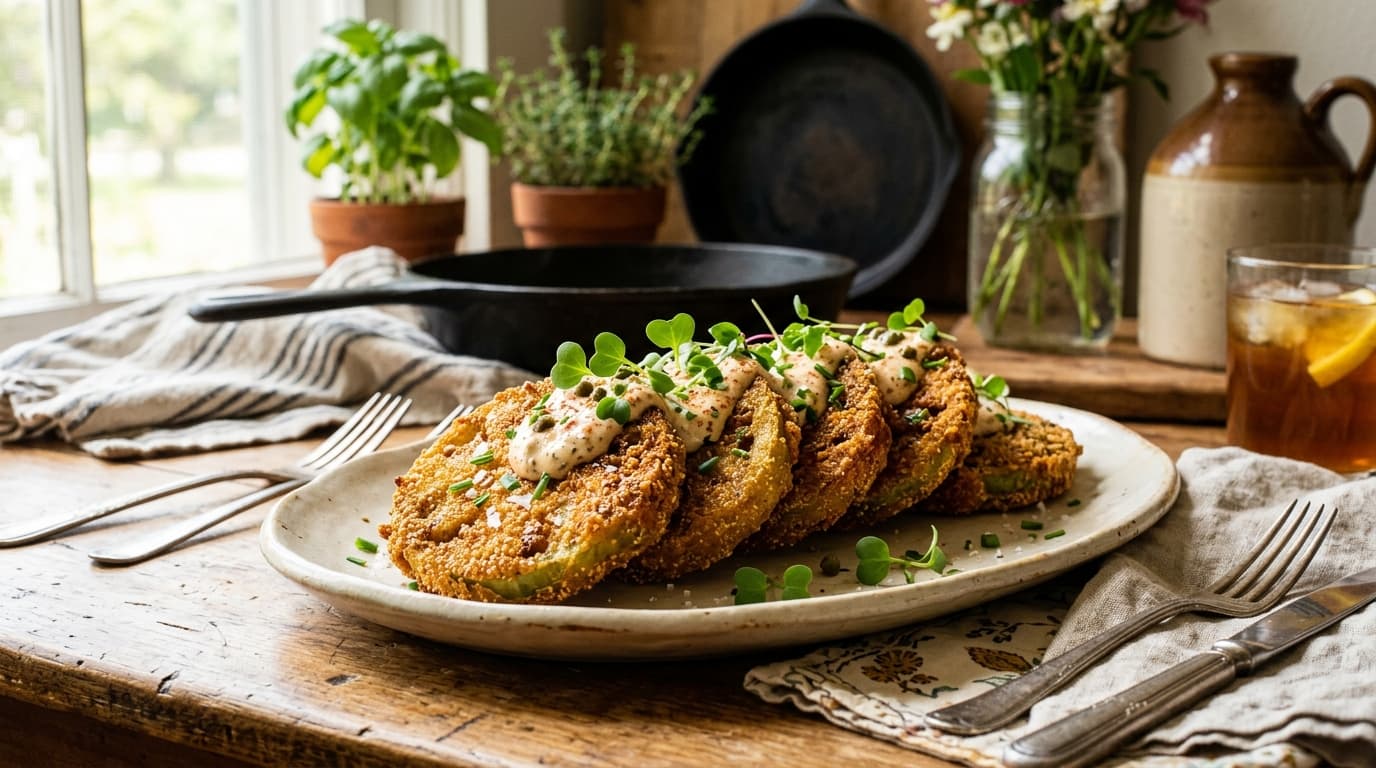
Crisp, thick-cut unripe green tomatoes dredged in seasoned flour, buttermilk egg wash, and coarse cornmeal, shallow-fried in cast iron until golden brown, served with a zesty Cajun remoulade.
Key Takeaways
- ✓Ready in just 15 mins using straightforward, kitchen-tested technique.
- ✓Delivers 7g of muscle-fueling protein per serving for lasting satiety.
- ✓Portion-balanced at 320 calories per serving with wholesome, unrefined ingredients.
- ✓Masterclass temperature checkpoints ensure maximum tenderness and flavor development.
The Story
Fried Green Tomatoes stand as an iconic staple of Southern cooking, celebrated in roadside diners, country family reunions, and high-end Charleston dining rooms. When properly executed, this dish presents a dynamic sensory contrast: a shatteringly crisp, coarse cornmeal-panko crust that gives way to a hot, tender, tangy, and slightly tart tomato interior, cut by the creamy, savory sting of scratch Cajun remoulade.
Despite its rustic reputation, frying green tomatoes requires technical culinary discipline. Common errors include a limp, oil-soaked crust that detaches in the pan, a watery tomato center that dilutes the seasoning, or scorched cornmeal surrounding raw, hard fruit.
Producing restaurant-grade fried green tomatoes demands understanding the pectin chemistry of unripe nightshades, managing osmotic moisture through pre-salting, building a three-tier dredging emulsion, and frying at regulated oil temperatures.
The Food Science of Unripe Tomatoes
Understanding the biology and structural chemistry of green tomatoes clarifies why they behave differently than ripe red tomatoes:
1. High Pectin and Cellular Rigidity
As tomatoes ripen, pectin methyl esterase and polygalacturonase enzymes break down the protopectin within plant cell walls, transforming firm tissue into soft, juicy fruit pulp while starches convert to fructose.- Unripe Green Tomatoes: Possess intact, cross-linked protopectin fibers and dense cellular structure. They have firm flesh with low free moisture and a crisp texture resembling an under-ripe apple.
- Thermal Resistance: When sliced and exposed to 365°F (185°C) frying oil, the intact pectin matrix withstands heat without disintegrating into mush, allowing the fruit to soften into a succulent, custard-like texture while supporting the heavy cornmeal crust.
- High Malic and Citric Acidity: Green tomatoes contain elevated levels of malic and citric acids with very little sugar. This sharp, tangy astringency cuts through the rich, savory animal fat and fried coating, refreshing the palate.
2. The Osmotic Pre-Salt Protocol
Even though green tomatoes feel rock-hard, their plant cells contain water bound by minerals.- If placed into hot oil without prep, rapid steam expansion pushes outward against the breading. This creates a steam pocket between the tomato surface and the flour coat, causing the crust to blister, separate, and slide off completely when picked up with a fork.
- The Solution: Slice the tomatoes into uniform 1/2-inch slabs. Lay them on paper towels and sprinkle both sides with kosher salt. Let rest for 15 to 20 minutes. Salt draws out surface water through osmosis. Blotting the slices thoroughly dry with fresh paper towels leaves a dry, tacky surface that bonds securely to flour starches.
Building the Three-Tier Breadcrumb Matrix
A durable, crunch-retaining crust requires a sequenced dredging system where each layer serves a distinct mechanical purpose:
- Layer 1: The Flour Anchor: All-purpose flour dusted over the dry tomato absorbs any remaining microscopic surface moisture. It provides a starch-rich adhesive foundation that allows the egg wash to wet the slick tomato skin.
- Layer 2: The Buttermilk-Egg Emulsion: Combining cultured whole buttermilk with beaten whole eggs creates a viscous wash. The lactic acid in the buttermilk tenders the outer tomato cell walls, while the egg yolk lecithin acts as an emulsifier that bonds the wet wash to the dry outer crumb.
- Layer 3: The Cornmeal-Panko-Parmesan Matrix:
The Chemistry of Frying: Cast Iron and Fat Selection
How you fry determines whether the coating turns golden and crisp or greasy and pale:
1. The Cast-Iron Thermal Advantage
A heavy seasoned 12-inch cast-iron skillet retains extensive heat. When 4 or 5 cold breaded tomato slices enter the pan, the oil temperature drops. A thin skillet will drop 60 degrees, causing the food to soak in oil. Heavy cast iron minimizes temperature drop, recovering quickly to the ideal 350°F–365°F (177°C–185°C) range.2. The Fat Blend: Neutral Oil + Rendered Bacon Fat
Frying purely in butter results in burnt milk solids before the tomatoes cook through. Frying purely in neutral vegetable oil yields crunch without character. The ideal method uses neutral oil (such as peanut or canola oil) with 2 to 3 tablespoons of rendered bacon drippings. The bacon fat introduces smoky pork depth that complements the tart green fruit.Step-by-Step Instructions
Follow these steps for classic Southern fried green tomatoes:
Step 1: Slice and Sweat the Green Tomatoes
Wash and dry 4 large firm green tomatoes. Trim away the stem ends. Cut the tomatoes crosswise into uniform 1/2-inch thick slices (discarding the small rounded end caps).Line a large rimmed baking sheet with two layers of paper towels. Arrange the tomato slices in a single layer. Sprinkle 1 teaspoon of kosher salt evenly across both sides of the slices. Let stand undisturbed at room temperature for 15 to 20 minutes; you will see beads of moisture pool on the surface.
Blot both sides of the tomato slices firmly with clean paper towels until completely dry to the touch.
Step 2: Mix the Scratch Cajun Remoulade
While the tomatoes sweat, prepare the remoulade so its flavors can marry.In a medium mixing bowl, whisk together 1/2 cup mayonnaise, 1 tablespoon Creole whole-grain mustard, 1 tablespoon fresh lemon juice, 1 tablespoon dill pickle relish (or minced capers), 1 finely grated garlic clove, 1 teaspoon hot pepper sauce, 1/2 teaspoon Worcestershire sauce, 1/2 teaspoon smoked paprika, and 1 tablespoon chopped fresh flat-leaf parsley until smooth and creamy. Cover and refrigerate until serving.
Step 3: Set Up the Three-Bowl Dredging Station
Arrange three wide, shallow pie pans or rimmed dishes in a row:- Bowl 1 (Flour): Whisk together 1 cup of all-purpose flour, 1/2 teaspoon kosher salt, 1/2 teaspoon black pepper, and 1/2 teaspoon garlic powder.
- Bowl 2 (Buttermilk Wash): Whisk 1/2 cup of well-shaken buttermilk with 2 large eggs until completely smooth and free of streaks.
- Bowl 3 (Crunch Crust): Combine 1 cup of yellow cornmeal, 1/2 cup of Japanese panko breadcrumbs, 1/4 cup of finely grated Parmesan cheese, 1/2 teaspoon garlic powder, 1/2 teaspoon onion powder, 1/2 teaspoon smoked paprika, and 1/4 teaspoon cayenne pepper. Toss with a fork until uniform.
Step 4: Dredge and Rest the Tomatoes
Work in batches of two or three slices using the "wet hand / dry hand" technique:- Dredge a dry tomato slice in Bowl 1 (flour), patting it gently to coat completely, then shake off all excess flour until only a sheer veil remains.
- Submerge into Bowl 2 (buttermilk wash), ensuring every corner is coated; let excess liquid drip back into the bowl for 2 seconds.
- Place into Bowl 3 (cornmeal-panko mixture). Spoon the cornmeal mixture generously over the top and press down firmly with your fingertips so the breading adheres in a solid crust.
Step 5: Heat the Skillet Fat
Pour neutral cooking oil into a 12-inch seasoned cast-iron skillet to a depth of 1/2 inch (roughly 1 cup of oil). Add 2 tablespoons of rendered bacon drippings.Place over medium heat. Heat the oil until it reaches 360°F (182°C) on a digital candy/deep-fry thermometer. If you drop a pinch of cornmeal into the pan, it should sizzle vigorously without smoking.
Step 6: Shallow-Fry to Deep Golden Perfection
Using tongs or a slotted fish spatula, carefully lower 3 or 4 breaded tomato slices into the hot oil, placing them away from you to avoid splashes. Do not crowd the skillet; there should be at least 1 inch of free oil between each slice so steam can escape.Fry undisturbed for 3 to 4 minutes, maintaining the oil temperature between 350°F and 365°F. Gently lift an edge: the underside should be a rich, golden mahogany brown.
Carefully flip each tomato slice over. Fry the second side for another 2 to 3 minutes until equally crisp, golden, and browned.
Step 7: Drain and Season Immediately
Using tongs or a spider skimmer, lift the fried tomatoes out of the oil, allowing excess fat to drain for a few seconds.Transfer them directly to a clean wire cooling rack set inside a baking sheet (avoid draining on paper towels, which traps steam beneath the hot tomatoes and softens the bottom crust).
Immediately sprinkle a light pinch of flaky sea salt or kosher salt over the hot crust while the surface oil is still sizzling. Repeat the frying process with the remaining breaded slices, monitoring oil temperature between batches.
Step 8: Garnish and Serve
Arrange the hot fried green tomatoes in an overlapping fan across a serving platter.Spoon a generous dollop of chilled Cajun remoulade sauce directly over the center of each slice, or serve the sauce in a small ceramic bowl alongside for dipping. Garnish with chopped fresh chives or microgreens and serve hot with sweet iced tea or cold beer.
Pro-Tips for Perfect Execution
- Always Use a Wire Rack for Draining: Draining fried foods on paper towels is a primary cause of soggy crusts. The hot tomato releases steam downward; paper towels trap this moisture, turning the crisp cornmeal soft within 60 seconds. An elevated wire cooling rack allows convective air to flow underneath, preserving 360-degree crunch.
- Keep Oil Temperature Stable: If the oil drops below 340°F (171°C), the breading will absorb liquid fat like a sponge, turning greasy. If the oil exceeds 380°F (193°C), the cornmeal will burn before the interior tomato flesh has time to soften.
- Do Not Crowd the Pan: Overcrowding dumps thermal energy from the skillet and traps moisture, causing the tomatoes to steam rather than fry.
Flavor Variations and Serving Styles
Storage, Freezing, and Reheating Science
Like most fried vegetable preparations, fried green tomatoes are at their absolute peak within 15 minutes of leaving the skillet. However, leftovers can be revived effectively:
Refrigerator Storage
Store leftover fried green tomatoes in an airtight container separated by sheets of parchment paper in the refrigerator for up to 3 days.Why You Must Never Microwave Fried Tomatoes
Microwaving rapidly heats water molecules inside the tomato flesh, turning them into high-pressure steam that erupts through the breading, turning the crisp crust into a mushy, separated paste.Reheating for Restored Crunch
- Oven / Toaster Oven Method (Best): Place tomatoes on a wire rack set in a baking sheet. Bake at 400°F (204°C) for 6 to 8 minutes until sizzling hot and re-crisped.
- Air Fryer Method: Reheat in an air fryer at 380°F (193°C) for 3 to 4 minutes. The fast air circulation removes trapped moisture and restores crunch.
The Agricultural History of Fried Green Tomatoes
While fried green tomatoes are celebrated worldwide as quintessential Southern food, their culinary history reflects nineteenth-century American agricultural thrift:
- The Frost-Line Harvesting Ritual: In late autumn across rural gardens from the Mid-Atlantic to the Deep South, the impending first hard frost threatened tomato vines loaded with un-ripened fruit. A hard freeze ruptures plant cells, turning unharvested tomatoes into rotting slush. Gardeners picked all remaining green tomatoes before the frost hit, using them for chow-chow relish, pickled green tomatoes, and skillet frying.
- The Cornmeal Culture: In Southern kitchens where wheat flour was historically expensive and corn was the dietary staple, frying foods in a cornmeal dredge was universal. Combining coarse native cornmeal with sour buttermilk produced a golden, rugged crust that became a signature regional technique.
Remoulade Emulsion Science: The Flavor Counterbalance
The accompanying remoulade is not merely a condiment; it functions as a biochemical flavor balance:
- The Acid Balance: Mayonnaise coats the palate in vegetable oil lipids. Adding freshly squeezed lemon juice, Creole coarse whole-grain mustard, and dill pickle brine introduces citric and acetic acids that cleave through the fried lipid film.
- The Sulfur-Capsaicin Spark: Minced garlic and Louisiana cayenne pepper sauce introduce allicin and capsaicin, which stimulate the trigeminal nerve and increase salivation, accentuating the tart malic acidity of the green tomato flesh.
Troubleshooting Common Frying Problems
1. The Breading Separates and Slides Off in the Skillet
- The Cause: The tomato was not salted to extract excess free moisture, or excess flour was not shaken off during dredging.
- The Solution: Follow the 15-minute salting protocol and blot thoroughly dry with paper towels. Shake off all excess flour until only a sheer veil remains before submerging in the buttermilk wash. Allow breaded slices to rest on a wire rack for 10 minutes before frying to set the starch glue.
2. The Crust is Dark Brown but the Tomato Inside is Raw and Crunchy
- The Cause: The skillet oil was too hot (above 380°F), scorching the cornmeal before thermal energy could penetrate into the tomato center.
- The Solution: Regulate oil temperature closely between 350°F and 360°F (177°C to 182°C). Cut slices to a precise 1/2-inch thickness—thicker slices struggle to cook through in the 6 to 7 minutes required to brown the crust.
3. The Fried Tomatoes Taste Greasy and Soggy
- The Cause: The oil temperature dropped below 330°F, causing the breading to absorb fat rather than vaporize surface moisture, or the cooked slices were drained flat on paper towels.
- The Solution: Fry only 3 to 4 slices at a time in a heavy cast-iron skillet so oil temperature stays stable. Drain cooked tomatoes on an elevated wire cooling rack rather than paper towels.
Nutritional Breakdown and Macro Profile
Per serving (serving size: 3 slices with 1 tablespoon remoulade sauce, recipe makes 4 generous appetizer servings):
| Nutrient | Amount per Serving | % Daily Value |
|---|---|---|
| Calories | 320 kcal | — |
| Total Fat | 18 g | 23% |
| Saturated Fat | 3.5 g | 18% |
| Cholesterol | 55 mg | 18% |
| Sodium | 620 mg | 27% |
| Total Carbohydrates | 34 g | 12% |
| Dietary Fiber | 3.5 g | 13% |
| Total Sugars | 5 g | — |
| Protein | 7 g | 14% |
| Potassium | 440 mg | 9% |
| Calcium | 80 mg | 6% |
| Iron | 2.2 mg | 12% |
Fried Green Tomatoes
Crisp, thick-cut unripe green tomatoes dredged in seasoned flour, buttermilk egg wash, and coarse cornmeal, shallow-fried in cast iron until golden brown, served with a zesty Cajun remoulade.
Macro Nutrition Profile (Per Serving)
Ingredients
Three-Stage Dredge Station
Zesty Southern Remoulade Sauce
Ingredient Substitutions
| Original Ingredient | Healthy Alternative |
|---|---|
| Animal protein | Firm tofu, tempeh, or organic chickpeas |
| Cooking fat | Extra virgin olive oil or grass-fed butter |
Instructions
Slice and Sweat the Green Tomatoes: Wash and dry 4 large firm green tomatoes. Trim away the stem ends. Cut the tomatoes crosswise into uniform 1/2-inch thick slices (discarding the small rounded end caps). Line a large rimmed baking sheet with two layers of paper towels. Arrange the tomato slices in a single layer. Sprinkle 1 teaspoon of kosher salt evenly across both sides of the slices. Let stand undisturbed at room temperature for 15 to 20 minutes; you will see beads of moisture pool on the surface. Blot both sides of the tomato slices firmly with clean paper towels until completely dry to the touch.
Mix the Scratch Cajun Remoulade: While the tomatoes sweat, prepare the remoulade so its flavors can marry. In a medium mixing bowl, whisk together 1/2 cup mayonnaise, 1 tablespoon Creole whole-grain mustard, 1 tablespoon fresh lemon juice, 1 tablespoon dill pickle relish (or minced capers), 1 finely grated garlic clove, 1 teaspoon hot pepper sauce, 1/2 teaspoon Worcestershire sauce, 1/2 teaspoon smoked paprika, and 1 tablespoon chopped fresh flat-leaf parsley until smooth and creamy. Cover and refrigerate until serving.
Set Up the Three-Bowl Dredging Station: Arrange three wide, shallow pie pans or rimmed dishes in a row: Bowl 1 (Flour): Whisk together 1 cup of all-purpose flour, 1/2 teaspoon kosher salt, 1/2 teaspoon black pepper, and 1/2 teaspoon garlic powder. Bowl 2 (Buttermilk Wash): Whisk 1/2 cup of well-shaken buttermilk with 2 large eggs until completely smooth and free of streaks. Bowl 3 (Crunch Crust): Combine 1 cup of yellow cornmeal, 1/2 cup of Japanese panko breadcrumbs, 1/4 cup of finely grated Parmesan cheese, 1/2 teaspoon garlic powder, 1/2 teaspoon onion powder, 1/2 teaspoon smoked paprika, and 1/4 teaspoon cayenne pepper. Toss with a fork until uniform.
Dredge and Rest the Tomatoes: Work in batches of two or three slices using the "wet hand / dry hand" technique: Dredge a dry tomato slice in Bowl 1 (flour), patting it gently to coat completely, then shake off all excess flour until only a sheer veil remains. Submerge into Bowl 2 (buttermilk wash), ensuring every corner is coated; let excess liquid drip back into the bowl for 2 seconds. Place into Bowl 3 (cornmeal-panko mixture). Spoon the cornmeal mixture generously over the top and press down firmly with your fingertips so the breading adheres in a solid crust. Transfer the breaded slices to a wire cooling rack set over a baking sheet. Let the breaded slices rest on the rack for 8 to 10 minutes before frying. This resting phase allows the flour starches to hydrate, forming a tacky seal that welds the crust to the tomato wall.
Heat the Skillet Fat: Pour neutral cooking oil into a 12-inch seasoned cast-iron skillet to a depth of 1/2 inch (roughly 1 cup of oil). Add 2 tablespoons of rendered bacon drippings. Place over medium heat. Heat the oil until it reaches 360°F (182°C) on a digital candy/deep-fry thermometer. If you drop a pinch of cornmeal into the pan, it should sizzle vigorously without smoking.
Shallow-Fry to Deep Golden Perfection: Using tongs or a slotted fish spatula, carefully lower 3 or 4 breaded tomato slices into the hot oil, placing them away from you to avoid splashes. Do not crowd the skillet; there should be at least 1 inch of free oil between each slice so steam can escape. Fry undisturbed for 3 to 4 minutes, maintaining the oil temperature between 350°F and 365°F. Gently lift an edge: the underside should be a rich, golden mahogany brown. Carefully flip each tomato slice over. Fry the second side for another 2 to 3 minutes until equally crisp, golden, and browned.
Drain and Season Immediately: Using tongs or a spider skimmer, lift the fried tomatoes out of the oil, allowing excess fat to drain for a few seconds. Transfer them directly to a clean wire cooling rack set inside a baking sheet (avoid draining on paper towels, which traps steam beneath the hot tomatoes and softens the bottom crust). Immediately sprinkle a light pinch of flaky sea salt or kosher salt over the hot crust while the surface oil is still sizzling. Repeat the frying process with the remaining breaded slices, monitoring oil temperature between batches.
Garnish and Serve: Arrange the hot fried green tomatoes in an overlapping fan across a serving platter. Spoon a generous dollop of chilled Cajun remoulade sauce directly over the center of each slice, or serve the sauce in a small ceramic bowl alongside for dipping. Garnish with chopped fresh chives or microgreens and serve hot with sweet iced tea or cold beer.
The Southern BLT Upgrade (The FGT-BLT): Substitute fried green tomatoes for standard red tomato slices on a toasted sourdough or brioche BLT sandwich. Layer with thick-cut smoked peppered bacon, crisp romaine, and a swipe of Cajun remoulade or roasted garlic aioli.
The Crab and Pimento Stack: Stack two fried green tomatoes with a warm layer of homemade Southern pimento cheese melted between them. Crown the top tomato with 2 ounces of warm sautéed jumbo lump crab meat tossed in lemon butter.
Goat Cheese and Hot Honey Platter: Top each hot fried green tomato with a medallion of fresh creamy goat cheese (chèvre). Drizzle with warm hot honey and garnish with fresh thyme leaves for a sweet, tangy, spicy contrast.
The Breading Separates and Slides Off in the Skillet: The Cause: The tomato was not salted to extract excess free moisture, or excess flour was not shaken off during dredging. The Solution: Follow the 15-minute salting protocol and blot thoroughly dry with paper towels. Shake off all excess flour until only a sheer veil remains before submerging in the buttermilk wash. Allow breaded slices to rest on a wire rack for 10 minutes before frying to set the starch glue.
The Crust is Dark Brown but the Tomato Inside is Raw and Crunchy: The Cause: The skillet oil was too hot (above 380°F), scorching the cornmeal before thermal energy could penetrate into the tomato center. The Solution: Regulate oil temperature closely between 350°F and 360°F (177°C to 182°C). Cut slices to a precise 1/2-inch thickness—thicker slices struggle to cook through in the 6 to 7 minutes required to brown the crust.
The Fried Tomatoes Taste Greasy and Soggy: The Cause: The oil temperature dropped below 330°F, causing the breading to absorb fat rather than vaporize surface moisture, or the cooked slices were drained flat on paper towels. The Solution: Fry only 3 to 4 slices at a time in a heavy cast-iron skillet so oil temperature stays stable. Drain cooked tomatoes on an elevated wire cooling rack rather than paper towels.
Tried this recipe?
Let us know how it turned out! Click a star below to leave a review and rate the recipe.
Storage & Freezing Tips
- Refrigerator: Store in an airtight container for up to 2 days. Keep the components separate if possible to preserve texture.
- Reheating: Reheat gently in a skillet on medium-low heat with a splash of olive oil or butter.
- Freezing: Freezing is not recommended for this dish because ingredients like eggs become soggy, rubbery, or mushy when defrosted.
Frequently Asked Questions
Can this recipe be prepared ahead of time?▼
Yes, this meal is excellent for weekly meal prep. Store components separately and assemble before serving.
Is this recipe gluten-free?▼
All ingredients used are naturally gluten-free. If you are highly sensitive, verify that packaged ingredients are certified gluten-free.
Tried this recipe?
Tag @stewartlucas on Instagram and hashtag it #nutriguide!
You Might Also Like

Stewart Lucas
Nutritionist & Recipe DeveloperStewart Lucas is a nutritionist and recipe developer representing the NutriGuide team. All recipes, nutritional values, and diet protocols published on this site are designed and audited by certified dietitians and clinical nutrition professionals to guarantee absolute accuracy.
Community Reviews
Please log in to leave a review.