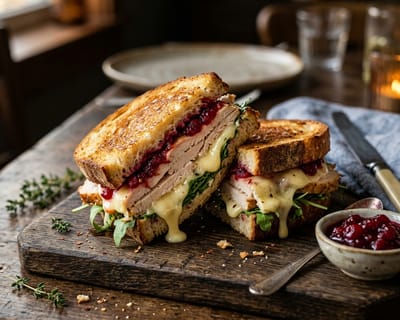
Turkey Cranberry Brie Sandwich

Gourmet toasted sandwich stacked with tender carved roast turkey breast, melting double-cream French Brie, tart scratch whole-berry cranberry sauce, peppery wild baby arugula, and Dijon aioli on butter-toasted artisanal sourdough.
Key Takeaways
- ✓Ready in just 15 mins using straightforward, kitchen-tested technique.
- ✓Delivers 40g of muscle-fueling protein per serving for lasting satiety.
- ✓Portion-balanced at 620 calories per serving with wholesome, unrefined ingredients.
- ✓Masterclass temperature checkpoints ensure maximum tenderness and flavor development.
The Story
The Turkey Cranberry Brie Sandwich represents one of the most successful flavor harmonies in contemporary deli and bistro cooking. By balancing the savory poultry depth of thick-carved roasted turkey breast with the creamy, buttery unctuousness of melting French Brie, the bright, tart acidity of simmered whole-berry cranberry sauce, and the peppery snap of fresh baby arugula inside butter-toasted artisanal sourdough, it delivers a sophisticated dining experience in a comfortable, handheld format.
While originally popularized as an ingenious way to repurpose holiday leftovers, this sandwich has earned a permanent place on gourmet café menus year-round. Yet home preparations often stumble: sourdough toasted to a burnt black crust while the cheese inside remains cold and chalky; waterlogged bread ruined by watery cranberry preserves; or bland, dry turkey overwhelmed by sweet jam.
Mastering this sandwich requires understanding the melting thermodynamics of soft-ripened bloomy-rind cheeses, the chemistry of natural pectin gelation in fruit spreads, structural moisture barriers in sandwich architecture, and gentle pan conduction.
Culinary Lineage: From Holiday Leftovers to Bistro Classic
The pairing of poultry with tart orchard fruit is centuries old. In British and colonial American foodways, roasted fowl was traditionally accompanied by tart gooseberry sauces, spiced apple compotes, or native wild cranberry relishes. Cranberries (Vaccinium macrocarpon), native to the peat bogs of northeastern North America, were harvested by indigenous Wampanoag and Algonquin peoples, who recognized their natural preserving properties due to high concentrations of benzoic acid.
Following the mid-twentieth-century standardization of the American Thanksgiving meal, the "day-after sandwich" became a domestic ritual. However, the introduction of French soft-ripened Brie cheese in place of everyday mild cheddar or processed Swiss elevated the sandwich into gourmet bistro territory during the 1980s and 1990s.
The soft, mushroom-scented, high-fat profile of Brie provides an unctuous luxury that complements the lean protein of roasted turkey, while tart whole cranberries cut cleanly through the rich cheese lipids, refreshing the tongue after every bite.
The Food Science of Soft-Ripened Brie: Melting Physics
Brie belongs to the family of soft-ripened, bloomy-rind cheeses traditionally originating in the Île-de-France region east of Paris:
1. The Bloomy Rind Chemistry (Penicillium camemberti)
The fuzzy white exterior of Brie is formed by inoculating the curds with the friendly mold Penicillium camemberti.- As the cheese ages from the outside in over 4 to 8 weeks, the mold secretes proteolytic and lipolytic enzymes.
- These enzymes break down the dense, insoluble casein milk proteins into shorter, soluble peptides and amino acids.
2. The Melting Threshold of Double-Cream Brie
Double-cream Brie contains roughly 60% fat in dry matter (about 30% to 32% total butterfat by weight).- At room temperature (68°F / 20°C), the butterfat is already partially liquid.
- When heated to between 110°F and 125°F (43°C to 52°C), the weakened casein protein matrix relaxes completely, transforming the cheese into a warm, creamy, lava-like flow.
- The Danger of Overheating: If heated above 160°F (71°C), the milk proteins curdle and contract, expelling their bound butterfat into a separated, greasy yellow puddle. Gentle pan heat is essential to achieve a luscious melt without breaking the emulsion.
The Chemistry of Scratch Cranberry Sauce: Pectin and Acid Balance
Commercial canned cranberry jelly is stiffened with processed gelatin and heavily sweetened with high-fructose corn syrup, leaving it cloying and one-dimensional. Making a fast, scratch whole-berry sauce in 8 minutes is culinary night and day:
1. High Natural Pectin
Fresh cranberries contain exceptional amounts of natural fruit pectin (a complex structural heteropolysaccharide found in plant cell walls).- When cranberries are simmered in orange juice and pure maple syrup, the heat causes the tough berry skins to pop with an audible snap.
- This rupture releases natural pectin chains into the liquid.
- In the presence of sugar and the natural fruit acids (citric, malic, and quinic acids), these pectin chains cross-link into a glossy, spoonable gel as the sauce cools, requiring zero artificial thickeners or cornstarch.
2. Acidic Contrast to Dairy Lipids
Cranberries have a very low pH (typically between 2.3 and 2.5), making them almost as acidic as fresh lemon juice.- This high natural acidity provides essential sensory contrast.
- The tart quinic and citric acids stimulate salivary flow and cleave cleanly through the heavy butterfat of the melted Brie and roasted turkey, preventing palate fatigue.
Sandwich Architecture: Engineering Moisture Defenses
A toasted sandwich with juicy meat, fruit sauce, and melting cheese can quickly turn soggy if assembled haphazardly. Sandwich engineering dictates the precise layering order:
- Top Slice: Artisanal sourdough (butter-toasted exterior)
- Moisture Barrier: Garlic Dijon aioli (emulsion shield)
- Fresh Greens: Wild baby arugula (insulated from direct pan heat)
- Fruit Core: Tart scratch whole-berry cranberry sauce (centered)
- Protein Layer: Thick-carved roasted turkey breast (hearty bite)
- Thermal Buffer: Melting slices of double-cream French Brie (softened by pan heat)
- Moisture Barrier: Garlic Dijon aioli (emulsion shield)
- Bottom Slice: Artisanal sourdough (butter-toasted exterior)
1. The Lipid Moisture Barrier
Never spread water-based sauces (like cranberry sauce or mustard alone) directly onto bare bread starches. Mayonnaise is a tight oil-in-water emulsion containing roughly 75% vegetable oil. Spreading garlic-Dijon aioli directly onto the inner surface of both sourdough slices coats the porous crumb with a hydrophobic fat layer, preventing moisture from migrating into the bread.2. Positioning the Cheese as a Heat Sink
Place the cold slices of Brie directly against the bottom bread slice. As heat conducts upward from the cast-iron griddle through the crust, the Brie absorbs the thermal energy immediately, melting into a creamy blanket that anchors the sliced turkey above it.3. Protecting the Fresh Greens
Baby arugula contains delicate cell walls that wilt into slimy, dark sludge if exposed to direct pan heat. By placing the arugula on top of the cranberry sauce beneath the upper bread slice, the greens are shielded from direct conductive heat, retaining their crisp crunch and peppery pungency.Bread Selection and Griddle Mechanics: Sourdough vs. Brioche
The choice of bread dictates both structural integrity and browning physics:
1. The Virtues of Country Sourdough
While sweet brioche is tender, its high sugar and egg content causes it to burn rapidly on a griddle before the cold Brie can melt. Artisanal country sourdough features:- A sturdy, chewy crumb that supports heavy layers of meat and melting cheese without collapsing.
- Natural lactic and acetic acids from wild fermentation that complement the tart cranberry sauce.
- Sturdy crust bubbles that toast into shatteringly crisp texture under pan heat.
2. Butter vs. Mayonnaise for Exterior Griddling
- Softened Unsalted Butter: Delivers classic nutty, sweet dairy flavor as milk solids undergo the Maillard reaction.
- Mayonnaise Technique: Spreading a thin layer of mayonnaise on the outer bread faces instead of butter provides an even browning agent with a higher smoke point, yielding an exceptionally crisp, golden crust that resists sogginess.
Step-by-Step Instructions
Follow these culinary steps for the ultimate Turkey Cranberry Brie Sandwich:
Step 1: Simmer the Scratch Cranberry Sauce
In a small heavy saucepan, combine 1 1/2 cups of fresh or frozen cranberries, 1/3 cup of pure maple syrup (or sugar), 1/4 cup of fresh orange juice, 1 teaspoon of grated orange zest, and a tiny pinch of kosher salt.Bring to a boil over medium heat, stirring occasionally.
Cook for 6 to 8 minutes: the cranberries will begin to pop with audible bursts. Press the berries gently against the side of the pot with a wooden spoon to burst remaining skins.
Once the sauce thickens and coats the back of a spoon, remove from the heat. Pour into a shallow glass bowl and let cool to room temperature (it will firm into a glossy, spreadable jam as it cools).
Step 2: Whisk the Garlic Dijon Aioli
In a small bowl, combine 1/3 cup of mayonnaise, 1 tablespoon of smooth Dijon mustard, 1 finely grated garlic clove, and 1 teaspoon of fresh lemon juice.Whisk with a fork until smooth and creamy. Season with a tiny pinch of black pepper. Set aside.
Step 3: Prep the Turkey and Brie
Slice 8 ounces of chilled double-cream French Brie cheese into uniform 1/4-inch thick slabs. (Leaving the cheese cold straight from the refrigerator prevents it from sticking to the knife blade).Carve 1 pound of roasted turkey breast into sturdy 1/4-inch slices across the grain.
Step 4: Assemble the Layered Sandwiches
Lay 8 slices of artisanal sourdough bread flat on a clean work surface.Spread 1 tablespoon of the garlic Dijon aioli evenly across the top face of all 8 bread slices.
On 4 of the bread slices (the base slices):
- Arrange the sliced Brie in an even layer covering the bread.
- Layer 4 ounces of carved roasted turkey breast directly over the Brie.
- Spoon 2 generous tablespoons of the cooled tart cranberry sauce over the turkey, spreading it gently toward the edges.
- Top the cranberry layer with a loose handful of fresh baby arugula.
- Close each sandwich with one of the remaining 4 bread slices, aioli-side facing downward against the arugula.
Step 5: Butter the Sandwich Exteriors
Using an offset spatula or butter knife, spread softened unsalted butter (or a thin sheen of mayonnaise) evenly across the top exposed slice of each sandwich.Step 6: Griddle on Low Heat
Place a wide 12-inch heavy cast-iron skillet or griddle over medium-low heat (around 300°F / 150°C). Allow the skillet to preheat thoroughly for 3 to 4 minutes.Carefully lift 2 assembled sandwiches and place them buttered-side down onto the hot cast-iron surface.
Immediately spread softened butter across the unbuttered top slices now facing upward.
Cover the skillet loosely with a heat-proof lid, large metal bowl, or sheet of aluminum foil.
Cook undisturbed over medium-low heat for 3 to 4 minutes. The trapped dome of steam will warm the turkey and melt the Brie, while the bottom sourdough slowly toasts into a rich, golden-brown crust.
Step 7: Flip and Brown the Second Side
Remove the lid. Using a wide metal spatula, carefully flip each sandwich over.Cook uncovered for an additional 2 1/2 to 3 minutes, pressing down very gently with the spatula to ensure even contact across the bread.
Watch the edges: the Brie should be visibly melting and bulging slightly past the crust, while the bottom bread becomes deep golden, crisp, and fragrant.
Step 8: Rest, Slice, and Serve
Transfer the toasted sandwiches to a wooden cutting board. Allow them to rest undisturbed for 60 to 90 seconds. (Resting allows the hot, flowing Brie to settle slightly so it does not escape across the board when cut).Using a sharp serrated bread knife, slice each sandwich diagonally across the middle with a gentle sawing motion.
Sprinkle the exposed cut faces with a tiny pinch of flaky Maldon sea salt. Serve immediately while warm, gooey, and crisp, accompanied by kettle-cooked chips or a fresh green salad.
Pro-Tips for Sandwich Mastery
- Chill the Brie Before Slicing: Room-temperature Brie is too soft to slice neatly and will glue itself to your knife. Keep it in the coldest part of the refrigerator until the exact moment you are ready to carve.
- Keep Heat at Medium-Low: The most frequent mistake is cooking over high heat. High heat burns the bread crust within 90 seconds, leaving the dense turkey and Brie cold in the center. Low heat and a pan cover ensure thorough thermal penetration.
- Use Artisanal Sourdough: Avoid soft sandwich bread, which collapses into a soggy sponge under the weight of turkey, cranberry, and melting cheese. Sturdy sourdough holds its structural shape.
Flavor Variations and Additions
Storage, Reheating, and Make-Ahead Instructions
Toasted sandwiches are at their peak freshly off the griddle, but smart component prep makes weekday assembly effortless:
Component Prep (Best for Entertaining)
- Cranberry Sauce: Can be made up to 10 days in advance and kept in an airtight glass jar in the refrigerator.
- Dijon Aioli: Can be whisked and refrigerated up to 5 days ahead.
- Turkey and Cheese: Pre-slice turkey and Brie up to 24 hours in advance and keep tightly wrapped.
- When guests arrive, assemble and griddle in 8 minutes.
Reheating Leftover Sandwiches
Store leftover wrapped sandwiches in the refrigerator for up to 2 days.- Skillet Reheating (Best): Place the cold sandwich into a dry skillet over medium-low heat. Cover with a lid and warm for 3 to 4 minutes per side until the bread is recrisped and the cheese is melted.
- Oven or Toaster Oven: Bake on a wire rack at 350°F (175°C) for 8 to 10 minutes.
- Never Microwave: Microwaving makes the sourdough rubbery and causes the Brie to break into liquid oil.
Sommelier Beverage Pairings
Balancing rich double-cream Brie, savory roasted turkey, and high-acid cranberry sauce calls for wines with bright fruit and refreshing acidity:
- Pinot Noir (Willamette Valley or Burgundy): The premier pairing. A light-to-medium-bodied Pinot Noir features bright red cherry and cranberry fruit notes that mirror the sauce, with earthy forest-floor undertones that harmonize with the bloomy Brie rind.
- Dry Riesling (Alsace or Finger Lakes): High natural acidity cuts through the buttery cheese, while subtle stone-fruit notes complement the roasted poultry.
- Dry Sparkling Rosé (Crémant d'Alsace or Champagne): Brisk effervescence scours rich dairy fat from the tongue, while delicate berry aromas echo the fresh cranberry jam.
- Non-Alcoholic Refreshers: Chilled sparkling apple cider with a dash of fresh lemon juice, unsweetened iced black tea with an orange twist, or sparkling pomegranate mineral water.
Troubleshooting Common Sandwich Problems
1. The Bread Burned Before the Cheese Melted
- The Cause: The stove burner heat was set too high, or the skillet was not covered.
- The Solution: Lower the burner to medium-low. Cover the pan with a lid or bowl for the first 3 minutes; trapped heat warms the turkey and melts the cheese from all sides while the bottom crust gently toasts.
2. The Bread Turned Gummy and Wet Under the Cranberry Sauce
- The Cause: Cranberry sauce was spooned directly against bare bread, or commercial watery jelly was used.
- The Solution: Coat both bread slices with Dijon aioli to create a hydrophobic lipid barrier. Place the cranberry sauce in the center between the turkey and greens, keeping it away from direct bread contact.
3. The Brie Melted Completely and Leaked Out onto the Skillet
- The Cause: The cheese slices were placed too close to the crust edge, or excessive pressure was applied with the spatula.
- The Solution: Keep cheese slices 1/2 inch inward from the bread perimeter. Do not press aggressively on the sandwich with the spatula while grilling.
Nutritional Breakdown and Macro Profile
Per serving (serving size: 1 whole large gourmet sandwich, recipe makes 4 full sandwiches):
| Nutrient | Amount per Serving | % Daily Value |
|---|---|---|
| Calories | 620 kcal | — |
| Total Fat | 30 g | 38% |
| Saturated Fat | 14 g | 70% |
| Cholesterol | 115 mg | 38% |
| Sodium | 1,020 mg | 44% |
| Total Carbohydrates | 48 g | 17% |
| Dietary Fiber | 3 g | 11% |
| Total Sugars | 12 g | — |
| Protein | 40 g | 80% |
| Potassium | 510 mg | 11% |
| Calcium | 220 mg | 17% |
| Iron | 3.8 mg | 21% |
Turkey Cranberry Brie Sandwich
Gourmet toasted sandwich stacked with tender carved roast turkey breast, melting double-cream French Brie, tart scratch whole-berry cranberry sauce, peppery wild baby arugula, and Dijon aioli on butter-toasted artisanal sourdough.
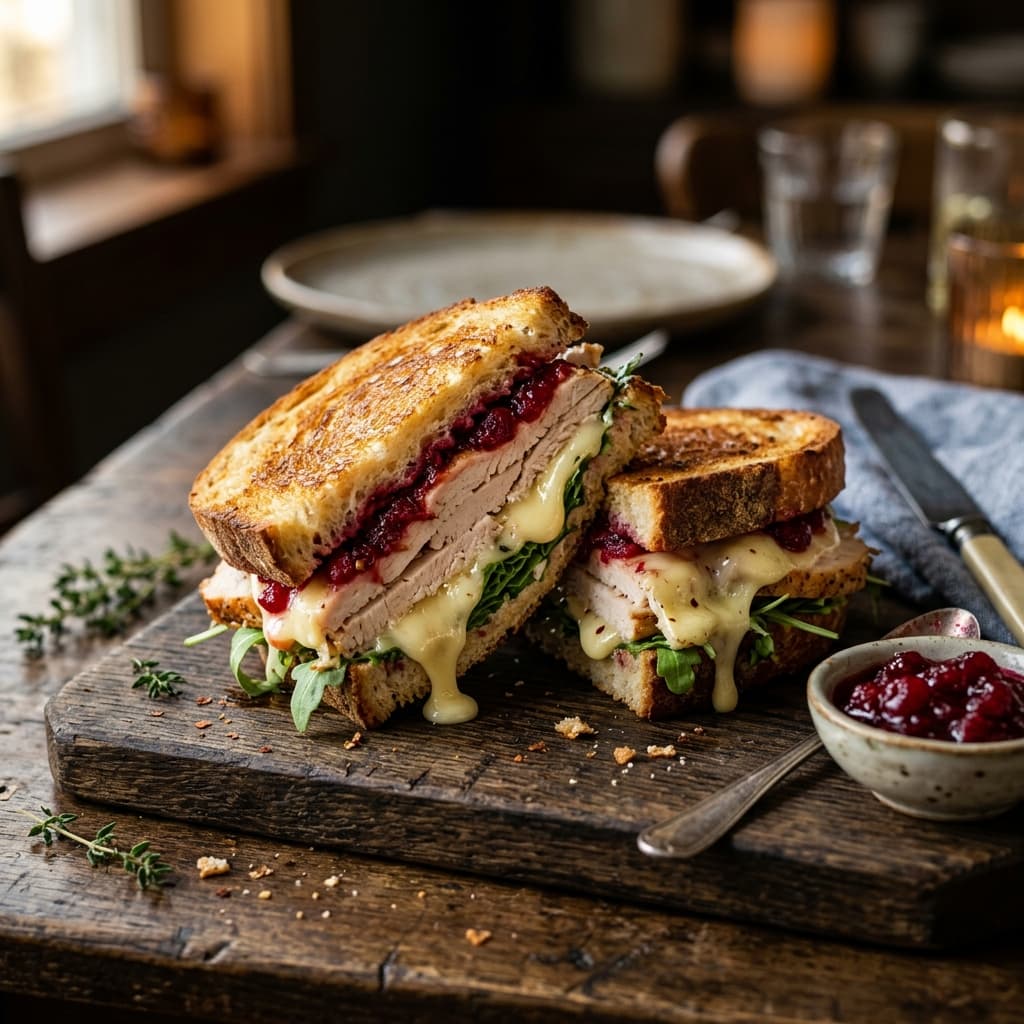
Macro Nutrition Profile (Per Serving)
Ingredients
Scratch Tart Whole-Berry Cranberry Sauce
Dijon Aioli & Peppery Greens
Griddle Toasting
Ingredient Substitutions
| Original Ingredient | Healthy Alternative |
|---|---|
| Chicken breast | Turkey breast or extra-firm tofu (1:1 ratio) |
| Dino kale/greens | Baby spinach or Swiss chard (cooks faster, add at the end) |
Instructions
Simmer the Scratch Cranberry Sauce: In a small heavy saucepan, combine 1 1/2 cups of fresh or frozen cranberries, 1/3 cup of pure maple syrup (or sugar), 1/4 cup of fresh orange juice, 1 teaspoon of grated orange zest, and a tiny pinch of kosher salt. Bring to a boil over medium heat, stirring occasionally. Cook for 6 to 8 minutes: the cranberries will begin to pop with audible bursts. Press the berries gently against the side of the pot with a wooden spoon to burst remaining skins. Once the sauce thickens and coats the back of a spoon, remove from the heat. Pour into a shallow glass bowl and let cool to room temperature (it will firm into a glossy, spreadable jam as it cools).
Whisk the Garlic Dijon Aioli: In a small bowl, combine 1/3 cup of mayonnaise, 1 tablespoon of smooth Dijon mustard, 1 finely grated garlic clove, and 1 teaspoon of fresh lemon juice. Whisk with a fork until smooth and creamy. Season with a tiny pinch of black pepper. Set aside.
Prep the Turkey and Brie: Slice 8 ounces of chilled double-cream French Brie cheese into uniform 1/4-inch thick slabs. (Leaving the cheese cold straight from the refrigerator prevents it from sticking to the knife blade). Carve 1 pound of roasted turkey breast into sturdy 1/4-inch slices across the grain.
Assemble the Layered Sandwiches: Lay 8 slices of artisanal sourdough bread flat on a clean work surface. Spread 1 tablespoon of the garlic Dijon aioli evenly across the top face of all 8 bread slices. On 4 of the bread slices (the base slices): Arrange the sliced Brie in an even layer covering the bread. Layer 4 ounces of carved roasted turkey breast directly over the Brie. Spoon 2 generous tablespoons of the cooled tart cranberry sauce over the turkey, spreading it gently toward the edges. Top the cranberry layer with a loose handful of fresh baby arugula. Close each sandwich with one of the remaining 4 bread slices, aioli-side facing downward against the arugula.
Butter the Sandwich Exteriors: Using an offset spatula or butter knife, spread softened unsalted butter (or a thin sheen of mayonnaise) evenly across the top exposed slice of each sandwich.
Griddle on Low Heat: Place a wide 12-inch heavy cast-iron skillet or griddle over medium-low heat (around 300°F / 150°C). Allow the skillet to preheat thoroughly for 3 to 4 minutes. Carefully lift 2 assembled sandwiches and place them buttered-side down onto the hot cast-iron surface. Immediately spread softened butter across the unbuttered top slices now facing upward. Cover the skillet loosely with a heat-proof lid, large metal bowl, or sheet of aluminum foil. Cook undisturbed over medium-low heat for 3 to 4 minutes. The trapped dome of steam will warm the turkey and melt the Brie, while the bottom sourdough slowly toasts into a rich, golden-brown crust.
Flip and Brown the Second Side: Remove the lid. Using a wide metal spatula, carefully flip each sandwich over. Cook uncovered for an additional 2 1/2 to 3 minutes, pressing down very gently with the spatula to ensure even contact across the bread. Watch the edges: the Brie should be visibly melting and bulging slightly past the crust, while the bottom bread becomes deep golden, crisp, and fragrant.
Rest, Slice, and Serve: Transfer the toasted sandwiches to a wooden cutting board. Allow them to rest undisturbed for 60 to 90 seconds. (Resting allows the hot, flowing Brie to settle slightly so it does not escape across the board when cut). Using a sharp serrated bread knife, slice each sandwich diagonally across the middle with a gentle sawing motion. Sprinkle the exposed cut faces with a tiny pinch of flaky Maldon sea salt. Serve immediately while warm, gooey, and crisp, accompanied by kettle-cooked chips or a fresh green salad.
The Crispy Applewood Bacon Stack: Layer 3 strips of shatteringly crisp applewood-smoked bacon over the turkey breast before adding the cranberry sauce. The smoky, salty pork fat elevates the sweet-tart cranberry and rich Brie.
The Honey-Mustard and Green Apple Crunch: Whisk 1 teaspoon of clover honey into the Dijon aioli. Add paper-thin slices of crisp Granny Smith apple directly over the turkey for bright orchard crunch.
The Spiced Pear and Pecan Twist: Simmer 1 cup of peeled, diced Bosc pears with the cranberries, a cinnamon stick, and a pinch of ground cloves. Scatter toasted chopped pecans over the cheese layer for nutty autumn crunch.
The Bread Burned Before the Cheese Melted: The Cause: The stove burner heat was set too high, or the skillet was not covered. The Solution: Lower the burner to medium-low. Cover the pan with a lid or bowl for the first 3 minutes; trapped heat warms the turkey and melts the cheese from all sides while the bottom crust gently toasts.
The Bread Turned Gummy and Wet Under the Cranberry Sauce: The Cause: Cranberry sauce was spooned directly against bare bread, or commercial watery jelly was used. The Solution: Coat both bread slices with Dijon aioli to create a hydrophobic lipid barrier. Place the cranberry sauce in the center between the turkey and greens, keeping it away from direct bread contact.
The Brie Melted Completely and Leaked Out onto the Skillet: The Cause: The cheese slices were placed too close to the crust edge, or excessive pressure was applied with the spatula. The Solution: Keep cheese slices 1/2 inch inward from the bread perimeter. Do not press aggressively on the sandwich with the spatula while grilling.
Tried this recipe?
Let us know how it turned out! Click a star below to leave a review and rate the recipe.
Storage & Freezing Tips
- Refrigerator: Store leftovers in an airtight container for up to 3-4 days.
- Reheating: Heat in a saucepan or skillet on medium heat until hot throughout.
- Freezing: Freeze portions in airtight containers for up to 2 months. Reheat directly from frozen or after thawing.
Frequently Asked Questions
Can this recipe be prepared ahead of time?▼
Yes, this meal is excellent for weekly meal prep. Store components separately and assemble before serving.
Is this recipe gluten-free?▼
All ingredients used are naturally gluten-free. If you are highly sensitive, verify that packaged ingredients are certified gluten-free.
Tried this recipe?
Tag @stewartlucas on Instagram and hashtag it #nutriguide!
You Might Also Like


Stewart Lucas
Chief Culinary SpecialistStewart Lucas is the Chief Culinary Specialist and lead recipe developer representing the NutriGuide team. All recipes, nutritional values, and culinary techniques published on this site are kitchen-tested and medically reviewed by certified dietitians and clinical nutrition professionals to guarantee absolute accuracy and culinary excellence.
Community Reviews
Please log in to leave a review.