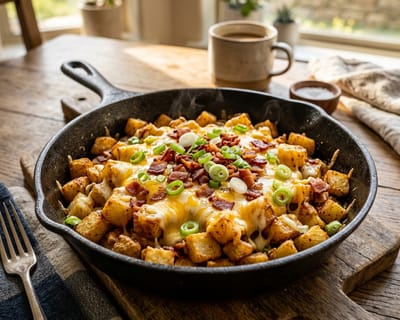
Bacon Cheddar Breakfast Potatoes

Crispy cast-iron skillet breakfast home fries tossed in rendered bacon fat, smoked paprika, garlic, and caramelized onions, topped with melted sharp cheddar cheese, crumbled thick-cut bacon, and sliced green onions.
Key Takeaways
- ✓Ready in just 30 mins using straightforward, kitchen-tested technique.
- ✓Delivers 14g of muscle-fueling protein per serving for lasting satiety.
- ✓Portion-balanced at 390 calories per serving with wholesome, unrefined ingredients.
- ✓Masterclass temperature checkpoints ensure maximum tenderness and flavor development.
The Story
Bacon Cheddar Breakfast Potatoes stand as the quintessential foundation of the classic American diner and weekend brunch spread. Featuring cubed potatoes par-boiled to tender perfection, pan-fried in rendered applewood bacon drippings until deeply golden and crisp, tossed with caramelized onions and aromatic seasonings, and finished under a blanket of melted sharp cheddar cheese, they deliver an irresistible contrast of crunchy crust, pillowy center, and savory richness.
Despite their simple ingredient roster, breakfast potatoes frequently fall short in home kitchens: soggy, limp cubes soaked in cooking oil; raw, hard interiors masked by burnt exteriors; or potatoes that stick stubbornly to the skillet and tear into greasy mush.
Mastering restaurant-grade breakfast potatoes requires understanding potato starch chemistry, the mechanics of alkaline par-boiling, surface starch gelatinization, and heat conduction in cast-iron cookery.
The Food Science of Potato Starches: Amylose vs. Amylopectin
The physical texture of a fried potato cube is governed by the ratio of two starch polymers contained within its cellular amyloplasts:
1. Russet Potatoes (High Amylose)
Russet Burbank potatoes contain roughly 20% to 22% starch, dominated by linear amylose chains.- When cooked, their cells separate easily, producing a dry, floury, and fluffy interior.
- When fried, amylose molecules dehydrate into an exceptionally rigid, glass-like crust.
- However, because their cellular walls are fragile, russet cubes can disintegrate if par-boiled too aggressively.
2. Yukon Gold Potatoes (Medium Starch, High Moisture)
Yukon Gold potatoes strike a harmonious balance with roughly 15% to 17% starch and higher levels of branched amylopectin and cellular pectin.- They hold their sharp cubic edges cleanly throughout boiling and skillet tossing.
- Their natural sugars impart a buttery, sweet corn-like flavor, and their interior remains creamy and moist.
- For the ultimate breakfast home fry, Yukon Golds provide the best combination of structural resilience and rich flavor, while Russets deliver maximum crust crunch.
The Alkaline Par-Boil Method: The Secret to Shattering Crunch
The greatest mistake in preparing skillet home fries is tossing raw, cold potato cubes directly into a hot frying pan:
- Raw potatoes contain roughly 80% water. When raw cubes hit hot grease, surface moisture turns to steam, creating a thermal barrier that prevents rapid browning.
- By the time the dense raw core conducts enough heat to soften, the outer edges have scorched or absorbed excessive fat, leaving them greasy and soggy.
1. The Chemistry of Baking Soda in Boiling Water
To create a crust that stays crisp for over thirty minutes, the potatoes must be par-boiled in alkaline water:- Adding 1/2 teaspoon of sodium bicarbonate (baking soda) to the boiling water raises the water pH to roughly 8.0–8.5.
- In an alkaline environment, the pectin that glues the potato's plant cells together dissolves much faster than starch gelatinizes.
- The outer 1 millimeter of the potato cube rapidly breaks down into a soft, porous slurry of gelatinized starch, while the inner core cooks to tender doneness.
2. The Pot Shake (Roughing the Surface)
After draining the par-boiled potatoes thoroughly in a colander, return them to the warm, dry pot.- Vigorously shake the pot back and forth with a lid on or toss with a wooden spoon for 15 seconds.
- The tumbling action causes the softened, alkaline-treated exterior to abrade, coating every cube in a thick, cloudy paste of rough potato starch.
- When this starchy slurry hits hot bacon fat, it expands into thousands of microscopic, jagged crisp points that fry into a shatteringly crisp, bubbly shell.
Fat Thermodynamics: The Power of Rendered Bacon Drippings
Cooking oil selection fundamentally alters the flavor and crispness of skillet potatoes:
1. Vegetable Oil vs. Animal Lipids
While neutral canola or vegetable oil can fry potatoes, it imparts zero savory complexity. Rendered bacon fat consists of saturated and monounsaturated fatty acids with suspended pork collagen peptides and savory glutamates.- Saturated animal fats solidify at room temperature and remain stable under high skillet temperatures without smoking or breaking down.
- As the potatoes sear, the porous exterior starch matrix absorbs the aromatic bacon drippings, seasoning the potato from the outside in with natural wood smoke and pork umami.
2. The Heat Conduction of Cast Iron
A heavy 12-inch seasoned cast-iron skillet provides immense thermal mass. When two pounds of par-boiled potatoes hit the pan, thin aluminum nonstick pans experience a sudden temperature drop, causing the potatoes to steam rather than fry. Heavy cast iron retains heat, recovering immediately and maintaining the 350°F–375°F (175°C–190°C) frying threshold required to sear the starches instantly.The Timing of Alliums and Aromatics
Raw yellow onions consist of 89% water and high concentrations of natural sugars.
- If diced onions are added to the skillet at the beginning with raw or par-boiled potatoes, the moisture released by the onions steams the potatoes, preventing them from crisping.
- Furthermore, onion sugars caramelize and scorch within 8 to 10 minutes at high heat, turning bitter and black before the potatoes finish browning.
- The Professional Technique: Sauté the diced onions and peppers in the skillet right after rendering the bacon until tender and sweet, then remove them to a plate. Fry the potatoes undisturbed in the remaining fat. Reintroduce the caramelized onions, garlic, and seasonings during the final 3 to 4 minutes of cooking so every component reaches peak flavor without scorching.
Cheddar Cheese Melting Physics: Preventing the Grease Slick
Cheddar cheese aged for 9 to 12 months possesses high protein content and moderate moisture:
- When exposed to boiling skillet temperatures above 175°F (79°C), the casein protein strands contract tightly, squeezing out their bound butterfat as a yellow, oily puddle, leaving the cheese rubbery and tough.
- The Gentle Steam Melt: Turn off the stovetop flame completely. Scatter freshly shredded sharp cheddar and Monterey Jack across the mounded hot potatoes.
- Cover the skillet tightly with a lid or large metal bowl for 2 minutes.
- The ambient trapped heat and rising steam melt the cheese into a glossy, stretchy, cohesive blanket without breaking the emulsion.
Step-by-Step Instructions
Follow these culinary steps for perfect Bacon Cheddar Breakfast Potatoes:
Step 1: Render and Crisp the Bacon
Place a heavy 12-inch cast-iron skillet over medium heat.Add 6 strips of diced thick-cut applewood-smoked bacon. Cook for 7 to 9 minutes, stirring occasionally with a wooden spoon, until the bacon is deeply browned, rendered, and shatteringly crisp.
Using a slotted spoon, transfer the crisp bacon crumbles to a paper-towel-lined plate.
Pour the rendered bacon drippings into a heat-proof measuring cup. You should have roughly 3 to 4 tablespoons of aromatic fat. Wipe any burned specks from the skillet with a dry paper towel, but leave the pan seasoned.
Step 2: Sauté the Onions and Peppers
Return 1 tablespoon of the warm bacon fat to the skillet over medium heat.Add 1 finely diced yellow onion and 1 finely diced red bell pepper. Sauté for 6 to 8 minutes, stirring frequently, until the vegetables are soft, tender, and lightly caramelized at the edges.
Add 3 cloves of finely minced garlic during the final 60 seconds of cooking, stirring continuously until fragrant.
Transfer the sautéed onions, peppers, and garlic to a small bowl and set aside.
Step 3: Alkaline Par-Boil the Potatoes
While the bacon renders, bring 3 quarts of water to a rolling boil in a large 5-quart Dutch oven or stockpot over high heat.Add 1 tablespoon of kosher salt and 1/2 teaspoon of baking soda.
Add 2 1/2 pounds of cubed Yukon Gold potatoes (cut into uniform 3/4-inch pieces).
Return to a boil, then reduce heat to maintain a steady simmer. Cook for 6 to 8 minutes, testing with a paring knife: the knife tip should slide into the potato cube with slight resistance, and the exterior should look soft and chalky, but the cube must not be falling apart.
Step 4: Drain and Rough the Potato Surface
Drain the potatoes thoroughly in a large colander. Allow them to sit undisturbed for 2 to 3 minutes so surface moisture can flash off completely into steam.Return the dry, steaming potatoes to the empty warm pot.
Grasp the pot handles with kitchen towels, cover with the lid, and shake vigorously up and down for 10 to 15 seconds.
Remove the lid: the potato cubes should now be coated in a thick, cloudy, paste-like layer of roughed-up potato starch.
Step 5: The Initial High-Heat Sear
Return the 12-inch cast-iron skillet to medium-high heat. Add the remaining 2 to 3 tablespoons of rendered bacon fat (add 1 tablespoon of butter or olive oil if you have less than 3 tablespoons of fat).Allow the fat to heat until shimmering and faintly smoking (roughly 375°F / 190°C).
Carefully pour the roughed-up potatoes into the skillet. Using a flat metal spatula, spread the potatoes into a single, even layer across the entire pan floor.
Leave the potatoes undisturbed for 5 to 6 minutes. Do not stir or agitate. Let the direct thermal contact dehydrate the bottom starches into a deep, crunchy, golden crust.
Step 6: Flip and Crisp All Sides
Using a stiff, thin-bladed metal spatula, slide underneath the potatoes and turn them in large sections. You will see deep mahogany-brown, blistered crusts.Cook undisturbed for another 4 to 5 minutes to brown the second side.
Gently toss and turn the potatoes for an additional 4 to 6 minutes, allowing all remaining pale facets to make contact with the hot iron floor and develop an even, all-around crisp shell.
Step 7: Season and Reintroduce Aromatics
Sprinkle 1 1/2 teaspoons of smoked Spanish paprika, 1 teaspoon of garlic powder, 1/2 teaspoon of onion powder, 1/2 teaspoon of dried thyme, 1/2 teaspoon of freshly cracked black pepper, and 1/2 teaspoon of kosher salt evenly across the potatoes.Toss thoroughly with your spatula for 60 seconds to coat every cube and toast the spices in the residual fat.
Add the reserved sautéed onions, bell peppers, and garlic back into the skillet. Toss gently for 1 to 2 minutes until hot and uniformly combined.
Step 8: Melt the Cheese and Garnish
Reduce the stovetop heat to low (or turn the burner off completely if the skillet is screaming hot).Scatter 1 1/2 cups of freshly shredded sharp cheddar cheese and 1/2 cup of Monterey Jack cheese evenly across the top of the potatoes.
Sprinkle the reserved crispy bacon crumbles over the cheese.
Cover the skillet tightly with a lid, large metal bowl, or sheet of aluminum foil. Let stand undisturbed for 2 to 3 minutes until the cheese is completely melted, bubbling, and glossy.
Remove the cover. Scatter thinly sliced green onions and a light pinch of flaky Maldon sea salt across the top. Serve immediately directly from the warm cast-iron skillet.
Pro-Tips for Diner-Quality Breakfast Potatoes
- Never Skip the Baking Soda: Par-boiling in alkaline water is the single most important scientific step. Without it, potatoes develop a leathery, smooth skin that softens into grease; with it, you get thousands of micro-crisp blisters.
- Let Steam Flash Off: Never dump dripping-wet potatoes into hot fat. Excess water drops the fat temperature instantly and causes violent splattering. Letting the drained potatoes steam-dry in the colander for 3 minutes is essential.
- Use a Thin Metal Spatula: A thick plastic spatula will blunt against crispy potatoes and tear off the delicate golden crust. A flexible, thin metal fish spatula or diner spatula slides cleanly beneath the crust without destroying it.
- Keep Ingredients in a Single Layer: If potatoes are piled three layers deep in a small skillet, the trapped moisture from the bottom cubes will steam the top cubes into mush. If doubling the recipe, use two skillets or roast on large rimmed baking sheets.
Flavor Variations and Additions
Storage, Reheating, and Make-Ahead Instructions
Cooked breakfast potatoes taste best straight from the skillet, but leftovers can be revived easily:
Overnight Make-Ahead Strategy
Par-boil, drain, rough the surface, and cool the potato cubes the evening before. Store on a parchment-lined baking sheet covered loosely with a clean kitchen towel in the refrigerator. In the morning, sear directly in hot bacon fat; the chilled, dehydrated surface crisps even faster.Storing Cooked Leftovers
Store cooled cheesy potatoes in an airtight glass container in the refrigerator for up to 4 days.Reheating Instructions
- Skillet Method (Best): Heat 1 teaspoon of butter in a cast-iron skillet over medium heat. Add the leftover potatoes, cover for 3 minutes to melt the cheese, then uncover and cook for 2 minutes to recrisp the bottom.
- Air Fryer Method: Air fry at 375°F (190°C) for 4 to 5 minutes until hot and crunchy.
- Avoid the Microwave: Microwaving vibrates internal water molecules into steam, permanently destroying the crisp starch crust and turning the cheese rubbery.
Breakfast & Brunch Beverage Pairings
The rich, savory profile of crisp potatoes, smoked bacon fat, and sharp cheddar cheese pairs naturally with refreshing morning drinks:
- Dark Roast Drip Coffee: The roasted bitterness and rich acidity of freshly brewed dark roast coffee cut cleanly through the rich bacon fat and melted dairy.
- Spicy Bloody Mary: The tangy tomato juice, horseradish pungency, Worcestershire umami, and celery salt of a classic Bloody Mary provide a lively acidic counterpoint to dense, savory potatoes.
- Dry Mimosa or Bellini: Crisp Prosecco with a splash of tart freshly squeezed orange juice provides effervescence that scours the tongue between bites.
- Iced Cold Brew with Sweet Cream: Cold brew coffee provides a smooth, chocolatey note that complements roasted potato starches.
Troubleshooting Common Potato Problems
1. The Potatoes Turned Mushy and Crumbled into Mashed Potatoes
- The Cause: Potatoes were boiled too long during the par-boil stage, or a low-starch waxy red potato was used.
- The Solution: Boil Yukon Gold or Russet cubes for strictly 6 to 8 minutes. A paring knife should meet slight resistance in the center.
2. The Potatoes Are Greasy and Soggy Rather Than Crisp
- The Cause: The skillet fat was not hot enough when the potatoes were added, or the skillet was overcrowded.
- The Solution: Ensure the bacon fat reaches 375°F before adding potatoes. Use a wide 12-inch skillet so cubes sit in a single uncrowded layer.
3. The Potatoes Burned on the Outside but Remained Hard in the Center
- The Cause: The potatoes were added raw without par-boiling, or the stovetop burner was set to high heat.
- The Solution: Always par-boil the potatoes until tender. Keep skillet heat at medium to medium-high to brown starches without scorching.
Nutritional Breakdown and Macro Profile
Per serving (serving size: roughly 1 cup of loaded potatoes, recipe makes 6 generous servings):
| Nutrient | Amount per Serving | % Daily Value |
|---|---|---|
| Calories | 390 kcal | — |
| Total Fat | 22 g | 28% |
| Saturated Fat | 10 g | 50% |
| Cholesterol | 50 mg | 17% |
| Sodium | 680 mg | 30% |
| Total Carbohydrates | 36 g | 13% |
| Dietary Fiber | 4 g | 14% |
| Total Sugars | 3 g | — |
| Protein | 14 g | 28% |
| Potassium | 780 mg | 17% |
| Calcium | 210 mg | 16% |
| Iron | 2.2 mg | 12% |
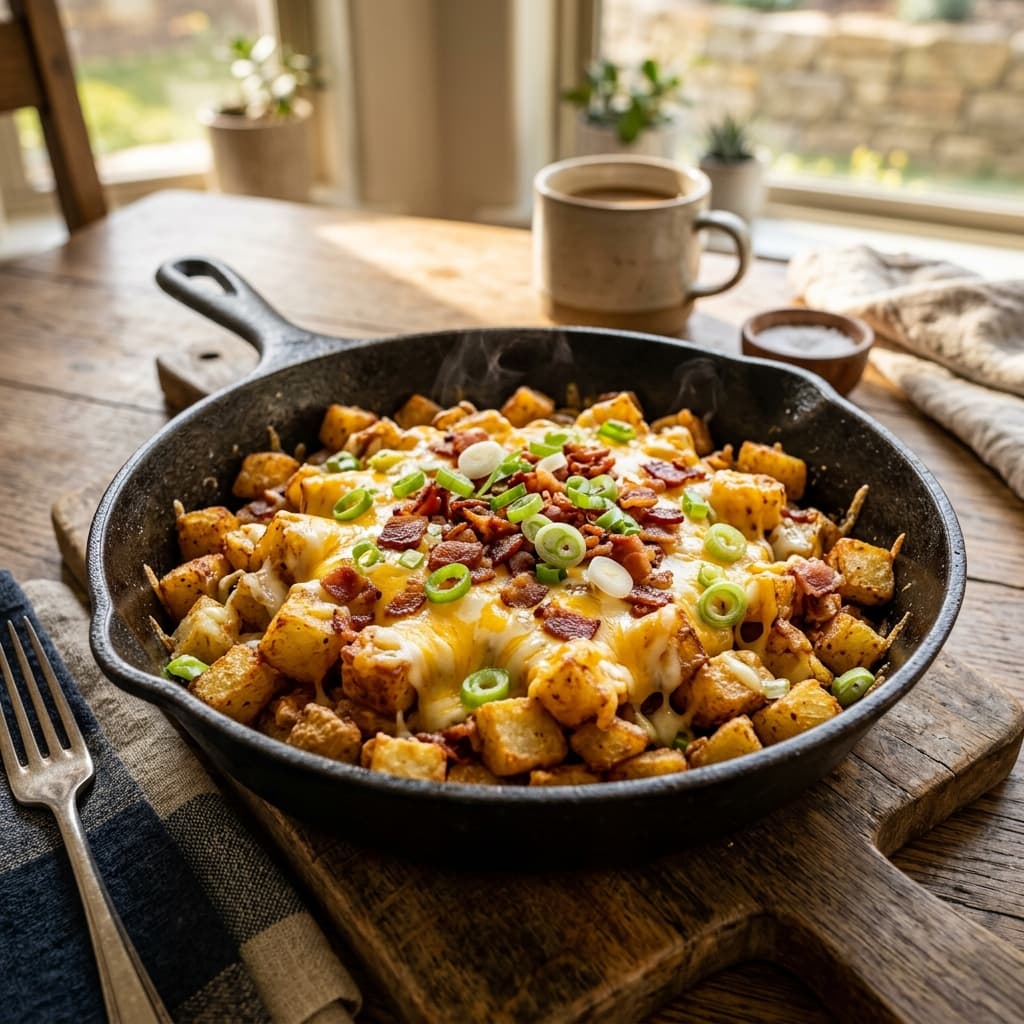
Bacon Cheddar Breakfast Potatoes
Crispy cast-iron skillet breakfast home fries tossed in rendered bacon fat, smoked paprika, garlic, and caramelized onions, topped with melted sharp cheddar cheese, crumbled thick-cut bacon, and sliced green onions.
Macro Nutrition Profile (Per Serving)
Ingredients
Ingredient Substitutions
| Original Ingredient | Healthy Alternative |
|---|---|
| Animal protein | Firm tofu, tempeh, or organic chickpeas |
| Cooking fat | Extra virgin olive oil or grass-fed butter |
Instructions
Render and Crisp the Bacon: Place a heavy 12-inch cast-iron skillet over medium heat. Add 6 strips of diced thick-cut applewood-smoked bacon. Cook for 7 to 9 minutes, stirring occasionally with a wooden spoon, until the bacon is deeply browned, rendered, and shatteringly crisp. Using a slotted spoon, transfer the crisp bacon crumbles to a paper-towel-lined plate. Pour the rendered bacon drippings into a heat-proof measuring cup. You should have roughly 3 to 4 tablespoons of aromatic fat. Wipe any burned specks from the skillet with a dry paper towel, but leave the pan seasoned.
Sauté the Onions and Peppers: Return 1 tablespoon of the warm bacon fat to the skillet over medium heat. Add 1 finely diced yellow onion and 1 finely diced red bell pepper. Sauté for 6 to 8 minutes, stirring frequently, until the vegetables are soft, tender, and lightly caramelized at the edges. Add 3 cloves of finely minced garlic during the final 60 seconds of cooking, stirring continuously until fragrant. Transfer the sautéed onions, peppers, and garlic to a small bowl and set aside.
Alkaline Par-Boil the Potatoes: While the bacon renders, bring 3 quarts of water to a rolling boil in a large 5-quart Dutch oven or stockpot over high heat. Add 1 tablespoon of kosher salt and 1/2 teaspoon of baking soda. Add 2 1/2 pounds of cubed Yukon Gold potatoes (cut into uniform 3/4-inch pieces). Return to a boil, then reduce heat to maintain a steady simmer. Cook for 6 to 8 minutes, testing with a paring knife: the knife tip should slide into the potato cube with slight resistance, and the exterior should look soft and chalky, but the cube must not be falling apart.
Drain and Rough the Potato Surface: Drain the potatoes thoroughly in a large colander. Allow them to sit undisturbed for 2 to 3 minutes so surface moisture can flash off completely into steam. Return the dry, steaming potatoes to the empty warm pot. Grasp the pot handles with kitchen towels, cover with the lid, and shake vigorously up and down for 10 to 15 seconds. Remove the lid: the potato cubes should now be coated in a thick, cloudy, paste-like layer of roughed-up potato starch.
The Initial High-Heat Sear: Return the 12-inch cast-iron skillet to medium-high heat. Add the remaining 2 to 3 tablespoons of rendered bacon fat (add 1 tablespoon of butter or olive oil if you have less than 3 tablespoons of fat). Allow the fat to heat until shimmering and faintly smoking (roughly 375°F / 190°C). Carefully pour the roughed-up potatoes into the skillet. Using a flat metal spatula, spread the potatoes into a single, even layer across the entire pan floor. Leave the potatoes undisturbed for 5 to 6 minutes. Do not stir or agitate. Let the direct thermal contact dehydrate the bottom starches into a deep, crunchy, golden crust.
Flip and Crisp All Sides: Using a stiff, thin-bladed metal spatula, slide underneath the potatoes and turn them in large sections. You will see deep mahogany-brown, blistered crusts. Cook undisturbed for another 4 to 5 minutes to brown the second side. Gently toss and turn the potatoes for an additional 4 to 6 minutes, allowing all remaining pale facets to make contact with the hot iron floor and develop an even, all-around crisp shell.
Season and Reintroduce Aromatics: Sprinkle 1 1/2 teaspoons of smoked Spanish paprika, 1 teaspoon of garlic powder, 1/2 teaspoon of onion powder, 1/2 teaspoon of dried thyme, 1/2 teaspoon of freshly cracked black pepper, and 1/2 teaspoon of kosher salt evenly across the potatoes. Toss thoroughly with your spatula for 60 seconds to coat every cube and toast the spices in the residual fat. Add the reserved sautéed onions, bell peppers, and garlic back into the skillet. Toss gently for 1 to 2 minutes until hot and uniformly combined.
Melt the Cheese and Garnish: Reduce the stovetop heat to low (or turn the burner off completely if the skillet is screaming hot). Scatter 1 1/2 cups of freshly shredded sharp cheddar cheese and 1/2 cup of Monterey Jack cheese evenly across the top of the potatoes. Sprinkle the reserved crispy bacon crumbles over the cheese. Cover the skillet tightly with a lid, large metal bowl, or sheet of aluminum foil. Let stand undisturbed for 2 to 3 minutes until the cheese is completely melted, bubbling, and glossy. Remove the cover. Scatter thinly sliced green onions and a light pinch of flaky Maldon sea salt across the top. Serve immediately directly from the warm cast-iron skillet.
The Spicy Tex-Mex Breakfast Skillet: Replace the Monterey Jack with spicy pepper Jack cheese. Add 1 finely diced jalapeño pepper to the sautéed onions. Serve topped with sliced pickled jalapeños, fresh cilantro, avocado cubes, and warm salsa verde.
The Loaded Loaded Baked Potato Style: After melting the cheese and bacon, dollop 1/3 cup of thick cultured sour cream across the top. Scatter finely snipped fresh chives alongside the green onions.
The Country Sausage and Pepper Skillet: Brown 8 ounces of crumbled bulk breakfast pork sausage in the skillet before adding the potatoes. Drizzle with 1/2 cup of warm country white pepper gravy right before serving.
The Potatoes Turned Mushy and Crumbled into Mashed Potatoes: The Cause: Potatoes were boiled too long during the par-boil stage, or a low-starch waxy red potato was used. The Solution: Boil Yukon Gold or Russet cubes for strictly 6 to 8 minutes. A paring knife should meet slight resistance in the center.
The Potatoes Are Greasy and Soggy Rather Than Crisp: The Cause: The skillet fat was not hot enough when the potatoes were added, or the skillet was overcrowded. The Solution: Ensure the bacon fat reaches 375°F before adding potatoes. Use a wide 12-inch skillet so cubes sit in a single uncrowded layer.
The Potatoes Burned on the Outside but Remained Hard in the Center: The Cause: The potatoes were added raw without par-boiling, or the stovetop burner was set to high heat. The Solution: Always par-boil the potatoes until tender. Keep skillet heat at medium to medium-high to brown starches without scorching.
Tried this recipe?
Let us know how it turned out! Click a star below to leave a review and rate the recipe.
Storage & Freezing Tips
- Refrigerator: Store leftovers in an airtight container for up to 3-4 days.
- Reheating: Heat in a saucepan or skillet on medium heat until hot throughout.
- Freezing: Freeze portions in airtight containers for up to 2 months. Reheat directly from frozen or after thawing.
Frequently Asked Questions
Can this recipe be prepared ahead of time?▼
Yes, this meal is excellent for weekly meal prep. Store components separately and assemble before serving.
Is this recipe gluten-free?▼
All ingredients used are naturally gluten-free. If you are highly sensitive, verify that packaged ingredients are certified gluten-free.
Tried this recipe?
Tag @stewartlucas on Instagram and hashtag it #nutriguide!
You Might Also Like
Stewart Lucas
Chief Culinary SpecialistStewart Lucas is the Chief Culinary Specialist and lead recipe developer representing the NutriGuide team. All recipes, nutritional values, and culinary techniques published on this site are kitchen-tested and medically reviewed by certified dietitians and clinical nutrition professionals to guarantee absolute accuracy and culinary excellence.
Community Reviews
Please log in to leave a review.