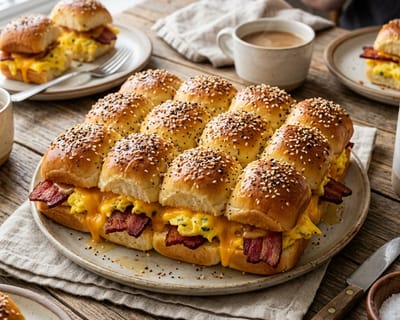
Bacon, Egg & Cheese Breakfast Sliders (Hawaiian Roll Masterclass)
The ultimate brunch masterclass: soft-curd scrambled eggs, hardwood-smoked crispy bacon, and melted sharp cheddar nestled in sweet Hawaiian rolls brushed with maple Dijon butter glaze.
Key Takeaways
- ✓Keep Hawaiian rolls connected as a single 12-roll slab and slice horizontally with a long serrated knife.
- ✓Cook scrambled eggs to a soft, glossy custard curd—they will continue cooking inside the oven bake.
- ✓Combining sharp cheddar with American cheese guarantees both complex aged flavor and silky melt.
- ✓Bake covered in foil for 10 minutes to melt cheese, then uncover for 6 minutes to caramelize the maple butter glaze.
The Story
The breakfast slider represents the brilliant intersection of two American culinary staples: the classic diner egg sandwich and the sweet, enriched bread traditions of Portuguese-Hawaiian baking. In mid-century Hawaii, the Robert Taira family popularized the sweet roll, adapting traditional Portuguese pao doce into fluffy, golden buns enriched with pineapple juice, butter, and eggs. Meanwhile, across classic East Coast bodegas and diners, the bacon, egg, and cheese on a hard roll had long reigned as the undisputed king of morning street food.
The innovation of transforming these single-serving sandwiches into an oven-baked pull-apart party slab emerged as home entertainers sought a way to serve hot, synchronized breakfast sandwiches to crowds without standing over a smoking griddle flipping individual eggs.
However, amateur slider attempts often plague hosts with common pitfalls: soggy bottom buns, rubbery, over-coagulated eggs, dry cheese, and burnt roll tops. This masterclass elevates the humble breakfast slider into an architectural triumph of texture and flavor. By understanding egg curd thermal thresholds, moisture barriers, and sugar caramelization kinetics in the maple butter glaze, you will deliver sliders with a golden, glossy, sesame-crusted crown, a creamy, molten center, and a structurally sound, buttery base that never turns soggy.
The Science of Flavor Chemistry & Thermal Dynamics
Achieving the perfect breakfast slider requires orchestrating multiple thermal processes simultaneously.
1. The Chemistry of Soft-Curd Egg Preservation
Eggs are composed of water, lipids, and albumin proteins. When whisked and exposed to heat, ovalbumin and conalbumin denature and form a tight mesh network that traps water. If scrambled over high heat until completely dry in the skillet and subsequently baked in a 350°F oven for 18 minutes, those proteins contract violently, squeezing out water (syneresis) and becoming rubbery and gray. To prevent this, the eggs must be cooked over medium-low heat with cold heavy cream to an 80% set state (custardy soft curds). As soon as wet curds form, they are pulled from the heat. When enclosed inside the bread and baked, the steam trapped between the layers gently brings the curds to 100% doneness without drying them out.2. Moisture Barrier Architecture
The biggest technical challenge in baking sliders is preventing moisture migration from warm eggs into the bottom bun. If hot eggs are placed directly on raw bread, steam condenses into the crumb, creating an unpalatable, gummy sludge. We establish an edible moisture barrier: a bottom layer of sliced cheese melted against the bottom bun before the eggs are added, or brushing the bottom slab with melted butter and lightly toasting it before assembly. The hydrophobic fat barrier repels water, keeping the bottom crumb light, airy, and golden.3. Maillard Reaction & Sugar Glaze Kinetics
Sweet Hawaiian rolls are high in reducing sugars (sucrose and fructose). Brushed with a composite glaze of melted European butter, pure Grade-A maple syrup, Dijon mustard, and garlic powder, the roll tops undergo rapid Maillard browning and sugar caramelization at 350°F (175°C). The addition of acidic Dijon mustard balances the saccharine notes of the bread, cutting through the heavy dairy and fat while providing an emulsifier that keeps the butter and syrup from separating on the bun. Sesame seeds provide crunch and nutty pyrazines when toasted by the dry radiant oven elements.Baking the sliders initially covered in foil traps internal moisture to melt the dense cheese layers without scorching the delicate surface sugars, followed by an uncovered blast to crisp the glaze into a lacquered mahogany crust.
4. Thermal Equilibrium in Multi-Serving Assembly
When baking a unified 12-roll slab, edge sliders receive ambient radiant heat from three sides while center sliders only receive vertical thermal conduction from top and bottom. To guarantee thermal equilibrium where center rolls melt at the exact same moment as corner rolls, we utilize heavy-gauge aluminum bakeware and a brief pre-compaction step. Pressing the top slab gently prior to glazing forces air pockets out of the interior crumb, creating a continuous heat conduit throughout all twelve portions.Anatomy of the Ingredients & Artisanal Sourcing
Every component in this slider build has been curated for functional performance and flavor harmony:
- The Bread Matrix (King's Hawaiian): While brioche or potato rolls work in a pinch, King's Hawaiian rolls possess an ultra-fine crumb and high egg content that holds structural integrity when sliced as an entire 12-roll sheet.
- The Dual-Cheese Strategy: Sharp aged cheddar supplies deep lactic tang and sharp umami, but cheddar alone separates into oily grease when baked. Slicing in American cheese (or creamy fontina/Havarti) introduces sodium citrate, an emulsifying salt that stabilizes the cheddar fat into a velvety, luscious cheese pull.
- The Bacon Technique: Use thick-cut bacon cooked until deeply caramelized and thoroughly drained on paper towels. Thin bacon goes limp inside sliders; thick-cut bacon maintains shatteringly crisp textural contrast against the pillow-soft eggs.
- Pure Maple Syrup vs Artificial Syrup: Use pure Grade-A Amber or Dark maple syrup. High-fructose corn syrup glazes scorch prematurely and taste cloying. Pure maple syrup caramelizes into complex butterscotch undertones.
Step-by-Step Culinary Masterclass
Step 1: Oven & Pan Calibration
Preheat your oven to 350°F (175°C) with the center rack in position. Line a heavy 9x13-inch metal baking dish or rimmed sheet pan with unbleached parchment paper, leaving 1 inch of overhang on the sides for easy lifting later.
- Chef's Technique Tip: Metal baking pans conduct heat faster than thick ceramic, ensuring the bottom of the sliders gets golden and crisp.
- Sensory Checkpoint: The parchment paper lies flat and the oven reaches an even 350°F on an oven thermometer.
Step 2: Precision Slab Bisection
Keep all 12 Hawaiian rolls connected as a single rectangular slab. Using a long, 10-inch serrated bread knife held completely parallel to your cutting board, slice horizontally through the equator of the rolls in a gentle sawing motion, separating the sheet into a top half and bottom half.
- Chef's Technique Tip: Keep your non-knife palm flat on top of the rolls with gentle downward pressure to guide an even horizontal slice.
- Sensory Checkpoint: Two identical, unbroken 12-roll sheets with level, flat surfaces.
Step 3: Building the Bottom Thermal Barrier
Place the bottom half of the rolls into the prepared baking dish. Layer 6 slices of cheese directly over the cut surface of the bottom rolls, ensuring full edge-to-edge coverage.
- Chef's Technique Tip: This cheese layer melts into the bread pores, creating a hydrophobic seal against egg moisture.
- Sensory Checkpoint: The bottom bread is completely covered by a uniform layer of cheese.
Step 4: The Gentle Custard Egg Scramble
Crack 8 eggs into a bowl with 2 tbsp heavy cream, 1/4 tsp salt, and cracked black pepper. Whisk vigorously for 60 seconds until completely homogeneous with no visible streaks of egg white. Melt 1 tbsp butter in a nonstick skillet over medium-low heat. Pour in eggs and let sit for 20 seconds. Use a silicone spatula to gently push soft curds from the edges toward the center. Remove skillet from heat when the eggs are 80% set, wet, and glistening.
- Chef's Technique Tip: Pull the eggs while they still look slightly runny; residual heat and the 18-minute oven bake will finish them to tender perfection.
- Sensory Checkpoint: Soft, pillow-like yellow curds with a velvety, glossy sheen.
Step 5: Layering the Savory Architecture
Spoon the soft scrambled eggs evenly over the cheese-lined bottom rolls. Arrange the 10 crispy bacon strips in a crisscross or parallel pattern over the eggs to ensure every single bite contains bacon. Top the bacon with the remaining 6 slices of sharp cheddar cheese.
- Chef's Technique Tip: Breaking bacon strips in half allows for denser, more uniform coverage without overlapping thick ends.
- Sensory Checkpoint: A structured, even stack of bread, cheese, egg, bacon, and top cheese.
Step 6: Lidding & Compacting
Place the top slab of rolls gently over the top cheese layer. Press down very lightly with both flat palms to nestle the layers together into a cohesive brick.
- Chef's Technique Tip: Light pressure eliminates air pockets, ensuring heat conducts evenly through all 12 sliders.
- Sensory Checkpoint: The top rolls sit level and square with the bottom slab.
Step 7: Whisking & Brushing the Lacquered Glaze
In a small saucepan or microwave-safe bowl, melt 3 tbsp butter with 1 tbsp maple syrup, 1 tsp Dijon mustard, and 1/2 tsp garlic powder. Whisk until emulsified. Using a pastry brush, generously paint the warm glaze across the tops and sides of the rolls. Sprinkle Everything Bagel seasoning or toasted sesame seeds across the glazed tops.
- Chef's Technique Tip: Be generous with the glaze—the butter bastes the crust while the maple syrup creates a crackly, candy-like glaze.
- Sensory Checkpoint: The roll tops glisten with a fragrant, amber-colored glaze, studded with seeds.
Step 8: The Two-Stage Steam & Crisp Bake
Tent a sheet of aluminum foil loosely over the baking dish, taking care not to touch the glazed tops. Bake at 350°F for 10 minutes to trap steam and melt the cheeses. Remove the foil and bake uncovered for an additional 6 to 8 minutes until the tops are deep golden brown and the cheese is visibly bubbling along the sides.
- Chef's Technique Tip: Watch closely during the final 3 minutes; high-sugar Hawaiian rolls transition from golden to dark quickly.
- Sensory Checkpoint: A rich mahogany crust that sounds crisp when tapped with a fingernail, with melted cheese oozing at the perimeter.
Step 9: Resting, Slicing & Serving
Remove from the oven and let rest in the baking dish for 4 to 5 minutes. Use the parchment paper wings to lift the entire slab onto a large wooden cutting board. Cut along the natural perforations between rolls using a sharp chef's knife. Serve hot immediately.
- Chef's Technique Tip: Resting allows the molten cheese to set slightly so the sliders hold their shape when sliced.
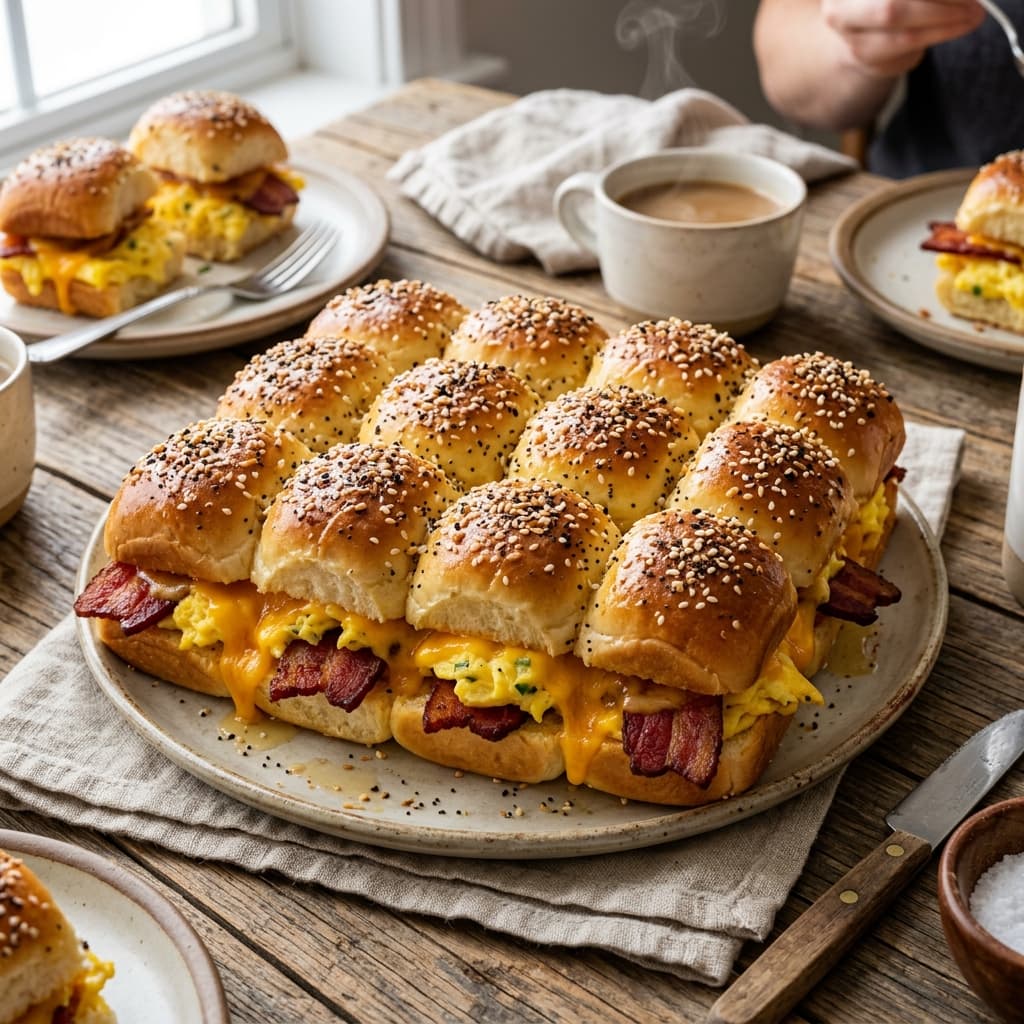
- Sensory Checkpoint: 12 individual, cleanly cut sliders with gooey cheese pulls and intact, fluffy layers.
Pro-Chef Troubleshooting & Critical Checkpoints
Problem: Bottom Buns Turned Soggy and Wet
- The Root Cause: Eggs were scrambled with too much water/milk and placed directly on bare bread, or sliders cooled inside an unlined, steamy ceramic dish.
- The Masterclass Solution: Ensure eggs are soft-scrambled with heavy cream (less water than milk), always lay cheese down first on the bottom bread, and lift the sliders out on parchment paper immediately after baking.
Problem: Roll Tops Burned Before Cheese Melted
- The Root Cause: Sliders were baked uncovered for the entire duration, allowing high oven heat to scorch the maple glaze sugars.
- The Masterclass Solution: Bake covered with foil for the first 10 minutes. Only uncover for the final 6 minutes to caramelize the crust.
Problem: Eggs are Dry, Chalky, and Crumbly
- The Root Cause: Eggs were fully cooked or overcooked in the skillet before being added to the sliders.
- The Masterclass Solution: Remove eggs from the stove when they are still 80% wet curds. The oven heat will gently finish cooking them.
Problem: Cheese Separated into Greasy Oil
- The Root Cause: Using only aged, dry sharp cheddar without an emulsifying melt cheese like American or Monterey Jack.
- The Masterclass Solution: Use the dual-cheese method outlined in the recipe. The emulsifying salts in American cheese bind the cheddar fats into a creamy, stable sauce.
Macro Analysis & Nutritional Optimization
While undeniably a decadent brunch indulgence, this masterclass slider provides substantial nutritional density and sustained morning satiety:
- 26 Grams of High-Quality Protein: Sourced from pasture-raised eggs, aged cheddar, and smoked bacon, providing a complete amino acid profile to stimulate muscle protein synthesis and suppress ghrelin (the hunger hormone).
- Choline & Micronutrient Richness: Whole egg yolks are the richest dietary source of choline, an essential nutrient for cellular membrane integrity, liver lipid metabolism, and neurotransmitter (acetylcholine) synthesis for cognitive focus.
- Balanced Energy Curve: The combination of protein and healthy lipids slows gastric emptying, mitigating the glucose spike typically associated with sweet enriched breads.
- Macro Profile per Slider: 520 kcal | 26g Protein | 38g Carbohydrates | 28g Fat.
Artisanal Serving & Pairing Architecture
Complement the rich, savory-sweet flavor profile of these sliders with vibrant, acidic, and refreshing morning pairings:
- Vibrant Fruit & Citrus Salad: Fresh ruby red grapefruit segments, blood orange slices, fresh mint, and pomegranate arils cleanly cleanse the palate after rich bacon and cheese.
- Crispy Potato Accompaniment: Skillet-fried rosemary breakfast potatoes or extra-crispy air-fryer hash brown patties.
- Morning Beverages:
Scientific Storage, Meal Prep & Reheating Protocol
These sliders are an extraordinary meal-prep option that freezes and reheats remarkably well:
- Refrigeration: Wrap individual cooled sliders tightly in aluminum foil. Store in the refrigerator for up to 4 days.
- Freezer Protocol: Wrap each slider in parchment paper, then tightly in foil, and place into a zip-top freezer bag for up to 2 months.
- The Masterclass Reheating Technique:
Frequently Asked Questions (Masterclass Edition)
Q: Can I prepare these sliders the night before?
A: Yes! Assemble the sliders completely (rolls, cheese, cooked bacon, soft-cooked eggs, top cheese, top bun), wrap tightly in plastic wrap, and refrigerate overnight. In the morning, whisk and brush the maple butter glaze over top, and bake for 15 minutes covered plus 7 minutes uncovered.Q: Can I substitute breakfast sausage or ham for the bacon?
A: Absolutely. Cooked breakfast sausage patties, browned ground sausage, or thin-sliced smoked deli ham work wonderfully. Ensure any sausage meat is well-drained of excess grease before layering.Q: What if I don't have Everything Bagel seasoning?
A: You can use toasted white and black sesame seeds, poppy seeds, or a pinch of coarse sea salt and cracked black pepper.Q: Why do you use both cheddar and American cheese?
A: Cheddar brings sharp, aged flavor, while American cheese provides sodium citrate, which keeps the cheese creamy and molten without breaking into grease.Q: Can I make a vegetarian version of these sliders?
A: Yes. Simply omit the bacon and replace with sautéed baby spinach, caramelized onions, and thinly sliced avocado added after baking.Bacon, Egg & Cheese Breakfast Sliders (Hawaiian Roll Masterclass)
The ultimate brunch masterclass: soft-curd scrambled eggs, hardwood-smoked crispy bacon, and melted sharp cheddar nestled in sweet Hawaiian rolls brushed with maple Dijon butter glaze.
Macro Nutrition Profile (Per Serving)
Ingredients
Ingredient Substitutions
| Original Ingredient | Healthy Alternative |
|---|---|
| Poached eggs | Firm tofu slices (lightly pan-seared) or avocado slices (for a rich plant-based fat source) |
| Baby spinach | Swiss chard, baby kale, or arugula (wilt at the same temperature/time) |
| White vinegar | Lemon juice or apple cider vinegar (acid helps egg whites coagulate) |
Instructions
Oven & Pan Calibration: Preheat your oven to 350°F (175°C) with the center rack in position. Line a heavy 9x13-inch metal baking dish or rimmed sheet pan with unbleached parchment paper, leaving 1 inch of overhang on the sides for easy lifting later. Chef's Technique Tip: Metal baking pans conduct heat faster than thick ceramic, ensuring the bottom of the sliders gets golden and crisp. Sensory Checkpoint: The parchment paper lies flat and the oven reaches an even 350°F on an oven thermometer.
Precision Slab Bisection: Keep all 12 Hawaiian rolls connected as a single rectangular slab. Using a long, 10-inch serrated bread knife held completely parallel to your cutting board, slice horizontally through the equator of the rolls in a gentle sawing motion, separating the sheet into a top half and bottom half. Chef's Technique Tip: Keep your non-knife palm flat on top of the rolls with gentle downward pressure to guide an even horizontal slice. Sensory Checkpoint: Two identical, unbroken 12-roll sheets with level, flat surfaces.
Building the Bottom Thermal Barrier: Place the bottom half of the rolls into the prepared baking dish. Layer 6 slices of cheese directly over the cut surface of the bottom rolls, ensuring full edge-to-edge coverage. Chef's Technique Tip: This cheese layer melts into the bread pores, creating a hydrophobic seal against egg moisture. Sensory Checkpoint: The bottom bread is completely covered by a uniform layer of cheese.
The Gentle Custard Egg Scramble: Crack 8 eggs into a bowl with 2 tbsp heavy cream, 1/4 tsp salt, and cracked black pepper. Whisk vigorously for 60 seconds until completely homogeneous with no visible streaks of egg white. Melt 1 tbsp butter in a nonstick skillet over medium-low heat. Pour in eggs and let sit for 20 seconds. Use a silicone spatula to gently push soft curds from the edges toward the center. Remove skillet from heat when the eggs are 80% set, wet, and glistening. Chef's Technique Tip: Pull the eggs while they still look slightly runny; residual heat and the 18-minute oven bake will finish them to tender perfection. Sensory Checkpoint: Soft, pillow-like yellow curds with a velvety, glossy sheen.
Layering the Savory Architecture: Spoon the soft scrambled eggs evenly over the cheese-lined bottom rolls. Arrange the 10 crispy bacon strips in a crisscross or parallel pattern over the eggs to ensure every single bite contains bacon. Top the bacon with the remaining 6 slices of sharp cheddar cheese. Chef's Technique Tip: Breaking bacon strips in half allows for denser, more uniform coverage without overlapping thick ends. Sensory Checkpoint: A structured, even stack of bread, cheese, egg, bacon, and top cheese.
Lidding & Compacting: Place the top slab of rolls gently over the top cheese layer. Press down very lightly with both flat palms to nestle the layers together into a cohesive brick. Chef's Technique Tip: Light pressure eliminates air pockets, ensuring heat conducts evenly through all 12 sliders. Sensory Checkpoint: The top rolls sit level and square with the bottom slab.
Whisking & Brushing the Lacquered Glaze: In a small saucepan or microwave-safe bowl, melt 3 tbsp butter with 1 tbsp maple syrup, 1 tsp Dijon mustard, and 1/2 tsp garlic powder. Whisk until emulsified. Using a pastry brush, generously paint the warm glaze across the tops and sides of the rolls. Sprinkle Everything Bagel seasoning or toasted sesame seeds across the glazed tops. Chef's Technique Tip: Be generous with the glaze—the butter bastes the crust while the maple syrup creates a crackly, candy-like glaze. Sensory Checkpoint: The roll tops glisten with a fragrant, amber-colored glaze, studded with seeds.
The Two-Stage Steam & Crisp Bake: Tent a sheet of aluminum foil loosely over the baking dish, taking care not to touch the glazed tops. Bake at 350°F for 10 minutes to trap steam and melt the cheeses. Remove the foil and bake uncovered for an additional 6 to 8 minutes until the tops are deep golden brown and the cheese is visibly bubbling along the sides. Chef's Technique Tip: Watch closely during the final 3 minutes; high-sugar Hawaiian rolls transition from golden to dark quickly. Sensory Checkpoint: A rich mahogany crust that sounds crisp when tapped with a fingernail, with melted cheese oozing at the perimeter.
Resting, Slicing & Serving: Remove from the oven and let rest in the baking dish for 4 to 5 minutes. Use the parchment paper wings to lift the entire slab onto a large wooden cutting board. Cut along the natural perforations between rolls using a sharp chef's knife. Serve hot immediately. Chef's Technique Tip: Resting allows the molten cheese to set slightly so the sliders hold their shape when sliced. Sensory Checkpoint: 12 individual, cleanly cut sliders with gooey cheese pulls and intact, fluffy layers.
Tried this recipe?
Let us know how it turned out! Click a star below to leave a review and rate the recipe.
Storage & Freezing Tips
- Refrigerator: Store in an airtight container for up to 2 days. Keep the components separate if possible to preserve texture.
- Reheating: Reheat gently in a skillet on medium-low heat with a splash of olive oil or butter.
- Freezing: Freezing is not recommended for this dish because ingredients like eggs become soggy, rubbery, or mushy when defrosted.
Frequently Asked Questions
Can this recipe be prepared ahead of time?▼
Yes, this meal is excellent for weekly meal prep. Store components separately and assemble before serving.
Is this recipe gluten-free?▼
All ingredients used are naturally gluten-free. If you are highly sensitive, verify that packaged ingredients are certified gluten-free.
Tried this recipe?
Tag @stewartlucas on Instagram and hashtag it #nutriguide!
You Might Also Like

Stewart Lucas
Nutritionist & Recipe DeveloperStewart Lucas is a nutritionist and recipe developer representing the NutriGuide team. All recipes, nutritional values, and diet protocols published on this site are designed and audited by certified dietitians and clinical nutrition professionals to guarantee absolute accuracy.
Community Reviews
Please log in to leave a review.