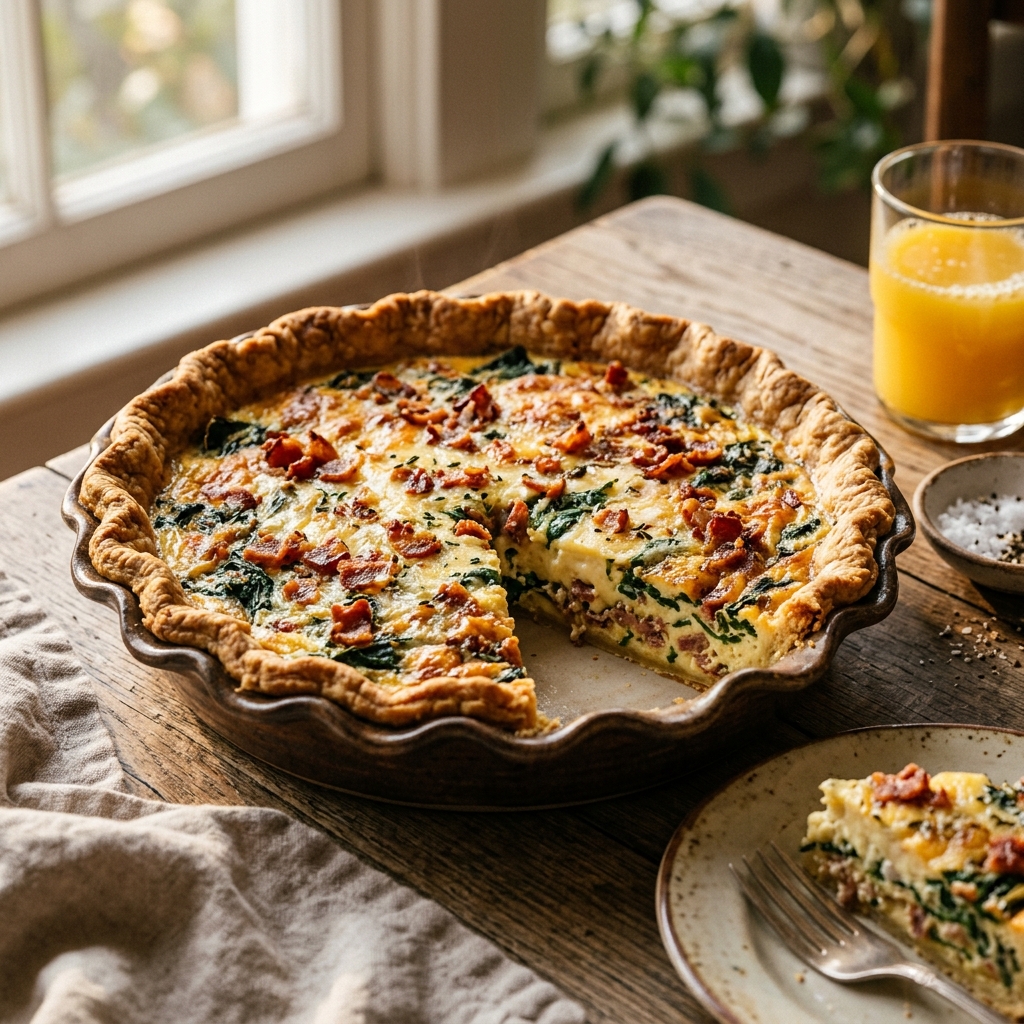
Bacon Spinach Breakfast Quiche

A bakery-caliber breakfast quiche featuring a buttery, flaky pie crust filled with a silky whole-egg and heavy cream custard, smoky thick-cut applewood bacon, tender baby spinach, and nutty Swiss and Gruyère cheese.
Key Takeaways
- ✓Ready in just 50 mins using straightforward, kitchen-tested technique.
- ✓Delivers 16g of muscle-fueling protein per serving for lasting satiety.
- ✓Portion-balanced at 440 calories per serving with wholesome, unrefined ingredients.
- ✓Masterclass temperature checkpoints ensure maximum tenderness and flavor development.
The Story
A bakery-caliber breakfast quiche featuring a buttery, flaky pie crust filled with a silky whole-egg and heavy cream custard, smoky thick-cut applewood bacon, tender baby spinach, and nutty Swiss and Gruyère cheese.
The Culinary Architecture of a True French-Style Quiche
A properly crafted breakfast quiche occupies a revered place in classic pastry and bistro cookery. Unlike a dense breakfast casserole or a firm frittata, an authentic quiche centers on a delicate culinary contradiction: an exceptionally flaky, golden-brown pastry shell that shatters under a fork, cradling a velvety, cloud-soft savory custard that trembles slightly on the plate.
When executing a bacon and spinach quiche at home, many home cooks encounter two common disappointments: a soggy, pale bottom crust that tears under a knife, or an overcooked custard that separates into rubbery curds and watery liquid. These flaws stem from failing to manage moisture migration and thermal kinetics.
By blind-baking the pastry shell with pie weights to establish a crisp starch seal, aggressively wringing out water from sautéed spinach, and respecting the delicate ratio of heavy cream to whole egg proteins, you elevate humble morning ingredients into an elegant centerpiece worthy of a traditional Parisian brasserie.
Ingredient Selection and Culinary Rationale
Every component in this recipe contributes directly to structural balance, moisture management, and harmonious flavor contrast.
The Pastry Crust: All-Butter Flaky Dough
While store-bought refrigerated pie crusts offer convenience on busy mornings, a homemade all-butter crust made with high-fat European-style butter yields superior flakiness and aroma. When cold butter is worked into flour leaving pea-sized pockets, those butter chunks melt in the oven, releasing steam that separates the gluten dough into hundreds of delicate, paper-thin wafers. Pre-baking this shell is mandatory; raw dough cannot crisp when cloaked in liquid egg custard.Thick-Cut Applewood-Smoked Bacon
Thin breakfast bacon turns limp and loses its identity when submerged in custard. Thick-cut applewood or hickory-smoked bacon provides substantial textural chew, rich cured depth, and gentle sweetness. Dicing the bacon into uniform half-inch pieces before rendering ensures every square inch of the quiche receives savory crunch. Rendering the bacon until crisp and draining it on paper towels eliminates excess liquid grease that would otherwise pool on top of the custard.Fresh Baby Spinach: Managing Intracellular Water
Fresh baby spinach leaves are tender and sweet, lacking the bitter oxalic bite found in mature flat-leaf varieties. However, raw spinach contains roughly ninety-one percent water by weight. If added directly to the pie shell, that moisture discharges into the custard as the cell walls collapse in the oven, diluting the egg proteins and creating a watery, unappetizing pool. Sautéing the leaves with aromatics and firmly pressing out all liquid through a towel converts loose water into concentrated vegetable sweetness.The Dairy Matrix: Heavy Whipping Cream vs. Milk
Custard texture is fundamentally governed by fat content. Whole milk alone contains eighty-eight percent water and only three-and-a-half percent butterfat; a quiche made solely with milk will cook up watery, porous, and rubbery. Heavy whipping cream contains thirty-six percent butterfat. Combining one-and-a-quarter cups of heavy cream with a half-cup of whole milk strikes the ideal equilibrium: enough rich fat to insulate the egg proteins from curdling under heat, while remaining light enough to slice cleanly without feeling heavy.The Alpine Cheeses: Gruyère and Swiss
Cave-aged Swiss Gruyère brings a distinct nutty sweetness, subtle saltiness, and complex alpine aroma. Combining it with standard Swiss (Emmental) cheese yields a silky, cohesive melt that suspends evenly throughout the custard without separating into oily grease puddles. Grating the cheese from cold solid blocks ensures clean shreds that interlock with the spinach and bacon crumbles.Whole Eggs and Extra Yolks
Whole egg whites provide the albumin proteins needed to coagulate and hold the custard in a sliceable slice. However, an abundance of egg whites can make custard stiff and spongy. Adding two additional egg yolks introduces extra emulsifying lecithin and milk fat, lending the custard its luxurious, pale-yellow hue and melt-in-the-mouth tenderness.Equipment Needed for Pastry and Custard Precision
Assembling a bakery-caliber quiche requires a few fundamental tools to guarantee even baking and clean slicing:
- 9-Inch Deep-Dish Ceramic Pie Pan or Fluted Tart Ring: A deep-dish ceramic pie dish retains steady heat and accommodates generous layers of filling and custard without overflowing. A metal tart pan with a removable bottom allows for stunning tableside unmolding.
- Parchment Paper and Ceramic Pie Weights (or Dried Beans): Essential for blind-baking the raw pastry shell. The weight holds the dough firmly against the pan floor, preventing shrinkage and unsightly bubbles.
- Large Heavy Skillet (12-Inch): For evenly rendering diced bacon and wilting fresh spinach leaves with shallots.
- Fine-Mesh Colander or Clean Linen Dish Towel: Indispensable for squeezing excess water out of the cooked spinach.
- Glass Mixing Bowl and Wire Whisk: For blending eggs, cream, milk, and seasonings into a completely smooth, aerated emulsion.
- Pastry Brush: For applying a protective egg-wash seal over the hot par-baked crust before pouring in the liquid custard.
The Science of Savory Custards: Protein Coagulation
To bake a custard that cuts like silk rather than sponge cake, home cooks must understand how egg proteins behave in the presence of heat, fat, and water.
The Denaturation Threshold
Egg proteins are long chains of amino acids curled into tight spheres. As heat enters the custard, those spheres begin to uncoil (denature) between 144°F and 149°F (62°C to 65°C). Once uncoiled, the protein strands bump into one another and form a loose, three-dimensional mesh that traps water and milk fat, transforming liquid into a soft gel.The Danger of Curdling (Syneresis)
If the internal custard temperature rises past 185°F (85°C), the protein strands bond too tightly. They contract violently like tiny wringing sponges, squeezing out the trapped water molecules. This phenomenon, known as syneresis, causes the custard to separate into rubbery curds swimming in water. High milk fat from heavy cream acts as a physical buffer, coating the proteins and softening their bonds so they cannot over-tighten, even if the oven fluctuates slightly.Blind-Baking and the Egg-Wash Barrier Seal
Unbaked flour dough absorbs liquid quickly. When wet custard sits on raw dough, the starch gelatinizes unevenly, creating a soggy crust. Pre-baking the dough with weights crisps the crust floor. To make the barrier completely impervious, brush the hot crust floor with a beaten egg yolk immediately after removing the pie weights, and return it to the oven for 2 minutes. The residual heat cooks the egg yolk into an invisible enamel shield that permanently blocks custard moisture from penetrating the pastry.Step-by-Step Instructions
Follow these clear, sequential directions to create an exquisite Bacon Spinach Breakfast Quiche serving 6 to 8 people.
Step 1: Roll, Shape, and Chill the Pastry Crust
On a lightly floured work surface, roll out your chilled all-butter pie dough into a 12-inch circle roughly 1/8-inch thick. Carefully drape the dough over a 9-inch deep-dish pie pan, pressing it gently into the bottom corners and up the sides without stretching the dough. Trim excess overhang to 1/2 inch, then fold the edges under and crimp the perimeter decoratively with your thumb and forefinger. Prick the bottom floor of the pastry all over with the tines of a fork (docking). Place the lined pan in the freezer for 20 minutes to firm up the butter.Step 2: Blind-Bake the Pastry Shell
Preheat your oven to 375°F (190°C) with an oven rack positioned in the lower-middle third. Remove the chilled pie shell from the freezer. Line the dough with a sheet of crumpled parchment paper (crumpling makes it fit the curves easily) and fill completely to the rim with ceramic pie weights, dried pinto beans, or uncooked rice. Bake for 16 to 18 minutes until the crimped edges turn pale golden. Carefully lift out the parchment and weights. Brush the bottom and sides of the hot pastry with a thin film of beaten egg wash. Return the bare crust to the oven for 3 to 4 minutes until the bottom looks dry and lightly set. Remove and set aside; reduce the oven temperature to 350°F (175°C).Step 3: Crisp the Diced Bacon
Place a 12-inch skillet over medium heat. Add the diced bacon and cook slowly, stirring occasionally, for 8 to 10 minutes until deep mahogany brown, fully rendered, and crisp. Using a slotted spoon, transfer the crispy bacon crumbles to a plate lined with paper towels to drain. Pour off all but 1 tablespoon of rendered bacon fat from the skillet.Step 4: Sauté and Dehydrate the Spinach
Return the skillet with the reserved bacon fat to medium heat. Add the finely minced shallot and cook for 2 minutes until translucent. Add the minced garlic and cook for 30 seconds until fragrant. Add the fresh baby spinach in generous handfuls, tossing with tongs as it wilts down. Sauté for 3 to 4 minutes until the spinach is dark green and all leaves are completely collapsed. Transfer the cooked spinach to a fine-mesh sieve or clean kitchen dish towel and let cool for 5 minutes. Using your hands or twisting the towel, squeeze firmly to expel all green liquid. Coarsely chop the compressed spinach cake on a cutting board into loose flakes.Step 5: Whisk the Rich Savory Custard
In a large glass bowl or measuring pitcher, combine 4 large whole eggs, 2 large egg yolks, 1 1/4 cups heavy whipping cream, and 1/2 cup whole milk. Add 1/2 teaspoon kosher salt, 1/4 teaspoon freshly cracked white or black pepper, and 1/4 teaspoon freshly grated nutmeg. Whisk vigorously for 60 seconds until completely uniform, smooth, and slightly aerated. Avoid heavy whipping that creates excessive surface foam.Step 6: Layer the Fillings into the Crust
Scatter half of the freshly shredded Gruyère and Swiss cheese blend (about 3/4 cup) across the bottom of the warm, blind-baked pastry crust. Scatter the squeezed, chopped spinach evenly over the cheese. Distribute three-quarters of the crisp bacon crumbles across the spinach layer. Top with the remaining shredded cheese. Layering the solid ingredients first ensures they stay distributed throughout the quiche rather than floating to the surface.Step 7: Pour the Custard and Garnish
Place the filled pie dish on a rimmed baking sheet (this catches any accidental spills and makes transport effortless). Slowly pour the egg and cream custard into the crust, allowing it to seep down through the crevices of the cheese, spinach, and bacon until it reaches roughly 1/4 inch below the crimped pastry rim. Scatter the remaining bacon crumbles across the top for visual appeal.Step 8: Bake to Gentle Wobble
Slide the baking sheet with the quiche into the preheated 350°F (175°C) oven. Bake for 42 to 48 minutes. Check progress at the 35-minute mark; if the outer pastry crimps are browning too rapidly, tent the edges loosely with a ring of aluminum foil or a pie crust shield. The quiche is done when the edges are puffed and lightly golden, while the center 2-inch circle still trembles gently like set gelatin when the pan is nudged. An instant-read thermometer inserted into the center should read 165°F to 170°F (74°C to 77°C).Step 9: Rest, Slice, and Serve
Transfer the quiche to a wire cooling rack and let rest undisturbed for at least 20 minutes before slicing. As it rests, the custard settles into a velvety, firm matrix and the pastry cools slightly to a shatter-crisp texture. Using a sharp serrated knife or chef's knife, slice into 6 or 8 clean triangular wedges. Serve warm or at room temperature accompanied by a crisp mixed greens salad tossed in a sharp lemon-dijon vinaigrette.Flavor Twists and Regional Variations
Nutritional Breakdown
Bacon Spinach Breakfast Quiche provides balanced morning nutrition, delivering sustained energy through high-density protein and healthy fats, alongside iron, vitamin A, and calcium from fresh spinach and whole dairy.
| Metric | Per Serving (1 Wedge, 1/8th of Quiche) | Daily Value (%) |
|---|---|---|
| Calories | 440 kcal | 22% |
| Protein | 16 g | 32% |
| Total Carbohydrates | 22 g | 8% |
| Dietary Fiber | 1.5 g | 5% |
| Total Fat | 33 g | 42% |
| Saturated Fat | 17 g | 85% |
| Cholesterol | 215 mg | 72% |
| Sodium | 560 mg | 24% |
| Potassium | 260 mg | 6% |
| Calcium | 280 mg | 22% |
| Iron | 2.1 mg | 12% |
Oven Temperature Control and Baking Mechanics
Precision thermal regulation is what separates home bakes from commercial bakery displays. Understanding how your oven heats ensures that your quiche crust browns while the delicate egg custard remains velvety and smooth.
Oven Rack Placement
Always bake quiche on the lower-middle oven rack. Placing the pie dish in the lower third brings the bottom of the pan closer to the primary heating element. This targeted bottom heat drives steam out of the butter-flour laminations, ensuring the bottom crust browns into a crisp, flaky foundation without needing prolonged oven times that would overcook the custard.Preventing Over-Browning on Pastry Edges
Because the crimped fluted rim of the pie crust stands above the wet custard, it cooks faster than the center of the pie. Check the crust after 25 minutes of baking. If the fluted edges have achieved an amber-gold color, loosely wrap a ring of aluminum foil or a reusable silicone pie crust protector around the rim. This shields the delicate exposed edges from radiant heat while allowing the custard center to finish setting undisturbed.Make-Ahead Entertaining and Reheating Strategies
Quiche is uniquely suited for stress-free morning hospitality because its flavor profile deepens and its custard firms up beautifully after chilling:
Advance Preparation Timeline
- Up to 48 Hours Ahead: Blind-bake the pastry shell completely, let cool to room temperature, and store covered in a dry pantry. Crisp the bacon, sauté and squeeze the spinach, and shred the cheeses; store in separate airtight containers in the refrigerator.
- Morning of Serving: Whisk the custard ingredients in 60 seconds, layer the chilled fillings into the pre-baked shell, pour in the custard, and bake fresh for 45 minutes.
Restoring Flakiness During Reheating
Never microwave a leftover quiche slice; microwaves excite water molecules rapidly, boiling the custard into a spongy rubber and turning the buttery pastry soggy. To restore the original bakery crispness, arrange leftover quiche slices on a parchment-lined baking sheet and warm in a preheated 325°F (165°C) oven or toaster oven for 10 to 14 minutes. The gentle dry heat crisps the crust while warming the custard through to a luscious, silky consistency.Bacon Spinach Breakfast Quiche
A bakery-caliber breakfast quiche featuring a buttery, flaky pie crust filled with a silky whole-egg and heavy cream custard, smoky thick-cut applewood bacon, tender baby spinach, and nutty Swiss and Gruyère cheese.
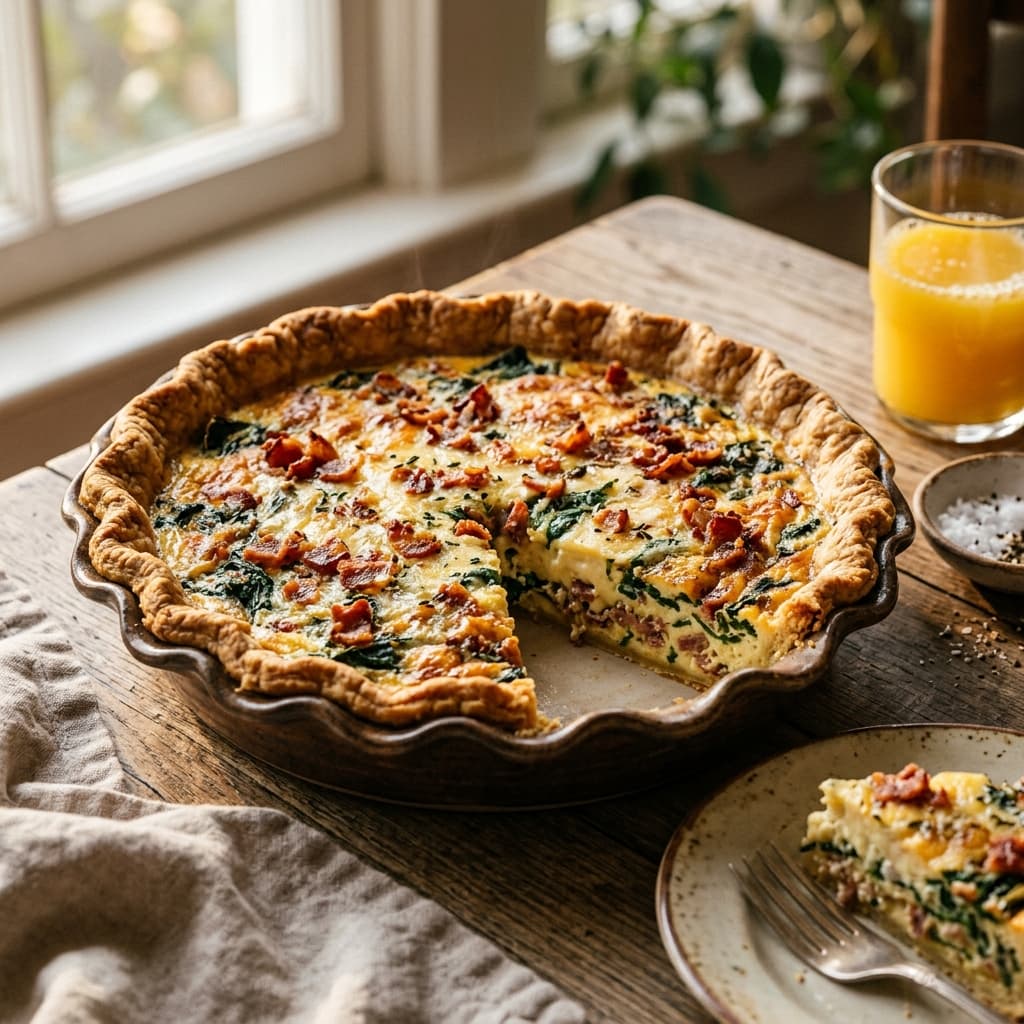
Macro Nutrition Profile (Per Serving)
Ingredients
Ingredient Substitutions
| Original Ingredient | Healthy Alternative |
|---|---|
| Animal protein | Firm tofu, tempeh, or organic chickpeas |
| Cooking fat | Extra virgin olive oil or grass-fed butter |
Instructions
Roll, Shape, and Chill the Pastry Crust: On a lightly floured work surface, roll out your chilled all-butter pie dough into a 12-inch circle roughly 1/8-inch thick. Carefully drape the dough over a 9-inch deep-dish pie pan, pressing it gently into the bottom corners and up the sides without stretching the dough. Trim excess overhang to 1/2 inch, then fold the edges under and crimp the perimeter decoratively with your thumb and forefinger. Prick the bottom floor of the pastry all over with the tines of a fork (docking). Place the lined pan in the freezer for 20 minutes to firm up the butter.
Blind-Bake the Pastry Shell: Preheat your oven to 375°F (190°C) with an oven rack positioned in the lower-middle third. Remove the chilled pie shell from the freezer. Line the dough with a sheet of crumpled parchment paper (crumpling makes it fit the curves easily) and fill completely to the rim with ceramic pie weights, dried pinto beans, or uncooked rice. Bake for 16 to 18 minutes until the crimped edges turn pale golden. Carefully lift out the parchment and weights. Brush the bottom and sides of the hot pastry with a thin film of beaten egg wash. Return the bare crust to the oven for 3 to 4 minutes until the bottom looks dry and lightly set. Remove and set aside; reduce the oven temperature to 350°F (175°C).
Crisp the Diced Bacon: Place a 12-inch skillet over medium heat. Add the diced bacon and cook slowly, stirring occasionally, for 8 to 10 minutes until deep mahogany brown, fully rendered, and crisp. Using a slotted spoon, transfer the crispy bacon crumbles to a plate lined with paper towels to drain. Pour off all but 1 tablespoon of rendered bacon fat from the skillet.
Sauté and Dehydrate the Spinach: Return the skillet with the reserved bacon fat to medium heat. Add the finely minced shallot and cook for 2 minutes until translucent. Add the minced garlic and cook for 30 seconds until fragrant. Add the fresh baby spinach in generous handfuls, tossing with tongs as it wilts down. Sauté for 3 to 4 minutes until the spinach is dark green and all leaves are completely collapsed. Transfer the cooked spinach to a fine-mesh sieve or clean kitchen dish towel and let cool for 5 minutes. Using your hands or twisting the towel, squeeze firmly to expel all green liquid. Coarsely chop the compressed spinach cake on a cutting board into loose flakes.
Whisk the Rich Savory Custard: In a large glass bowl or measuring pitcher, combine 4 large whole eggs, 2 large egg yolks, 1 1/4 cups heavy whipping cream, and 1/2 cup whole milk. Add 1/2 teaspoon kosher salt, 1/4 teaspoon freshly cracked white or black pepper, and 1/4 teaspoon freshly grated nutmeg. Whisk vigorously for 60 seconds until completely uniform, smooth, and slightly aerated. Avoid heavy whipping that creates excessive surface foam.
Layer the Fillings into the Crust: Scatter half of the freshly shredded Gruyère and Swiss cheese blend (about 3/4 cup) across the bottom of the warm, blind-baked pastry crust. Scatter the squeezed, chopped spinach evenly over the cheese. Distribute three-quarters of the crisp bacon crumbles across the spinach layer. Top with the remaining shredded cheese. Layering the solid ingredients first ensures they stay distributed throughout the quiche rather than floating to the surface.
Pour the Custard and Garnish: Place the filled pie dish on a rimmed baking sheet (this catches any accidental spills and makes transport effortless). Slowly pour the egg and cream custard into the crust, allowing it to seep down through the crevices of the cheese, spinach, and bacon until it reaches roughly 1/4 inch below the crimped pastry rim. Scatter the remaining bacon crumbles across the top for visual appeal.
Bake to Gentle Wobble: Slide the baking sheet with the quiche into the preheated 350°F (175°C) oven. Bake for 42 to 48 minutes. Check progress at the 35-minute mark; if the outer pastry crimps are browning too rapidly, tent the edges loosely with a ring of aluminum foil or a pie crust shield. The quiche is done when the edges are puffed and lightly golden, while the center 2-inch circle still trembles gently like set gelatin when the pan is nudged. An instant-read thermometer inserted into the center should read 165°F to 170°F (74°C to 77°C).
Rest, Slice, and Serve: Transfer the quiche to a wire cooling rack and let rest undisturbed for at least 20 minutes before slicing. As it rests, the custard settles into a velvety, firm matrix and the pastry cools slightly to a shatter-crisp texture. Using a sharp serrated knife or chef's knife, slice into 6 or 8 clean triangular wedges. Serve warm or at room temperature accompanied by a crisp mixed greens salad tossed in a sharp lemon-dijon vinaigrette.
Tried this recipe?
Let us know how it turned out! Click a star below to leave a review and rate the recipe.
Storage & Freezing Tips
- Refrigerator: Store in an airtight container for up to 2 days. Keep the components separate if possible to preserve texture.
- Reheating: Reheat gently in a skillet on medium-low heat with a splash of olive oil or butter.
- Freezing: Freezing is not recommended for this dish because ingredients like spinach/eggs become soggy, rubbery, or mushy when defrosted.
Frequently Asked Questions
Can this recipe be prepared ahead of time?▼
Yes, this meal is excellent for weekly meal prep. Store components separately and assemble before serving.
Is this recipe gluten-free?▼
All ingredients used are naturally gluten-free. If you are highly sensitive, verify that packaged ingredients are certified gluten-free.
Tried this recipe?
Tag @stewartlucas on Instagram and hashtag it #nutriguide!
You Might Also Like

Stewart Lucas
Chief Culinary SpecialistStewart Lucas is the Chief Culinary Specialist and lead recipe developer representing the NutriGuide team. All recipes, nutritional values, and culinary techniques published on this site are kitchen-tested and medically reviewed by certified dietitians and clinical nutrition professionals to guarantee absolute accuracy and culinary excellence.
Community Reviews
Please log in to leave a review.