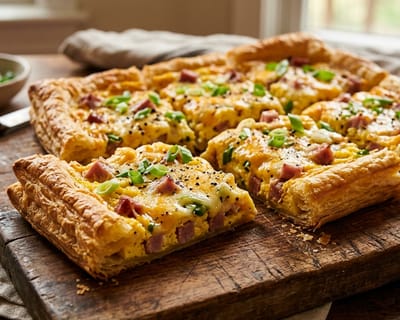
Cheesy Ham and Egg Breakfast Slab

Flaky, buttery all-butter puff pastry slab baked golden with soft-scrambled farm eggs, smoky diced country ham, rich melted sharp cheddar, and Swiss Gruyère, finished with scallions and Dijon cream.
Key Takeaways
- ✓Ready in just 25 mins using straightforward, kitchen-tested technique.
- ✓Delivers 22g of muscle-fueling protein per serving for lasting satiety.
- ✓Portion-balanced at 460 calories per serving with wholesome, unrefined ingredients.
- ✓Masterclass temperature checkpoints ensure maximum tenderness and flavor development.
The Story
The Cheesy Ham and Egg Breakfast Slab—often called a breakfast slab tart or brunch galette—represents a sophisticated evolution of morning pastry cookery. By taking the classic flavor matrix of a Parisian croque monsieur or a country ham and cheese omelet and baking it across a wide, golden expanse of laminated puff pastry, it creates a centerpiece that is crisp, savory, and effortlessly sliceable for entertaining crowds.
Despite its impressive visual appeal, homemade breakfast slabs often disappoint due to pastry failure. The most common flaws are a sodden, undercooked bottom crust that collapses under the weight of wet eggs, eggs that have overcooked into rubbery curds weeping clear whey onto the pastry, or an oily, separated cheese layer that renders the crust greasy.
Mastering this dish requires understanding the physics of steam-leavened laminated doughs, controlling protein syneresis through stovetop par-cooking, and balancing fat-to-moisture ratios in alpine and cheddar cheeses.
The Food Science of Laminated Puff Pastry (Pâte Feuilletée)
Traditional puff pastry is an engineered marvel of classical French baking:
1. The Lamination Mechanism
Puff pastry is constructed through repeated folding and rolling (tourage), creating hundreds of distinct sheets of flour dough (détrempe) separated by microscopic sheets of high-fat butter (beurrage).- Thermal Expansion: When placed into a hot 400°F (204°C) oven, water within the butter turns rapidly into steam.
- The Puffed Lift: Trapped between the impermeable flour layers, this expanding steam forces the individual pastry sheets apart, lifting the dough to six to eight times its original thickness.
- Starch Gelatinization: Simultaneously, the melting butter fries the thin dough leaves from within, gelatinizing wheat starches into a shatteringly crisp, honeycombed mosaic.
2. The Mechanics of the Frame: Scoring and Docking
A breakfast slab requires a sunken central basin to cradle the savory filling while maintaining a crisp, puffed exterior rim:- The Boundary Score: Using a sharp paring knife, score a clean border roughly 3/4 inch inward from all four edges, cutting only halfway through the dough thickness. This severs the surface gluten strands, allowing the outer perimeter to rise unrestrained.
- The Docking Vent: Using the tines of a fork, prick the inner rectangular field thoroughly at 1/2-inch intervals. These micro-perforations vent expanding steam freely from the central base, preventing the floor from ballooning upward while the outer frame puffs into a tall, fluted wall.
Egg Cookery: Preventing the Dreaded "Gum Line"
The single biggest error in breakfast tart cookery is pouring raw liquid egg custard directly onto unbaked or par-baked puff pastry:
1. The Capillary Action of Raw Dough
Raw or semi-baked pastry contains open starch pores. Raw beaten eggs are approximately 75% water. When poured across the pastry, free water immediately absorbs into the uncooked starch granules via capillary action.- Once wet egg liquid penetrates the dough floor, radiant oven heat cannot evaporate the moisture.
- The result is a permanent culinary defect known as a gum line: a dense, translucent, pasty gray layer of unbaked dough that never crisps, regardless of how long the slab remains in the oven.
2. The 70% Soft-Scramble Solution
To guarantee a crisp bottom crust and tender eggs, you must cook the eggs on the stovetop first:- Whisk eggs with cold water or cream and cook slowly in melted butter over medium-low heat.
- Halt cooking when the curds are roughly 70% set. The eggs should look like soft, glossy custard with large, delicate curds that still appear slightly wet and runny.
- When spread across the par-baked pastry, the set egg curds contain no free liquid to soak into the crust.
- The final 30% of cooking occurs inside the 400°F oven under radiant heat, emerging velvety, tender, and moist without weeping liquid (syneresis).
Selecting Meats and Balancing the Cheese Matrix
The savory toppings dictate the mouthfeel and flavor complexity of the finished slab:
1. The Ham: Smoked Country vs. Spiral-Cut
- Use quality bone-in smoked country ham, leftover spiral holiday ham, or thick deli-cut tavern ham.
- Cut the ham into neat 1/4-inch uniform cubes. Avoid paper-thin sliced deli shavings, which shrivel and turn leathery under high oven heat.
- Uniform cubes provide succulent, savory bites that contrast with the delicate flake of the pastry and the soft egg curds.
2. The Cheese Chemistry: Sharp Cheddar + Swiss Gruyère
- Aged Sharp Cheddar (60%): Delivers distinct lactic acidity, bright orange visual contrast, and savory sharpness. However, cheddar has a broken-down protein structure that exudes free butterfat when heated past 150°F (66°C).
- Swiss Gruyère (40%): An alpine cheese produced from unpasteurized cow's milk with an intact, stretchy protein network. Gruyère melts into a smooth, fondue-like blanket that traps the free oil of the cheddar, preventing greasiness while introducing sweet, nutty notes of hazelnut and brown butter.
- Hand-Grating is Mandatory: Never use pre-shredded packaged cheeses. Cellulose and starch coatings prevent the cheeses from melting together into a cohesive blanket.
Step-by-Step Instructions
Follow these culinary steps for the ultimate cheesy ham and egg breakfast slab:
Step 1: Thaw and Roll the Puff Pastry
Thaw 1 sheet of all-butter puff pastry in the refrigerator overnight. It should be cold and pliable, but not warm or sticky.Preheat your oven to 400°F (204°C) with an oven rack positioned in the center. Line a large rimmed half-sheet baking pan with parchment paper.
Lightly dust a clean work surface with flour. Unroll the puff pastry sheet and gently roll with a rolling pin into a 14x10-inch rectangle of uniform thickness. Transfer the rolled pastry onto the prepared parchment-lined baking sheet.
Step 2: Score and Dock the Pastry Frame
Using a sharp paring knife and a ruler (or steady hand), lightly score a 3/4-inch border around the entire perimeter of the pastry sheet, cutting only halfway through the dough thickness (do not cut all the way through).Using a fork, prick the inner rectangular area thoroughly all over, spacing the pricks roughly 1/2 inch apart. Leave the outer 3/4-inch border untouched.
In a small bowl, beat 1 egg with 1 tablespoon of water. Using a pastry brush, lightly brush the outer 3/4-inch border with the egg wash to ensure a deep golden shine.
Step 3: Par-Bake the Pastry Shell
Slide the baking sheet into the preheated 400°F (204°C) oven. Bake for 12 to 14 minutes, until the outer border has puffed tall and golden, and the center is lightly set and pale blonde.Remove from the oven. If the central docked area has puffed slightly, gently press it down with the back of a spatula or clean kitchen towel to re-flatten the basin. Let cool for 5 minutes.
Step 4: Soft-Scramble the Farm Eggs
While the pastry par-bakes, prepare the eggs. In a large bowl, whisk 8 large eggs with 2 tablespoons of cold water (or heavy cream), 1/4 teaspoon kosher salt, and 1/4 teaspoon black pepper until homogenous and streak-free.Melt 2 tablespoons of unsalted butter in a 10-inch nonstick skillet over medium-low heat. Pour in the whisked eggs.
Cook slowly, using a silicone spatula to sweep large, gentle curds from the outer edges toward the center. Remove the skillet from the burner when the eggs are 70% set—they should be glossy, soft, and custard-like, with visible wetness remaining. Transfer immediately to a clean plate to stop residual cooking.
Step 5: Assemble the Savory Slab
Spread the soft-scrambled eggs evenly across the flattened inner rectangular base of the par-baked pastry, staying inside the scored puffed border.Scatter 1 1/2 cups of diced smoked ham evenly across the eggs.
Drizzle 1/4 cup of heavy cream whisked with 1 teaspoon of Dijon mustard over the ham and egg layer (this introduces French bistro acidity and richness).
Evenly blanket the filling with 1 1/2 cups of freshly shredded sharp cheddar and 1 cup of shredded Swiss Gruyère. Scatter the sliced green onions across the cheese.
Step 6: Bake to Golden Perfection
Return the assembled slab to the 400°F (204°C) oven.Bake uncovered for 10 to 12 minutes, until the cheese is completely melted, bubbling, and blistered with light golden spots, and the outer puff pastry rim is deep golden brown and crisp.
Step 7: Rest, Garnish, and Serve
Transfer the baking sheet to a wire cooling rack. Let the slab rest undisturbed for 5 to 7 minutes. This allows the melted cheeses to set slightly, ensuring clean, intact slices.Scatter 1 tablespoon of finely snipped fresh chives, a pinch of flaky sea salt, and freshly cracked coarse black pepper over the top.
Using a large chef's knife or pizza cutting wheel, slice the slab into 8 to 10 rectangular portions. Serve warm alongside fresh seasonal berries, mixed greens with vinaigrette, and hot coffee.
Pro-Tips for Bakery-Grade Execution
- Keep Puff Pastry Cold: Butter in puff pastry melts at 90°F to 95°F. If the dough gets warm and sticky during rolling, return it to the refrigerator for 10 minutes. Cold butter hitting a hot 400°F oven is what generates steam and creates dramatic pastry lift.
- Use All-Butter Pastry (Dufour or Trader Joe's): Check the ingredients on commercial puff pastry boxes. Many standard brands use partially hydrogenated vegetable oils or palm oil instead of butter. All-butter puff pastry delivers unmatched flakiness, superior browning, and clean flavor.
- Do Not Overfill Pastry Edges: Keep all eggs, ham, and cheese inside the scored frame. If melted cheese runs over the puffed outer border, it will glue the laminated layers together, preventing them from puffing fully.
Flavor Variations and Additions
Storage, Reheating, and Make-Ahead Science
Laminated pastry dishes require specific handling to preserve their fragile crust structure:
Make-Ahead Strategy
- Par-Bake the Pastry: You can score, dock, and par-bake the pastry shell up to 24 hours in advance. Keep stored at room temperature covered loosely with a clean kitchen towel.
- Prep the Fillings: Dice the ham, shred the cheeses, and slice the alliums, keeping them refrigerated in separate airtight containers.
- Morning Assembly: Soft-scramble the eggs fresh, assemble onto the pastry shell, and bake for 10 to 12 minutes.
Storing Leftovers
Store leftover baked slices in an airtight glass container in the refrigerator for up to 3 days. Do not freeze baked puff pastry slabs, as the cellular moisture in the egg custard will thaw into water, making the bottom crust irreversibly soggy.Reheating for Restored Crunch
- Toaster Oven / Conventional Oven (Best): Place slices on a parchment-lined baking sheet and warm at 350°F (175°C) for 6 to 8 minutes until the pastry sizzles and the cheese re-melts.
- Air Fryer: Reheat at 330°F (165°C) for 3 to 4 minutes.
- Never Microwave: Microwaving destroys the crispness of the butter layers, turning the pastry rubbery and tough.
Pastry Rolling Dynamics and Oven Calibration
Baking puff pastry successfully requires honoring physical temperature thresholds:
- The Cold Dough Imperative: Butter inside puff pastry melts between 90°F and 95°F (32°C to 35°C). If the dough is rolled when warm, butter smears into the flour sheets, destroying the individual layers and causing the slab to bake flat, greasy, and dense. If your kitchen is warm or the dough becomes sticky, transfer it to a parchment-lined baking sheet and chill in the freezer for 5 minutes before continuing.
- Oven Preheating and Thermal Mass: Never bake puff pastry in an underheated oven. An oven heated to a true 400°F (204°C) provides immediate conductive and radiant heat that turns water in the butter into high-pressure steam before the fat has time to liquefy and leak out onto the pan.
Brunch Entertaining and Buffet Service Logistics
When serving this breakfast slab for weekend brunches, baby showers, or holiday mornings, follow these timing rules:
- The 30-Minute Flake Window: Puff pastry crust is at peak flakiness within 30 minutes of leaving the oven. Serve on a warm wooden board or ceramic platter rather than metal, as metal draws heat away quickly.
- Cutting Technique: Always use a very sharp chef's knife or a large pizza wheel. Press down firmly in a single, decisive motion rather than sawing back and forth. Sawing compresses the delicate air pockets, crushing the fluted outer pastry border.
Troubleshooting Common Breakfast Slab Defects
1. The Center Pastry Base is Soggy and Uncooked
- The Cause: Eggs were poured raw onto the pastry, or the pastry shell was not par-baked and docked before filling.
- The Solution: Dock the inner rectangle thoroughly with a fork and par-bake for 12 to 14 minutes until dry and set. Always soft-scramble the eggs on the stove first so no free water can seep into the crust.
2. The Outer Pastry Border Did Not Rise
- The Cause: Egg wash dripped down the cut outer edges of the pastry, or the border was scored too deeply (cutting completely through the dough).
- The Solution: When applying egg wash with a pastry brush, glaze only the top surface of the 3/4-inch border, taking care not to let egg liquid drip down the sides. Egg wash that runs down the cut edges acts like glue, binding the laminated leaves together and preventing steam expansion.
3. The Eggs Turned Watery and Separated in the Oven
- The Cause: Over-scrambling the eggs on the stovetop before baking.
- The Solution: Halt stovetop cooking when eggs are only 70% set—soft, wet, and custard-like. Overcooked egg proteins contract tightly and squeeze out water when exposed to secondary oven heat.
Nutritional Breakdown and Macro Profile
Per serving (serving size: 1 rectangular slice, recipe makes 8 generous servings):
| Nutrient | Amount per Serving | % Daily Value |
|---|---|---|
| Calories | 460 kcal | — |
| Total Fat | 32 g | 41% |
| Saturated Fat | 15 g | 75% |
| Cholesterol | 225 mg | 75% |
| Sodium | 780 mg | 34% |
| Total Carbohydrates | 22 g | 8% |
| Dietary Fiber | 1 g | 4% |
| Total Sugars | 2 g | — |
| Protein | 22 g | 44% |
| Potassium | 290 mg | 6% |
| Calcium | 280 mg | 22% |
| Iron | 2.4 mg | 13% |
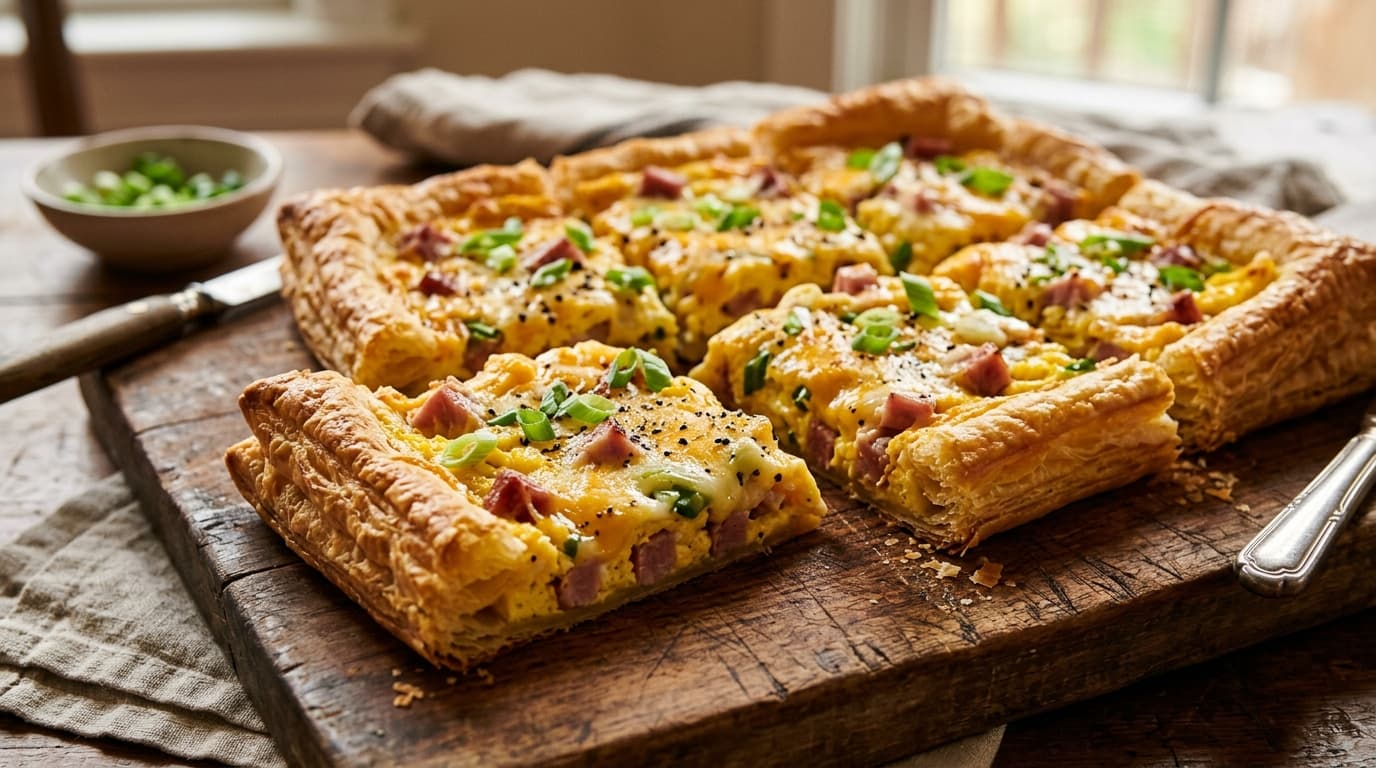
Cheesy Ham and Egg Breakfast Slab
Flaky, buttery all-butter puff pastry slab baked golden with soft-scrambled farm eggs, smoky diced country ham, rich melted sharp cheddar, and Swiss Gruyère, finished with scallions and Dijon cream.
Macro Nutrition Profile (Per Serving)
Ingredients
The Soft-Scrambled Egg Filling
Savory Meat & Artisan Cheese Topping
Ingredient Substitutions
| Original Ingredient | Healthy Alternative |
|---|---|
| Poached eggs | Firm tofu slices (lightly pan-seared) or avocado slices (for a rich plant-based fat source) |
| Baby spinach | Swiss chard, baby kale, or arugula (wilt at the same temperature/time) |
| White vinegar | Lemon juice or apple cider vinegar (acid helps egg whites coagulate) |
Instructions
Thaw and Roll the Puff Pastry: Thaw 1 sheet of all-butter puff pastry in the refrigerator overnight. It should be cold and pliable, but not warm or sticky. Preheat your oven to 400°F (204°C) with an oven rack positioned in the center. Line a large rimmed half-sheet baking pan with parchment paper. Lightly dust a clean work surface with flour. Unroll the puff pastry sheet and gently roll with a rolling pin into a 14x10-inch rectangle of uniform thickness. Transfer the rolled pastry onto the prepared parchment-lined baking sheet.
Score and Dock the Pastry Frame: Using a sharp paring knife and a ruler (or steady hand), lightly score a 3/4-inch border around the entire perimeter of the pastry sheet, cutting only halfway through the dough thickness (do not cut all the way through). Using a fork, prick the inner rectangular area thoroughly all over, spacing the pricks roughly 1/2 inch apart. Leave the outer 3/4-inch border untouched. In a small bowl, beat 1 egg with 1 tablespoon of water. Using a pastry brush, lightly brush the outer 3/4-inch border with the egg wash to ensure a deep golden shine.
Par-Bake the Pastry Shell: Slide the baking sheet into the preheated 400°F (204°C) oven. Bake for 12 to 14 minutes, until the outer border has puffed tall and golden, and the center is lightly set and pale blonde. Remove from the oven. If the central docked area has puffed slightly, gently press it down with the back of a spatula or clean kitchen towel to re-flatten the basin. Let cool for 5 minutes.
Soft-Scramble the Farm Eggs: While the pastry par-bakes, prepare the eggs. In a large bowl, whisk 8 large eggs with 2 tablespoons of cold water (or heavy cream), 1/4 teaspoon kosher salt, and 1/4 teaspoon black pepper until homogenous and streak-free. Melt 2 tablespoons of unsalted butter in a 10-inch nonstick skillet over medium-low heat. Pour in the whisked eggs. Cook slowly, using a silicone spatula to sweep large, gentle curds from the outer edges toward the center. Remove the skillet from the burner when the eggs are 70% set—they should be glossy, soft, and custard-like, with visible wetness remaining. Transfer immediately to a clean plate to stop residual cooking.
Assemble the Savory Slab: Spread the soft-scrambled eggs evenly across the flattened inner rectangular base of the par-baked pastry, staying inside the scored puffed border. Scatter 1 1/2 cups of diced smoked ham evenly across the eggs. Drizzle 1/4 cup of heavy cream whisked with 1 teaspoon of Dijon mustard over the ham and egg layer (this introduces French bistro acidity and richness). Evenly blanket the filling with 1 1/2 cups of freshly shredded sharp cheddar and 1 cup of shredded Swiss Gruyère. Scatter the sliced green onions across the cheese.
Bake to Golden Perfection: Return the assembled slab to the 400°F (204°C) oven. Bake uncovered for 10 to 12 minutes, until the cheese is completely melted, bubbling, and blistered with light golden spots, and the outer puff pastry rim is deep golden brown and crisp.
Rest, Garnish, and Serve: Transfer the baking sheet to a wire cooling rack. Let the slab rest undisturbed for 5 to 7 minutes. This allows the melted cheeses to set slightly, ensuring clean, intact slices. Scatter 1 tablespoon of finely snipped fresh chives, a pinch of flaky sea salt, and freshly cracked coarse black pepper over the top. Using a large chef's knife or pizza cutting wheel, slice the slab into 8 to 10 rectangular portions. Serve warm alongside fresh seasonal berries, mixed greens with vinaigrette, and hot coffee.
The Florentine (Spinach, Feta, and Bacon): Sauté 2 cups of fresh baby spinach in butter with a minced garlic clove until wilted and moisture has evaporated completely. Replace the ham with 6 strips of crisp crumbled bacon and fold the sautéed spinach into the scrambled eggs. Substitute crumbled Greek feta for half of the cheddar cheese.
The Wild Mushroom and Herb Tart: Sauté 8 ounces of sliced cremini or chanterelle mushrooms in butter with 1 teaspoon of fresh thyme leaves until caramelized. Layer over the eggs with diced prosciutto or pancetta and fontina cheese.
The Smoked Salmon and Goat Cheese Slab: Bake the pastry shell with only the scrambled eggs and Gruyère. Upon removing from the oven, drape 6 ounces of thinly sliced cold-smoked salmon across the warm slab. Dot with fresh goat cheese medallions, capers, thinly sliced red onion, and fresh dill sprigs.
The Center Pastry Base is Soggy and Uncooked: The Cause: Eggs were poured raw onto the pastry, or the pastry shell was not par-baked and docked before filling. The Solution: Dock the inner rectangle thoroughly with a fork and par-bake for 12 to 14 minutes until dry and set. Always soft-scramble the eggs on the stove first so no free water can seep into the crust.
The Outer Pastry Border Did Not Rise: The Cause: Egg wash dripped down the cut outer edges of the pastry, or the border was scored too deeply (cutting completely through the dough). The Solution: When applying egg wash with a pastry brush, glaze only the top surface of the 3/4-inch border, taking care not to let egg liquid drip down the sides. Egg wash that runs down the cut edges acts like glue, binding the laminated leaves together and preventing steam expansion.
The Eggs Turned Watery and Separated in the Oven: The Cause: Over-scrambling the eggs on the stovetop before baking. The Solution: Halt stovetop cooking when eggs are only 70% set—soft, wet, and custard-like. Overcooked egg proteins contract tightly and squeeze out water when exposed to secondary oven heat.
Tried this recipe?
Let us know how it turned out! Click a star below to leave a review and rate the recipe.
Storage & Freezing Tips
- Refrigerator: Store in an airtight container for up to 2 days. Keep the components separate if possible to preserve texture.
- Reheating: Reheat gently in a skillet on medium-low heat with a splash of olive oil or butter.
- Freezing: Freezing is not recommended for this dish because ingredients like eggs become soggy, rubbery, or mushy when defrosted.
Frequently Asked Questions
Can this recipe be prepared ahead of time?▼
Yes, this meal is excellent for weekly meal prep. Store components separately and assemble before serving.
Is this recipe gluten-free?▼
All ingredients used are naturally gluten-free. If you are highly sensitive, verify that packaged ingredients are certified gluten-free.
Tried this recipe?
Tag @stewartlucas on Instagram and hashtag it #nutriguide!
You Might Also Like
Stewart Lucas
Chief Culinary SpecialistStewart Lucas is the Chief Culinary Specialist and lead recipe developer representing the NutriGuide team. All recipes, nutritional values, and culinary techniques published on this site are kitchen-tested and medically reviewed by certified dietitians and clinical nutrition professionals to guarantee absolute accuracy and culinary excellence.
Community Reviews
Please log in to leave a review.