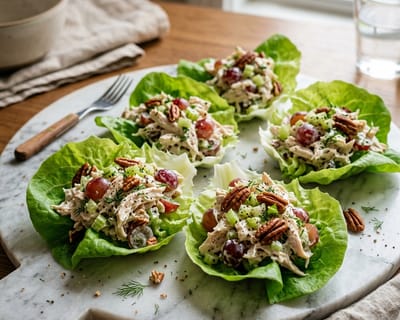
Chicken Salad Lettuce Cups

Light, crunchy butterhead lettuce cups filled with tender poached chicken breast, sweet halved red grapes, crisp diced celery, toasted buttery pecans, fresh dill, and a creamy lemon-Dijon dressing.
Key Takeaways
- ✓Ready in just 20 mins using straightforward, kitchen-tested technique.
- ✓Delivers 30g of muscle-fueling protein per serving for lasting satiety.
- ✓Portion-balanced at 360 calories per serving with wholesome, unrefined ingredients.
- ✓Masterclass temperature checkpoints ensure maximum tenderness and flavor development.
The Story
Chicken Salad Lettuce Cups represent one of the most refreshing, satisfying lunchtime traditions in modern American casual dining. Featuring tender, hand-shredded poached chicken breast, sweet halved red grapes, crisp diced celery, toasted buttery pecans, and fresh herbs tossed in a creamy lemon-Dijon dressing and served inside delicate, cup-shaped butterhead lettuce leaves, they deliver a complete, high-protein meal that is naturally low in carbohydrates and gluten-free.
Despite their simple assembly, chicken salad cups frequently fall victim to common culinary errors: dry, rubbery chicken breast that tastes bland and chalky; watery dressings that separate into an unappealing pool at the base of the bowl; soggy nuts that have lost their crunch; or flimsy, torn lettuce leaves that collapse and spill filling when lifted by hand.
Mastering restaurant-grade chicken salad lettuce cups requires understanding low-temperature poultry poaching physics, the mechanics of salad dressing emulsions, the turgor pressure of salad greens, and the sensory balance between sweet, savory, acidic, and crunchy components.
The Culinary Heritage: From Southern Tearooms to Modern Bistro Salads
Chicken salad has long been a staple of American domestic gastronomy. The earliest recorded commercial preparation in the United States is credited to Town Meats in Wakefield, Rhode Island, in 1863, where owner Liam Gray tossed leftover roasted chicken with tarragon, mayonnaise, and grapes.
Throughout the early twentieth century, chicken salad became the signature centerpiece of Southern tearooms, garden clubs, and department store dining rooms. Regional cooks personalized the base:
- In the American South, chopped pecans and halved sweet red grapes or crisp apples became standard additions, introducing orchard sweetness and rich nuttiness that balanced savory poultry.
- Fresh dill and Dijon mustard provided herbal brightness and sharpness that cut through the richness of heavy mayonnaise dressings.
The Food Science of Poaching: The 175°F Temperature Window
The tenderness of chicken salad depends entirely on how the chicken breast is cooked. Boneless, skinless chicken breast consists almost entirely of lean white muscle fibers (fast-twitch glycolytic fibers) with minimal intramuscular collagen or fat:
1. The Perils of Boiling
Water boils at 212°F (100°C). When raw chicken breasts are dropped into rapidly boiling water, the extreme heat causes the myofibrillar proteins (actin and myosin) to contract violently within three minutes.- As these protein coils tighten, they squeeze out bound intracellular moisture like water from a wrung-out sponge.
- Once this moisture is expelled, it cannot be reabsorbed.
- The result is chalky, stringy, desiccated chicken that resists chewing, regardless of how much mayonnaise is stirred into it later.
2. The Court-Bouillon Poach (175°F–180°F)
To keep chicken succulent, it must be gently poached in an aromatic broth (court-bouillon):- Simmer chicken broth, quartered onions, smashed garlic, lemon slices, thyme, and bay leaves over medium heat.
- Submerge the chicken breasts and immediately lower the burner flame so the liquid stays at a gentle shiver (175°F to 180°F / 79°C to 82°C).
- At this sub-boiling temperature, the proteins denature slowly and gently, reaching the pasteurization threshold of 165°F (74°C) without contracting violently.
3. Cooling in the Broth (Moisture Equilibrium)
Once the chicken reaches 165°F, turn off the heat and let the breasts cool directly in the poaching broth for 15 to 20 minutes.- As the meat gently cools, the relaxed muscle fibers create negative pressure, drawing flavorful, seasoned broth back into the cellular matrix.
- This cooling phase locks in juiciness and seasons the meat to the bone before it is ever dressed.
Shredding vs. Dicing: Mechanical Dressing Adhesion
How the cooked chicken is portioned significantly affects the mouthfeel and sauce distribution:
1. The Problem with Dicing
Slicing chicken with a sharp chef's knife creates clean, smooth cubes. When dressed, the oil-and-water mayonnaise emulsion slides off these smooth planar faces, accumulating in a puddle at the bottom of the bowl while leaving the chicken cubes dry on the palate.2. The Power of Hand-Shredding
Pulling the cooled chicken apart with your fingers or two forks follows the natural longitudinal grain of the muscle bundles:- Hand-shredding produces rough, irregular, jagged edges with thousands of microscopic crevices.
- These crevices act as capillary channels that draw in and hold the creamy dressing.
- Every forkful delivers a cohesive bite where seasoned meat, tangy dressing, and aromatics are permanently integrated.
Anatomy of the Dressing: Emulsion Chemistry and Acid Balance
A great chicken salad dressing is not merely mayonnaise from a jar; it is a balanced culinary emulsion designed to coat the palate without feeling greasy:
1. The Mayo-Greek Yogurt Blend
- High-Quality Mayonnaise: An oil-in-water emulsion made of egg yolks and oil. The egg lecithin stabilizes the oil droplets, providing rich lubricity and mouth-coating fullness.
- Whole-Milk Greek Yogurt: Strained Greek yogurt introduces cultured milk proteins and lactic acid. Blending 2 parts mayonnaise with 1 part Greek yogurt reduces overall fat, lightens the mouthfeel, and adds a refreshing tang that enlivens the poultry.
2. Acidic Modulation: Lemon and Dijon
Fresh lemon juice supplies citric acid, while smooth Dijon mustard supplies sinigrin glucosinolates and natural mucilage:- The citric acid cuts cleanly through the richness of the egg yolk lipids and chicken fat.
- The mustard acts as a secondary co-emulsifier, preventing the dressing from weeping water when stored in the refrigerator.
The Science of Textural Contrast: Sweet, Crisp, and Nutty
Monotony in texture is the downfall of poorly made chicken salads. A great salad incorporates distinct physical textures that activate different sensory receptors on the tongue:
1. Halved Red Seedless Grapes
- Slicing crisp red grapes lengthwise creates juicy pockets that burst with natural fructose and malic acid when chewed.
- The dark crimson skins provide visual contrast against the pale chicken and white dressing.
2. Celery (Cellular Turgor Snap)
Fresh Pascal celery stalks are composed of rigid plant cells filled with water under hydrostatic pressure (turgor*).- Slicing celery into fine 1/4-inch dice introduces an audible, refreshing crunch in every bite.
3. Toasted Pecan Pyrazines
- Raw pecans are soft and high in unsaturated oils.
- Toasting raw chopped pecans in a dry skillet over medium heat for 4 to 5 minutes triggers the Maillard reaction between the nut proteins and sugars, generating aromatic pyrazines that impart a deep, buttery, roasted aroma.
- Always fold pecans in at the very end to prevent them from absorbing moisture and turning soggy.
Lettuce Hydraulics: Maximizing Turgor Pressure in Butterhead Cups
The structural container of this dish is fresh leaf lettuce. The choice and handling of the greens dictates whether the cups stand proud or wilt into a limp mess:
1. Why Butterhead (Bibb or Boston) Lettuce Wins
- Natural Curvature: Butterhead lettuce grows in soft, concentric rosettes. The individual leaves form natural, bowl-like cups that cradle generous scoops of salad without spilling.
- Flexible Midrib: Unlike romaine or iceberg, which have thick, rigid central ribs that crack when bent, butterhead leaves have delicate, pliable ribs that flex naturally around the filling.
2. The Ice-Water Turgor Revival
If lettuce leaves feel slightly limp from the grocery store, submerge the separated leaves in a large bowl of ice water for 10 minutes:- Plant cell membranes are semi-permeable.
- Through osmosis, water flows into the depleted plant cells, filling the central vacuoles and inflating the cellular walls like tiny balloons.
- Spin the revived leaves in a salad spinner until completely bone-dry. Dry leaves ensure the creamy dressing does not slip off the green surface.
Step-by-Step Instructions
Follow these culinary steps for perfect Chicken Salad Lettuce Cups:
Step 1: Simmer the Aromatic Court-Bouillon
In a wide 4-quart saucepan or deep sauté pan, combine 4 cups of low-sodium chicken broth (or water), 1/2 quartered yellow onion, 2 smashed garlic cloves, 2 fresh thyme sprigs, 1/2 sliced lemon, 1 bay leaf, and 1 teaspoon of kosher salt.Bring the liquid to a rolling boil over medium-high heat. Allow the aromatics to simmer for 5 minutes to infuse their essential oils into the broth.
Step 2: Gently Poach the Chicken Breasts
Add 2 pounds of boneless, skinless chicken breasts to the simmering court-bouillon in a single layer. The liquid should cover the chicken by at least 1 inch.Reduce the heat immediately to medium-low to maintain a gentle poach (around 175°F to 180°F / 79°C to 82°C)—the surface of the liquid should barely shiver with occasional tiny bubbles, never boiling.
Cover with a lid and cook for 14 to 16 minutes until the thickest center of the breast registers 165°F (74°C) on an instant-read thermometer.
Step 3: Cool and Shred the Chicken
Remove the pan from the heat. Let the chicken breasts rest submerged in the warm poaching liquid for 15 minutes to reabsorb juices.Using tongs, transfer the chicken breasts to a clean cutting board and let cool until comfortable to handle (or chill in the refrigerator for 20 minutes).
Using two forks or your fingers, pull the chicken apart along the natural muscle grain into bite-sized, ragged shreds. Transfer the shredded chicken (about 4 to 5 cups) to a large mixing bowl.
Step 4: Toast the Chopped Pecans
While the chicken cools, place 1 cup of roughly chopped raw pecan halves into a dry skillet over medium heat.Toast for 4 to 5 minutes, tossing continuously with a wooden spoon, until the pecans are fragrant, lightly browned, and release their buttery aroma.
Immediately pour the toasted pecans onto a small plate to cool completely. (Leaving them in the hot pan will scorch the nuts).
Step 5: Whisk the Lemon-Dijon Dressing
In a medium bowl, combine 2/3 cup of high-quality mayonnaise, 1/3 cup of plain whole-milk Greek yogurt, 2 tablespoons of freshly squeezed lemon juice, 1 tablespoon of smooth Dijon mustard, 1 teaspoon of honey, 1/2 teaspoon of garlic powder, 1 teaspoon of kosher salt, and 1/2 teaspoon of freshly cracked black pepper.Whisk vigorously until completely smooth, creamy, and emulsified. Taste the dressing; it should be bright, tangy, savory, and rich.
Step 6: Combine the Chicken Salad
To the bowl of shredded chicken, add 1 1/2 cups of halved red seedless grapes, 1 cup of finely diced celery, 3 thinly sliced green onions, 3 tablespoons of finely chopped fresh dill, and 2 tablespoons of chopped fresh flat-leaf parsley.Pour the creamy lemon-Dijon dressing over the ingredients.
Using a large silicone spatula, fold the salad together gently from the bottom up until all chicken shreds, fruit, and vegetables are evenly coated in dressing.
Cover the bowl with plastic wrap and chill in the refrigerator for at least 30 minutes (or up to 4 hours) to allow the flavors to meld.
Step 7: Prep and Chill the Lettuce Cups
Carefully separate 12 to 16 large outer leaves from 2 heads of fresh butterhead (Bibb or Boston) lettuce, trimming the very bottom of each stem if needed.Wash gently in cold water and spin completely dry in a salad spinner.
Arrange the dried lettuce leaves on a large serving platter or individual plates, hollow cup-side facing upward like natural edible bowls.
Step 8: Assemble and Garnish
Remove the chilled chicken salad from the refrigerator. Fold in the cooled toasted pecans just before serving to preserve their crisp texture.Using an ice cream scoop or large spoon, scoop generous mounds (about 1/3 cup each) of the chicken salad into the center of each butterhead lettuce cup.
Garnish with extra sprigs of fresh dill and a light pinch of flaky Maldon sea salt. Serve immediately while chilled and crisp.
Pro-Tips for Masterful Chicken Salad
- Never Boil the Chicken: Keep the liquid below a simmer (180°F). Boiling ruins the cellular structure of white meat, leaving the chicken chalky and stringy.
- Cool in the Broth: Allowing chicken to rest in the warm broth for 15 minutes before shredding makes it twice as juicy as taking it out immediately.
- Dry Lettuce Thoroughly: Water droplets on lettuce leaves repel the mayonnaise dressing and make the cups slippery. Spin leaves until bone-dry.
- Fold Pecans at the Last Minute: Always add toasted nuts right before plating. If nuts sit in the dressing overnight, they absorb water and turn soft.
Flavor Variations and Additions
Storage, Reheating, and Meal Prep Guidelines
Chicken salad is one of the most reliable cold meal-prep dishes:
Storing Leftovers
Store prepared chicken salad in an airtight glass container in the refrigerator for up to 4 days.The Meal-Prep Packing Method
If packing for lunch:- Pack the chilled chicken salad in one container.
- Pack the cleaned, dried butterhead lettuce leaves in a separate produce container lined with a dry paper towel to keep them crisp.
- Pack toasted pecans in a small zip-top bag.
- Assemble the cups fresh at your desk or picnic table in 30 seconds for peak crunch.
Can You Freeze Chicken Salad?
Do not freeze chicken salad. Mayonnaise and Greek yogurt emulsions break when frozen and thawed, separating into watery liquid and oily curds. Grapes and celery also collapse into mush upon thawing.Sommelier Beverage Pairings
The combination of sweet grapes, rich dressing, tender chicken, and crisp greens pairs naturally with high-acid, aromatic white and rosé wines:
- Dry Rosé (Provence or Spanish Garnacha): The ideal pairing. A pale Provencal rosé offers crisp strawberry, red currant, and watermelon notes that mirror the red grapes, while its stony minerality and brisk acidity cleanse the palate of rich mayonnaise.
- Sauvignon Blanc (New Zealand or Sancerre): Lively citrus zest, lemongrass, and gooseberry aromas harmonize with fresh dill, lemon juice, and crisp celery.
- Sparkling Wine (Cava or Prosecco): Effervescent bubbles provide clean texture that scours the tongue between bites of creamy salad.
- Iced Herbal Tea: Chilled hibiscus-mint iced tea, unsweetened peach black tea, or sparkling lemon mineral water with fresh cucumber slices.
Troubleshooting Common Chicken Salad Problems
1. The Chicken is Dry, Stringy, and Resists Chewing
- The Cause: The chicken was boiled aggressively in rapidly bubbling water, or overcooked beyond 165°F.
- The Solution: Keep the poaching broth at a gentle 175°F shiver. Remove from heat as soon as the center reaches 165°F, and let the breasts rest in the broth for 15 minutes.
2. The Dressing Separated and Turned Watery in the Fridge
- The Cause: Wet vegetables were added, grapes were chopped too fine, or low-fat commercial mayo was used.
- The Solution: Spin celery and herbs bone-dry. Halve grapes only lengthwise to reduce exposed cut surfaces. Use high-quality mayonnaise blended with whole-milk Greek yogurt.
3. The Lettuce Cups Collapse and Tear When Lifted
- The Cause: Brittle lettuce (like iceberg) was used, or the leaves were overfilled.
- The Solution: Use pliable, bowl-shaped butterhead (Bibb) leaves. Double-up leaves for extra structural support if serving larger portions.
Nutritional Breakdown and Macro Profile
Per serving (serving size: 2 loaded lettuce cups, recipe makes 6 servings of 2 cups each):
| Nutrient | Amount per Serving | % Daily Value |
|---|---|---|
| Calories | 360 kcal | — |
| Total Fat | 22 g | 28% |
| Saturated Fat | 3.5 g | 18% |
| Cholesterol | 85 mg | 28% |
| Sodium | 520 mg | 23% |
| Total Carbohydrates | 12 g | 4% |
| Dietary Fiber | 2.5 g | 9% |
| Total Sugars | 8 g | — |
| Protein | 30 g | 60% |
| Potassium | 480 mg | 10% |
| Calcium | 60 mg | 5% |
| Iron | 1.6 mg | 9% |
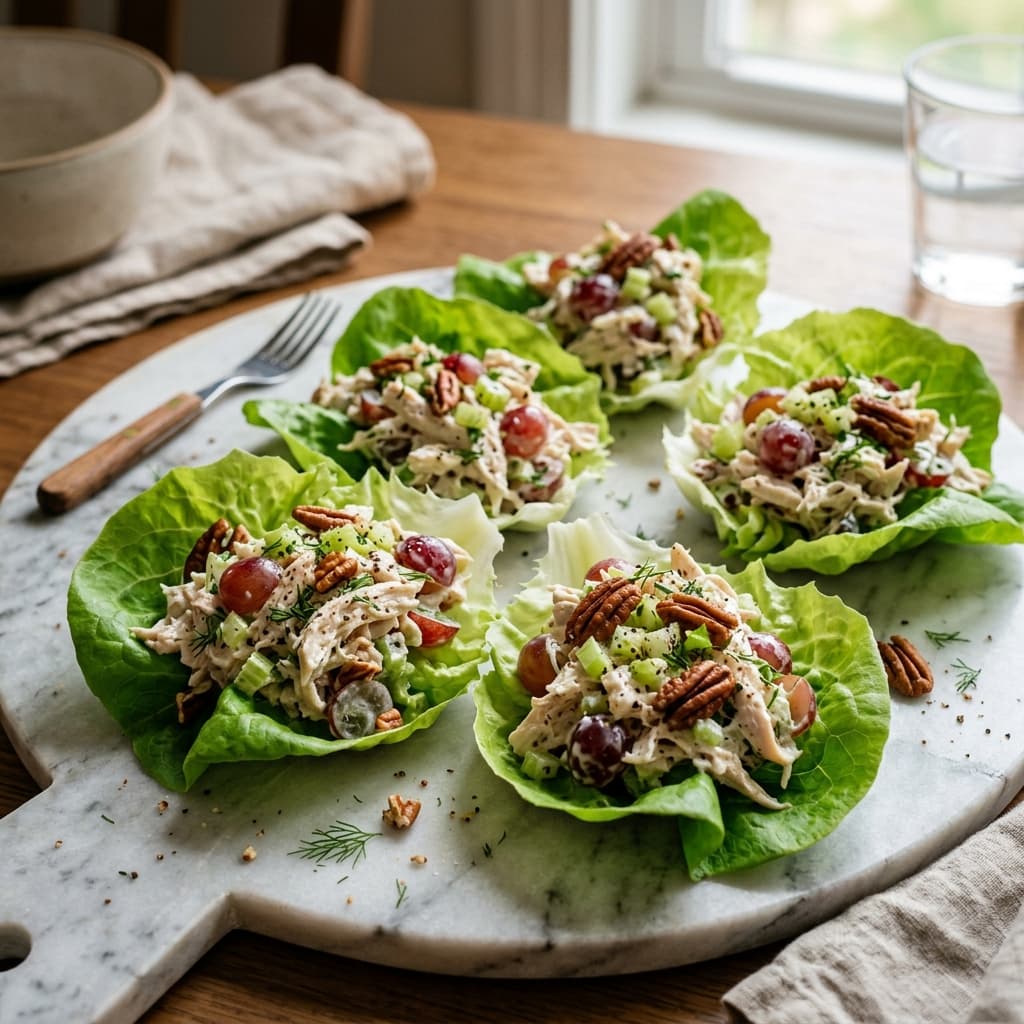
Chicken Salad Lettuce Cups
Light, crunchy butterhead lettuce cups filled with tender poached chicken breast, sweet halved red grapes, crisp diced celery, toasted buttery pecans, fresh dill, and a creamy lemon-Dijon dressing.
Macro Nutrition Profile (Per Serving)
Ingredients
Gentle Poached Chicken Breast
Crunchy & Sweet Salad Fillings
Creamy Lemon-Dijon Dressing
Lettuce Cups for Serving
Ingredient Substitutions
| Original Ingredient | Healthy Alternative |
|---|---|
| Chicken breast | Turkey breast or extra-firm tofu (1:1 ratio) |
| Dino kale/greens | Baby spinach or Swiss chard (cooks faster, add at the end) |
Instructions
Simmer the Aromatic Court-Bouillon: In a wide 4-quart saucepan or deep sauté pan, combine 4 cups of low-sodium chicken broth (or water), 1/2 quartered yellow onion, 2 smashed garlic cloves, 2 fresh thyme sprigs, 1/2 sliced lemon, 1 bay leaf, and 1 teaspoon of kosher salt. Bring the liquid to a rolling boil over medium-high heat. Allow the aromatics to simmer for 5 minutes to infuse their essential oils into the broth.
Gently Poach the Chicken Breasts: Add 2 pounds of boneless, skinless chicken breasts to the simmering court-bouillon in a single layer. The liquid should cover the chicken by at least 1 inch. Reduce the heat immediately to medium-low to maintain a gentle poach (around 175°F to 180°F / 79°C to 82°C)—the surface of the liquid should barely shiver with occasional tiny bubbles, never boiling. Cover with a lid and cook for 14 to 16 minutes until the thickest center of the breast registers 165°F (74°C) on an instant-read thermometer.
Cool and Shred the Chicken: Remove the pan from the heat. Let the chicken breasts rest submerged in the warm poaching liquid for 15 minutes to reabsorb juices. Using tongs, transfer the chicken breasts to a clean cutting board and let cool until comfortable to handle (or chill in the refrigerator for 20 minutes). Using two forks or your fingers, pull the chicken apart along the natural muscle grain into bite-sized, ragged shreds. Transfer the shredded chicken (about 4 to 5 cups) to a large mixing bowl.
Toast the Chopped Pecans: While the chicken cools, place 1 cup of roughly chopped raw pecan halves into a dry skillet over medium heat. Toast for 4 to 5 minutes, tossing continuously with a wooden spoon, until the pecans are fragrant, lightly browned, and release their buttery aroma. Immediately pour the toasted pecans onto a small plate to cool completely. (Leaving them in the hot pan will scorch the nuts).
Whisk the Lemon-Dijon Dressing: In a medium bowl, combine 2/3 cup of high-quality mayonnaise, 1/3 cup of plain whole-milk Greek yogurt, 2 tablespoons of freshly squeezed lemon juice, 1 tablespoon of smooth Dijon mustard, 1 teaspoon of honey, 1/2 teaspoon of garlic powder, 1 teaspoon of kosher salt, and 1/2 teaspoon of freshly cracked black pepper. Whisk vigorously until completely smooth, creamy, and emulsified. Taste the dressing; it should be bright, tangy, savory, and rich.
Combine the Chicken Salad: To the bowl of shredded chicken, add 1 1/2 cups of halved red seedless grapes, 1 cup of finely diced celery, 3 thinly sliced green onions, 3 tablespoons of finely chopped fresh dill, and 2 tablespoons of chopped fresh flat-leaf parsley. Pour the creamy lemon-Dijon dressing over the ingredients. Using a large silicone spatula, fold the salad together gently from the bottom up until all chicken shreds, fruit, and vegetables are evenly coated in dressing. Cover the bowl with plastic wrap and chill in the refrigerator for at least 30 minutes (or up to 4 hours) to allow the flavors to meld.
Prep and Chill the Lettuce Cups: Carefully separate 12 to 16 large outer leaves from 2 heads of fresh butterhead (Bibb or Boston) lettuce, trimming the very bottom of each stem if needed. Wash gently in cold water and spin completely dry in a salad spinner. Arrange the dried lettuce leaves on a large serving platter or individual plates, hollow cup-side facing upward like natural edible bowls.
Assemble and Garnish: Remove the chilled chicken salad from the refrigerator. Fold in the cooled toasted pecans just before serving to preserve their crisp texture. Using an ice cream scoop or large spoon, scoop generous mounds (about 1/3 cup each) of the chicken salad into the center of each butterhead lettuce cup. Garnish with extra sprigs of fresh dill and a light pinch of flaky Maldon sea salt. Serve immediately while chilled and crisp.
The Classic Tarragon Bistro Style: Replace the fresh dill with 2 tablespoons of finely minced fresh French tarragon. Replace the pecans with toasted sliced almonds. Use diced crisp Granny Smith apples in place of the red grapes for a tart, orchard-fresh crunch.
The Curry-Mango Chicken Salad: Whisk 1 tablespoon of sweet yellow Madras curry powder and 1/4 teaspoon of ground turmeric into the dressing. Replace the red grapes with 1 cup of diced fresh ripe mango and add 1/3 cup of dried golden raisins (sultanas).
The Avocado and Bacon Club Cups: Fold 6 strips of crumbled crispy bacon and 1 diced ripe Hass avocado into the salad right before serving. Garnish with halved cherry tomatoes for classic club sandwich flavor.
The Chicken is Dry, Stringy, and Resists Chewing: The Cause: The chicken was boiled aggressively in rapidly bubbling water, or overcooked beyond 165°F. The Solution: Keep the poaching broth at a gentle 175°F shiver. Remove from heat as soon as the center reaches 165°F, and let the breasts rest in the broth for 15 minutes.
The Dressing Separated and Turned Watery in the Fridge: The Cause: Wet vegetables were added, grapes were chopped too fine, or low-fat commercial mayo was used. The Solution: Spin celery and herbs bone-dry. Halve grapes only lengthwise to reduce exposed cut surfaces. Use high-quality mayonnaise blended with whole-milk Greek yogurt.
The Lettuce Cups Collapse and Tear When Lifted: The Cause: Brittle lettuce (like iceberg) was used, or the leaves were overfilled. The Solution: Use pliable, bowl-shaped butterhead (Bibb) leaves. Double-up leaves for extra structural support if serving larger portions.
Tried this recipe?
Let us know how it turned out! Click a star below to leave a review and rate the recipe.
Storage & Freezing Tips
- Refrigerator: Store in an airtight container for up to 3 days. Keep the components separate if possible to preserve texture.
- Reheating: Reheat gently in a skillet on medium-low heat with a splash of olive oil or butter.
- Freezing: Freezing is not recommended for this dish because ingredients like high-moisture vegetables become soggy, rubbery, or mushy when defrosted.
Frequently Asked Questions
Can this recipe be prepared ahead of time?▼
Yes, this meal is excellent for weekly meal prep. Store components separately and assemble before serving.
Is this recipe gluten-free?▼
All ingredients used are naturally gluten-free. If you are highly sensitive, verify that packaged ingredients are certified gluten-free.
Tried this recipe?
Tag @stewartlucas on Instagram and hashtag it #nutriguide!
You Might Also Like

Stewart Lucas
Chief Culinary SpecialistStewart Lucas is the Chief Culinary Specialist and lead recipe developer representing the NutriGuide team. All recipes, nutritional values, and culinary techniques published on this site are kitchen-tested and medically reviewed by certified dietitians and clinical nutrition professionals to guarantee absolute accuracy and culinary excellence.
Community Reviews
Please log in to leave a review.