
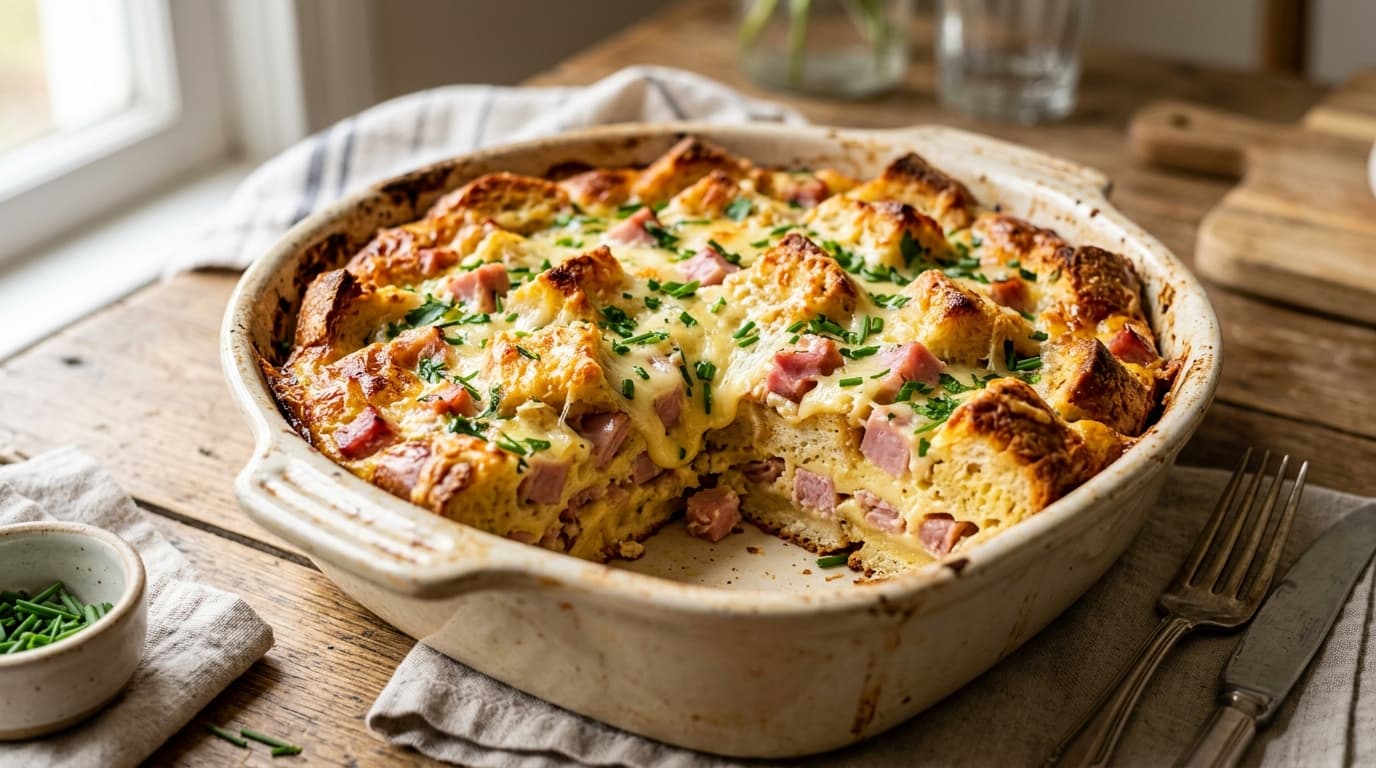
Ham and Swiss Breakfast Strata
A layered savory breakfast casserole made with cubed crusty bread, diced smoked ham, shredded Gruyère cheese, sweet sautéed shallots, and an egg custard seasoned with fresh thyme and nutmeg.
Key Takeaways
- ✓Ready in just 55 mins using straightforward, kitchen-tested technique.
- ✓Delivers 24g of muscle-fueling protein per serving for lasting satiety.
- ✓Portion-balanced at 440 calories per serving with wholesome, unrefined ingredients.
- ✓Masterclass temperature checkpoints ensure maximum tenderness and flavor development.
The Story
Breakfast strata is one of the most reliable dishes in American home entertaining. Combining stale bread, cured ham, alpine cheese, and a rich dairy custard into a layered casserole, it occupies the culinary space between a savory bread pudding and a French quiche.
Unlike a quiche, which requires blind-baking a delicate pastry crust, a strata uses cubed rustic bread as its structural skeleton. Because the entire casserole is assembled the evening before and rests in the refrigerator overnight, morning preparation requires nothing more than transferring the chilled ceramic dish directly into a hot oven.
When executed with proper attention to starch hydration and custard ratios, a strata emerges from the oven puffed, deeply golden on top, and meltingly custardy in the center, slicing into clean, cohesive portions.
The Origins and Evolution of the Strata
The word strata derives from the Italian plural noun for "layers" (strati). In culinary terminology, it refers to any dish constructed by building alternating horizontal layers of ingredients inside a deep baking vessel.
The earliest documented American version of a strata appeared in the 1902 revised edition of The Boston Cooking-School Cook Book by Fannie Farmer. Farmer's initial formula, titled "Cheese Strata," was a modest Great Depression-era precursor: alternating slices of buttered white sandwich bread with layers of mild American cheddar cheese, submerged under an egg-and-milk mixture and baked until set. It was designed as an economical way to repurpose stale bread and leftover dairy during periods of household scarcity.
Over the subsequent decades, the strata evolved from a frugal leftover repurposing method into a centerpiece of American brunch culture.
During the 1950s and 1960s, community cookbooks across the American Midwest and New England expanded the basic cheese strata by adding cooked breakfast meats: crisp bacon, breakfast sausage crumbles, and diced cured ham.
By replacing soft commercial sandwich bread with crusty European-style sourdough or rich brioche, and swapping processed cheese for nutty Alpine varieties like Swiss Gruyère and Emmental, the modern strata achieved a permanent place on holiday morning and weekend brunch tables.
The Chemistry of Starch Retrogradation and Custard Absorption
Understanding the physical structure of bread explains why fresh bread makes poor strata, while dry, day-old bread creates an ideal texture.
When bread is fresh from the bakery, its wheat starches (amylose and amylopectin) are hydrated and swollen from the baking process, holding roughly 35% to 40% water within an elastic gluten network. If you pour raw egg custard over soft, fresh bread, the bread cells are already saturated with water. Unable to draw the custard into their core, the delicate cell walls dissolve under the weight of the liquid, resulting in a soggy, disintegrating porridge.
Staling vs. Oven Drying
Staling is often misunderstood as simple moisture loss. In food science, staling is primarily caused by retrogradation: the recrystallization of gelatinized starch molecules into a rigid, crystalline structure as the bread cools over 24 to 48 hours.
While day-old stale bread is firmer than fresh bread, it still retains significant internal moisture.
The most reliable technique is deliberate oven dehydration:
- Cut the bread into uniform 1-inch cubes.
- Spread the cubes across a rimmed baking sheet in a single layer.
- Bake at 300°F (150°C) for 15 to 18 minutes, stirring once halfway through.
Custard Ratios: Balancing Eggs, Milk, and Cream
A strata succeeds or fails based on the composition of its custard. If the custard contains too many eggs relative to dairy, the baked strata turns tough, rubbery, and smells overly sulfurous. If the custard has too much dairy and too few eggs, the casserole will not set, leaving an unappealing pool of watery liquid at the bottom of the dish.
The Golden Ratio for Savory Bread Puddings
Through kitchen testing across culinary literature, the standard ratio for an 8-to-9-cup volume of cubed bread in a 9x13-inch baking dish is:
- 8 large eggs (providing roughly 400 grams of whole egg liquid)
- 3 cups total dairy liquid (specifically, 2 1/2 cups whole milk and 1/2 cup heavy cream)
Why Fat Content Matters
Do not use skim milk, 1% milk, or fat-free milk substitutes in a strata custard.
Whole milk contains roughly 3.25% butterfat, while heavy cream contains 36% butterfat. Blending 2 1/2 cups of whole milk with 1/2 cup of heavy cream produces an overall dairy fat level of approximately 8%.
This lipid content is critical for two distinct biochemical reasons:
- Protein Cushioning: Fat globules coat the egg proteins (ovalbumin, ovotransferrin, and livetin). As the casserole bakes and the internal temperature climbs through 160°F to 175°F (71°C to 79°C), the egg proteins uncoil and link into a three-dimensional gel network. Butterfat physically interrupts these protein bonds, preventing them from knitting together too tightly. This prevents syneresis (weeping of water) and ensures a creamy, tender curd.
- Flavor Extraction: Key aromatic compounds in nutmeg, black pepper, and thyme are fat-soluble. The lipids in whole milk and cream dissolve these flavor molecules, distributing warm, savory notes uniformly throughout the casserole.
Choosing the Right Cheese: The Alpine Swiss Family
Swiss cheese is a broad term in American supermarkets, encompassing everything from bland, rubbery processed blocks with large machine-formed holes to complex, cave-aged European cheeses.
For an authentic Ham and Swiss Strata, choose a cheese from the Alpine family:
1. Gruyère AOP (The Premier Choice)
Gruyère is a raw cow's milk cheese crafted in the Canton of Fribourg in western Switzerland. Aged for a minimum of 5 months (and up to 18 months for reserve varieties), Gruyère develops a dense, smooth paste with sweet, nutty, and earthy flavors.Gruyère has an ideal calcium-to-protein ratio and a moisture content of roughly 36%, which allows it to melt smoothly without separating into an oily puddle. Its sharp, savory funk provides the perfect counterweight to sweet cured ham and rich egg custard.
2. Emmental AOP (The Classic "Holey" Swiss)
Originating in the Emme valley in Switzerland, Emmental is the cheese that inspired American "Swiss cheese." It is characterized by large fermentation gas eyes and a mild, buttery, hazelnut-like flavor.Emmental melts exceptionally well and is slightly sweeter and less assertive than Gruyère. Combining equal parts Gruyère and Emmental delivers both complex savory depth and clean melting properties.
3. Sharp White Cheddar (The Acidity Booster)
While Swiss cheese provides rich nuttiness and elastic melt, it can occasionally lack sharp acidity. Incorporating 1 cup (4 ounces) of aged sharp white cheddar adds a distinct lactic tang that balances the rich dairy and cuts through the sweet, salty profile of the ham.Always shred your cheese directly from a block. Commercial pre-shredded cheese packages contain powdered cellulose and potato starch to prevent clumping. These starches inhibit smooth melting, leaving a chalky, greasy coating on the top of your strata.
The Ham: Sourcing and Slicing
Smoked city ham or leftover bone-in holiday ham is the ideal meat for this strata.
Look for cured ham with firm texture and low added water. Avoid thin, watery deli counter lunchmeats that have been injected with water and sodium phosphates; these release excess brine during baking and dilute the custard.
Cut the ham into clean 1/2-inch cubes. Slicing the ham into 1/2-inch dice matches the scale of the 1-inch bread cubes. When layered together, the ham distributes evenly through every forkful rather than sinking to the bottom of the dish or clumping in one corner.
Why Shallots Must Be Sautéed First
Raw alliums contain high concentrations of water and sharp, volatile sulfur compounds (syn-propanethial-S-oxide).
If raw diced onions or shallots are tossed directly into the bread mixture, they release cold moisture as the casserole bakes, creating localized soggy pockets around the bread. Furthermore, baking inside a gentle custard does not provide enough dry heat to break down raw onion pungency.
Sautéing finely minced shallots in 2 tablespoons of unsalted butter over medium heat for 5 minutes accomplishes three tasks:
- It softens the tough cellulose cell walls, allowing the shallots to blend seamlessly into the texture of the bread.
- It evaporates excess internal water so the custard remains undiluted.
- It converts harsh sulfur compounds into sweet, mellow caramelized sugars that enhance the savory notes of the ham and Gruyère.
Essential Equipment
- 9x13-Inch Ceramic or Glass Baking Dish: A 3-quart rectangular baking dish (9x13 inches with 2-inch deep sides) is the standard vessel. Ceramic (such as stoneware or porcelain) and tempered glass are superior to thin metal pans for strata. Ceramic conducts heat slowly and evenly, preventing the edges and bottom of the custard from overcooking before the deep center is set.
- Rimmed Half-Sheet Baking Pan: Used first to toast and dry the bread cubes in the oven, and placed underneath the baking dish during the final bake to catch any accidental bubble-overs.
- Large Balloon Whisk and Mixing Bowls: For aerating and blending the 8 eggs, milk, cream, mustard, and seasonings into a smooth, homogenous custard.
- Box Grater: For grating fresh blocks of Gruyère and white cheddar.
- Instant-Read Digital Thermometer: The most reliable tool for verifying that the center of the strata has reached 165°F (74°C), ensuring the eggs are fully set and safe without overbaking.
Step-by-Step Instructions
Step 1: Prep and Dry the Bread
Position an oven rack in the center of your oven and preheat to 300°F (150°C).Using a sharp serrated bread knife, cut 1 pound of day-old crusty sourdough or artisan bread into uniform 1-inch cubes. You should have roughly 8 to 9 cups of cubed bread.
Spread the bread cubes in an even, single layer across a large rimmed baking sheet. Bake for 15 to 18 minutes, stirring once halfway through. The bread cubes should feel completely dry and firm to the touch, like stale bread, but should not take on significant brown color. Remove the baking sheet from the oven and allow the bread to cool completely to room temperature.
Step 2: Sauté the Aromatics
Melt 2 tablespoons of unsalted butter in a small skillet over medium heat.Add 2 finely minced shallots (about 1/2 cup) along with a pinch of salt. Sauté for 4 to 5 minutes, stirring frequently with a spatula, until the shallots are soft, translucent, and sweet.
Add 2 cloves of finely minced garlic and cook for 45 seconds until fragrant. Remove the skillet from the heat and set aside to cool for 5 minutes.
Step 3: Shred the Cheese and Prep the Ham
Using the large holes of a box grater, shred 8 ounces of Swiss Gruyère (about 2 cups) and 4 ounces of sharp white cheddar (about 1 cup). Toss the two cheeses together in a bowl.Dice 8 ounces of cooked smoked ham into uniform 1/2-inch cubes (about 2 cups).
Step 4: Layer the Strata
Generously butter the bottom and sides of a 9x13-inch ceramic or glass baking dish with 1 tablespoon of softened butter.Scatter half of the cooled, dried bread cubes across the bottom of the prepared dish in an even layer.
Distribute half of the diced ham and half of the sautéed shallots and garlic evenly over the bread layer.
Sprinkle half of the shredded cheese mixture (about 1 1/2 cups) over the ham and bread.
Repeat with a second layer: arrange the remaining bread cubes on top, followed by the remaining ham, remaining shallots, and the remaining 1 1/2 cups of shredded cheese. Ensure the cheese is distributed all the way to the edges and corners of the dish.
Step 5: Whisk the Savory Egg Custard
In a large mixing bowl, crack 8 large room-temperature eggs. Whisk vigorously for 30 seconds until the yolks and whites are completely blended into a uniform liquid.Pour in 2 1/2 cups of whole milk and 1/2 cup of heavy whipping cream.
Add 1 1/2 tablespoons of smooth Dijon mustard, 1 teaspoon of fine kosher salt, 1/2 teaspoon of freshly cracked black pepper, 1/4 teaspoon of freshly grated nutmeg, and 1 tablespoon of fresh thyme leaves.
Whisk thoroughly for 45 to 60 seconds until the mustard is fully dissolved and the seasonings are evenly suspended throughout the liquid.
Step 6: Pour and Hydrate
Slowly pour the custard mixture evenly over the layered bread, ham, and cheese in the baking dish, making sure to wet every exposed bread cube on top.Take the back of a large silicone spatula or clean hands and gently press down on the bread cubes across the entire surface of the dish. You will see the custard liquid rise up between the cubes. Do not smash or crush the bread; simply submerge it momentarily so the dry bread surfaces make complete contact with the liquid.
Step 7: The Overnight Chill
Tightly cover the baking dish with a sheet of plastic wrap or aluminum foil.Place the dish in the refrigerator to chill for at least 6 hours, and ideally 8 to 12 hours overnight.
During this extended resting period, the dehydrated bread cubes draw the custard into their core via capillary action, while the proteins in the milk and eggs begin to lightly bind with the starches. The bread will swell, and almost all the visible liquid pooling at the edges will be absorbed.
Step 8: Temper and Preheat
The following morning, remove the strata from the refrigerator 30 to 45 minutes before baking. Set the covered dish on the kitchen counter to take off the deep refrigerator chill. Placing a cold glass or ceramic dish straight from a 38°F refrigerator into a hot 350°F oven can cause thermal shock and crack the dish, and it causes the exterior of the strata to cook much faster than the icy center.While the strata tempers, preheat your oven to 350°F (175°C). Ensure an oven rack is positioned in the center of the oven.
Step 9: Bake to Golden Perfection
Remove the plastic wrap from the baking dish. If using aluminum foil, tent it loosely over the top of the dish so it does not touch the cheese.Place the baking dish onto a rimmed baking sheet (to catch any accidental drips) and slide it into the center of the preheated oven.
Bake covered with foil for 30 minutes. This traps steam and allows the internal custard to heat through evenly without over-browning the top cheese.
Carefully remove the foil tent and continue baking uncovered for another 25 to 30 minutes.
The strata is finished when:
- The top crust is puffed, golden brown, and crisp around the edges.
- The center feels slightly firm to a gentle touch and does not jiggle wetly.
- A thin knife or skewer inserted into the very center comes out clean with no raw liquid egg.
- An instant-read digital thermometer inserted into the center reads between 160°F and 165°F (71°C to 74°C).
Step 10: Rest, Garnish, and Slice
Transfer the baking dish to a wire cooling rack on the counter. Do not slice the strata immediately.Allow the strata to rest undisturbed for 15 full minutes. As it rests, the puffed top will settle slightly (about 1/2 inch), and the internal egg custard will set from a loose gel into a firm, sliceable structure.
Scatter 2 tablespoons of finely sliced fresh chives over the top for a burst of fresh color and mild allium sharpness.
Use a sharp chef's knife to cut the strata into 8 or 10 generous squares. Use a wide spatula to lift the portions cleanly onto warm plates. Serve immediately.
Common Mistakes and How to Avoid Them
The Strata is Soggy and Watery at the Bottom
- The Cause: Fresh, un-toasted bread was used, the strata was not chilled long enough for the bread to absorb the custard, or low-fat milk was used.
- The Solution: Always cube and oven-dry your bread at 300°F until firm to the touch before assembling. Let the assembled casserole rest in the refrigerator for at least 6 to 8 hours so the bread cells drink in the liquid. Stick to whole milk and heavy cream.
The Top Bread Cubes are Burnt While the Center is Still Raw
- The Cause: The oven temperature was too high, the strata was baked uncovered the entire time, or the casserole was put into the oven ice-cold directly from the refrigerator.
- The Solution: Always let the chilled strata temper on the counter for 30 to 45 minutes before baking. Bake covered with foil for the first 30 minutes at 350°F, then uncover for the final 25 to 30 minutes to brown the cheese.
The Strata is Rubber and Separated Into Liquid Whey
- The Cause: The strata was overbaked past an internal temperature of 175°F (79°C), causing the egg proteins to seize tightly and squeeze out their water (syneresis).
- The Solution: Use an instant-read digital thermometer. Remove the strata from the oven the moment the center registers 160°F to 165°F. Residual carryover heat will finish setting the custard during the 15-minute rest.
Variations and Recipe Substitutions
Storage, Reheating, and Make-Ahead Science
Strata is an ideal make-ahead dish, both before baking and as cooked leftovers.
Refrigerator Storage
Allow leftover baked strata to cool completely at room temperature for no longer than 1 hour. Cover the baking dish tightly with aluminum foil or transfer individual sliced squares into airtight glass containers. Store in the refrigerator at 38°F (3°C) or colder for up to 4 days.Freezing Guidelines
- Freezing Cooked Slices: Wrap individual cooled squares tightly in plastic wrap, then wrap in a layer of heavy aluminum foil. Place in a freezer zip-top bag and freeze for up to 2 months. Thaw overnight in the refrigerator before reheating.
- Avoid Freezing Unbaked Strata: Freezing an unbaked strata is not recommended. Ice crystals formed during freezing rupture the hydrated bread starch walls, causing the casserole to separate into soggy bread paste and watery curds when thawed and baked.
Reheating Instructions
- Oven Method (Best Texture): Place chilled strata squares on a baking sheet or in an oven-safe dish. Cover loosely with aluminum foil and heat in a 350°F (175°C) oven for 15 to 20 minutes until warmed through and the cheese is remelted. Remove the foil for the last 3 minutes to recrisp the top crust.
- Microwave Method: Place a single slice on a microwave-safe plate. Heat on 50% power for 90 seconds to 2 minutes. Low power warms the custard gently without turning the egg rubbery.
Nutritional Profile and Macro Targets
Ham and Swiss Breakfast Strata provides high-density complete protein, complex carbohydrates, healthy dietary fats, and bioavailable calcium.
| Nutrient | Amount per Serving (1/8 Recipe) | Daily Value (%) |
|---|---|---|
| Calories | 440 kcal | 22% |
| Protein | 24 g | 48% |
| Total Fat | 26 g | 33% |
| Saturated Fat | 13 g | 65% |
| Carbohydrates | 28 g | 10% |
| Dietary Fiber | 2 g | 7% |
| Sugars | 5 g | - |
| Sodium | 780 mg | 34% |
| Cholesterol | 240 mg | 80% |
| Potassium | 310 mg | 7% |
| Calcium | 380 mg | 29% |
| Iron | 2.4 mg | 13% |
Ham and Swiss Breakfast Strata
A layered savory breakfast casserole made with cubed crusty bread, diced smoked ham, shredded Gruyère cheese, sweet sautéed shallots, and an egg custard seasoned with fresh thyme and nutmeg.
Macro Nutrition Profile (Per Serving)
Ingredients
Ingredient Substitutions
| Original Ingredient | Healthy Alternative |
|---|---|
| Animal protein | Firm tofu, tempeh, or organic chickpeas |
| Cooking fat | Extra virgin olive oil or grass-fed butter |
Instructions
Prep and Dry the Bread: Position an oven rack in the center of your oven and preheat to 300°F (150°C). Using a sharp serrated bread knife, cut 1 pound of day-old crusty sourdough or artisan bread into uniform 1-inch cubes. You should have roughly 8 to 9 cups of cubed bread. Spread the bread cubes in an even, single layer across a large rimmed baking sheet. Bake for 15 to 18 minutes, stirring once halfway through. The bread cubes should feel completely dry and firm to the touch, like stale bread, but should not take on significant brown color. Remove the baking sheet from the oven and allow the bread to cool completely to room temperature.
Sauté the Aromatics: Melt 2 tablespoons of unsalted butter in a small skillet over medium heat. Add 2 finely minced shallots (about 1/2 cup) along with a pinch of salt. Sauté for 4 to 5 minutes, stirring frequently with a spatula, until the shallots are soft, translucent, and sweet. Add 2 cloves of finely minced garlic and cook for 45 seconds until fragrant. Remove the skillet from the heat and set aside to cool for 5 minutes.
Shred the Cheese and Prep the Ham: Using the large holes of a box grater, shred 8 ounces of Swiss Gruyère (about 2 cups) and 4 ounces of sharp white cheddar (about 1 cup). Toss the two cheeses together in a bowl. Dice 8 ounces of cooked smoked ham into uniform 1/2-inch cubes (about 2 cups).
Layer the Strata: Generously butter the bottom and sides of a 9x13-inch ceramic or glass baking dish with 1 tablespoon of softened butter. Scatter half of the cooled, dried bread cubes across the bottom of the prepared dish in an even layer. Distribute half of the diced ham and half of the sautéed shallots and garlic evenly over the bread layer. Sprinkle half of the shredded cheese mixture (about 1 1/2 cups) over the ham and bread. Repeat with a second layer: arrange the remaining bread cubes on top, followed by the remaining ham, remaining shallots, and the remaining 1 1/2 cups of shredded cheese. Ensure the cheese is distributed all the way to the edges and corners of the dish.
Whisk the Savory Egg Custard: In a large mixing bowl, crack 8 large room-temperature eggs. Whisk vigorously for 30 seconds until the yolks and whites are completely blended into a uniform liquid. Pour in 2 1/2 cups of whole milk and 1/2 cup of heavy whipping cream. Add 1 1/2 tablespoons of smooth Dijon mustard, 1 teaspoon of fine kosher salt, 1/2 teaspoon of freshly cracked black pepper, 1/4 teaspoon of freshly grated nutmeg, and 1 tablespoon of fresh thyme leaves. Whisk thoroughly for 45 to 60 seconds until the mustard is fully dissolved and the seasonings are evenly suspended throughout the liquid.
Pour and Hydrate: Slowly pour the custard mixture evenly over the layered bread, ham, and cheese in the baking dish, making sure to wet every exposed bread cube on top. Take the back of a large silicone spatula or clean hands and gently press down on the bread cubes across the entire surface of the dish. You will see the custard liquid rise up between the cubes. Do not smash or crush the bread; simply submerge it momentarily so the dry bread surfaces make complete contact with the liquid.
The Overnight Chill: Tightly cover the baking dish with a sheet of plastic wrap or aluminum foil. Place the dish in the refrigerator to chill for at least 6 hours, and ideally 8 to 12 hours overnight. During this extended resting period, the dehydrated bread cubes draw the custard into their core via capillary action, while the proteins in the milk and eggs begin to lightly bind with the starches. The bread will swell, and almost all the visible liquid pooling at the edges will be absorbed.
Temper and Preheat: The following morning, remove the strata from the refrigerator 30 to 45 minutes before baking. Set the covered dish on the kitchen counter to take off the deep refrigerator chill. Placing a cold glass or ceramic dish straight from a 38°F refrigerator into a hot 350°F oven can cause thermal shock and crack the dish, and it causes the exterior of the strata to cook much faster than the icy center. While the strata tempers, preheat your oven to 350°F (175°C). Ensure an oven rack is positioned in the center of the oven.
Bake to Golden Perfection: Remove the plastic wrap from the baking dish. If using aluminum foil, tent it loosely over the top of the dish so it does not touch the cheese. Place the baking dish onto a rimmed baking sheet (to catch any accidental drips) and slide it into the center of the preheated oven. Bake covered with foil for 30 minutes. This traps steam and allows the internal custard to heat through evenly without over-browning the top cheese. Carefully remove the foil tent and continue baking uncovered for another 25 to 30 minutes. The strata is finished when: The top crust is puffed, golden brown, and crisp around the edges. The center feels slightly firm to a gentle touch and does not jiggle wetly. A thin knife or skewer inserted into the very center comes out clean with no raw liquid egg. An instant-read digital thermometer inserted into the center reads between 160°F and 165°F (71°C to 74°C).
Rest, Garnish, and Slice: Transfer the baking dish to a wire cooling rack on the counter. Do not slice the strata immediately. Allow the strata to rest undisturbed for 15 full minutes. As it rests, the puffed top will settle slightly (about 1/2 inch), and the internal egg custard will set from a loose gel into a firm, sliceable structure. Scatter 2 tablespoons of finely sliced fresh chives over the top for a burst of fresh color and mild allium sharpness. Use a sharp chef's knife to cut the strata into 8 or 10 generous squares. Use a wide spatula to lift the portions cleanly onto warm plates. Serve immediately.
Tried this recipe?
Let us know how it turned out! Click a star below to leave a review and rate the recipe.
Storage & Freezing Tips
- Refrigerator: Store in an airtight container for up to 2 days. Keep the components separate if possible to preserve texture.
- Reheating: Reheat gently in a skillet on medium-low heat with a splash of olive oil or butter.
- Freezing: Freezing is not recommended for this dish because ingredients like eggs become soggy, rubbery, or mushy when defrosted.
Frequently Asked Questions
Can this recipe be prepared ahead of time?▼
Yes, this meal is excellent for weekly meal prep. Store components separately and assemble before serving.
Is this recipe gluten-free?▼
All ingredients used are naturally gluten-free. If you are highly sensitive, verify that packaged ingredients are certified gluten-free.
Tried this recipe?
Tag @stewartlucas on Instagram and hashtag it #nutriguide!
You Might Also Like




Stewart Lucas
Nutritionist & Recipe DeveloperStewart Lucas is a nutritionist and recipe developer representing the NutriGuide team. All recipes, nutritional values, and diet protocols published on this site are designed and audited by certified dietitians and clinical nutrition professionals to guarantee absolute accuracy.
Community Reviews
Please log in to leave a review.