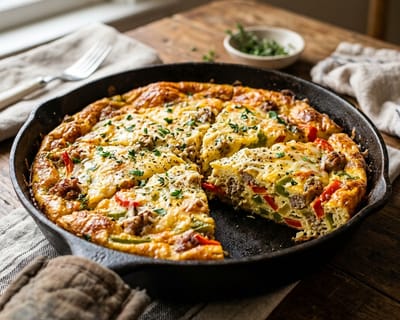
Sausage and Pepper Frittata

Fluffy, slow-baked Italian frittata packed with browned sweet Italian sausage crumbles, sweet red and yellow bell peppers, caramelized yellow onions, creamy whole-milk ricotta, and melted fontina cheese in a seasoned cast-iron skillet.
Key Takeaways
- ✓Ready in just 30 mins using straightforward, kitchen-tested technique.
- ✓Delivers 26g of muscle-fueling protein per serving for lasting satiety.
- ✓Portion-balanced at 410 calories per serving with wholesome, unrefined ingredients.
- ✓Masterclass temperature checkpoints ensure maximum tenderness and flavor development.
The Story
The Sausage and Pepper Frittata represents one of the most reliable, nutrient-dense breakfast and brunch preparations in Italian culinary tradition. By uniting browned Italian sweet sausage crumbles, tender sautéed red and yellow bell peppers, sweet caramelized onions, and melting alpine fontina cheese suspended in a rich egg custard, it delivers a complete, savory meal cooked in a single cast-iron skillet.
Despite its straightforward appeal, home cooks frequently encounter disappointing results: frittatas with burnt, leathery bottoms and raw, runny centers; watery custards weeping clear liquid across the plate; or spongy, overcooked eggs that taste unpleasantly of sulfur.
Achieving a creamy, tender frittata requires understanding the thermodynamics of cast-iron cookery, managing vegetable water release, balancing dairy fat ratios with egg protein denaturing points, and executing the stovetop-to-oven transition with precision.
Culinary Heritage: The Italian Frittata vs. The French Omelet
While both rely on beaten eggs cooked in a pan, the Italian frittata and the classical French folded omelet represent entirely distinct culinary philosophies:
1. The French Omelet
The classical French rolled omelet is a study in rapid, high-heat technique executed over a two-minute window. Eggs are beaten with minimal seasoning, poured into a foaming buttered pan, stirred rapidly with small chopsticks or a fork to produce microscopic curds, and rolled into an almond-shaped cylinder that remains soft and creamy (baveuse) in the center. Fillings are added at the very end or layered inside the fold.2. The Italian Frittata
The Italian frittata (derived from friggere, meaning 'to fry') is an open-faced, slow-cooked preparation designed for rustic practicality. Rather than tucking fillings inside a fragile fold, aromatics, meats, and vegetables are sautéed directly in the skillet first.The beaten eggs and dairy are poured over top, gently stirred to suspend the ingredients throughout the liquid matrix, and allowed to slowly set into a thick, sliceable egg cake. Because it is cooked through and holds its structural shape when sliced, the frittata serves equally well warm out of the oven, at room temperature for an afternoon antipasto, or wedged between slices of crusty bread for a midday sandwich.
The Food Science of Egg Coagulation and Dairy Lipids
The texture of a frittata is dictated by protein denaturing kinetics. Whole chicken eggs consist of roughly 75% water, 12% protein, and 10% fat:
1. Protein Denaturation Thresholds
- Ovalbumin and Ovotransferrin (Egg Whites): Begin unfolding and cross-linking at 144°F (62°C), setting into a firm, rigid network by 149°F (65°C).
- Lipovitellin and Low-Density Lipoproteins (Egg Yolks): Begin thickening at 150°F (65°C) and reach a solid gel state at 158°F (70°C).
- The Syneresis Risk (Weeping Eggs): If whole eggs are beaten without dairy and cooked under aggressive heat past 170°F (77°C), the protein strands cross-link too tightly. As the protein mesh contracts like a tightening net, it squeezes out bound water. The result is a watery puddle on the plate and a dry, rubbery curd. Furthermore, excessive heat drives the breakdown of sulfur-bearing amino acids (cysteine and methionine), releasing hydrogen sulfide gas that reacts with iron in the yolk to produce an unpleasant gray-green color and a sulfurous aroma.
2. Dairy Lipids as Thermal Shields
Whisking whole eggs with heavy cream (36% to 40% milk fat) or whole milk introduces water and microscopic butterfat globules:- Thermal Buffering: The suspended fat globules physically position themselves between the unfolding egg protein chains, hindering their ability to bond too tightly.
- Raising the Coagulation Point: This lipid buffer raises the setting threshold to 165°F–175°F (74°C–79°C), providing a broad thermal safety margin that keeps the custard creamy, tender, and moist throughout baking.
- The Golden Ratio: Use 1/3 cup of heavy cream or whole milk for 10 large eggs. Using too much dairy dilutes the egg proteins excessively, preventing the frittata from setting firmly enough to slice cleanly.
Moisture Management in Vegetables: Dehydrating Peppers and Onions
Bell peppers and onions are essential for sweetness and aromatic depth, but their internal water content represents the single greatest threat to a clean frittata:
1. The 92% Water Problem
Raw red and yellow bell peppers consist of roughly 92% water trapped within cellulose cellular walls. Raw onions consist of 89% water. If raw or barely softened peppers are submerged in raw egg batter, the heat of the oven causes the vegetable cell walls to rupture, dumping trapped water directly into the baking eggs. This creates soggy, un-set pockets of wet curd around each vegetable slice.2. The High-Heat Sauté Pre-Cook
Before any eggs enter the pan, the sliced peppers and onions must be sautéed over medium-high heat:- Water Evaporation: Sautéing for 8 to 10 minutes drives off surface and intracellular moisture as steam.
- Caramelization and Sweetness: As water evaporates, the natural fructose and glucose in the peppers and onions concentrate and undergo pyrolysis (caramelization) and the Maillard reaction with sausage drippings, developing complex sweet, savory notes.
- Only when the vegetables are soft, lightly blistered, and thoroughly dry should the egg mixture be added.
Sausage Selection and Fat Management
Sweet Italian pork sausage supplies savory fennel seeds, garlic, black pepper, and animal fats:
1. Bulk Sausage vs. Links
Always select bulk ground sweet Italian pork sausage, or purchase links and slit the casings to remove the meat. Ground meat crumbles easily in the skillet, ensuring tiny, bite-sized nuggets of seasoned pork disperse evenly throughout every square inch of the frittata.2. Rendering Intramuscular Fat
Pork sausage contains approximately 20% to 30% fat. Sautéing the sausage crumbles over medium-high heat until deeply browned renders out clear, aromatic pork fat.- Do not discard all the rendered fat: leave approximately 1 to 2 tablespoons in the skillet.
- This hot fat thoroughly coats the floor and sloped sides of the cast-iron pan, providing the primary lubrication layer that prevents the eggs from sticking.
Cheese Selection: Melting Fontina, Grated Parmesan, and Ricotta Clouds
A well-composed frittata uses cheeses with distinct melting properties:
| Cheese Variety | Moisture & Fat Content | Culinary Role in Frittata |
|---|---|---|
| Italian Fontina | Semi-soft, 45% fat, high moisture | Melts smoothly into stretchy, creamy pockets throughout the interior without separating into grease. |
| Parmigiano-Reggiano | Hard, aged 24 months, low moisture | Provides concentrated savory umami glutamates and pleasant salinity suspended directly in the beaten eggs. |
| Whole-Milk Ricotta | Fresh, unaged, high moisture | Dropped in whole tablespoons across the top right before baking; forms warm, pillowy clouds of mild dairy contrast. |
Stovetop-to-Oven Baking Thermodynamics
Cooking a frittata entirely on the stovetop requires covering the pan with a lid over low heat, which traps steam, washes away surface color, and often burns the bottom before the top center firms up. The two-stage hybrid method is culinarily superior:
1. The Stovetop Stage: Edge Setting and Gentle Agitation
The beaten egg mixture is poured into the hot skillet with the browned sausage and peppers over medium-low heat:- As the eggs hit the hot iron, a thin outer layer immediately coagulates.
- Using a heat-resistant silicone spatula, gently sweep the cooked curds from the outer edges inward toward the center, tilting the pan so raw liquid egg runs to the edges.
- Repeat this sweeping motion 3 to 4 times over 90 seconds until soft, loose curds form throughout the base, but the mixture is still mostly liquid.
- This step evenly distributes the heavy sausage and peppers so they do not sink to the bottom floor.
2. The Oven Stage: Omnidirectional Convection Finish
Transfer the skillet immediately to a preheated 350°F (175°C) oven:- The heavy cast-iron pan retains heat, gently cooking the bottom layer without scorch.
- The ambient dry heat of the oven slowly penetrates the top and sides, puffing the egg custard evenly from all directions.
- Baking for 14 to 18 minutes sets the center gently without crossing the syneresis threshold.
Step-by-Step Instructions
Follow these culinary steps for the ultimate Sausage and Pepper Frittata:
Step 1: Preheat Oven and Prep the Eggs
Preheat your oven to 350°F (175°C) with an oven rack positioned in the center.In a large glass or stainless-steel mixing bowl, crack 10 large whole eggs. Add 1/3 cup of heavy cream (or whole milk), 1/3 cup of freshly grated Parmigiano-Reggiano, 1/2 teaspoon of kosher salt, 1/2 teaspoon of freshly cracked black pepper, and 1/4 teaspoon of crushed red pepper flakes.
Whisk steadily with a wire whisk for 90 seconds until the yolks and whites are completely combined into a smooth, uniform liquid with no stringy albumen streaks remaining. Set aside at room temperature.
Step 2: Brown the Italian Sausage
Place a heavy 10-inch or 12-inch seasoned cast-iron skillet over medium-high heat.Add 1 pound of bulk sweet Italian pork sausage. Using a stiff wooden spatula or meat chopper, break the meat into small 1/2-inch crumbles as it cooks.
Sauté for 6 to 8 minutes until the sausage is deeply browned, fully cooked through, and has rendered its aromatic fat.
Using a slotted spoon, transfer the browned sausage to a plate lined with paper towels, leaving approximately 2 tablespoons of rendered pork fat in the skillet. (If the sausage is lean and yields less than 2 tablespoons of fat, add 1 tablespoon of extra virgin olive oil).
Step 3: Sauté the Bell Peppers and Onions
Return the skillet with the rendered sausage fat to medium heat.Add the sliced red bell pepper, sliced yellow bell pepper, and sliced yellow onion. Sprinkle with 1/2 teaspoon of kosher salt.
Sauté the vegetables for 8 to 10 minutes, stirring frequently with a wooden spoon, until the peppers are tender, their edges are lightly caramelized, and surface water has evaporated completely.
Add 3 thinly sliced garlic cloves during the final 90 seconds of cooking, stirring continuously until fragrant but not browned.
Step 4: Combine the Aromatics and Sausage
Return the cooked browned sausage crumbles back into the skillet with the peppers and onions.Toss thoroughly with tongs or a spatula to evenly distribute the meat and vegetables across the bottom of the pan.
Reduce the stovetop burner heat to medium-low. Ensure the ingredients form an even, level layer across the skillet floor.
Step 5: Pour the Eggs and Agitate Curds
Give the beaten egg mixture a final quick whisk, then pour it slowly and evenly over the sausage and vegetables in the skillet.Allow the pan to sit undisturbed over medium-low heat for 60 seconds until the eggs begin to set along the outer perimeter.
Using a heat-resistant silicone spatula, gently push the set outer edges inward toward the center, tilting the skillet slightly so un-cooked liquid egg runs into the bare spaces along the edges.
Perform this gentle push 3 to 4 times over 90 seconds. The eggs should form loose, creamy curds while remaining predominantly liquid on top.
Step 6: Top with Fontina and Ricotta Clouds
Scatter 1 cup of freshly shredded fontina cheese evenly across the top of the eggs.Using two small teaspoons, drop 1/2 cup of whole-milk ricotta in generous, dolloped mounds across the surface (roughly 6 to 8 dollops).
The dollops will soften and melt into warm, creamy pockets as the frittata bakes.
Step 7: Bake in the Oven
Carefully transfer the cast-iron skillet to the center rack of the preheated 350°F (175°C) oven (use a heavy oven mitt on the hot handle).Bake undisturbed for 14 to 18 minutes. Check the frittata at the 14-minute mark: the edges should be puffed and golden, and the center should be set with only a gentle, slight tremor when the pan is nudged. (An instant-read thermometer inserted into the center should register 160°F to 165°F / 71°C to 74°C).
Remove the skillet immediately from the oven.
Step 8: Rest, Garnish, and Slice
Set the hot skillet on a wooden trivet or wire cooling rack. Allow the frittata to rest undisturbed for 8 to 10 minutes.During this rest, residual thermal energy finishes cooking the core, and the melted cheeses settle so the frittata can be sliced without collapsing.
Scatter 2 tablespoons of finely chopped fresh flat-leaf parsley and torn fresh basil across the top.
Run a flexible silicone spatula around the outer circumference and underneath the base to ensure smooth release. Slice into 6 to 8 generous wedges directly in the pan, or slide the whole frittata onto a round wooden serving board before carving. Serve warm or at room temperature.
Pro-Tips for Picture-Perfect Skillet Frittatas
- Room-Temperature Eggs: Cold eggs straight from the refrigerator cool down the hot skillet suddenly, causing uneven cooking and increasing the time required for the center to set. Take eggs out of the fridge 20 minutes before whisking.
- Never Skip Agitating the Curds: Pouring eggs into a pan and immediately transferring to the oven causes the heavy sausage and peppers to sink to the iron floor, forming a scorched bottom crust. Gently pushing the curds inward for 90 seconds suspends the ingredients throughout the custard.
- Control Pan Size: For a 10-egg frittata, a 10-inch or 12-inch skillet is ideal. Using a skillet smaller than 10 inches makes the frittata too thick, causing the exterior to overcook before the center sets; using a 14-inch pan makes the frittata paper-thin and dry.
- Remember the Hot Handle: A cast-iron skillet emerging from a 350°F oven retains intense heat for over 30 minutes. Always slip a silicone handle sleeve or drape a folded kitchen towel over the handle to prevent accidental burns during serving.
Flavor Variations and Additions
Storage, Reheating, and Make-Ahead Guidelines
Frittatas are among the most meal-prep-friendly egg dishes because their structure stabilizes as they cool:
Storing Leftovers
Allow leftover frittata wedges to cool completely to room temperature. Transfer to an airtight container lined with parchment paper or wrap individual wedges tightly in plastic wrap. Store refrigerated for up to 4 days.Reheating Instructions
- Skillet Reheating (Best): Place a slice in a dry nonstick or cast-iron skillet over medium-low heat. Cover with a lid and heat for 4 to 5 minutes until the cheese is remelted and the bottom is lightly crisp.
- Oven Reheating: Place wedges on a baking sheet, cover loosely with foil, and warm in a 325°F (163°C) oven for 8 to 10 minutes.
- Avoid High-Power Microwaving: Microwaving at full power boils the moisture inside the egg custard, causing the proteins to tighten and turn rubbery. If using a microwave, reheat at 50% power in 45-second intervals.
Serving at Room Temperature
Leftover frittata tastes wonderful served at ambient room temperature alongside a crisp green salad tossed in red wine vinaigrette.Beverage & Brunch Pairings
Pairing beverages with a savory sausage and pepper frittata requires balancing rich dairy fat, pork umami, and sweet bell peppers:
- Crisp Sparkling Wine (Prosecco Superiore or Franciacorta): Italian sparkling wine provides lively carbonation and green-apple acidity that cleanses the palate of rich fontina cheese and pork lipids between bites.
- Light-Bodied Italian Red Wine (Chianti or Barbera d'Asti): Barbera offers bright acidity and low tannins with juicy red-cherry fruit that complements the sweet bell peppers and savory Italian sausage.
- Cold Brew Coffee with Splash of Whole Milk: The smooth, low-acid chocolate notes of cold brew coffee pair naturally with roasted pork and caramelized onions during a relaxed brunch.
- Fresh Citrus Juice: Freshly squeezed orange juice or grapefruit juice delivers natural citric acidity that cuts through the rich egg custard.
Troubleshooting Common Frittata Failures
1. The Frittata Weeps Water onto the Plate
- The Cause: Bell peppers or onions were added raw or undercooked, releasing steam during baking; or the frittata was baked too long, causing egg proteins to contract and squeeze out moisture.
- The Solution: Sauté peppers and onions for 8 to 10 minutes until completely dry and tender before adding eggs. Pull the frittata from the oven when the center still has a slight wobble (160°F).
2. The Bottom Crust is Scorched and Leathery
- The Cause: The stovetop heat was set too high while agitating curds, or the skillet sat on the burner too long before moving to the oven.
- The Solution: Keep the stovetop heat at medium-low. Only leave the pan on the burner for 90 seconds to start the curds, then immediately transfer to the 350°F oven.
3. The Eggs Stick Stubbornly to the Cast-Iron Skillet
- The Cause: Using an unseasoned, dry pan, or pouring cold eggs into a cold pan.
- The Solution: Use a well-seasoned cast-iron skillet. Ensure at least 1 to 2 tablespoons of rendered fat coats the bottom and sides, and allow the pan to reach 325°F before pouring in the eggs.
4. The Frittata Puffs Up Enormously Then Deflates into a Dense Puck
- The Cause: Beating the eggs with an electric mixer or whisking too aggressively incorporates excessive air bubbles that expand in the oven and burst.
- The Solution: Whisk eggs gently with a hand whisk just until yolks and whites are smoothly blended without frothing.
Nutritional Breakdown and Macro Profile
Per serving (serving size: 1 generous wedge, recipe makes 6 servings):
| Nutrient | Amount per Serving | % Daily Value |
|---|---|---|
| Calories | 410 kcal | — |
| Total Fat | 31 g | 40% |
| Saturated Fat | 12 g | 60% |
| Cholesterol | 355 mg | 118% |
| Sodium | 820 mg | 36% |
| Total Carbohydrates | 6 g | 2% |
| Dietary Fiber | 1.5 g | 5% |
| Total Sugars | 3 g | — |
| Protein | 26 g | 52% |
| Potassium | 440 mg | 9% |
| Calcium | 240 mg | 18% |
| Iron | 2.8 mg | 16% |
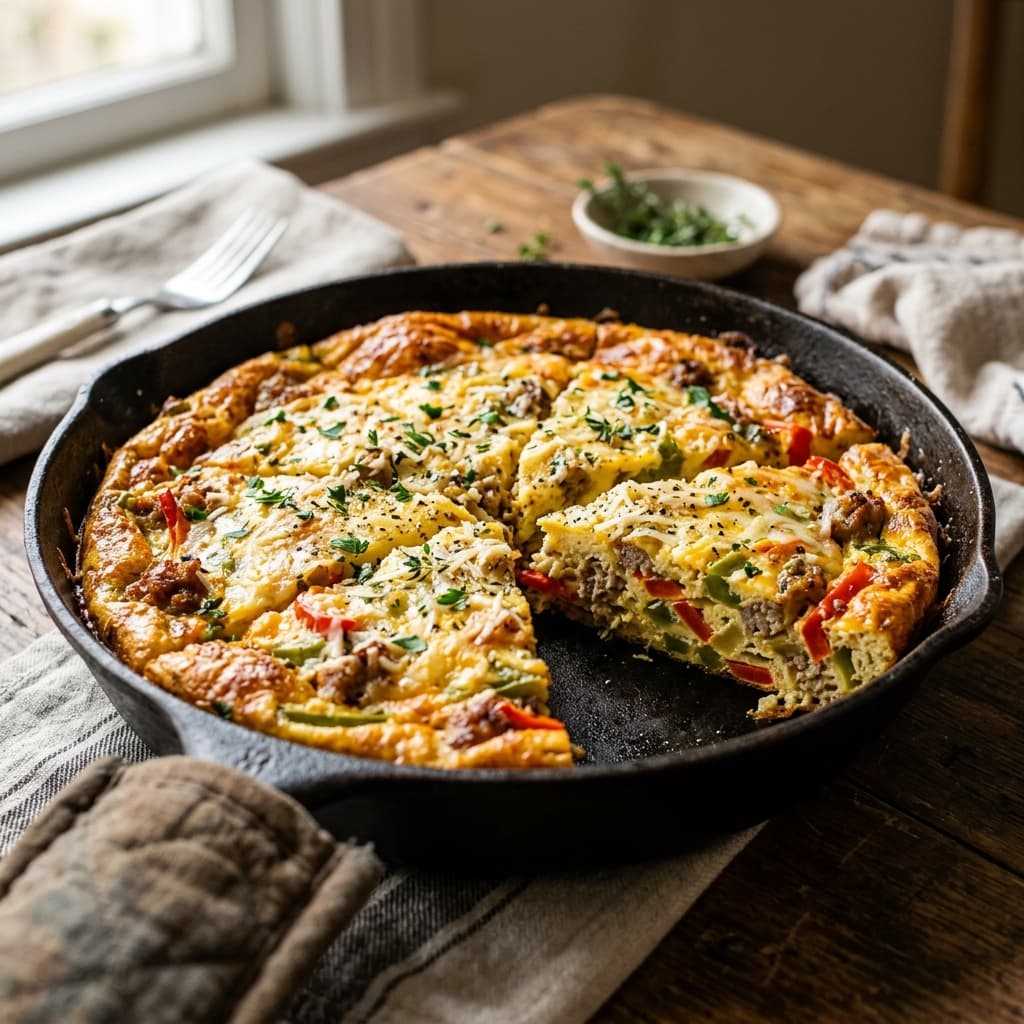
Sausage and Pepper Frittata
Fluffy, slow-baked Italian frittata packed with browned sweet Italian sausage crumbles, sweet red and yellow bell peppers, caramelized yellow onions, creamy whole-milk ricotta, and melted fontina cheese in a seasoned cast-iron skillet.
Macro Nutrition Profile (Per Serving)
Ingredients
Ingredient Substitutions
| Original Ingredient | Healthy Alternative |
|---|---|
| Animal protein | Firm tofu, tempeh, or organic chickpeas |
| Cooking fat | Extra virgin olive oil or grass-fed butter |
Instructions
Preheat Oven and Prep the Eggs: Preheat your oven to 350°F (175°C) with an oven rack positioned in the center. In a large glass or stainless-steel mixing bowl, crack 10 large whole eggs. Add 1/3 cup of heavy cream (or whole milk), 1/3 cup of freshly grated Parmigiano-Reggiano, 1/2 teaspoon of kosher salt, 1/2 teaspoon of freshly cracked black pepper, and 1/4 teaspoon of crushed red pepper flakes. Whisk steadily with a wire whisk for 90 seconds until the yolks and whites are completely combined into a smooth, uniform liquid with no stringy albumen streaks remaining. Set aside at room temperature.
Brown the Italian Sausage: Place a heavy 10-inch or 12-inch seasoned cast-iron skillet over medium-high heat. Add 1 pound of bulk sweet Italian pork sausage. Using a stiff wooden spatula or meat chopper, break the meat into small 1/2-inch crumbles as it cooks. Sauté for 6 to 8 minutes until the sausage is deeply browned, fully cooked through, and has rendered its aromatic fat. Using a slotted spoon, transfer the browned sausage to a plate lined with paper towels, leaving approximately 2 tablespoons of rendered pork fat in the skillet. (If the sausage is lean and yields less than 2 tablespoons of fat, add 1 tablespoon of extra virgin olive oil).
Sauté the Bell Peppers and Onions: Return the skillet with the rendered sausage fat to medium heat. Add the sliced red bell pepper, sliced yellow bell pepper, and sliced yellow onion. Sprinkle with 1/2 teaspoon of kosher salt. Sauté the vegetables for 8 to 10 minutes, stirring frequently with a wooden spoon, until the peppers are tender, their edges are lightly caramelized, and surface water has evaporated completely. Add 3 thinly sliced garlic cloves during the final 90 seconds of cooking, stirring continuously until fragrant but not browned.
Combine the Aromatics and Sausage: Return the cooked browned sausage crumbles back into the skillet with the peppers and onions. Toss thoroughly with tongs or a spatula to evenly distribute the meat and vegetables across the bottom of the pan. Reduce the stovetop burner heat to medium-low. Ensure the ingredients form an even, level layer across the skillet floor.
Pour the Eggs and Agitate Curds: Give the beaten egg mixture a final quick whisk, then pour it slowly and evenly over the sausage and vegetables in the skillet. Allow the pan to sit undisturbed over medium-low heat for 60 seconds until the eggs begin to set along the outer perimeter. Using a heat-resistant silicone spatula, gently push the set outer edges inward toward the center, tilting the skillet slightly so un-cooked liquid egg runs into the bare spaces along the edges. Perform this gentle push 3 to 4 times over 90 seconds. The eggs should form loose, creamy curds while remaining predominantly liquid on top.
Top with Fontina and Ricotta Clouds: Scatter 1 cup of freshly shredded fontina cheese evenly across the top of the eggs. Using two small teaspoons, drop 1/2 cup of whole-milk ricotta in generous, dolloped mounds across the surface (roughly 6 to 8 dollops). The dollops will soften and melt into warm, creamy pockets as the frittata bakes.
Bake in the Oven: Carefully transfer the cast-iron skillet to the center rack of the preheated 350°F (175°C) oven (use a heavy oven mitt on the hot handle). Bake undisturbed for 14 to 18 minutes. Check the frittata at the 14-minute mark: the edges should be puffed and golden, and the center should be set with only a gentle, slight tremor when the pan is nudged. (An instant-read thermometer inserted into the center should register 160°F to 165°F / 71°C to 74°C). Remove the skillet immediately from the oven.
Rest, Garnish, and Slice: Set the hot skillet on a wooden trivet or wire cooling rack. Allow the frittata to rest undisturbed for 8 to 10 minutes. During this rest, residual thermal energy finishes cooking the core, and the melted cheeses settle so the frittata can be sliced without collapsing. Scatter 2 tablespoons of finely chopped fresh flat-leaf parsley and torn fresh basil across the top. Run a flexible silicone spatula around the outer circumference and underneath the base to ensure smooth release. Slice into 6 to 8 generous wedges directly in the pan, or slide the whole frittata onto a round wooden serving board before carving. Serve warm or at room temperature.
The Spicy Calabrian Chili Frittata: Use hot Italian pork sausage seasoned with fennel and chili powder. Stir 1 tablespoon of minced jarred Calabrian chilis in oil into the sautéed bell peppers. Replace the fontina with smoked provolone cheese for a rustic, smoky finish.
The Spinach and Goat Cheese Frittata: Add 4 cups of fresh baby spinach to the skillet during the last 2 minutes of sautéing peppers until completely wilted. Replace the ricotta dollops with 4 ounces of crumbled fresh goat cheese (chèvre).
The Mediterranean Olive and Herb Frittata: Stir 1/3 cup of halved pitted Kalamata olives and 1 tablespoon of chopped fresh oregano into the sautéed peppers. Replace the fontina with crumbled Greek sheep's-milk feta cheese.
The Frittata Weeps Water onto the Plate: The Cause: Bell peppers or onions were added raw or undercooked, releasing steam during baking; or the frittata was baked too long, causing egg proteins to contract and squeeze out moisture. The Solution: Sauté peppers and onions for 8 to 10 minutes until completely dry and tender before adding eggs. Pull the frittata from the oven when the center still has a slight wobble (160°F).
The Bottom Crust is Scorched and Leathery: The Cause: The stovetop heat was set too high while agitating curds, or the skillet sat on the burner too long before moving to the oven. The Solution: Keep the stovetop heat at medium-low. Only leave the pan on the burner for 90 seconds to start the curds, then immediately transfer to the 350°F oven.
The Eggs Stick Stubbornly to the Cast-Iron Skillet: The Cause: Using an unseasoned, dry pan, or pouring cold eggs into a cold pan. The Solution: Use a well-seasoned cast-iron skillet. Ensure at least 1 to 2 tablespoons of rendered fat coats the bottom and sides, and allow the pan to reach 325°F before pouring in the eggs.
The Frittata Puffs Up Enormously Then Deflates into a Dense Puck: The Cause: Beating the eggs with an electric mixer or whisking too aggressively incorporates excessive air bubbles that expand in the oven and burst. The Solution: Whisk eggs gently with a hand whisk just until yolks and whites are smoothly blended without frothing.
Tried this recipe?
Let us know how it turned out! Click a star below to leave a review and rate the recipe.
Storage & Freezing Tips
- Refrigerator: Store in an airtight container for up to 2 days. Keep the components separate if possible to preserve texture.
- Reheating: Reheat gently in a skillet on medium-low heat with a splash of olive oil or butter.
- Freezing: Freezing is not recommended for this dish because ingredients like eggs become soggy, rubbery, or mushy when defrosted.
Frequently Asked Questions
Can this recipe be prepared ahead of time?▼
Yes, this meal is excellent for weekly meal prep. Store components separately and assemble before serving.
Is this recipe gluten-free?▼
All ingredients used are naturally gluten-free. If you are highly sensitive, verify that packaged ingredients are certified gluten-free.
Tried this recipe?
Tag @stewartlucas on Instagram and hashtag it #nutriguide!
You Might Also Like
Stewart Lucas
Chief Culinary SpecialistStewart Lucas is the Chief Culinary Specialist and lead recipe developer representing the NutriGuide team. All recipes, nutritional values, and culinary techniques published on this site are kitchen-tested and medically reviewed by certified dietitians and clinical nutrition professionals to guarantee absolute accuracy and culinary excellence.
Community Reviews
Please log in to leave a review.