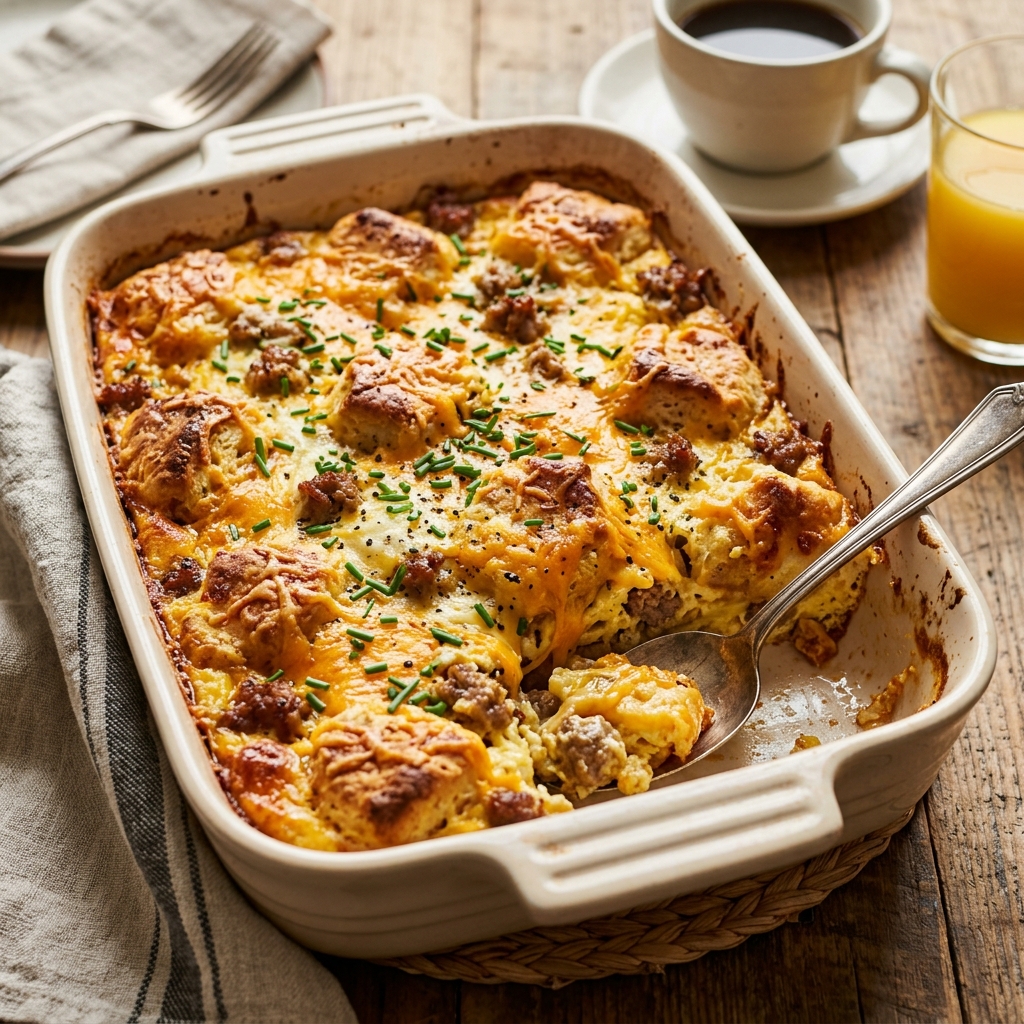
Sausage, Egg & Cheese Biscuit Bake (Flaky Southern Casserole Masterclass)
The definitive weekend breakfast casserole masterclass. Master the science of flaky layered biscuit expansion, custard egg suspension, caramelized sage pork sausage, and melted sharp cheddar that never turns soggy.
Key Takeaways
- ✓Cut refrigerated biscuits into 8 uniform pieces each and scatter loosely so egg custard can circulate between them.
- ✓Brown the pork sausage thoroughly and drain all rendered liquid grease to prevent an oily casserole.
- ✓Whisk dry ground mustard and heavy cream into the eggs to create a stable custard that bakes fluffy rather than watery.
- ✓Bake at 375°F (190°C) for 35 minutes until biscuits are puffed and a toothpick inserted into the egg center emerges clean.
The Story
The breakfast casserole is an enduring Southern and Midwestern culinary institution, originally born in church fellowship halls, holiday morning kitchens, and farmhouse tables where feeding a large family swiftly and warmly was an everyday necessity. Traditional casseroles combined stale torn white bread, day-old breakfast meats, and whatever eggs the hens had laid, baked together in a communal cast iron or enamel dish.
With the mid-20th-century invention of refrigerated canned biscuits, Southern home cooks revolutionized this breakfast staple. Instead of dense sandwich bread, flaky laminated biscuit dough provided an airy, buttery texture that puffed dramatically in the oven. The dough absorbed the savory rendered juices of spiced sage pork sausage while creating golden, pull-apart crusts along the surface.
Yet, many biscuit casseroles turn out disappointing: heavy dough balls trapped in a raw, gummy purgatory beneath watery, overcooked eggs, or swimming in a pool of greasy pork fat.
This masterclass deconstructs the thermodynamics of dough aeration and egg protein coagulation. By mastering the browning-and-drain method, cutting biscuits into precise octants for optimal surface-area-to-volume ratio, and creating a balanced dairy custard, you will bake a spectacular golden breakfast casserole that rises like a savory soufflé, slicing into neat, towering squares of cheesy, sausage-studded perfection.
The Science of Flavor Chemistry & Thermal Dynamics
Baking raw starch dough and egg custard together in a single pan requires careful management of heat penetration and moisture equilibrium.
1. The Surface Area Physics of Biscuit Octants
If you drop whole or halved canned biscuits into liquid egg, the outer layers of dough cook into a rubbery skin, while the dense center remains completely raw and doughy because heat cannot penetrate the thick starch mass before the eggs curdle. By cutting each biscuit into 8 uniform bite-sized cubes, we dramatically increase the surface area. Heat reaches the center of each dough piece within 12 minutes, allowing the chemical leavening agents (sodium acid pyrophosphate and baking soda) to generate carbon dioxide gas rapidly. The biscuit pieces puff and rise upward to float on top of the custard, developing a golden, flaky, caramelized exterior crust while the bottom half melds into a savory, bread-pudding-like custard.2. Moisture Removal & Lipid Drainage from Sausage
Commercial breakfast sausage contains anywhere from 20% to 35% fat. If unrendered sausage or warm sausage dripping with grease is dumped into eggs, the free liquid fat separates during baking, forming an unsightly, greasy orange oil slick on top of the casserole. We brown the pork sausage with onions and garlic over medium heat until deeply caramelized (Maillard browning). Then, we transfer the sausage into a fine-mesh colander set over a bowl, pressing gently to drain away the rendered lard. This locks the rich sage and pepper seasonings into the meat while keeping the casserole light, clean, and grease-free.3. Custard Chemistry: Dry Mustard & Whole Milk
Eggs alone will bake into a dense, rubbery sponge. Whisking in whole milk or heavy cream introduces milk fats and lactose, which tenderize the protein network, allowing ovalbumin to set into a silky, tender custard. The addition of 1/2 teaspoon of dry ground mustard is a classical culinary secret: mustard contains natural mucilage and phospholipids that act as a stabilizing emulsifier, binding the dairy fat, melted cheese oils, and egg proteins into a cohesive, velvety matrix that will never weep water (syneresis) onto your plate.Anatomy of the Ingredients & Artisanal Sourcing
Building a masterclass breakfast casserole starts with choosing the right ingredients:
- The Biscuits (Homestyle vs Flaky Layers): Grands 'Homestyle Buttermilk' or 'Flaky Layers' are both exceptional. Flaky Layers biscuits produce shatteringly crisp golden leaves on top, while Homestyle biscuits yield a slightly denser, traditional Southern dumpling texture. Keep them ice-cold in the refrigerator right up until the moment you cut them.
- The Sausage Selection: Use high-quality bulk pork breakfast sausage seasoned with sage, black pepper, and rosemary (such as Jimmy Dean Regular or Hot, or local butcher sausage). If you prefer poultry, ground turkey breakfast sausage works well—just ensure it is seasoned generously with poultry herbs.
- Cheese Grating Rules: Always grate your cheddar cheese fresh from the block. Pre-shredded bagged cheese is coated in powdered cellulose (wood pulp) and potato starch to prevent sticking in the bag. These starches inhibit cheese from melting smoothly and impart a gritty, powdery texture to the custard.
- Pasture-Raised Eggs: Look for pasture-raised eggs with vibrant deep-orange yolks. These yolks contain higher concentrations of carotenoids and lutein, resulting in a rich golden custard with superior richness.
Step-by-Step Culinary Masterclass
Step 1: Oven Calibration & Pan Preparation
Preheat your oven to 375°F (190°C) with the rack set in the center position. Generously grease a 9x13-inch glass or ceramic baking dish with 1 tablespoon of softened butter, coating the bottom and all four sides thoroughly.
- Chef's Technique Tip: Butter provides a richer, nuttier bottom crust than non-stick aerosol cooking spray.
- Sensory Checkpoint: The baking dish has a glistening, uniform butter coating across all interior surfaces.
Step 2: Caramelizing the Sausage & Alliums
Heat a large skillet over medium-high heat. Add 1 lb of pork breakfast sausage, breaking it apart with a wooden spoon. Add the finely minced yellow onion and minced garlic. Cook for 7 to 9 minutes, stirring frequently, until the sausage is deeply browned, crumbly, and no pink remains.
- Chef's Technique Tip: Letting the sausage sit untouched for 2 minutes at the start creates deep brown fond on the meat, maximizing savory flavor.
- Sensory Checkpoint: Crumbly, dark-brown sausage crumbles with softened, translucent sweet onions.
Step 3: Lipid Drainage Protocol
Line a colander or plate with a double layer of paper towels. Transfer the cooked sausage and onion mixture onto the paper towels. Press gently with a wooden spatula to blot and drain off excess rendered fat. Let cool for 5 minutes.
- Chef's Technique Tip: Never dump piping hot sausage directly into raw eggs, or the eggs will scramble prematurely in the bowl.
- Sensory Checkpoint: Savory, seasoned sausage crumbles that are dry and free of pooling grease.
Step 4: Precision Biscuit Cutting
Remove the can of biscuits directly from the refrigerator. Pop open the can and separate the 8 round biscuits. Using a sharp chef's knife or bench scraper, slice each biscuit in half horizontally, then in half vertically, then diagonally to create 8 uniform triangular bite-sized pieces per biscuit (64 pieces total).
- Chef's Technique Tip: Keep dough cold; warm biscuit dough gets sticky and compresses, preventing proper oven rise.
- Sensory Checkpoint: 64 individual, clean-cut biscuit dough pieces sitting ready on your cutting board.
Step 5: Whisking the Masterclass Custard
In a large mixing bowl, crack 8 eggs. Pour in 1/2 cup whole milk or heavy cream. Add garlic powder, smoked paprika, dry ground mustard, sea salt, and freshly cracked black pepper. Whisk vigorously for a full 90 seconds until the custard is completely homogeneous, frothy, and pale yellow.
- Chef's Technique Tip: Whisking incorporates air, which expands during baking to give the casserole an airy, soufflé-like lift.
- Sensory Checkpoint: A silky, aerated yellow custard with no lingering clumps of egg white.
Step 6: Layering the Biscuit & Sausage Foundation
Scatter the 64 biscuit dough pieces loosely across the bottom of the buttered 9x13 baking dish. Do not pack them tightly together; leave small gaps. Scatter the drained, warm cooked sausage crumbles evenly over and in between the biscuit pieces.
- Chef's Technique Tip: Tucking sausage crumbles into the crevices between biscuits ensures every forkful has equal meat distribution.
- Sensory Checkpoint: An even mosaic of raw biscuit dough cubes interspersed with dark caramelized sausage.
Step 7: The Cheese Infiltration
Sprinkle 1.5 cups of freshly grated sharp Cheddar cheese and 1/2 cup of Pepper Jack cheese evenly over the sausage and biscuit layer, gently jiggling the pan so cheese falls into the crevices.
- Chef's Technique Tip: Reserving 1 cup of cheddar for the top allows for a stunning, golden melted cheese crust at the end.
- Sensory Checkpoint: A blanket of shredded cheese settled between and over the biscuit and meat layer.
Step 8: Pouring the Custard Suspension
Slowly and steadily pour the whisked egg custard evenly over the entire casserole, moving the bowl from end to end to ensure all biscuit pieces and cheese are soaked. Use a spatula to gently press down on any floating biscuits so they absorb the liquid.
- Chef's Technique Tip: Pour slowly around the perimeter first, then fill the center, allowing the custard to seep into the bottom.
- Sensory Checkpoint: The custard fills the pan, reaching about halfway up the biscuit pieces.
Step 9: Top Cheese Crown & Baking
Scatter the remaining 1 cup of sharp Cheddar cheese across the top surface. Place the baking dish uncovered into the preheated 375°F (190°C) oven. Bake for 32 to 36 minutes.
- Chef's Technique Tip: If the cheese top browns too quickly at the 25-minute mark, tent loosely with a sheet of foil.
- Sensory Checkpoint: The casserole puffs high above the rim, biscuits are deep golden brown, and the center does not wobble.
Step 10: Doneness Verification & The Resting Window
Insert a toothpick or paring knife into the exact center of the casserole. It should come out completely clean with no wet liquid egg. Remove from the oven and set on a wire cooling rack to rest for 8 to 10 minutes before slicing. Garnish generously with sliced green scallions.
- Chef's Technique Tip: Resting is mandatory; cutting immediately causes the steaming custard to collapse and weep liquid.
- Sensory Checkpoint: A puffed, golden-amber crust with bubbling cheese edges that settles into a firm, sliceable breakfast masterpiece.
Pro-Chef Troubleshooting & Critical Checkpoints
Problem: The Biscuit Pieces are Raw and Doughy in the Middle
- The Root Cause: Biscuits were cut into pieces that were too large (halves or quarters), or the casserole was underbaked.
- The Masterclass Solution: Always cut each biscuit into 8 small pieces (64 total). Test center doneness with a paring knife—the knife must emerge completely dry.
Problem: The Casserole is Greasy and Pools Orange Oil
- The Root Cause: Sausage fat was not drained, or pre-shredded cheese with added oils was used.
- The Masterclass Solution: Always drain cooked sausage thoroughly on paper towels, and grate fresh cheddar from a block.
Problem: Eggs Weep Water onto the Plate After Slicing
- The Root Cause: Casserole was sliced immediately straight out of the hot oven, or too much skim milk was used.
- The Masterclass Solution: Rest the casserole for a full 10 minutes on the counter to allow the egg proteins to set, and use whole milk or heavy cream with dry ground mustard.
Macro Analysis & Nutritional Optimization
This hearty Southern bake provides serious morning fuel for active families, athletes, and brunch gatherings:
- 28 Grams of Protein per Slice: Sourced from pasture-raised eggs, spiced pork sausage, and real aged cheddar, delivering sustained satiety that eliminates mid-morning sugar cravings.
- Essential Micronutrients: Provides over 35% of the daily value for Calcium (vital for bone density and muscle contraction) alongside Vitamin A, Zinc, and Selenium.
- Carbohydrate Replenishment: Flaky biscuit starches provide glycogen replenishment ideal for post-workout mornings or heavy physical labor.
- Dietary Adaptations: Swap pork sausage for lean ground turkey sausage to lower saturated fat by 40%, or substitute gluten-free refrigerated biscuit dough for celiac-safe dining.
- Macro Profile per Serving (1/8th Casserole): 560 kcal | 28g Protein | 36g Carbohydrates | 32g Fat.
Artisanal Serving & Pairing Architecture
Balance the rich, savory depth of this biscuit casserole with bright, acidic, and refreshing table additions:
- Sweet & Acidic Accompaniments: Fresh mixed berries (blackberries, raspberries, blueberries) tossed with fresh mint and lemon zest.
- Southern Table Sauces: Serve with a bottle of smoky chipotle hot sauce, Louisiana crystal hot sauce, or warm country sausage gravy for drizzling.
- Beverage Pairings:
Scientific Storage, Meal Prep & Reheating Protocol
This biscuit bake is legendary for meal prep, tasting just as extraordinary reheated throughout the week:
- Refrigeration: Cool completely to room temperature. Cover the baking dish tightly with foil or slice into individual portions and store in airtight glass containers for up to 4 to 5 days.
- Freezer Storage: Wrap individual cooked, cooled squares in parchment paper and then heavy aluminum foil. Freeze for up to 2 months.
- The Masterclass Reheating Technique:
Frequently Asked Questions (Masterclass Edition)
Q: Can I make this casserole the night before and bake it in the morning?
A: Yes! Assemble the entire casserole (biscuits, sausage, cheese, poured egg custard), cover tightly with plastic wrap, and refrigerate overnight for up to 12 hours. In the morning, let the dish sit on the counter for 15 minutes to take the chill off, then bake at 375°F for 38 to 42 minutes (adding about 5 minutes to compensate for the cold start).Q: Can I use frozen biscuit dough instead of canned refrigerated biscuits?
A: Yes, but you must thaw the frozen biscuits in the refrigerator until pliable so you can slice them into 8 bite-sized cubes each before assembling.Q: Can I add vegetables like bell peppers or spinach?
A: Absolutely! Sauté diced bell peppers, mushrooms, or baby spinach along with the sausage and onions to soften them and evaporate excess moisture before layering into the casserole.Q: What if my biscuit tops are browning too fast before the eggs set?
A: Simply tent a piece of aluminum foil loosely over the baking dish during the last 10 minutes. This prevents the biscuit crowns from scorching while allowing the center eggs to reach 165°F.Sausage, Egg & Cheese Biscuit Bake (Flaky Southern Casserole Masterclass)
The definitive weekend breakfast casserole masterclass. Master the science of flaky layered biscuit expansion, custard egg suspension, caramelized sage pork sausage, and melted sharp cheddar that never turns soggy.

Macro Nutrition Profile (Per Serving)
Ingredients
Ingredient Substitutions
| Original Ingredient | Healthy Alternative |
|---|---|
| Poached eggs | Firm tofu slices (lightly pan-seared) or avocado slices (for a rich plant-based fat source) |
| Baby spinach | Swiss chard, baby kale, or arugula (wilt at the same temperature/time) |
| White vinegar | Lemon juice or apple cider vinegar (acid helps egg whites coagulate) |
Instructions
Oven Calibration & Pan Preparation: Preheat your oven to 375°F (190°C) with the rack set in the center position. Generously grease a 9x13-inch glass or ceramic baking dish with 1 tablespoon of softened butter, coating the bottom and all four sides thoroughly. Chef's Technique Tip: Butter provides a richer, nuttier bottom crust than non-stick aerosol cooking spray. Sensory Checkpoint: The baking dish has a glistening, uniform butter coating across all interior surfaces.
Caramelizing the Sausage & Alliums: Heat a large skillet over medium-high heat. Add 1 lb of pork breakfast sausage, breaking it apart with a wooden spoon. Add the finely minced yellow onion and minced garlic. Cook for 7 to 9 minutes, stirring frequently, until the sausage is deeply browned, crumbly, and no pink remains. Chef's Technique Tip: Letting the sausage sit untouched for 2 minutes at the start creates deep brown fond on the meat, maximizing savory flavor. Sensory Checkpoint: Crumbly, dark-brown sausage crumbles with softened, translucent sweet onions.
Lipid Drainage Protocol: Line a colander or plate with a double layer of paper towels. Transfer the cooked sausage and onion mixture onto the paper towels. Press gently with a wooden spatula to blot and drain off excess rendered fat. Let cool for 5 minutes. Chef's Technique Tip: Never dump piping hot sausage directly into raw eggs, or the eggs will scramble prematurely in the bowl. Sensory Checkpoint: Savory, seasoned sausage crumbles that are dry and free of pooling grease.
Precision Biscuit Cutting: Remove the can of biscuits directly from the refrigerator. Pop open the can and separate the 8 round biscuits. Using a sharp chef's knife or bench scraper, slice each biscuit in half horizontally, then in half vertically, then diagonally to create 8 uniform triangular bite-sized pieces per biscuit (64 pieces total). Chef's Technique Tip: Keep dough cold; warm biscuit dough gets sticky and compresses, preventing proper oven rise. Sensory Checkpoint: 64 individual, clean-cut biscuit dough pieces sitting ready on your cutting board.
Whisking the Masterclass Custard: In a large mixing bowl, crack 8 eggs. Pour in 1/2 cup whole milk or heavy cream. Add garlic powder, smoked paprika, dry ground mustard, sea salt, and freshly cracked black pepper. Whisk vigorously for a full 90 seconds until the custard is completely homogeneous, frothy, and pale yellow. Chef's Technique Tip: Whisking incorporates air, which expands during baking to give the casserole an airy, soufflé-like lift. Sensory Checkpoint: A silky, aerated yellow custard with no lingering clumps of egg white.
Layering the Biscuit & Sausage Foundation: Scatter the 64 biscuit dough pieces loosely across the bottom of the buttered 9x13 baking dish. Do not pack them tightly together; leave small gaps. Scatter the drained, warm cooked sausage crumbles evenly over and in between the biscuit pieces. Chef's Technique Tip: Tucking sausage crumbles into the crevices between biscuits ensures every forkful has equal meat distribution. Sensory Checkpoint: An even mosaic of raw biscuit dough cubes interspersed with dark caramelized sausage.
The Cheese Infiltration: Sprinkle 1.5 cups of freshly grated sharp Cheddar cheese and 1/2 cup of Pepper Jack cheese evenly over the sausage and biscuit layer, gently jiggling the pan so cheese falls into the crevices. Chef's Technique Tip: Reserving 1 cup of cheddar for the top allows for a stunning, golden melted cheese crust at the end. Sensory Checkpoint: A blanket of shredded cheese settled between and over the biscuit and meat layer.
Pouring the Custard Suspension: Slowly and steadily pour the whisked egg custard evenly over the entire casserole, moving the bowl from end to end to ensure all biscuit pieces and cheese are soaked. Use a spatula to gently press down on any floating biscuits so they absorb the liquid. Chef's Technique Tip: Pour slowly around the perimeter first, then fill the center, allowing the custard to seep into the bottom. Sensory Checkpoint: The custard fills the pan, reaching about halfway up the biscuit pieces.
Top Cheese Crown & Baking: Scatter the remaining 1 cup of sharp Cheddar cheese across the top surface. Place the baking dish uncovered into the preheated 375°F (190°C) oven. Bake for 32 to 36 minutes. Chef's Technique Tip: If the cheese top browns too quickly at the 25-minute mark, tent loosely with a sheet of foil. Sensory Checkpoint: The casserole puffs high above the rim, biscuits are deep golden brown, and the center does not wobble.
Doneness Verification & The Resting Window: Insert a toothpick or paring knife into the exact center of the casserole. It should come out completely clean with no wet liquid egg. Remove from the oven and set on a wire cooling rack to rest for 8 to 10 minutes before slicing. Garnish generously with sliced green scallions. Chef's Technique Tip: Resting is mandatory; cutting immediately causes the steaming custard to collapse and weep liquid. Sensory Checkpoint: A puffed, golden-amber crust with bubbling cheese edges that settles into a firm, sliceable breakfast masterpiece.
Tried this recipe?
Let us know how it turned out! Click a star below to leave a review and rate the recipe.
Storage & Freezing Tips
- Refrigerator: Store in an airtight container for up to 2 days. Keep the components separate if possible to preserve texture.
- Reheating: Reheat gently in a skillet on medium-low heat with a splash of olive oil or butter.
- Freezing: Freezing is not recommended for this dish because ingredients like eggs become soggy, rubbery, or mushy when defrosted.
Frequently Asked Questions
Can this recipe be prepared ahead of time?▼
Yes, this meal is excellent for weekly meal prep. Store components separately and assemble before serving.
Is this recipe gluten-free?▼
All ingredients used are naturally gluten-free. If you are highly sensitive, verify that packaged ingredients are certified gluten-free.
Tried this recipe?
Tag @stewartlucas on Instagram and hashtag it #nutriguide!
You Might Also Like

Stewart Lucas
Nutritionist & Recipe DeveloperStewart Lucas is a nutritionist and recipe developer representing the NutriGuide team. All recipes, nutritional values, and diet protocols published on this site are designed and audited by certified dietitians and clinical nutrition professionals to guarantee absolute accuracy.
Community Reviews
Please log in to leave a review.